I’m sitting here drinking coffee and looking out the back window as 16G40 winds relentlessly pummel the lake. It got me to thinking about flying floats in big winds with an airplane with the wing, like a Cub.
Years ago I was landing a Cub at Troutdale, Oregon in very steady 28 mph winds that were straight down the runway. I was practically levitating in that lightweight, long winged airplane. Groundspeed was minimal and I essentially just set down in a hover.
If i had been on floats, the groundspeed would not have been high enough to stay on step. So as a low-time float pilot, what exactly happens if you let down at such a low groundspeed? Do you just plooosh into the water like a bath toy? Or is it a more gentle affair since you’re effectively still flying all the way down to the surface?
Or does the wise old pilot just ponder such things from the comfort of the porch, without learning the hard way?
Let’s say you let down smoothly and go directly from flying to floating. Now you have to taxi to your dock or beach and that’s really fun in big winds. I read about an Aeronca Sedan, an airplane that is notoriously under floated on Edo 2000s, that tucked a float and flipped over while coming about after taxiing downwind. What was his mistake?
High winds and low groundspeed on floats
Sun Oct 05, 2025 12:56 pm
Re: High winds and low groundspeed on floats
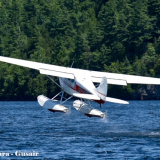
If the winds are that high do not try to turn downwind, no more than a 45 degree angle into the wind and sail sideways if the mooring point or dock is still ahead of you. Or power to idle, drop flaps if you have them, open doors and sail backwards while remaining pointed into the wind until you have drifted past your intend mooring point or dock. Then add power as required and again approach at no greater than a 45 degree angle.

Sun Oct 05, 2025 1:20 pm
Re: High winds and low groundspeed on floats
What are the waves doing as you sit and ponder those 40kt gusts?
I have a bit of total time but I am a relatively low time float pilot.... I'll be in the coffee shop.
I have a bit of total time but I am a relatively low time float pilot.... I'll be in the coffee shop.
Sun Oct 05, 2025 1:29 pm
Re: High winds and low groundspeed on floats
kg wrote:What are the waves doing as you sit and ponder those 40kt gusts?.
8-10" I guess. Not huge. When I did my float rating in Talkeetna, one of my first outings in the Pacer was to (I think) Swan Lake a few miles NW. I was so focused on the approach and setup and the streaking for wind direction that I didn't really consider the wave height. I guess my instructor didn't either. We let down and it was bigger than I'd want to do again. We got out of there after a bit of a rough and exciting takeoff.
- Zzz offline


- Posts: 2855
- Joined: Fri Oct 08, 2004 11:09 pm
- Location: northern
- Aircraft: Swiveling desk chair
Half a century spent proving “it is better to be thought a fool than to open your mouth and remove all doubt.”
Sun Oct 05, 2025 1:30 pm
Re: High winds and low groundspeed on floats
Mapleflt wrote:If the winds are that high do not try to turn downwind, no more than a 45 degree angle into the wind and sail sideways if the mooring point or dock is still ahead of you. Or power to idle, drop flaps if you have them, open doors and sail backwards while remaining pointed into the wind until you have drifted past your intend mooring point or dock. Then add power as required and again approach at no greater than a 45 degree angle.
This is the kind of stuff I need to study further with a skilled float instructor. It's kinda conditions allowing, so hard to order on-demand.
- Zzz offline
- Posts: 2855
- Joined: Fri Oct 08, 2004 11:09 pm
- Location: northern
- Aircraft: Swiveling desk chair
Half a century spent proving “it is better to be thought a fool than to open your mouth and remove all doubt.”
Sun Oct 05, 2025 1:53 pm
Re: High winds and low groundspeed on floats
I had the benefit of learning from some very experienced hands. No way I would have ever tried this alone in my early years and now that I'm over 21 I'll be at the bar quaffing an adult beverage.
Sun Oct 05, 2025 6:12 pm
Re: High winds and low groundspeed on floats
I will admit to not knowing the current curriculum for a float rating, its been a few years and I don't teach at all. When I was trained "sailing" was a skill that was taught but as Zzz has pointed out you do need the "conditions" to do the training.
Mon Oct 06, 2025 7:14 pm
Re: High winds and low groundspeed on floats
I have taken off in 35 knot headwinds in the old yellow 185 on floats. It just got up and went like hell no problem.
That was the day I was telling you about where I had to sail into the beach at Captain Tom because it was too risky to try to turn around.
That was the day I was telling you about where I had to sail into the beach at Captain Tom because it was too risky to try to turn around.
Fri Oct 10, 2025 1:30 pm
Re: High winds and low groundspeed on floats
I've never quite done winds like you're talking about but when I've operated in high winds the float speed has been a non-issue. My water speed at touch down would definitely be below planing speed and you just settle in for a very short landing. You just kind of get the last part of your landing run. Can't tell you what zero water speed would be like but I think it'd go fine, other than the wave action you'd be seeing around here. Of course the other thing here in BC is the terrain makes high winds like you're talking about absolutely miserable to fly in, even just being in the air.
- Fraser Farmer offline
- Posts: 388
- Joined: Tue May 13, 2014 10:38 pm
- Location: Abbotsford
- Aircraft: 1977 Cessna 185
Mon Oct 13, 2025 2:38 pm
Re: High winds and low groundspeed on floats
Working seaplanes around Kodiak teaches you a lot about sailing. Fortunately, there aren't many docks there, and beaches tend to be a bit more forgiving upon arrival.
But, sailing is a skill that needs to be covered during a float rating. And, "lack of conditions" is no excuse. You can sail with 5 to 10 knots quite nicely. Granted, bigger winds afford the ability to sail with the engine running, so if things start getting out of hand, a blast of power, judiciously applied may save the day.
But, get a nice 15 knot wind going, and you'll be amazed at how controllable the plane is in reverse gear. What is the maximum wind I'd turn a seaplane in? Hard to say, it's more of a "feel" kind of thing. But, guess why the early floated Pipers were only equipped with one water rudder? Made it harder to get far enough out of whack to sink. The original water rudders on the Beaver's Bristol 4580 floats were much smaller than the EDO 4930 floats' water rudders. When I started working that airplane on Kodiak, I had some difficulties and situations I didn't like. The shores on Kodiak are ROCK, so even the gentlest "arrival" via water rudders first is going to do some damage.
So, like any pilot, I whined to our Chief of Maintenance, who was also an old time Beaver driver. He came out of his office, took one look at those water rudders and told me "No sweat, we'll make bigger rudders for you. I'm surprised you've made it this long".
The SES rating is almost guaranteed the rating with required skills that are skipped over during training and the check ride. Sailing, docking, mooring are often "overlooked" in a lot of places. But, these are skills that become a matter of survival in some situations.
A quick story about wave heights: I was in Danger Bay, on the south end of Kodiak, about to land the Beaver. Another pilot called on the radio (we all monitored the CTAF for village strips everywhere on the island) and just after I landed, he asked me how rough the water was. I told him quite honestly that it was not bad. He landed, came to shore and chewed me up and down for lying to him about the conditions. I pointed at his Cessna 180 and suggested that if he had a REAL seaplane, he'd have agreed with me.
But, sailing is a skill that needs to be covered during a float rating. And, "lack of conditions" is no excuse. You can sail with 5 to 10 knots quite nicely. Granted, bigger winds afford the ability to sail with the engine running, so if things start getting out of hand, a blast of power, judiciously applied may save the day.
But, get a nice 15 knot wind going, and you'll be amazed at how controllable the plane is in reverse gear. What is the maximum wind I'd turn a seaplane in? Hard to say, it's more of a "feel" kind of thing. But, guess why the early floated Pipers were only equipped with one water rudder? Made it harder to get far enough out of whack to sink. The original water rudders on the Beaver's Bristol 4580 floats were much smaller than the EDO 4930 floats' water rudders. When I started working that airplane on Kodiak, I had some difficulties and situations I didn't like. The shores on Kodiak are ROCK, so even the gentlest "arrival" via water rudders first is going to do some damage.
So, like any pilot, I whined to our Chief of Maintenance, who was also an old time Beaver driver. He came out of his office, took one look at those water rudders and told me "No sweat, we'll make bigger rudders for you. I'm surprised you've made it this long".
The SES rating is almost guaranteed the rating with required skills that are skipped over during training and the check ride. Sailing, docking, mooring are often "overlooked" in a lot of places. But, these are skills that become a matter of survival in some situations.
A quick story about wave heights: I was in Danger Bay, on the south end of Kodiak, about to land the Beaver. Another pilot called on the radio (we all monitored the CTAF for village strips everywhere on the island) and just after I landed, he asked me how rough the water was. I told him quite honestly that it was not bad. He landed, came to shore and chewed me up and down for lying to him about the conditions. I pointed at his Cessna 180 and suggested that if he had a REAL seaplane, he'd have agreed with me.


DISPLAY OPTIONS
Who is online
Users browsing this forum: No registered users and 0 guests
Latest Features
-
Live to Tell
A Minnesota pilot is surprised to learn that the sudden asymmetric drag of an out-of-rig ski can…Read More -
Creators
Working in some of the Yukon's most beautiful and remote environments, photographer Simon Blakesley captures aircraft in…Read More -
Aircraft Ownership and Maintenance
Upgrading to big tires can make a huge difference in backcountry performance, but with those gains come…Read More -
Tales from Yesteryear
In this tale from bush flying yesteryear, Don Cogger signs up to help Atlee Dodge Jr recovery…Read More


Latest Knowledge Base
-
Destinations
A regional guide with ideas for winter camping destinations in California, Nevada, New Mexico, and Arizona.Read More -
Aircraft
Finding an affordable aircraft that can handle the backcountry for $80K or less? A challenge for sure, but with the…Read More -
Aircraft
01.29.2018 - Zane - Updated tire diameter graphic to add 8.50x10 Guide to tires for use in the backcountry and off-airport landing…Read More -
Pilots
12.22.2013 - Initial article format Operating aircraft on skis and negotiating a snow-covered landscape is an entirely unique skillset and environment.…Read More


