Backcountry Pilot • I'm really not that stupid...honest

I'm really not that stupid...honest

Near misses, close calls, and lessons learned the hard way. Share with others so that they might avoid the same mistakes.
21 postsPage 1 of 21, 2

I'm really not that stupid...honest

This is a selection out of a journal that I have to keep for one of the lame classes that I have take. Please take it easy on me I'm not as thick skinned as others :oops: , but since there has been some talk about underpowered planes I though someone might learn something from my mistakes.

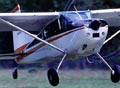
The flight in was beautiful, mostly smooth air, some clouds, and lots to look at. We arrived to see that there was a lot of snow along the river. I knew there would be snow on the mountains but I figured that because the river runs mostly north and south that the sun would be shining on it most of the day and therefore melt the snow along the banks. Everywhere else was melted except right were we wanted to go, the runway was the only spot with snow still covering it. I took a look at the runway and saw tire tracks from other planes that had landed, it also appeared that the snow was not very deep so I thought I’d take a look and if things looked good I’d land. Besides the fact that we wanted to stop and eat I had to pee really bad and that helps motivate me to get on the ground. I flew the approach and got low and slow over the runway and things were looking good, then I realized I was not in a favorable situation; the snow was deeper than it appeared. Image
I began to add power to abort the landing but quickly realized that I may or may not make it over the trees at the end of the strip. Rather than risk meeting the trees at 65 mph and 50 feet off the ground I opted to land. I was already just off the ground in a tail low attitude so I decreased power slightly and let the wheels settle in. Once they touched I added a slight amount of power and some back pressure to keep the tail down. The drag the snow produced slowed the plane faster than the plane wanted to and it jerked side to side while still pointing straight down the runway. I didn’t dare to stop till I reached a place free of snow just incase I couldn’t get going again; it took over half throttle just to keep moving. We parked, got out and wandered around after the frightening and incredibly stupid landing. “Why did I do that” I kept thinking to myself, “am I a complete idiot,” (no response necessary). I knew that as the day progressed the downstream wind would increase and therefore departure would become more difficult so I didn’t want to stay as long as we had planned. We sat and talked, snacked on some food we brought, but we didn’t cook the meal, and relaxed till our nerves settled.
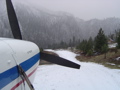
Image
My wife took this picture so I would never forget my error in judgment.
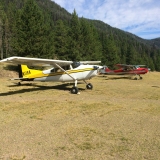
We got in the plane and prepared to takeoff. My wife said she was just going to cover her eyes and to let her know when we were off the ground. I taxied to the end of the strip, which thankfully was the uphill end. I turned around keeping a much speed as possible; as the nose swung around I applied full power, positioned the controls to keep the plane in a tail low attitude while still letting the tail off and prayed for success. The runway was long so if necessary I could reduce power and abort the departure. We picked up speed slowly but it would be fast enough if things didn’t get any worse (like a sudden gust of wind); as the speed increased the weight of the plane was shifted from the tires to the wings, acceleration increased and I pulled it off as soon as possible, staying in ground effect till best climb speed was reached, we then climbed away from the strip and continued downstream till there was enough room to turn around and head for home. Image
The rest of the fright was uneventful, except for a real “greaser” landing when we got home.

I am glad that things turned out well and I can say that I learned a lot from today’s experiences. Everyone makes mistakes that they can learn from but this was a preventable mistake that taught me a lot about things I should have already known.

Some of the things I should have considered.

Don't get that low and that slow it such a low powered plane.

Make decisions sooner while there is still a way out.

Don't push your luck, espically with a loved one onboard. You can kill yourself if you want, just dont kill anyone else in the process.

I knew where I wanted to go, but I need to be willing to pick a different place, maybe somewhere that isn't covered in snow.

Last edited by whee on Tue Mar 13, 2007 6:59 pm, edited 1 time in total.
whee offline
User avatar
Posts: 3386
Joined: Fri Jan 20, 2006 1:59 pm
Location: SE Idaho

Whee, you're really not that stupid! This has happened many, many times to people probably more experienced than you. Often the result is far worse....usually a nose-over in a taildragger or a broken nose strut in a nosedragger.

The only really safe way to land any wheeled aircraft in snow is to have someone on the ground to tell you exactly how deep the snow is, and if it's more than 2 inches of light powder, forget it!

Been there, done that. :(

Rocky
RockyTFS offline
User avatar
Posts: 190
Joined: Wed Jan 10, 2007 5:05 pm
Location: Hailey, Idaho

Aviation is cruel teacher; first comes the exam followed by the lesson or something like that. Yours is a good one for us all to examine.

Every quality aviation magazine has a true confessions section where people tell about their misadventures so others may learn. Your story would be a good submission to magazines like AOPA Pilot or Aviation Safety.

What a wife! Mine would have walked home regardless of the widerness.
crazyivan offline
User avatar
Posts: 159
Joined: Fri May 26, 2006 8:59 am
Location: Maine

Great post. Just like Jr.CubBuilder I had a similar experience on a strip where the grass was just a little too long and wet. I did a touch-and-go, only the "touch" slowed the airplane down a lot more rapidly than normal. Then, of course, the "go" didn't work out normal either. By the time I realized my mistake it was too late to abort and I had to make an immediate turn after lift-off to avoid some trees at the end of the runway. Luckily, that break in the trees was there and gave me an out or I might not be here today to describe my stupidity. Now when I go to an unfamiliar short grass strip, I always plan a full-stop landing. Not to mention calling to get a condition report if possible.
ShamuPilot offline
User avatar
Posts: 66
Joined: Thu Dec 28, 2006 11:31 pm
Location: Mission Viejo, CA

ShamuPilot:
Now when I go to an unfamiliar short grass strip, I always plan a full-stop landing. Not to mention calling to get a condition report if possible.

This is an extremely good attitude towards any small airfield or airstrip landing! The accident files have literally thousands of mishaps, many fatal, that were caused by the pilot NOT ACCEPTING that he/she had screwed up big time and that the best solution was to get on and stay on the ground and ride it out. This is something that glider pilots seldom have a problem with since EVERY landing is no go-around. It's an attitude that has much to recommend it in the backcountry. Once beyond the point where an abort is possible, you land or crash on the strip!

These same accident files also show that once on the ground below flying speed, almost all of those accidents did NOT result in fatalities! Even the ugly ones, e.g. going off the end and down an embankment, hitting deer, moose, elk, trucks, trees, other airplanes, whatever.

The obvious answer is velocity...would you rather hit a tree at 75 kts or a moose at 30? No contest.

The way to do this is to choose your limits before the approach, e.g. "this approach is favourable for go-around even after touchdown, this one is not below 200 feet, this one is a land or crash situation". Make a habit of calling out that point aloud!

Make a point of getting up to date info on every strip you visit, long distance phoning is cheap compared to fixing airplanes. This is now so much easier than it was 20 years ago with resources like AirNav.com and other internet resources, not to mention this forum itself!

UBCP has a wonderful airstrip database and supposedly there are folks on Idaho working on one too. Google Earth is one of the most fascinating new ways to prepare yourself for a backcountry strip, now if we could just get it and Microsoft flight simulator to work together (Maybe someone has already done this)?

Rocky
Last edited by RockyTFS on Tue Mar 13, 2007 7:55 pm, edited 1 time in total.
RockyTFS offline
User avatar
Posts: 190
Joined: Wed Jan 10, 2007 5:05 pm
Location: Hailey, Idaho

We planned on going into the strip a few days earlier and I talked to someone then that said the runways were clear. I didn't figure there would be any additional snowfall since the weather had been pretty good so off we went. I wondered if snow had fallen or if the info was wrong.

After we departed the strip we found that the other runways nearby were clear and were being used. Apparently the info was accurate for the other strips. At the time I didn't think of them since I had never landed at them before.

Jon

If you didn't notice I added a couple pictures.
whee offline
User avatar
Posts: 3386
Joined: Fri Jan 20, 2006 1:59 pm
Location: SE Idaho

Thanks for sharing. I think most of us, especially backcountry pilots, have a journal (written or mental) of learning experiences and scary moments. I know I do, and I feel like I keep adding pages at a distressing rate :shock:

I also see a lot of value in sharing with others, you make people think about what they would do in your situation, and they also learn from the discussion of others.


From the pictures, I'd guess Indian Creek?

John
LowAndSlow offline
User avatar
Posts: 161
Joined: Wed Feb 15, 2006 9:27 am
Location: Medford, OR

Rocky,

Sorry, but I beg to differ with you, to a point. That point is that very few landings truly involve a "committment" to land. I had a guy nearly destroy a Super Cub totally without any cause whatever, cause he got close to really rough snow, on a big open lake, and said, after the landing "I was committed to land".

Bullshift, actually. There are few situations where you are truly committed to land. Certainly there are more in places like the Idaho backcountry, for example, due to terrain. But, almost any airplane at flying speed will easily outclimb 50 foot trees. It's when you get to the 2800 foot mountain at the end that you are "committed".

Unfortunately, far too many pilots damage airplanes on the ground because they somehow thought they were "committed" to land, often on airports with easy go around capabilities.

Look at the accident statistics. There are FAR more fender-bender accidents in the backcountry than there are fatalities. The fender benders occur often because pilots opted NOT to go around, when in fact a go around was a totally feasable and in fact, advisable, option.

To suggest that you should suck it up and crash your airplane just cause you didn't hit your spot is wrong.

The key to successful backcountry flying is being able to touch down where you want to, at the speed you need to. That's all. If a pilot can't do that, he or she has no business going to places that have no go around=period.

And, in fact, if a pilot can't meet that simple test, they really need to get some training and practice BEFORE they go anywhere, cause sooner or later, they'll get in trouble on a great big airport as well.

Go-arounds are something that should be practiced, and mastered.

To do a low pass, and decide that you can't go around from that implies bad planning of the pass. Indeed, perhaps the best choice was to land at that point. Far better would have been to plan the low pass such that it could have been completed without the need to risk the airplane or his neck.

I'm not intending to be critical of the poster, cause we've all done things like this, and hopefully learned from them. The point is, learn the capabilities of your aircraft BEFORE you put it into a situation where you're not sure it'll get out of there safely.

MTV
mtv offline
Knowledge Base Author
User avatar
Posts: 10515
Joined: Sat Feb 25, 2006 1:47 am
Location: Bozeman

MTV -

I agree with what you've said, but it also reminded me of a conversation I had with one of the guys that taught me most of the backcountry flying I do. It regarded flying with an airplane at max gross (air-taxi ops mostly) on a warm day at a tough strip with limited go-around opportunities. Basically, the conversation boiled down to you'd be better off crash/landing into the trees at the end of the runway than trying to outclimb terrain and stall/spin or some other catastrophic maneuver on climb-out. It really stuck with me - I have no intention to crash, ever, but there are times, albeit not many, when you make a commitment to be on the ground no matter what. I think about his words everytime I set myself up for a landing.

As you said MTV, the situation and location play a major roll, and the best way to avoid those kinds of commitments is proper training, equipment and attitude.

John
LowAndSlow offline
User avatar
Posts: 161
Joined: Wed Feb 15, 2006 9:27 am
Location: Medford, OR

I completely agree with Rocky, it is much better to run off the end still on the ground, rather than over the proverbial 50' trees. I think Rocky is pointing out that if you realize that you screwed up, it is better to be close to the ground going slow, correct me if I'm misinterpeting Rocky. I would rather scrub off speed on the ground than hit the tops of the trees still at Vx. Saying that, I do agree that many pilots are over their heads, and should not be going to these places with marginal skills, however, we all screw up.
propeller26 offline
User avatar
Posts: 174
Joined: Mon Mar 12, 2007 9:30 pm
Location: Redding, CA
Aircraft: Cessna 185 Skywagon

MTV, I certainly didn't mean to suggest that if a go-around were possible and advisable, you shouldn't do it. I just meant that some folks crashed and died when it wasn't possible to do a go-around, and they might have lived if they had understood and accepted that and crashed under control at low speed on the strip.

Unfortunately, you are correct that many accidents have also resulted from people not realizing that they could and should go-around.

You are also correct that very few landings require a "commitment" to land when beyond a certain point in the approach. Most that I know of are here in Idaho!

The key thing is knowing which is which and having a plan and a go/no-go point already figured out.

As far as hitting your intended landing spot at the correct touchdown speed, you are ABSOLUTELY correct! Anyone intending to go into some of the strips we talk about here on the forum who can't hit their intended spot 100 times out of 100 within plus or minus 200 feet without bouncing should stick to strips at least 3000 feet long until they can. That still leaves many wonderful places to visit throughout the West.

Rocky
RockyTFS offline
User avatar
Posts: 190
Joined: Wed Jan 10, 2007 5:05 pm
Location: Hailey, Idaho

Rocky,

Thanks for the clarification. I knew where you were going with your comments, but it almost read like "don't even think about doing a go around". I knew that was not what you intended, so just wanted to clarify.

As to hitting your spot within 200 feet, I'd argue if you can't hit your spot within twenty feet, on a bad day, you'd best be doing some practice prior to getting into the real back country.

Again, the key is to know how to FLY your airplane. Having the confidence and proven ability to put it where you want it every time is key to operations on one way strips, and there are some out there.

On the other hand, being fully familiar with the climb and maneuvering capability of your aircraft is also essential, so that you know how to fly the thing in the event a go around is advisable, and POSSIBLE.

Every pilot should practice go arounds, and the skills it takes to complete them successfully. While "scrubbing off extra speed" on a bunch of trees may in fact be the safest way to conclude a flight, it would have been a lot better to know NOT to get into that spot in the first place until you are really qualified to land there.

I think we're on the same page here, generally.

MTV
mtv offline
Knowledge Base Author
User avatar
Posts: 10515
Joined: Sat Feb 25, 2006 1:47 am
Location: Bozeman

go around

One tip I have learned from Jeremy is to use the left arm for the majority of your elevator authority, rather than using lots of trim when landing. It makes it much easier if you must "go around" to transition to climb without having too much trim "up". Practicing touch and goes, you can find the right combination for your application.
RanchAero offline
User avatar
Posts: 297
Joined: Fri Jun 09, 2006 7:55 am
Location: Olympia, WA
1976 Maule M5-235C

MTV:
As to hitting your spot within 200 feet, I'd argue if you can't hit your spot within twenty feet, on a bad day, you'd best be doing some practice prior to getting into the real back country.


Yeah, I thought about saying within 50 feet, but then I remembered a few bounced landings that were supposed to be stopped within 600 feet but actually used 800. Luckily the strip was 1200 feet long! That's still a pretty short strip for a 180 with a moderate load.

Perhaps a more accurate goal would be minus 50 feet and plus 150, that's pretty good performance for lower time pilots and good enough for a 1500 foot strip. By our standards, that's not a real short strip but it is for most flatlander pilots.

I usually figure that one mild bounce or really just a skip will easily use up 100 feet at 50 kts. It happens even to the best of us.

Rocky
RockyTFS offline
User avatar
Posts: 190
Joined: Wed Jan 10, 2007 5:05 pm
Location: Hailey, Idaho

Weeelllll, I'd like to say I've never bounced a landing....

But, in the country I worked for many years, bouncing a landing was just plain unacceptable. A bounce equals a go around, and if you bounced it, you BEST have thought about the go around possibilities first.

Sorry, but those parameters would be purely unacceptable in the back country that I'm familiar with.

I thought all you Idaho guys thought the Idaho backcountry is the toughest of the tough 8) .

Apparently, Alaska demands a bit more precision.

MTV
mtv offline
Knowledge Base Author
User avatar
Posts: 10515
Joined: Sat Feb 25, 2006 1:47 am
Location: Bozeman

RockyTFS wrote:MTV:
As to hitting your spot within 200 feet, I'd argue if you can't hit your spot within twenty feet, on a bad day, you'd best be doing some practice prior to getting into the real back country.


Yeah, I thought about saying within 50 feet, but then I remembered a few bounced landings that were supposed to be stopped within 600 feet but actually used 800. Luckily the strip was 1200 feet long! That's still a pretty short strip for a 180 with a moderate load.
Rocky


Gotta say I'm with MTV on this one. 500 foot strip with a HEAVY C180 is the norm and expected if you're working in AK.

Gump
GumpAir offline
User avatar
Posts: 4557
Joined: Wed Feb 14, 2007 9:14 am
Location: Lost somewhere in Nevada
Aircraft: Old Clunker

GumpAir wrote:
RockyTFS wrote:MTV:
As to hitting your spot within 200 feet, I'd argue if you can't hit your spot within twenty feet, on a bad day, you'd best be doing some practice prior to getting into the real back country.


Yeah, I thought about saying within 50 feet, but then I remembered a few bounced landings that were supposed to be stopped within 600 feet but actually used 800. Luckily the strip was 1200 feet long! That's still a pretty short strip for a 180 with a moderate load.
Rocky


Gotta say I'm with MTV on this one. 500 foot strip with a HEAVY C180 is the norm and expected if you're working in AK.

Gump


And... To be fair to the Idaho and the other high altitude guys and gals...

Density altitude is the AK pilot's friend. A Cessna 185 at sea leavel and 15 F, will do things that would be absolutely suicidal at 7,000 ft MSL and 80 F.

Gump
GumpAir offline
User avatar
Posts: 4557
Joined: Wed Feb 14, 2007 9:14 am
Location: Lost somewhere in Nevada
Aircraft: Old Clunker

Gump,

Yes, but high density altitude does not imply or precipitate a bounce, or any reason to be less precise. Go arounds can certainly be more "interesting" of course..

MTV
mtv offline
Knowledge Base Author
User avatar
Posts: 10515
Joined: Sat Feb 25, 2006 1:47 am
Location: Bozeman

MTV

True, but the thick dense air at cold and low, equals slower "across the ground" speeds, even though you use the same indicated airspeed. And you can feel a huge difference in the flare and that cushion of ground effect. Everything equal, I can flare and land at Kotzebue at gross weight+ pretty much power-off and roll on exactly like I want to, where down here in Nevada at 4,500 feet in the summer, the same landing would take a good handful of throttle to make a decent flare. The lack of ground effect (or what feels like lack of ground effect) is the difference.
GumpAir offline
User avatar
Posts: 4557
Joined: Wed Feb 14, 2007 9:14 am
Location: Lost somewhere in Nevada
Aircraft: Old Clunker

Whee,

Beautiful Luscombe you have there. Thanks for sharing your experience. I learned a few lessons in my Dad's Luscombe when I was a teenager. Great Plane.

Another good thing that we all got from your experience is a nice long discussion about the good, the bad and the ugly from what happened.

Thanks again.
Tailwagger2000 offline
Posts: 28
Joined: Sun Nov 26, 2006 9:00 pm
Location: NJ
David

DISPLAY OPTIONS

Next
21 postsPage 1 of 21, 2

Who is online

Users browsing this forum: No registered users and 0 guests

Latest Features

Latest Knowledge Base