My question for Rich, the turn doctor, would be why at 60 degree bank we crop dusters are not having to pull 2 gs? But that would be unfair. His experiment eliminates the variable of allowing the nose to go down naturally. Apples and oranges. He is the level turn doctor. Rob, actually any not wrung out in twenty minutes crop duster, is the energy management turn doctor. Rich will get the instrument pilot onto the right control usage track quickly. Crop dusters better understand what the airplane wants to do and effective rudder usage. They also understand, or suffer the stall, resulting from overuse of elevator when too low to recover.
Oil and water don't mix. Instrument technique and contact flying technique appear to mix until we get below the one thousand feet necessary to recover from inadvertent stall. Integrated instrument enhanced the new PTS in the 70s. The fact that integrated instruments turned out not to work well in low altitude work and the normal pattern was ignored to make the FAA look good. So integrated instruments has continued into the ACS. Rich's learn to feel for gs should mitigate stall in the pattern, but only treat the symptoms. Good stick feel will not eliminate the certain cause, not the probable cause. The certain cause is that the pilot pulled back on the stick. The airplane cannot stall itself. It was designed not to stall itself. That makes fifty years of the school solution shooting itself in the foot. We are actually training pilots to stall in the pattern. Distraction, poor recurrent training, poor pilot attitude, and various other things become the probable cause of the stall. The wrong orientation, indoctrination, and initial training deficiencies are not cited as that would make the FAA look bad.
Learn To Turn
Thu Oct 07, 2021 5:37 am
- contactflying offline
- Posts: 4972
- Joined: Wed Apr 03, 2013 7:36 pm
- Location: Aurora, Missouri 2H2
Download my free "https://tinyurl.com/Safe-Maneuvering" e-book.
Thu Oct 07, 2021 7:09 am
Re: Learn To Turn
Groan!!
Guys, please just take a step back here for a moment.
First, nothing in the Learn To Turn program is inconsistent with what you two (Rob and Contact) are preaching. This is about TURNING an airplane....NOT just about "level turns".
Second, EVERY pilot operates close to the ground at some point, at least twice on EVERY flight. Crop dusters/Ag Pilots/Aerial Applicators don't have any exclusive on that....they DO spend more time close to the ground than most of us.....good for them, and I have no doubt that the demands of that job require skills and knowledge.
Contact appears horrified by what he refers to as the "level turn". I have spent more than a few thousand hours myself in "level turns" at well below 500 feet agl. That's what wildlife types do on a daily basis in most cases. Looking at things on the ground from low level doesn't work very well using the "energy management turn". And, many, many pilots (right, wrong or dead) do this sort of flying every day. That's my point: I have NO argument with your "energy management turn" concept....WHERE it applies. My point is, that doesn't work in EVERY flying situation that a pilot will encounter. Note my use of the term "will encounter". We don't always get to choose the circumstances we operate under. And, not all of us fly swaths back and forth all day in a structured environment.
BUT, the point of Rich's program, and the reason I posted it here, is that, as Rich points out, we (that means the flight training industry in this country) does not do a good job of teaching the very basics of aerodynamics. Inherent to that is a clear understanding of what the airplanes controls do and don't do.
That basic structure applies to ALL turning scenarios. And, if you read Rich's material carefully, what he's presenting certainly doesn't exclude your energy management turn.
I seriously doubt that any Ag pilot survives very long without developing a basic understanding of aerodynamics and the function of the controls of his/her airplane. Rich's point is simply that we ALL need to get a better handle on those concepts, and this should be a major emphasis item in basic flight training--it should NOT be something we have to figure out on our own after we receive a certificate.
During my initial flight training, my primary instructor was an airline pilot wanna be, just filling squares, and building time so he could get a "Real job". Fortunately for me, that school went belly up (I've actually appreciated the IRS intervention there) and I got hooked up with a guy who had upwards of 30,000 hours of flying GA airplanes as my next instructor. WOW!! What a difference! And, that guy's admonition after I passed the PPL check ride was: "Listen to EVERYone who talks about flying technique. Then take whatever seems to make sense, and apply it. If it works, make that part of YOUR flying. That gentleman I firmly believe, saved my life.
Unlike my original flight instructor, Rich's mantra is that flight instruction IS a "real job", and is arguably more important than any other in aviation. He's simply trying to offer some information for flight instructors and pilots that THEIR initial training may not have covered adequately.
It took me quite a few flight hours and flying with people with many, many thousands of hours of flying all sorts of airplanes to become a much better aviator. I'm still not as good at it as I should be. But, I'm working on it.
I don't pretend to have all the answers yet. I try to maintain an open mind, and, respecting Howard Riley's advice, take from ANY program that which I think will make me a better pilot and a better flight instructor. I think this program offers some really good insights in that regard. If you don't think so, then ignore this whole thread.
Take from it what you feel is beneficial, and leave the rest. But, bad mouthing a whole program because you feel it doesn't adequately support your own narrow view of the world is counter productive.
My opinion only....as one who's spent quite a few hours very close to the ground....but not in a straight line, and not flying 180 degree turns.
FWIW, which may not be much. But, most of all, whatever you do, try to be a better pilot EVERY time you fly, and fly safe!
MTV
Guys, please just take a step back here for a moment.
First, nothing in the Learn To Turn program is inconsistent with what you two (Rob and Contact) are preaching. This is about TURNING an airplane....NOT just about "level turns".
Second, EVERY pilot operates close to the ground at some point, at least twice on EVERY flight. Crop dusters/Ag Pilots/Aerial Applicators don't have any exclusive on that....they DO spend more time close to the ground than most of us.....good for them, and I have no doubt that the demands of that job require skills and knowledge.
Contact appears horrified by what he refers to as the "level turn". I have spent more than a few thousand hours myself in "level turns" at well below 500 feet agl. That's what wildlife types do on a daily basis in most cases. Looking at things on the ground from low level doesn't work very well using the "energy management turn". And, many, many pilots (right, wrong or dead) do this sort of flying every day. That's my point: I have NO argument with your "energy management turn" concept....WHERE it applies. My point is, that doesn't work in EVERY flying situation that a pilot will encounter. Note my use of the term "will encounter". We don't always get to choose the circumstances we operate under. And, not all of us fly swaths back and forth all day in a structured environment.
BUT, the point of Rich's program, and the reason I posted it here, is that, as Rich points out, we (that means the flight training industry in this country) does not do a good job of teaching the very basics of aerodynamics. Inherent to that is a clear understanding of what the airplanes controls do and don't do.
That basic structure applies to ALL turning scenarios. And, if you read Rich's material carefully, what he's presenting certainly doesn't exclude your energy management turn.
I seriously doubt that any Ag pilot survives very long without developing a basic understanding of aerodynamics and the function of the controls of his/her airplane. Rich's point is simply that we ALL need to get a better handle on those concepts, and this should be a major emphasis item in basic flight training--it should NOT be something we have to figure out on our own after we receive a certificate.
During my initial flight training, my primary instructor was an airline pilot wanna be, just filling squares, and building time so he could get a "Real job". Fortunately for me, that school went belly up (I've actually appreciated the IRS intervention there) and I got hooked up with a guy who had upwards of 30,000 hours of flying GA airplanes as my next instructor. WOW!! What a difference! And, that guy's admonition after I passed the PPL check ride was: "Listen to EVERYone who talks about flying technique. Then take whatever seems to make sense, and apply it. If it works, make that part of YOUR flying. That gentleman I firmly believe, saved my life.
Unlike my original flight instructor, Rich's mantra is that flight instruction IS a "real job", and is arguably more important than any other in aviation. He's simply trying to offer some information for flight instructors and pilots that THEIR initial training may not have covered adequately.
It took me quite a few flight hours and flying with people with many, many thousands of hours of flying all sorts of airplanes to become a much better aviator. I'm still not as good at it as I should be. But, I'm working on it.
I don't pretend to have all the answers yet. I try to maintain an open mind, and, respecting Howard Riley's advice, take from ANY program that which I think will make me a better pilot and a better flight instructor. I think this program offers some really good insights in that regard. If you don't think so, then ignore this whole thread.
Take from it what you feel is beneficial, and leave the rest. But, bad mouthing a whole program because you feel it doesn't adequately support your own narrow view of the world is counter productive.
My opinion only....as one who's spent quite a few hours very close to the ground....but not in a straight line, and not flying 180 degree turns.
FWIW, which may not be much. But, most of all, whatever you do, try to be a better pilot EVERY time you fly, and fly safe!
MTV


Thu Oct 07, 2021 7:50 am
Re: Learn To Turn
Thanks Mike. We appreciate your point of view. I would not have survived doing low level work the way you and many others have done it for years. I am just not that organized and careful. I was lucky enough to get trained by mavericks who taught me how to sort it out on the fly. So I got good instruction and I sorted some techniques out on my own by trial and error.
I agree with you, Mike, that there are good techniques out there that we all should at least consider. Standardization is a good cow pony. It keeps the crazy eyed cows from running off and keeps the drags closed up as well. A tough job. Exclusion of new data is not helpful, but often used as a standardization technique. We crazies and drags and those in between are part of the herd.
I agree with you, Mike, that there are good techniques out there that we all should at least consider. Standardization is a good cow pony. It keeps the crazy eyed cows from running off and keeps the drags closed up as well. A tough job. Exclusion of new data is not helpful, but often used as a standardization technique. We crazies and drags and those in between are part of the herd.
- contactflying offline
- Posts: 4972
- Joined: Wed Apr 03, 2013 7:36 pm
- Location: Aurora, Missouri 2H2
Download my free "https://tinyurl.com/Safe-Maneuvering" e-book.
Thu Oct 07, 2021 10:08 am
Re: Learn To Turn
contactflying wrote:Thanks Mike. We appreciate your point of view. I would not have survived doing low level work the way you and many others have done it for years. I am just not that organized and careful. I was lucky enough to get trained by mavericks who taught me how to sort it out on the fly. So I got good instruction and I sorted some techniques out on my own by trial and error.
I agree with you, Mike, that there are good techniques out there that we all should at least consider. Standardization is a good cow pony. It keeps the crazy eyed cows from running off and keeps the drags closed up as well. A tough job. Exclusion of new data is not helpful, but often used as a standardization technique. We crazies and drags and those in between are part of the herd.
Jim,
One of the things I've noticed is that you, Rich Stowell and I all three are pretty big fans of Wolfgang.....that provides a great place to start.
MTV
Thu Oct 07, 2021 10:31 am
Re: Learn To Turn
mtv wrote:
During my initial flight training, my primary instructor was an airline pilot wanna be, just filling squares, and building time so he could get a "Real job". Fortunately for me, that school went belly up (I've actually appreciated the IRS intervention there) and I got hooked up with a guy who had upwards of 30,000 hours of flying GA airplanes as my next instructor. WOW!! What a difference! And, that guy's admonition after I passed the PPL check ride was: "Listen to EVERYone who talks about flying technique. Then take whatever seems to make sense, and apply it. If it works, make that part of YOUR flying. That gentleman I firmly believe, saved my life.
Unlike my original flight instructor, Rich's mantra is that flight instruction IS a "real job", and is arguably more important than any other in aviation. He's simply trying to offer some information for flight instructors and pilots that THEIR initial training may not have covered adequately.
It took me quite a few flight hours and flying with people with many, many thousands of hours of flying all sorts of airplanes to become a much better aviator. I'm still not as good at it as I should be. But, I'm working on it.
MTV
It has always struck me as totally @ss backwards that primary instruction is given by the least experienced pilots out there. At best they can teach you not to kill yourself in the first few hundred hours. Then hopefully you can go and find someone who knows something to help. The internet just adds another level of misinformation with 500 hour youtube stars.
I feel I was lucky as I came in with several hundred hours of paragliding, some gliding, a lot of model planes and a lot of sailing. But it was really only after flying with some high time old school stick and rudder pilots that I began to understand what I do not know. Fun learning though...
- daedaluscan offline


- Posts: 1269
- Joined: Sat Jan 12, 2013 1:06 pm
- Location: Texada BC
Thu Oct 07, 2021 11:42 am
Re: Learn To Turn
daedaluscan wrote:
It has always struck me as totally @ss backwards that primary instruction is given by the least experienced pilots out there. At best they can teach you not to kill yourself in the first few hundred hours. Then hopefully you can go and find someone who knows something to help. The internet just adds another level of misinformation with 500 hour youtube stars.
I feel I was lucky as I came in with several hundred hours of paragliding, some gliding, a lot of model planes and a lot of sailing. But it was really only after flying with some high time old school stick and rudder pilots that I began to understand what I do not know. Fun learning though...
So so true, it is so @ss backwards - but there are schools that are staffed with the "experienced" pilots, you just have to know that is what you want and look for them - I started my training at the big fancy flight school locally and after my 6th flight I was already on my 3rd instructor as the others had moved on to the airlines as they built their time. They were nice enough.. but they were just building time to move on to the next phase... and didn't have a-lot of experience other then hours building. I feel extremely lucky that happened early in my training - I decided I didn't want to learn from the kids working their way through the system - and made my way over to the dumpy looking school with all the Citabrias lined up. Was not as fancy as the other one (did I mention the dumpy part) - but I got a top notch flight education - my instructor was a full time instructor - ex-navy, had tens of thousands of hours and wanted nothing to do with the airlines anymore, he literally lived out of his vehicle next to the flight school. He lived and breathed aviation, he was a hard @ss at times and I don't think he could hold down a corporate gig (he would have been a HR nightmare) - but not only did he teach me how to get my pilots license - but he taught me how to fly - how to be PIC. Its also where I became hooked on tailwheels...
Fri Oct 08, 2021 8:11 am
Re: Learn To Turn
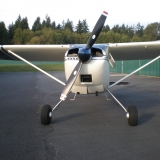
A friend of mine likes to say "I got my license in a 150--
then I learned to fly in a Cub".
With the same sort of instructor as Corefile had.
then I learned to fly in a Cub".
With the same sort of instructor as Corefile had.
Cessna Skywagon -- accept no substitute!
Sun Oct 10, 2021 6:53 am
Re: Learn To Turn
Dynamic neutral stability, built into the design of the airplane, makes the nose go down naturally in any curved flight, any turn, because it wants to stay at trim set airspeed. That natural pitch down, relative to the relative wind, can be overcome either with additional lift component of power or by pulling back on the elevator. Almost all students pull back on the elevator, even when they have additional power available. Dangerous. So, knowing that Rich and MTV are right, does the horizontal stabilizer provide the same as elevator pitch up to cause the banked airplane to turn without pulling back on the elevator? Does the gust which causes more relative wind on one wing that the other cause bank and thus turn without pulling back on the elevator?
So after using zoom reserve airspeed (the law of the roller coaster) to zoom up and slow down, Rob and I bank steeply and let her have her head. We pull back little if any on the elevator. Does the airplane now slip to keep the nose going straight because the elevator is the turn control and is not being pulled? No the airplane turns quite well. So does the dynamic neutral stability horizontal stabilizer fixed pitch down to hold the nose up in 1g flight cause the turn? What about the rudder in very steep turns. It is now pitching the nose down more because it has become the elevator and the elevator has become the rudder relative to the earth. Is that why Rob and I have trouble walking after a day, or night, spraying. Why are our legs worn out. Because we have been using the elevator, the one behind the vertical stabilizer, to turn. If relative to the earth voids me, OK. But I want to get to that next swath run relative to the earth. I don't know the math and science, I just want to make the airplane go where I need to spray without stalling. I just want to get the turn done and the wing level before going over wires. I just want to get around before hitting the ground. I am a fussy pilot.
Rich and MTV, can we all win on this? I should be a politician.
So after using zoom reserve airspeed (the law of the roller coaster) to zoom up and slow down, Rob and I bank steeply and let her have her head. We pull back little if any on the elevator. Does the airplane now slip to keep the nose going straight because the elevator is the turn control and is not being pulled? No the airplane turns quite well. So does the dynamic neutral stability horizontal stabilizer fixed pitch down to hold the nose up in 1g flight cause the turn? What about the rudder in very steep turns. It is now pitching the nose down more because it has become the elevator and the elevator has become the rudder relative to the earth. Is that why Rob and I have trouble walking after a day, or night, spraying. Why are our legs worn out. Because we have been using the elevator, the one behind the vertical stabilizer, to turn. If relative to the earth voids me, OK. But I want to get to that next swath run relative to the earth. I don't know the math and science, I just want to make the airplane go where I need to spray without stalling. I just want to get the turn done and the wing level before going over wires. I just want to get around before hitting the ground. I am a fussy pilot.
Rich and MTV, can we all win on this? I should be a politician.
- contactflying offline
- Posts: 4972
- Joined: Wed Apr 03, 2013 7:36 pm
- Location: Aurora, Missouri 2H2
Download my free "https://tinyurl.com/Safe-Maneuvering" e-book.
Mon Oct 11, 2021 3:38 pm
Re: Learn To Turn
daedaluscan wrote:It has always struck me as totally @ss backwards that primary instruction is given by the least experienced pilots out there.
This made me laugh as I recalled a contract negotiation some years ago between my company and our helicopter aviation provider. Our company apparently felt that the pilots were paid too much, which of course was not true since helo pilots don't make the big bucks. I reasoned that someone in our contracts department, none of whom knew anything about aviation, heard that you could hire "certified flight instructors" for near minimum wage. I figured that, to them, "certified flight instructor" sounded like the pinnacle of the profession, rather than the bottom of the food chain.
Having said that, I have flown with many, many CFIs over the years, never had one that I didn't have confidence in, and always came away with something that I learned.
Ross
DISPLAY OPTIONS
Who is online
Users browsing this forum: No registered users and 9 guests
Latest Features
-
Live to Tell
A Minnesota pilot is surprised to learn that the sudden asymmetric drag of an out-of-rig ski can…Read More -
Creators
Working in some of the Yukon's most beautiful and remote environments, photographer Simon Blakesley captures aircraft in…Read More -
Aircraft Ownership and Maintenance
Upgrading to big tires can make a huge difference in backcountry performance, but with those gains come…Read More -
Tales from Yesteryear
In this tale from bush flying yesteryear, Don Cogger signs up to help Atlee Dodge Jr recovery…Read More


Latest Knowledge Base
-
Destinations
A regional guide with ideas for winter camping destinations in California, Nevada, New Mexico, and Arizona.Read More -
Aircraft
Finding an affordable aircraft that can handle the backcountry for $80K or less? A challenge for sure, but with the…Read More -
Aircraft
01.29.2018 - Zane - Updated tire diameter graphic to add 8.50x10 Guide to tires for use in the backcountry and off-airport landing…Read More -
Pilots
12.22.2013 - Initial article format Operating aircraft on skis and negotiating a snow-covered landscape is an entirely unique skillset and environment.…Read More


