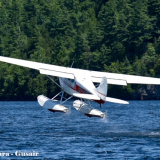
Supposedly (if to be believed) cruising at 130 kts for 5 hrs, this thing is going to be a game changer.
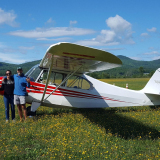
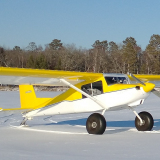
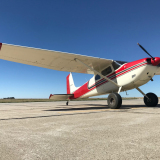
Most of the breakthrough comes from the semi-solid hybrid battery design, which is pretty nutty when you start to dig into it. Looking like they are going to offer a 2 place that looks pretty close to the original cub with the exception of the rear seat, which is raised 3” higher than the traditional seat placement to accommodate the battery.
The really exciting thing is that they will have their STC finished at the same time to retrofit most PA-18s (must have flaps.). The engine will only be slightly more expensive than an OH'd 320, and the battery bank will be around $12-18k, depending on which capacity bank that’s chosen. You will have to swap the engine mount and add the cargo door (the electric motor sits a tiny bit further fwd). Personally I think it sorta makes the cub look a little weird, but for the power and range???
When I got to fly the demonstrator, I couldn’t get over how quiet it was… Plus, with the electric motor being so small, the firewall forward cargo area is gonna open up a whole new dimension for hauling gear.
Anyway, should be pretty freaking cool!
Greg-

Here is their press release:
FOR IMMEDIATE RELEASE
Lec’traCub Announces Certification Milestone for 225hp-Class Electric Cub and STC Retrofit Program
Silicon Valley startup brings next-generation electric propulsion to legacy backcountry aircraft
PALO ALTO, CA — Lec’traCub today announced that its proprietary electric propulsion system has received FAA certification for installation in light utility aircraft, with full certification of its flagship LC-225e VoltCub™ expected by January 27. Alongside the new production aircraft, the company confirmed simultaneous completion of a Supplemental Type Certificate (STC) program enabling retrofit of most flap-equipped PA-18 Super Cubs.
Designed as a practical, pilot-focused evolution of the classic Cub platform, the LC-225e delivers performance comparable to traditional 225 hp configurations while introducing a radically simplified propulsion architecture.
“This isn’t about replacing the Cub—it’s about revealing what it was always capable of becoming,” said Frank Joule, Chief Engineer at Lec’traCub. “By removing the constraints of reciprocating engines, we’ve opened up new possibilities in efficiency, payload distribution, and operational flexibility.”
Performance & Configuration
The LC-225e VoltCub™ features Lec’traCub’s semi-solid hybrid battery architecture, pairing a high-density lithium-metal core with a stabilized gel-electrolyte matrix. This approach provides enhanced thermal stability, improved cycle life, and higher discharge rates compared to conventional lithium-ion systems.
Equivalent Output: 225 hp (continuous-rated electric propulsion system)
Cruise Performance: 130 knots true airspeed
Endurance: Up to 5 hours (depending on configuration and power setting)
Battery System: Modular semi-solid hybrid packs (field-swappable options available)
Estimated Battery Cost: $12,000–$18,000 depending on capacity tier
Recharge Options: Level 2 AC, DC fast charge, and proprietary “RampCharge™” quick-connect system
The aircraft retains the familiar Cub silhouette, with a subtle modification to the rear cockpit geometry. The aft seat has been raised approximately three inches to accommodate the structural integration of the battery system while maintaining center-of-gravity limits.
Retrofit Program (STC)
Lec’traCub’s STC program allows operators to retrofit existing PA-18 airframes with the LC-225e propulsion system. The conversion includes:
Replacement electric motor and controller assembly
Revised engine mount (slightly forward-shifted geometry)
Integrated battery housing and thermal management system
Updated instrumentation and energy management display
Installation costs are expected to be competitive with a conventional engine overhaul, with the added benefit of significantly reduced maintenance requirements.
Operational Experience
Test pilots have highlighted the aircraft’s unique acoustic profile and low-speed handling characteristics.
“It’s the quiet that gets you first,” said Sparky Gibbins, Lead Test Pilot for Lec’traCub. “You’re at 500 feet, 40 miles an hour, door open, and there’s just…wind. No vibration, no engine note—just pure flying. It changes how you think about the airplane.”
The compact footprint of the electric motor has also enabled additional forward cargo capacity, opening new use cases for backcountry operations, aerial survey, and recreational flying.
Looking Ahead
Lec’traCub plans initial deliveries shortly after certification, with both factory-built aircraft and retrofit kits entering production in early 2027. The company indicates strong early interest from flight schools, bush operators, and private owners seeking lower operating costs and simplified systems.
“Electric propulsion isn’t the future—it’s the present, if you’re willing to build for it,” added Joule. “The VoltCub is just the beginning.”
For more information, contact [email protected].
About Lec’traCub
Lec’traCub is a Silicon Valley-based aerospace startup focused on electrifying legacy light aircraft platforms through advanced propulsion and energy storage technologies. Founded by a team of engineers, pilots, and “recovering A&Ps,” the company is dedicated to preserving the spirit of classic aviation while advancing its capabilities.