14 Things That Made Us Slow Down and Look
At this point in mid-August, the hype and excitement around EAA's Airventure has calmed to imperceptible levels; the exhibitors are enjoying well-deserved vacations thinking about anything BUT aviation, and the only thing that can eclipse the talk of the new Garmin glass panel products is the discussion of the great post-smoke Fisk arrival Charley Foxtrot of 2026. I'm glad all survived.
So, the last thing most people want to read about now is OSH news, but ours is a little different—we've compiled a list of the things we thought were interesting and relevant to backcountry and STOL pilots, with gratuitous photography. Enjoy, and we'll see you there next year.
1 MOSAIC Phase 2
"Personally, I'm super excited for MOSAIC. Especially as it applies to new aircraft manufacture and the maintenance of the existing fleet."
MOSAIC and Light Sport Question
MOSAIC Phase 2 took effect July 24 during the show. This is the FAA's Modernization of Special Airworthiness Certification rule, and the short version is that it redefines which airplanes a pilot operating under Sport Pilot rules can fly. The old rule capped LSAs at 1,320 lbs max gross, with an extra allowance for floats. But with MOSAIC, the weight limitation has been replaced by a performance limit: if an airplane has a clean stall speed (Vs1) at or below 59 knots calibrated airspeed and no more than four seats, it can be flown under Sport Pilot privileges. This includes aircraft like Cessna 170s and 172s, and many two-seat taildraggers and backcountry types whose weight required a Private certificate and 3rd class medical or Basic Med to operate.
Remember the benefit of the Sport Pilot rule? It allowed operation of qualifying aircraft without an FAA medical exam—daytime VFR using only a valid U.S. driver's license in place of a medical certificate. That's been the rule since 2004, and MOSAIC doesn't change it. What MOSAIC does change is the airplane you're allowed to fly on that basis. A pilot who opts to not seek (or renew) a FAA medical certificate can now legally fly a much more capable airplane, in the daytime, on a driver's license medical. Two catches: night flying still requires at least BasicMed or a third-class medical, and you cannot have been denied or had a medical revoked. Details are in the AOPA MOSAIC FAQ.
While it sounds amazing, your insurance company is separate from the FAA. Even if the FAA lets you fly on a driver's license, plenty of insurance policies still require a valid medical as a condition of coverage. Before you drop your medical and lean on the driver's-license path, call your insurer and confirm you're still covered.
2 Van's RV-15: The High Wing/Backcountry Van's
RV-15 prototype N7357, Van's high-wing taildragger aimed at backcountry pilots, arrived camo-wrapped and sporting big tires. Van's began taking deposits on the wing kit in 2025, with wing kit deliveries now underway and orders for the remaining kits (tail, fuselage, finish, and firewall-forward) opening on a published schedule through 2026.
The engineer I spoke with told me about several changes to the fuselage they have planned: one being shifting the instrument panel slightly forward, as well as some rear cabin tweaks.
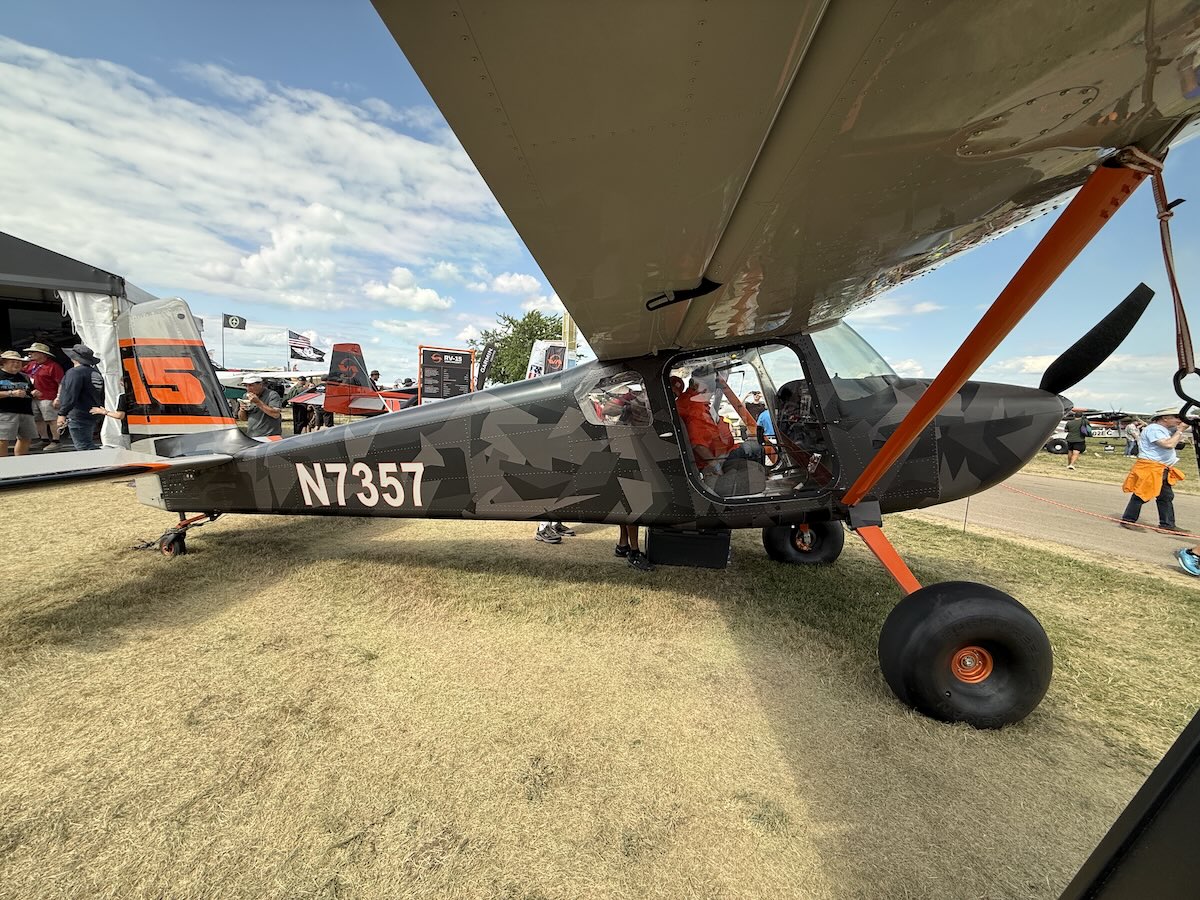 Van's RV-15 looking positively ready for action.
Photo: Zane Jacobson
Van's RV-15 looking positively ready for action.
Photo: Zane Jacobson
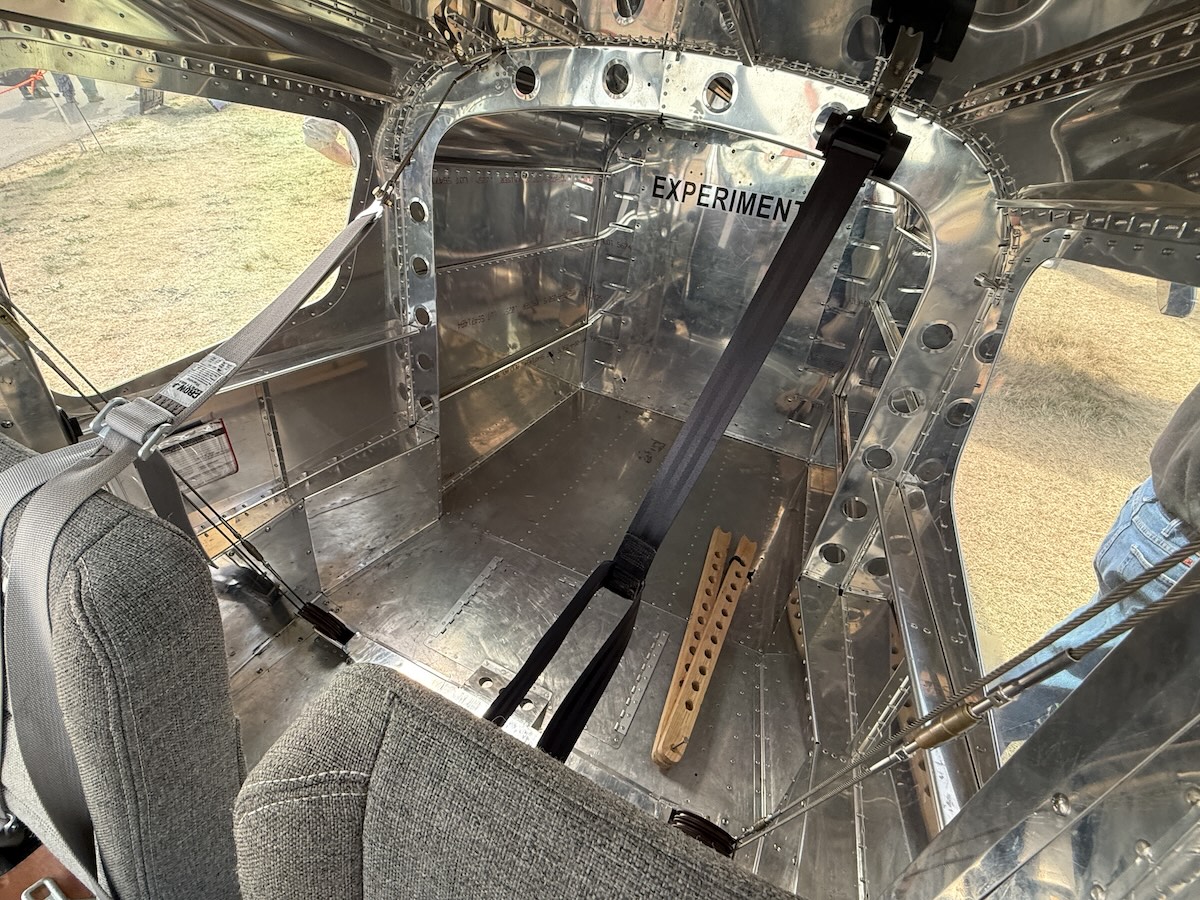 So much popcorn...what's the useful load on this thing again?
Photo: Zane Jacobson
So much popcorn...what's the useful load on this thing again?
Photo: Zane Jacobson
It's a clean-sheet high-wing from Van's, designed for short-field and off-airport flying. Van's set ambitious goals—takeoff and landing in 400 feet or less and a 140-knot top end—and founder Dick VanGrunsven has said the RV-15 "has something new to offer that backcountry pilots will appreciate," with a nosewheel version also in the works. This is nothing short of a miracle from a company who less than 3 years ago was staring down bankruptcy after some laser cutting QC issues swamped it with bad press.
The promise is a backcountry hauler with Van's build quality and support behind it, at a kit price expected to undercut the boutique bush builders. For the latest on kit stages and delivery timing, Van's has full details on their RV-15 page.
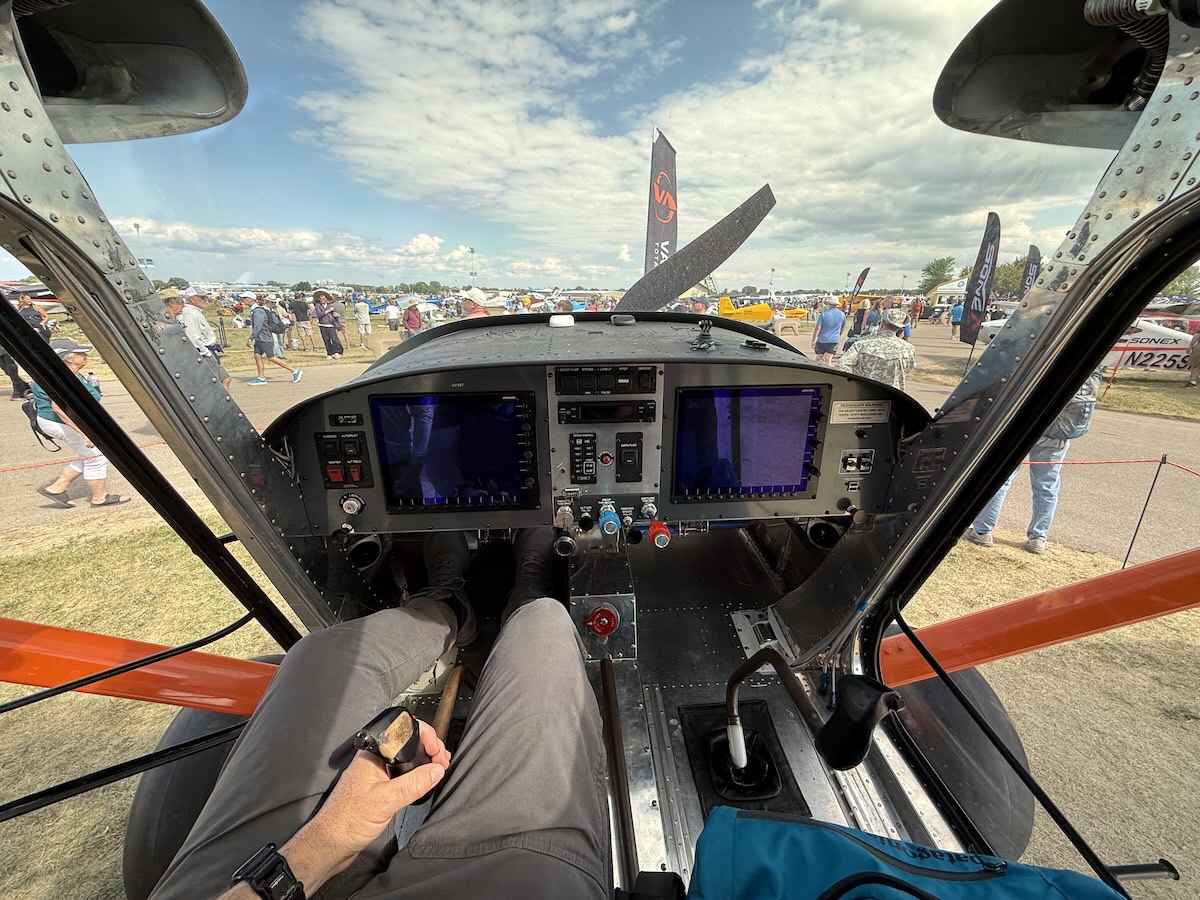 Tall guys rejoice— this thing is going to fit all body types.
Photo: Zane Jacobson
Tall guys rejoice— this thing is going to fit all body types.
Photo: Zane Jacobson
 If you've never inspected a RV model closely, the suspended pedals are always a cool surprise. They're adjustable, too.
Photo: Zane Jacobson
If you've never inspected a RV model closely, the suspended pedals are always a cool surprise. They're adjustable, too.
Photo: Zane Jacobson
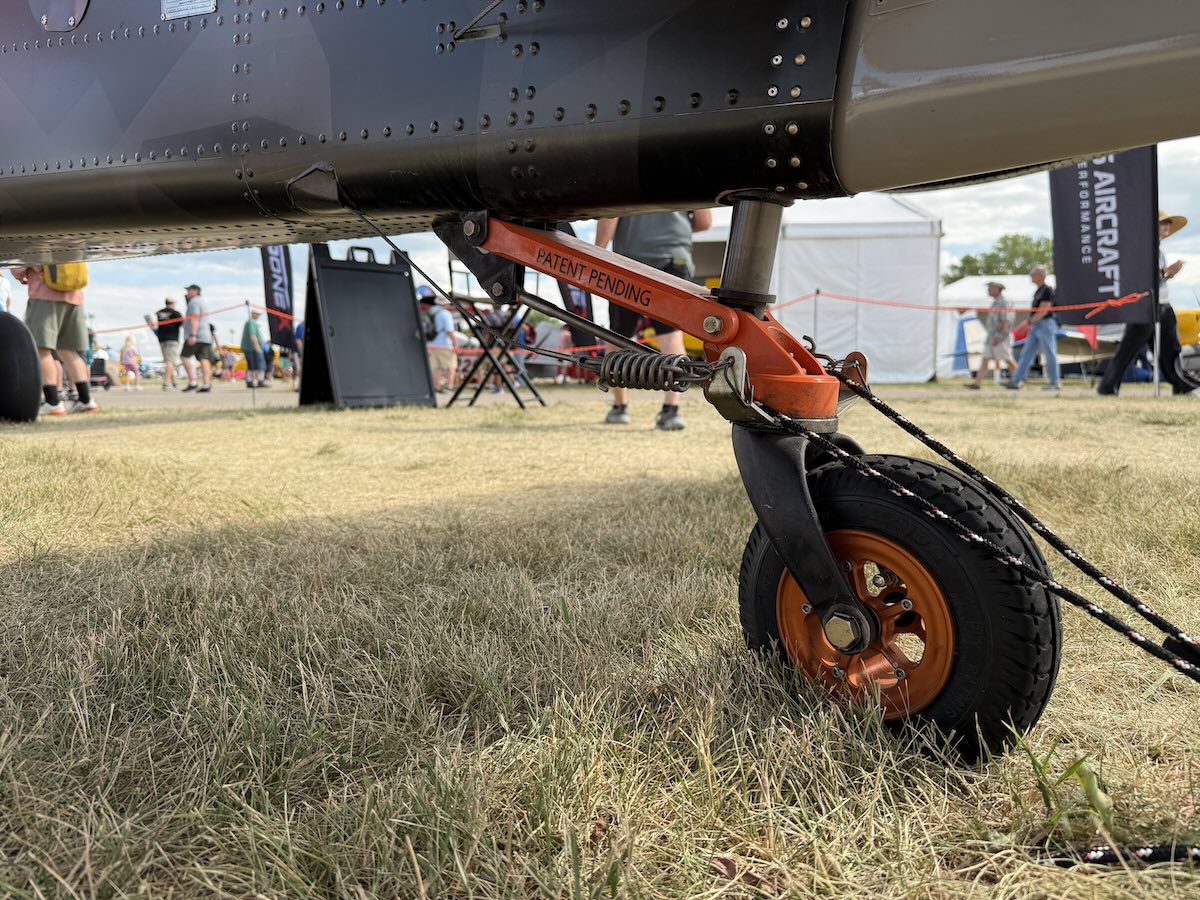 Patent pending: squishy tailwheel spring.
Photo: Zane Jacobson
Patent pending: squishy tailwheel spring.
Photo: Zane Jacobson
3 The KFA Safari XL
Down at the ultralight field sat a gray-over-black bush plane, the KFA Safari XL (N937MD, the Rotax 916iS model), which "looks like a Kitfox." Founder Stefan Coetzee has clearly heard it a thousand times. His response: Kitfox itself started life as a modified Avid Flyer, and this whole planform traces back to Dean Wilson forty years ago. Everybody's been riffing on the theme ever since. He'll tell you that no part of the Safari would bolt onto a Kitfox, and that the design has been through several lives—Bushbaby, then Explorer, Safari, Safari XL—enjoying thoughtful revision each time somebody figured out a better way to build it.
The XL is the big one: it's deliberately sized to fit larger pilots, with a roomy cabin and a generous baggage area. It comes standard with a long-span wing that adds carbon-fiber leading edges, more fuel capacity, and better STOL numbers. It boasts better all-around specs than most kits in this class. Flying's profile has more on the company's history.
 A builder's freshly finished KFA Safari XL on affordable sand rail wheels & tires
Photo: Erin Halley
A builder's freshly finished KFA Safari XL on affordable sand rail wheels & tires
Photo: Erin Halley
KFA's focus is affordable, capable airplanes, and the Safari XL is offered a few ways: a quickbuild kit at $83,000, a ready-to-fly equipped with a Rotax 916iS (160hp) at $264,900, and a 135hp turbo ready-to-fly at $229,000. Depending on the engine, the XL will take off in roughly 200 feet and land in about 225, cruise near 95 knots, and climb at 1,500 fpm. Taking the kit route rewards sweat equity: KFA says the average builder finishes a standard non-quickbuild kit in under 700 hours, with kit delivery currently averaging 12 to 14 weeks and factory-built airplanes running 4 to 7 months.
 It's all a blur now, but I recall something about the KFA Safari XL's seats being super adjustable.
Photo: Zane Jacobson
It's all a blur now, but I recall something about the KFA Safari XL's seats being super adjustable.
Photo: Zane Jacobson
The old forum wisdom usually cuts against building a small airplane when a proven one is sitting right there. The Safari XL's pitch is that you don't have to give up space or capability to go this route—it's built to haul bigger people and bigger loads into rough places. The KFA US site still says "under development," and you'll need to confirm what each kit stage includes; the Safari XL kit, for instance, comes standard with the wing quickbuild, with firewall-forward priced separately (reach out to them to confirm.)
The U.S. operation is also new: the airplanes are partially built in South Africa, with manufacturing and build-assist standing up in Burlington, Wisconsin. Full factory-produced Safari XLs are slated to be available in the U.S., available to Sport Pilots under the new MOSAIC rules.
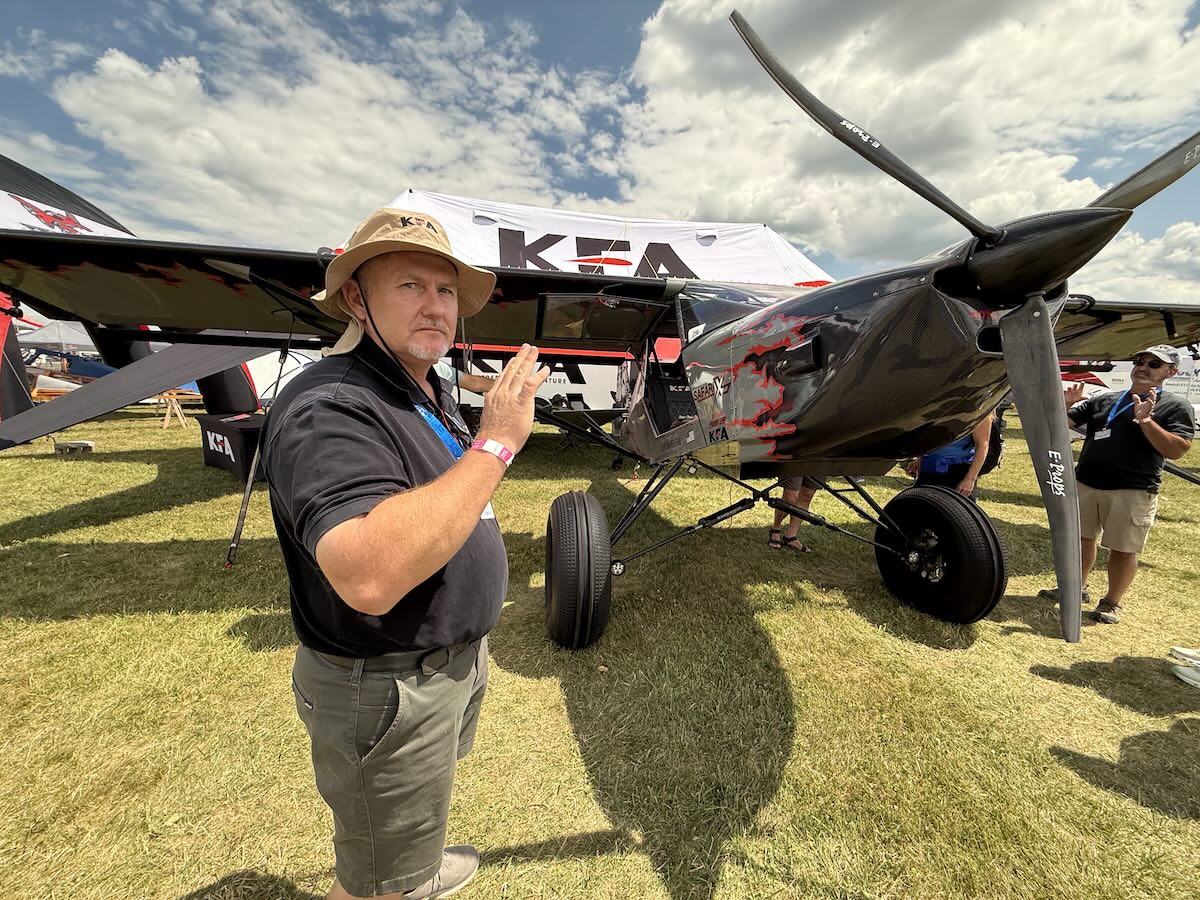 Stefan Coetzee, founder of KFA assuming a defensive stance against the relentless press. Just kidding—he was friendly and eager to talk about his airplanes.
Photo: Zane Jacobson
Stefan Coetzee, founder of KFA assuming a defensive stance against the relentless press. Just kidding—he was friendly and eager to talk about his airplanes.
Photo: Zane Jacobson
4 Unleaded Fuel: Swift 100R and G100UL
"G100UL stains and does not evaporate and I do not care for the turpentine smell. I have a mason jar of Swift 100R, and it does NOT stain, it evaporates and smells a bit better - like nail polish. I also found G100UL stains 16 - inches x 2 - inches wide aft of my oil breather on the belly. Took compound to remove."
More G100UL enviro gas issues
If you sit behind a high-compression or fuel-injected engine (Cessna 185 among them) the looming threat of 100LL going away might cause some restless nights. According to the sole global producer of TEL, Innotec in the United Kingdom, leaded avgas (100LL) is on its way out. Two unleaded replacements are competing to take its place: GAMI's G100UL and Swift Fuels' 100R.
Both fuels are meant to let existing piston engines run without lead, but they've taken different paths to approval. G100UL got to market first through the FAA's STC process (a per-aircraft approval you buy). Swift's 100R is going the industry-standard route—an ASTM specification (D8603), the same kind of blanket standard that lets any distributor stock and sell a fuel with confidence. At the show Swift touted its expanded approvals: roughly 1,200 engines and 1,600 airframes now covered. The ASTM approval is what gets a fuel into the truck that shows up at your home strip. G100UL doesn't have that yet.
Why are updates on this relevant? Field reports on G100UL have been rough—paint staining, and enough concern that some airframe makers have warned owners to avoid it. One airplane isn't a study, but our member's mason-jar test (link above) lines up with what others are seeing. And for our fleet specifically—old airframes with old fuel systems—the bigger issue with any new unleaded fuel is the "cleaning" effect. These fuels are stronger solvents than the leaded gas your airplane grew up on, so they can loosen thirty years of varnish and gunk and start finding leaks at old seals you never knew were weak. The usual weak points are old nitrile O-rings and tank sealant; the fix is upgrading to fuel-resistant Viton seals. None of this means unleaded is bad—it means if you fly something old, inspect your fuel system well before and after you switch.
5 Hartzell Frontier Prop for the Cessna 180
Hartzell showed off its new Frontier STC'd aluminum prop on the Cessna 180 with the O-470 (models A-J). It's an 88-inch, two-blade scimitar prop that the company says delivers up to a 5% improvement in ground roll, takeoff distance, and climb while keeping the Skywagon's prop-clearance profile.
As I understand, this is essentially the two-blade version of the much-acclaimed 3-blade Voyager that has become so popular with Skywagon owners. Recall that Hartzell continues to offer a $1,000 discount on backcountry propellers for RAF members and each qualifying propeller sold also comes with a $250 donation to the RAF.
 Despite the news, we couldn't find any cool two-blade props on the Hartzell static displays.
Photo: Zane Jacobson
Despite the news, we couldn't find any cool two-blade props on the Hartzell static displays.
Photo: Zane Jacobson
 Lovely wagon sporting what I assume to be a Voyager.
Photo: Zane Jacobson
Lovely wagon sporting what I assume to be a Voyager.
Photo: Zane Jacobson
6 uAvionix / ForeFlight SkyPlay Mini
uAvionix and ForeFlight showed off the new Sentry SkyPlay Mini, a 3 1/8" device that runs ForeFlight right in your instrument panel instead of only on your iPad. Most panels languishing with traditional six-packs have plenty of standard round 3-inch holes free after jettisoning the ones that have grown less useful (VSI?) and the SkyPlay Mini drops into that opening. No cutting up the panel, no $100K full avionics refresh, and it works in both certified aircraft and experimentals. It gives ForeFlight's moving map a permanent, hardwired home in the panel, with a knob instead of a touchscreen. For a bare-bones taildragger panel, that's a pretty clever option, and a clever market move, helping to more firmly entrench Foreflight users in their ecosystem. There's no price or firm ship date yet—units are expected to ship later this year.
 Sentry SkyPlay Mini
Photo: Zane Jacobson
Sentry SkyPlay Mini
Photo: Zane Jacobson
7 RAF's Fly Rocky Top—An Exciting New Destination
The RAF rolled out Fly Rocky Top, an entire network of strips in the eastern Tennessee mountains. Seven to start, built around a base at Rockwood (RKW), which itself features a paved runway plus a new 2,400-foot grass strip with camping and a pavilion in the works.
The list also includes Smuggler's Landing, McGraw's Backyard (5TN4), Robbin's Farm, and Tellico Plains (85TN). Sawbriar comes online in August 2026; Higdon Field is set to reopen.
 Flying over the sleeper backcountry paradise of eastern Tennessee.
Photo: Voortex Productions
Flying over the sleeper backcountry paradise of eastern Tennessee.
Photo: Voortex Productions
It's part of the RAF's bigger "Expanding the Map" push to open or reopen 15-plus strips starting in 2026, and the strips are already in the RAF Airfield Guide, so you can plan a trip down there right now. This is the thing to build your fall flying around.
 Tellico Plains (85TN), one of the Rocky Top close-by destinations.
Photo: Courtesy of RAF
Tellico Plains (85TN), one of the Rocky Top close-by destinations.
Photo: Courtesy of RAF
8 Wheels and Tires: Tubeless ACME, STOLWheelz, and More
"No valve stem to shear off. No worries about pinched tubes. Can run LOW pressures without worry of either of the above."
Tubeless tires
 Tubeless tires
Photo: Zane Jacobson
Tubeless tires
Photo: Zane Jacobson
If there was a theme running through the hard goods vendors this year, it was tubeless tire setups. For years, the Alaskan Bushwheels have ruled because they are a self-contained unit that can be run at super low pressure without concern for shearing the valve stem. But without the pressed donut design, what can we do to avoid paying $5K a pop? The answer is tubeless wheels, a sealed wheel half with integral valve stem, just like your modern car or (top tier) mountain bike. Several outfits are pushing the same idea from different directions: ditch the tube, run lower pressure, and maybe repurpose an existing offroad tire.
There is one caveat though—without the suppleness of the low-pressure bushwheel, where is the suspension that isolates airframes from rough ground? That's the thing—these large diameter wheel and tire setups do best on modern sophisticated shock systems with damping; maybe not so suited to a Cessna.
ACME Aero had their tubeless Bushmaster tires on billet wheels; STOLWheelz is offering lightweight UTV-style tubeless setups with beadlock options that let you jump to 35s economically; and Beringer rolled out new tubeless-ready wheels.
 Tubeless tires
Photo: Zane Jacobson
Tubeless tires
Photo: Zane Jacobson
Why it matters: a tube is the thing that fails when you run a big tire soft. Pinch it, or shear the valve stem when the tire creeps on the rim, and you're stranded off-airport. A sealed tubeless setup lets you run the low pressures that make big tires worth having—those baby-head-rock-absorbing 4 to 6 psi numbers—without the tube-related failures. The tradeoff is cost, and on some non-integrated designs the risk of a side hit unseating the bead, so it's worth understanding exactly how each brand seals. For the full rundown on sizes, wheels, and pressures, our own Tire Guide is the place to start.
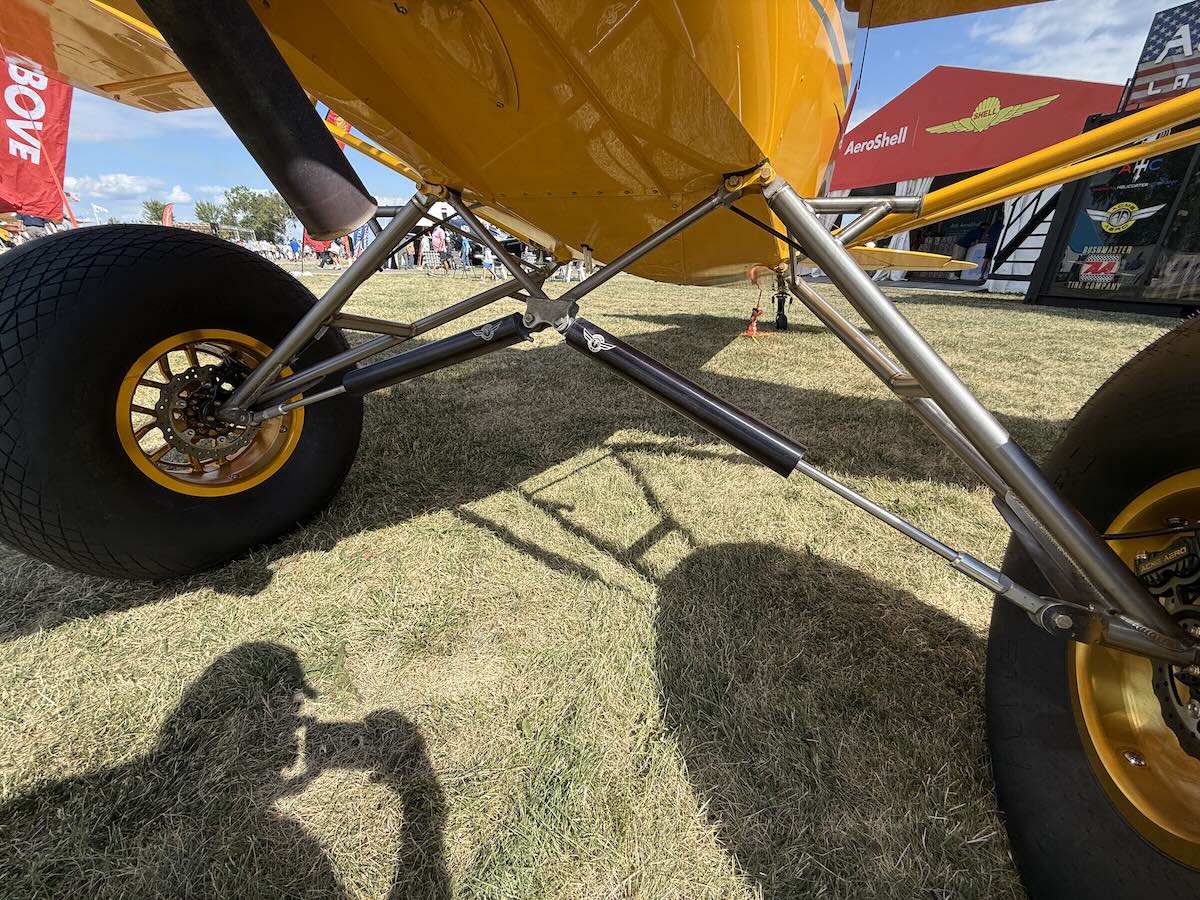 ACME had their setup on display, along with their titanium gear legs, pictured here.
Photo: Zane Jacobson
ACME had their setup on display, along with their titanium gear legs, pictured here.
Photo: Zane Jacobson
 Tubeless/ATV tire setup on the KFA Safari XL
Photo: Zane Jacobson
Tubeless/ATV tire setup on the KFA Safari XL
Photo: Zane Jacobson
9 Beringer 10" Wheels and Brakes for the Skywagon
Beringer had a whole wall of wheels, brakes, and their B'Flex landing gear, but the two that matter most for our crowd are new STOL wheel-and-brake packages. The 10" HE STOL is built for the Cessna 180/185 and Helio Courier, with a listed static load of 3,147 lbs per wheel, an RF-046 wheel running a 24x7.7" tubeless tire, and the EA-029 caliper. There's also a smaller 8" LE STOL aimed at the Zenair 750, ICP Ventura, KFA Safari XL, and RANS S21, rated at 1,617 lbs per wheel on a 27.5x10⁻⁸" tubeless tire.
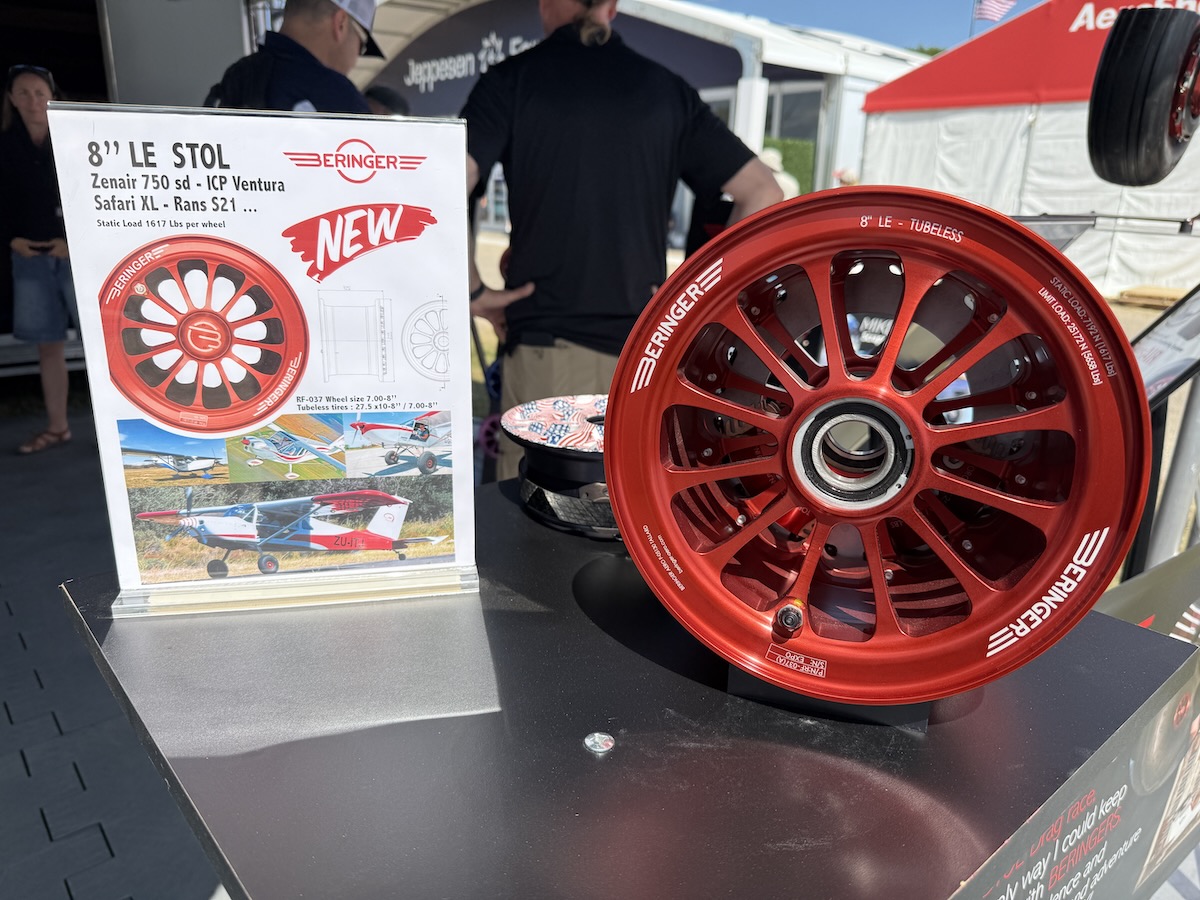 Beringer 8" Wheels and Brakes for mid-weight experimentals
Photo: Zane Jacobson
Beringer 8" Wheels and Brakes for mid-weight experimentals
Photo: Zane Jacobson
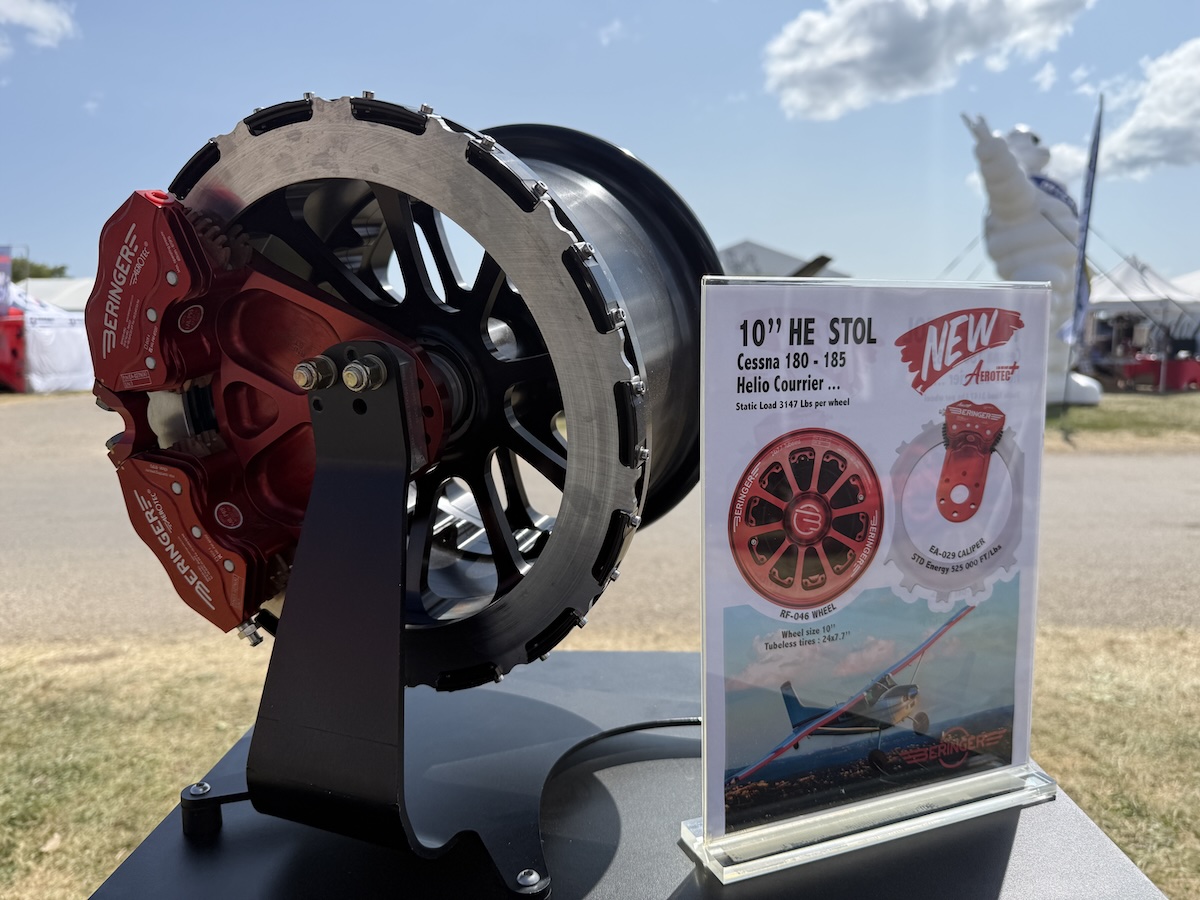 Beringer 10" Wheels and Brakes for the Skywagon and Helio Courier
Photo: Zane Jacobson
Beringer 10" Wheels and Brakes for the Skywagon and Helio Courier
Photo: Zane Jacobson
For Skywagon owners this is a real alternative to the usual heavy-duty-brake path when moving to big tires, and is an alternative to the Grove 10" if you're interested in running the big Desser tires. Beringer's pitch is that you get their braking performance and a tubeless wheel in one engineered package rather than cobbling components together. This is a full brake-and-wheel conversion, so factor in the cost and confirm the STC or field-approval path for your specific airframe before you commit. For a 180/185 owner eyeing big tires, it's a strong option to weigh against the Cleveland-plus-Bushwheel route a lot of us are familiar with. And it just looks beautiful.
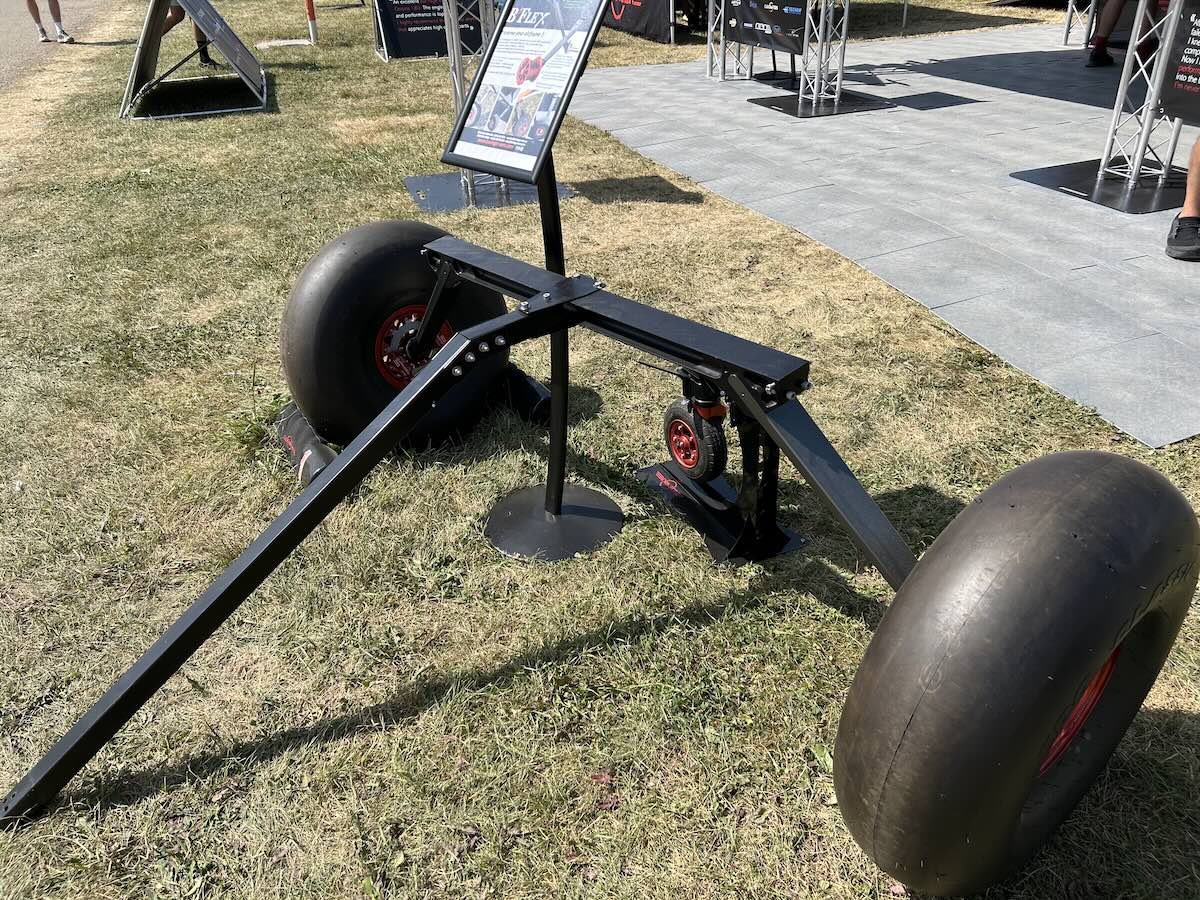 B Flex
Photo: Zane Jacobson
B Flex
Photo: Zane Jacobson
10 CubCrafters Carbon Cub ULT
CubCrafters hung a FADEC-controlled turbine—TurboTech's TP-R90—on a Carbon Cub and called it the ULT: 130-plus mph cruise, 682-mile range, off the ground in 50 feet, burning Jet-A. It's reportedly the first U.S.-built turboprop a Sport Pilot can legally fly under MOSAIC.
 CubCrafters Carbon Cub ULT
Photo: Zane Jacobson
CubCrafters Carbon Cub ULT
Photo: Zane Jacobson
The ULT carries a 1,865-lb gross weight with an estimated 985-lb useful load and 44 gallons of fuel, good for about 5.2 hours of endurance. Claimed stall speed is 32 mph and landing distance 90 feet, so it keeps the short-field manners the Carbon Cub is known for while adding turbine muscle. The Jet-A angle may align with a new reality—the growing uncertainty of 100LL (see the fuel section below)—so this could be one solution (just remember that Jet-A weighs 6.68 lbs/gallon in your W&B.) Push-button start and single-lever thrust mean there's no prop or mixture to manage in the pattern or off a gravel bar. And this thing will turn heads from the sound. Fun.
 CubCrafters Carbon Cub ULT
Photo: Zane Jacobson
CubCrafters Carbon Cub ULT
Photo: Zane Jacobson
There's no price yet. First deliveries are projected for 2027, with deposits being taken now. More at CubCrafters, or read Flying's writeup.
 CubCrafters Carbon Cub ULT
Photo: Zane Jacobson
CubCrafters Carbon Cub ULT
Photo: Zane Jacobson
11 Velo X Velocitor X-1: A Single-Seat Personal eVTOL
Maybe not exactly a traditional backcountry aircraft, but given the explosion of eVTOL vehicles in the last few years, you can bet we'll see them out there at some point. Enter the Velo X Aerospace Velocitor X-1, a single-seat electric VTOL billed as "the ultimate personal eVTOL." Eight motors on four arms let it lift straight off the ground and hover on GPS like a helicopter. Listed numbers: 70-plus mph cruise, 45 minutes flight time plus a 15-minute reserve, a ballistic parachute deployable at 50 AGL, and lidar obstacle detection. It's built around one person having fun via the MOSAIC/Part 103 path. Pre-orders are open ($5,000 deposit, first run of 100) at around $156,000, with 2027 production targeted. Prototype-stage, so plenty could change—but it stopped a lot of people. More at Velo X Aerospace.
 Velo X Aerospace
Photo: Zane Jacobson
Velo X Aerospace
Photo: Zane Jacobson
12 BRC Frontier Floats with Z-Drive
BRC of Alberta, Canada was at the show with their Frontier Floats equipped with the patented Z-Drive, solving an old floatplane headache—maneuvering on the water at idle. The Z-Drive is a jet pump built right into the float, drawing water in and pushing a straightened jet out for thrust, so you can position the airplane at the dock or in current more easily. Many of us who have spent hours working on our old-fashioned docking may scoff, but this could be really cool, and a game changer for working in current. Details at BRC Aircraft.
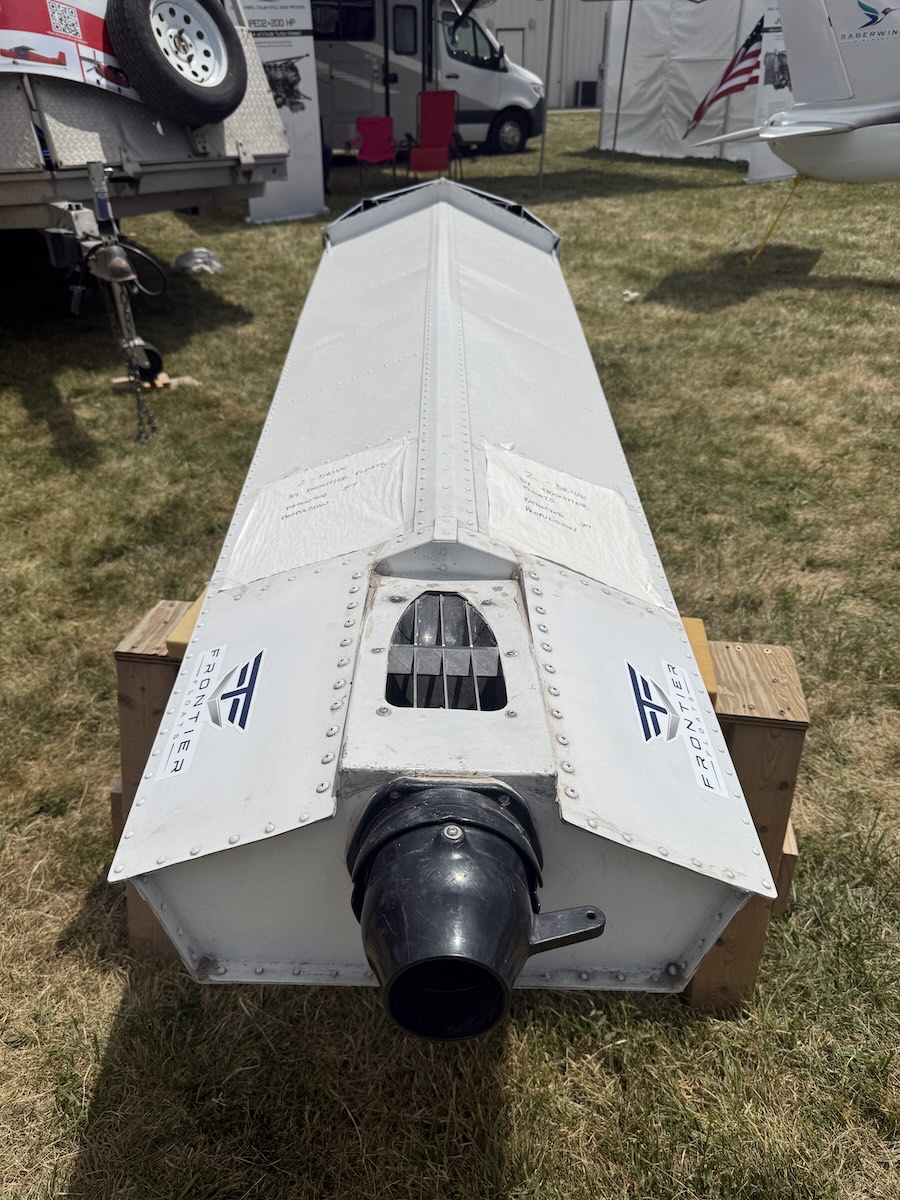 Velo X Aerospace
Photo: Zane Jacobson
Velo X Aerospace
Photo: Zane Jacobson
13 The Seized Stinson: A Pilot's Emergency-Landing Fight
We walked to the AOPA booth and saw a 1946 Stinson 108 parked on a trailer. I immediately recognized the aircraft. On October 15, 2025, Minnesota pilot Darrin Smedsmo was flying from Roseau to Bemidji when his engine failed over Lower Red Lake. He put it down safely on State Highway 89—a textbook emergency landing—only to have the aircraft seized by Red Lake Nation authorities, who cited a 1978 tribal resolution banning flight below 20,000 feet over the reservation. The airplane sat impounded for more than seven months.
Smedsmo contacted AOPA, and the association—along with the Minnesota Pilots Association and several legislators—pushed the case all the way to the Departments of Transportation and Interior, arguing that airspace is exclusively federal territory and that penalizing a safety-driven emergency landing sets a dangerous precedent. After federal pressure, the aircraft was returned and all charges dropped on June 3, 2026. AOPA's full account of the resolution is here.
 Darrin Smedsmo's 1946 Stinson 108, on display at AirVenture after a seven-month impoundment that took federal intervention to resolve.
Photo: Zane Jacobson
Darrin Smedsmo's 1946 Stinson 108, on display at AirVenture after a seven-month impoundment that took federal intervention to resolve.
Photo: Zane Jacobson
14 The Boss 182 Floatplane
Over at the EAA Seaplane Base, it's an entirely different world set at a sheltered lagoon on Lake Winnebago. With exhibitor presence from the likes of Aerocet and Wipaire, it's definitely a mellower scene than the main show grounds. One prominent aircraft in attendance was Wipaire's "Boss 182"—an STC conversion that utilizes a Lycoming IO-580, pumping out 315-340 hp (the upper end resulting from a LyCon tune.) Despite this information from their website, the sticker on the cowling says "350HP".
If you don't quite have a sense for the usual powerplant pairings on a Cessna 182 (230-260hp), that is an ENORMOUS amount of power for an airplane that likely weighs around 1800 lbs. The STC gives it a gross weight increase to between 3,370-3,500 lbs, putting it solidly in the realm of the 185's performance.
 The Wipaire Boss 182
Photo: Zane Jacobson
The Wipaire Boss 182
Photo: Zane Jacobson
A note on independence: BackcountryPilot.org covers products on editorial merit, based on what we think matters to backcountry pilots. Some companies mentioned here are site advertisers.