Like many mentioned before, when flying VFR the pilot's main focus should be looking outside and not being occupied inside the cockpit. Looking at some of the cockpit pictures on this forum, I can't believe how cluttered and disorganized some cockpits are with gadgets. They sure must be distracting. Of course it must be good to have a GPS mounted, backed up with a mounted ipad and the ipad backed-up by an iphone or second ipad because someone could get lost on the 100 mile VFR flight from his home airport (I am sarcastic here). In my opinion a single engine VFR aircraft cockpit should be setup as simple and functional as possible to keep instrument scan time to a minimum. Obviously most single engine VFR aircraft are designed to be safely flown to a landing without any instrumentation.
I am sure we might see regulation in the not so far future which and how aftermarket gadgets are legal to be mounted and operated in an aircraft as we are seeing now with motor vehicles where phone use and texting is prohibited (at least where I live) as their distraction is becoming a main cause for accidents on the roads.
Midair Cirrus SR22 & R44
Wed Oct 29, 2014 9:48 am
Wed Oct 29, 2014 11:44 am
Re: Midair Cirrus SR22 & R44
Pusher wrote:Like many mentioned before, when flying VFR the pilot's main focus should be looking outside and not being occupied inside the cockpit. Looking at some of the cockpit pictures on this forum, I can't believe how cluttered and disorganized some cockpits are with gadgets. They sure must be distracting. Of course it must be good to have a GPS mounted, backed up with a mounted ipad and the ipad backed-up by an iphone or second ipad because someone could get lost on the 100 mile VFR flight from his home airport (I am sarcastic here). In my opinion a single engine VFR aircraft cockpit should be setup as simple and functional as possible to keep instrument scan time to a minimum. Obviously most single engine VFR aircraft are designed to be safely flown to a landing without any instrumentation.
I am sure we might see regulation in the not so far future which and how aftermarket gadgets are legal to be mounted and operated in an aircraft as we are seeing now with motor vehicles where phone use and texting is prohibited (at least where I live) as their distraction is becoming a main cause for accidents on the roads.
As the one who (as far as I know) has taken the most good natured ribbing about my panel here, let me explain it just a little. It's not nearly as distracting to me, as it might appear to others.
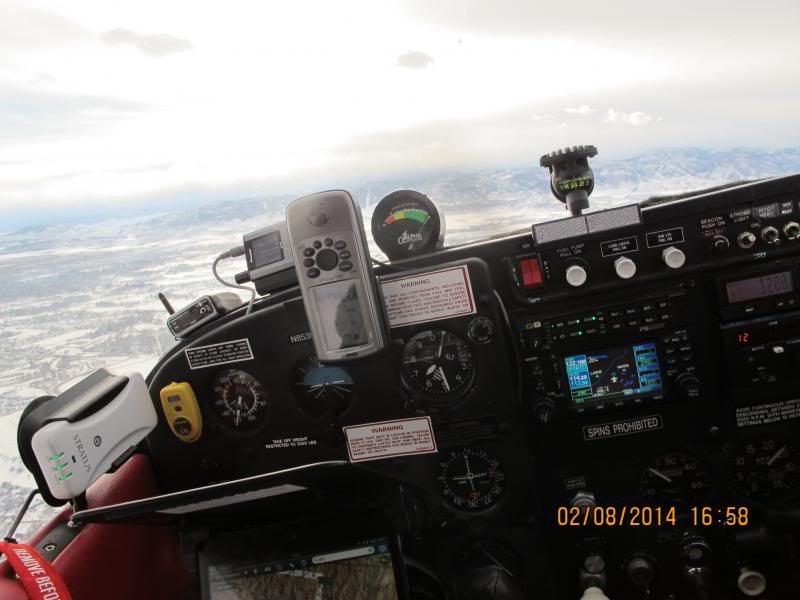
Starting on the left:
*The Stratus II has nothing to look at, other than the lights to tell that it's working. It provides ADS-B in information, including weather and some traffic.
*The yellow CO detector has a screen, but I would only likely look at it if the alarm and red light on the top activated.
*Above that is a traffic detector made by Accu-check (they've gone out of business) which lights only when a transponder is detected within a 5 mile range. Believe me that if it lights most of its lights, I'm looking hard outside!
*To its right is an XM radio, listen only, for music while on cross countries. The only time I look at it is if I change channels, and that's rare. I turn it off altogether within 7 or 8 miles of my destination airport.
*Next is a Garmin 96C, my first aviation GPS, which I've had for about 10 years and still use as a back-up on cross countries because I like its moving map. Although I turn it on when I turn on the other avionics, I rarely look at it except on cross countries.
*Next is the Alpha Systems angle of attack indicator. That's been there almost 5 years now, and I do glance at it during nearly every final approach leg--makes for much slower approach speeds when lightly loaded, among other things. I ignore it in cruise or in the pattern until slowing on base, as it doesn't tell me anything.
*Next is a SIRS compass, which based on advice from others on this forum, I purchased to replace my failing original Airpath. They were right--it's about the most trouble-free and accurate magnetic compass available.
*Below the compass is a double compass deviation card, the left side for normal use, the right when the pitot heat and AOA heat are turned on.
Let me say here that none of the items on top of the panel block my view in normal flight--a shorter pilot might have that problem.
On the yoke is my iPad Mini running Foreflight Pro, which I use in lieu of a chart now. As mentioned, it provides weather and some traffic now, through the Stratus II ADS-B in receiver. I don't look at it any more often than I formerly looked at charts, and it sure has cut down on cockpit clutter. I suspect I will look at it more often once I have ADS-B out, which will give me more ADS-B in information, especially traffic.
In the center of the panel is the PSE audio panel and 430W.
Not showing is a bracket for my iPhone, which I mount to the left of the 96C in IFR conditions, which provides a back-up AI running off the AHRS of the Stratus II.
The MP and tach are below the radios.
Now let's look at the right side of the panel (picture taken before the Airpath was replaced with the SIRS).

*The transponder and the Narco nav/com are to the right of the audio panel and 430W.
*The first gauge to the right is the vacuum gauge.
*To its right is a digital EI fuel flow gauge/totalizer.
*Below the vacuum gauge is the switch for the 406 ELT.
*Next to it is the Insight G1 engine analyzer.
*To its right is a digital EI volt/amp meter.
*Below those is the standard Cessna fuel, oil pressure, and oil temp gauges.
*Below all of the gauges is the King ADF. The head for it is on the lower left of the pilot side panel, not visible in either picture but easily visible to the pilot.
So maybe there's a lot more there than in the typical 172 panel, but it's all usable stuff, depending on the purpose and characteristics of the flight. When I fly VFR, I'm looking outside most of the time. I briefly look at the flight gauges and the engine instruments, as we all should. When I'm flying IFR and in IMC, I do spend most of my time looking inside.
Cary
"I have slipped the surly bonds of earth..., put out my hand and touched the face of God." J.G. Magee
Wed Oct 29, 2014 11:50 am
Re: Midair Cirrus SR22 & R44
contactflying wrote:Wait! Does training trump technology here too?
I'm afraid not.
The "Make the panel larger to stuff more TV screens in with flashing lights and loud alarm sounds and when all else fails because we're completely overwhelmed by it all so pull the red handle on the ceiling to float to safety" crowd is the new norm, and the FAA and manufacturers new target group for pilots.
I love new gadgets. They're magic. But instead of pilotage and folks actually needing to look out and pay attention to where they are, and where they're going so they don't get lost, it's all GPS. Which means the average Joe is now flying IFR, without the protection of being in the IFR system, and concentration on the TV screens and not see-and-avoid.
Hopefully those of us playing in the dirt and avoiding going where we got to talk to anyone, can still go out and enjoy basic by the seat of the pants flying for a bit longer. Got a feeling our grandkids aren't going to have that freedom for much longer though....
(I need one of those beat a dead horse smiley things
 )
)Gump
Wed Oct 29, 2014 1:17 pm
Re: Midair Cirrus SR22 & R44
Cary
Thanks for the reply. This is just my opinion, so please take it for what it is and don't take it personal. Yes your panel is one of the panels I am talking about. You have 3 GPS (including your ipad) with nav data displayed. You do not think this is overkill? I am sure all the equipment you installed is for safety purposes. However, less is sometimes more. NASA, Boeing and Airbus studied a lot of accidents and incidents to replace the traditional 6 packs aircraft had at that time. What they found out is that it was important to simplify how information is displayed to the pilot and can be viewed/scanned easily, to unclutter the instrument panel. They came up with the glass cockpit. The findings of these studies apply to any panel design, regardless of VFR or IFR; display all information in such a way that the pilot can focus on the main task "fly the airplane".
Technology is all fine and great, however when shit hits the fan it comes back to the basic principles, aviate, navigate and communicate. Unfortunately more and more pilots rely on technology and forget about the basics.
Thanks for the reply. This is just my opinion, so please take it for what it is and don't take it personal. Yes your panel is one of the panels I am talking about. You have 3 GPS (including your ipad) with nav data displayed. You do not think this is overkill? I am sure all the equipment you installed is for safety purposes. However, less is sometimes more. NASA, Boeing and Airbus studied a lot of accidents and incidents to replace the traditional 6 packs aircraft had at that time. What they found out is that it was important to simplify how information is displayed to the pilot and can be viewed/scanned easily, to unclutter the instrument panel. They came up with the glass cockpit. The findings of these studies apply to any panel design, regardless of VFR or IFR; display all information in such a way that the pilot can focus on the main task "fly the airplane".
Technology is all fine and great, however when shit hits the fan it comes back to the basic principles, aviate, navigate and communicate. Unfortunately more and more pilots rely on technology and forget about the basics.
Wed Oct 29, 2014 3:07 pm
Re: Midair Cirrus SR22 & R44
GumpAir wrote:contactflying wrote:Wait! Does training trump technology here too?
I'm afraid not.
The "Make the panel larger to stuff more TV screens in with flashing lights and loud alarm sounds and when all else fails because we're completely overwhelmed by it all so pull the red handle on the ceiling to float to safety" crowd is the new norm, and the FAA and manufacturers new target group for pilots.
I love new gadgets. They're magic. But instead of pilotage and folks actually needing to look out and pay attention to where they are, and where they're going so they don't get lost, it's all GPS. Which means the average Joe is now flying IFR, without the protection of being in the IFR system, and concentration on the TV screens and not see-and-avoid.
Hopefully those of us playing in the dirt and avoiding going where we got to talk to anyone, can still go out and enjoy basic by the seat of the pants flying for a bit longer. Got a feeling our grandkids aren't going to have that freedom for much longer though....
(I need one of those beat a dead horse smiley things
Gump

You're welcome.
Thu Oct 30, 2014 12:49 pm
Re: Midair Cirrus SR22 & R44
Planes are falling out of the sky now for largely the same reasons they were falling out of the sky 30 years ago. I don't think a cluttered cockpit is to blame. Most planes flying are busier on the panel than Cary's plane. And if forgetting "the basics" is really at fault, then I'd hazard a guess that they must have been the case 30 years ago too.
I do like the comments about being able to see traffic. I thought I was pretty good at spotting traffic. Until I flew with a PCAS unit the first time.
I was seeing maybe 1/2 the traffic around me without it in busy airspace. Passengers were finding others. I was finding traffic for other pilots. I don't know anyone who can honestly say they are masters of their domain in this area. It's easy to be smug when you don't know what you are missing.
Midairs vs age occur fairly closely with the distribution of age of pilots...but there is a noticeable increase that I think might have a bit to do with vision. I don't have the 20/10 or better vision I had in my teens or 20's. I do have to try quite a bit harder and use blind area techniques to improve my success. Kids are often the pros at finding traffic because (dang it) they still DO have 20/10 or better vision.
I do like the comments about being able to see traffic. I thought I was pretty good at spotting traffic. Until I flew with a PCAS unit the first time.
I was seeing maybe 1/2 the traffic around me without it in busy airspace. Passengers were finding others. I was finding traffic for other pilots. I don't know anyone who can honestly say they are masters of their domain in this area. It's easy to be smug when you don't know what you are missing.
Midairs vs age occur fairly closely with the distribution of age of pilots...but there is a noticeable increase that I think might have a bit to do with vision. I don't have the 20/10 or better vision I had in my teens or 20's. I do have to try quite a bit harder and use blind area techniques to improve my success. Kids are often the pros at finding traffic because (dang it) they still DO have 20/10 or better vision.
Thu Oct 30, 2014 6:45 pm
Re: Midair Cirrus SR22 & R44
In this crash, the R44 driver that climbed up into the Cirrus was 27 years old. And the other recent mishap, age was about the same. Eyesight had absolutely nothing to do with it, other than not using said eyesight.
Gump
Gump
Thu Oct 30, 2014 7:02 pm
Re: Midair Cirrus SR22 & R44
GumpAir wrote:In this crash, the R44 driver that climbed up into the Cirrus was 27 years old. And the other recent mishap, age was about the same. Eyesight had absolutely nothing to do with it, other than not using said eyesight.
I wonder if it's possible that the R44 was pointed away from the Cirrus and thus unable to see him approach from behind. While, at the same time, maybe climbing from below the Cirrus so in the Cirrus' blind spot below the nose?
- rw2 offline
- Posts: 1799
- Joined: Sat Dec 22, 2012 1:10 pm
- Location: San Miguel de Allende
- FindMeSpot URL: https://share.delorme.com/LaNaranjaDanzante
- Aircraft: Experimental Maule
Follow my Flying, Cooking and Camping adventures at RichWellner.com
Thu Oct 30, 2014 7:12 pm
Re: Midair Cirrus SR22 & R44
It'll be interesting to see what the investigation shows. The helicopter had two commercial pilots and a third person aboard. And, tower instructed the Cirrus driver to maintain pattern altitude until turning base, after the Cirrus reported only two of three helos in the pattern in sight.
Gut feeling, and past personal experience with helicopters climbing steeply right at me while in the pattern, tells me the Cirrus driver probably got blindsided from directly below, or behind and below. When I talked to the pilots later in my incidents, they apologized, and admitted to not looking and not realizing I was above when they lifted off. Both times it happened, I was watching them like a hawk because they weren't talking on the radio and I didn't trust them. These did not happen at a towered field though.
In the Cirrus/R44 deal it'll be interesting to see who was where when the investigation gets published. Somebody climbed or descended without looking, and were where they shouldn't have been.
Gump
Gut feeling, and past personal experience with helicopters climbing steeply right at me while in the pattern, tells me the Cirrus driver probably got blindsided from directly below, or behind and below. When I talked to the pilots later in my incidents, they apologized, and admitted to not looking and not realizing I was above when they lifted off. Both times it happened, I was watching them like a hawk because they weren't talking on the radio and I didn't trust them. These did not happen at a towered field though.
In the Cirrus/R44 deal it'll be interesting to see who was where when the investigation gets published. Somebody climbed or descended without looking, and were where they shouldn't have been.
Gump
Thu Oct 30, 2014 7:49 pm
Re: Midair Cirrus SR22 & R44
We who operate non-standard, like helicopters, are supposed to stay well below and not on any centerline extended. 500' is suggested, but I never wanted to be above 200.' It just ain't safe in a congested area.
- contactflying offline
- Posts: 4972
- Joined: Wed Apr 03, 2013 7:36 pm
- Location: Aurora, Missouri 2H2
Download my free "https://tinyurl.com/Safe-Maneuvering" e-book.
Sat Nov 01, 2014 2:41 pm
Re: Midair Cirrus SR22 & R44
Thinking through my own practices on keeping the eyes outside of the cockpit, how often/when do you all scan the gauges?
Sat Nov 01, 2014 3:52 pm
Re: Midair Cirrus SR22 & R44
Titus577 wrote:Thinking through my own practices on keeping the eyes outside of the cockpit, how often/when do you all scan the gauges?
Titus,
When cruising along, well away from airports, scanning is fine. When you're close to an airport, that's when everything flying tends to converge on one point, roughly. And, that's where you REALLY need to have your A game going as far as searching for other traffic, and paying careful attention to traffic calls, assuming you have a radio.
At that point, say within seven miles or so of an airport, scanning gauges really isn't all that important. You need to start slowing, of course, but a quick glance at the airspeed instrument takes a tiny bit of time. But, if your oil pressure suddenly drops to zero, you're headed toward the airport anyway, right? So, much of the information on the panel is really optional at this point.....at least it can generally wait.
Away from an airport, the likelihood of a midair is lower. Not zero, mind you. Probably the closest I've ever come to another airplane in flight was high over Kodiak on a stone clear day in the spring. This was during the sac roe herring season, when dozens of herring spotter airplanes descend on the island, thrashing around in circles all looking straight down for fish. So, since the weather was beautiful, I climbed up to 6500 feet to clear all the terrain and was motoring along happily, when suddenly, a Cessna 206 appeared just to my left, crossing right in front of me. He was REALLY close, like 50 feet close. He'd been behind the door post of the Beaver I was in, and had stayed there till really close. We both saw each other at almost exactly the same time.
Back in town, we got together and tried to figure that one out. Turns out we were both up high, which we normally would never have been, for the same reason....to reduce the likelihood of a mid air with a herring spotter......duh.
In retrospect, there's no way either of us could probably have avoided that near miss. I'm pretty sure he was behind my door post, so maneuvering, I might have found him. I was behind his right side door post, and he had no pax, so nobody in the right seat who may have seen me. It was just the perfect storm of what could have been, but just barely wasn't.
I go on VERY high alert around airports. I don't believe ANY position reports except mine.....you hear pilots reporting "over the airport at .... feet", and you look, and look, and finally you find the jackass still two miles from the airport, etc.
High alert around airports, and that includes remote landing sites.
Helicopters just ain't natural....they move in directions that are just not right. So, keep a REALLY good eye on them. The good news is that most helicopter pilots are really sharp and pretty professional. There's a few jerks out there, but in my career, I always found the helicopter guys the easiest to get along with, and the most professional.
MTV


Sat Nov 01, 2014 4:09 pm
Re: Midair Cirrus SR22 & R44
I check the gauges when not involved in takeoff, landing, or in a congested area. The best place to check the gauges is before takeoff and well before starting down toward or getting close to an airport or congested area.
Integration of contact and instrument flying techniques have led to poor contact flying and a private pilot flight test that could be accurately termed a basic instrument flight test.
There is nothing wrong with learning to fly by reference to instruments. The is something wrong with flying around in congested areas in VMC as if we were in IMC.
This poor contact flight training is not the pilots fault. It is the fault of an instrument heavy training culture.
Integration of contact and instrument flying techniques have led to poor contact flying and a private pilot flight test that could be accurately termed a basic instrument flight test.
There is nothing wrong with learning to fly by reference to instruments. The is something wrong with flying around in congested areas in VMC as if we were in IMC.
This poor contact flight training is not the pilots fault. It is the fault of an instrument heavy training culture.
- contactflying offline
- Posts: 4972
- Joined: Wed Apr 03, 2013 7:36 pm
- Location: Aurora, Missouri 2H2
Download my free "https://tinyurl.com/Safe-Maneuvering" e-book.
Sat Nov 01, 2014 11:15 pm
'74 7GCBC, 26" ABW, Aera 660 feeding G5 and FC-10 FF.
Sun Nov 02, 2014 9:55 am
Re: Midair Cirrus SR22 & R44
Pusher wrote:Cary
Thanks for the reply. This is just my opinion, so please take it for what it is and don't take it personal. Yes your panel is one of the panels I am talking about. You have 3 GPS (including your ipad) with nav data displayed. You do not think this is overkill? I am sure all the equipment you installed is for safety purposes. However, less is sometimes more. NASA, Boeing and Airbus studied a lot of accidents and incidents to replace the traditional 6 packs aircraft had at that time. What they found out is that it was important to simplify how information is displayed to the pilot and can be viewed/scanned easily, to unclutter the instrument panel. They came up with the glass cockpit. The findings of these studies apply to any panel design, regardless of VFR or IFR; display all information in such a way that the pilot can focus on the main task "fly the airplane".
Technology is all fine and great, however when shit hits the fan it comes back to the basic principles, aviate, navigate and communicate. Unfortunately more and more pilots rely on technology and forget about the basics.
Not taking it personal, but like my explanations of each of the items indicates, some of that stuff has nothing to stare at, and I don't stare at much of the rest of it except during IFR flight in IMC.
As for the GPS redundancy, there's only one IFR-certified GPS there. I was reluctant to get rid of the much older 96C handheld until I got comfortable with the 430W, and I do like its moving map better. I admit that the GPS in the iPad is handy for seeing where exactly I am on the chart, and geo-referencing is really great during instrument approaches for situational awareness. Redundant, yes to some extent, but really they serve different purposes--and again, I'm not inclined to stare at them in lieu of looking out the window.
I'm not a panel-watcher. When I instructed, one of my "tools" was a dish towel, to drape over the panel when a student tended to watch the gauges too much. I think in almost 42 years of flying, I've developed a reasonable ability to feel the airplane. But I gotta admit, I do like gadgets!
Cary
"I have slipped the surly bonds of earth..., put out my hand and touched the face of God." J.G. Magee
Sun Nov 02, 2014 10:26 am
Re: Midair Cirrus SR22 & R44
Fly like the FAA is videoing you!
Fly like your CFI taught you!
If you are 2-3 miles from an airport and you are at an altitude where you could encounter another aircraft keep your eyes outside the plane and your head on a swivel!
I tell my passengers to look outside, and if they see a plane say "PLANE and POINT" I tell them saying I see a plane over there doesn't work. POINT!!! If it is a long ways away talk very calm. If it is about to hit us YELL!!!!
I also tell them in very serious terms. YOU HAVE AS MUCH TO LOOSE AS I DO IF WE HAVE A MID AIR COLLISION!!!
My gut tells me this will take care of 95% of mid air collisions.
Cheers...Rob
Fly like your CFI taught you!
If you are 2-3 miles from an airport and you are at an altitude where you could encounter another aircraft keep your eyes outside the plane and your head on a swivel!
I tell my passengers to look outside, and if they see a plane say "PLANE and POINT" I tell them saying I see a plane over there doesn't work. POINT!!! If it is a long ways away talk very calm. If it is about to hit us YELL!!!!
I also tell them in very serious terms. YOU HAVE AS MUCH TO LOOSE AS I DO IF WE HAVE A MID AIR COLLISION!!!
My gut tells me this will take care of 95% of mid air collisions.
Cheers...Rob
- OregonMaule offline

- Posts: 6977
- Joined: Fri Sep 01, 2006 9:44 pm
- Location: Orygun
My SPOT page
"They who can give up essential liberty to obtain a little temporary safety, deserve neither liberty nor safety". Ben Franklin
http://en.wikiquote.org/wiki/Benjamin_Franklin
"They who can give up essential liberty to obtain a little temporary safety, deserve neither liberty nor safety". Ben Franklin
http://en.wikiquote.org/wiki/Benjamin_Franklin
Mon Nov 03, 2014 4:31 pm
Re: Midair Cirrus SR22 & R44
Cary wrote:...On the yoke is my iPad Mini running Foreflight Pro, .... and it sure has cut down on cockpit clutter.
That's friggin hilarious!!!
- Barnstormer offline
- Posts: 2700
- Joined: Sun Oct 14, 2012 7:42 am
- Location: Alaska
- Aircraft: C185
Thu Nov 06, 2014 9:04 am
Re: Midair Cirrus SR22 & R44
What is the evolution of our not really believing aircraft are out there? If we consider the exposure, either in hours or cycles, we are less likely to collide with another automobile (per million hours or cycles) than with another aircraft. Now consider the training. Are we ever given any reason to believe that focus on the electronics is more important than focus on the road? On the drivers test, are headings emphasized more than contact driving?
Yes, automation will come to autos, just as it now controls many aircraft. But complete control of the system will probably come first. In aviation, we train integration of contact and instrument flying. This better prepares us for full automation. Until that happens, Positive Control Airspace to the surface, there will be a bad mix around airports where everyone is legally operating in VFR. Yes, an IFR flight plan helps us get into congested areas in VMC. But we are legally, and skin and tinally, VFR.
Until full automation comes, and VFR flight is outlawed with maneuvering flight, I think we need to train sterile cockpit (nothing showing) contact flying. I think contact flying should be separate from and not integrated with instrument (reference mostly to instruments) flying. I think the dual cross country and first solo cross country should be at 500' AGL, where the student can actually see things on the earth and the shapes of things on the horizon. Muscle memory is easier to develop early in training rather than later. And from that low altitude he will see every aircraft out there (no ground clutter.) I think pure contact flying training would help develop the muscle memory that there really are aircraft out there. If a pilot believes another aircraft is on a collision course with him, he will more likely see all other aircraft in the area.
I am an instrument instructor and believe IFR is the safest way to fly. I am also a contact flying instructor and believe flight by reference to terrain and man-made structures is legitimate and rewarding. I just believe that trying to combine, integrate, the two is dangerous in a see and avoid world.
Yes, automation will come to autos, just as it now controls many aircraft. But complete control of the system will probably come first. In aviation, we train integration of contact and instrument flying. This better prepares us for full automation. Until that happens, Positive Control Airspace to the surface, there will be a bad mix around airports where everyone is legally operating in VFR. Yes, an IFR flight plan helps us get into congested areas in VMC. But we are legally, and skin and tinally, VFR.
Until full automation comes, and VFR flight is outlawed with maneuvering flight, I think we need to train sterile cockpit (nothing showing) contact flying. I think contact flying should be separate from and not integrated with instrument (reference mostly to instruments) flying. I think the dual cross country and first solo cross country should be at 500' AGL, where the student can actually see things on the earth and the shapes of things on the horizon. Muscle memory is easier to develop early in training rather than later. And from that low altitude he will see every aircraft out there (no ground clutter.) I think pure contact flying training would help develop the muscle memory that there really are aircraft out there. If a pilot believes another aircraft is on a collision course with him, he will more likely see all other aircraft in the area.
I am an instrument instructor and believe IFR is the safest way to fly. I am also a contact flying instructor and believe flight by reference to terrain and man-made structures is legitimate and rewarding. I just believe that trying to combine, integrate, the two is dangerous in a see and avoid world.
- contactflying offline
- Posts: 4972
- Joined: Wed Apr 03, 2013 7:36 pm
- Location: Aurora, Missouri 2H2
Download my free "https://tinyurl.com/Safe-Maneuvering" e-book.
Thu Nov 06, 2014 1:57 pm
Re: Midair Cirrus SR22 & R44
Zzz wrote:It's been funny, and a little sad at times, to see the attitudes and reception that this technology gets in aviator circles over the last 20 years. The attitude somehow focusing on the irony of a safety device influencing risktaking.
Welcome to the world.

Take a look at the phase-in of ABS braking... the studies all agree - in the long run, motorists just learn to drive more dangerously and the rate of braking-related accidents remains about the same.
That's human nature.
Thu Nov 06, 2014 2:38 pm
Re: Midair Cirrus SR22 & R44
Battson wrote:Zzz wrote:It's been funny, and a little sad at times, to see the attitudes and reception that this technology gets in aviator circles over the last 20 years. The attitude somehow focusing on the irony of a safety device influencing risktaking.
Welcome to the world.
Take a look at the phase-in of ABS braking... the studies all agree - in the long run, motorists just learn to drive more dangerously and the rate of braking-related accidents remains about the same.
That's human nature.
Interesting. In the US ABS did reduce accident rates. Fatal rates stayed about the same, but overall rates were down 6-8%, which is a fair number. Soure: http://www-nrd.nhtsa.dot.gov/Pubs/811182.pdf
tl;dr Overall rates were down 6-8%. The cost of ABS for the entire automotive fleet is about $6.5B a year. The annual savings from avoided wrecks if $6-8B per year. So they are effectively only a break even item purely economically (i.e. without factoring in pain and suffering).
- rw2 offline
- Posts: 1799
- Joined: Sat Dec 22, 2012 1:10 pm
- Location: San Miguel de Allende
- FindMeSpot URL: https://share.delorme.com/LaNaranjaDanzante
- Aircraft: Experimental Maule
Follow my Flying, Cooking and Camping adventures at RichWellner.com
DISPLAY OPTIONS
Who is online
Users browsing this forum: No registered users and 1 guest
Latest Features
-
Live to Tell
A Minnesota pilot is surprised to learn that the sudden asymmetric drag of an out-of-rig ski can…Read More -
Creators
Working in some of the Yukon's most beautiful and remote environments, photographer Simon Blakesley captures aircraft in…Read More -
Aircraft Ownership and Maintenance
Upgrading to big tires can make a huge difference in backcountry performance, but with those gains come…Read More -
Tales from Yesteryear
In this tale from bush flying yesteryear, Don Cogger signs up to help Atlee Dodge Jr recovery…Read More


Latest Knowledge Base
-
Destinations
A regional guide with ideas for winter camping destinations in California, Nevada, New Mexico, and Arizona.Read More -
Aircraft
Finding an affordable aircraft that can handle the backcountry for $80K or less? A challenge for sure, but with the…Read More -
Aircraft
01.29.2018 - Zane - Updated tire diameter graphic to add 8.50x10 Guide to tires for use in the backcountry and off-airport landing…Read More -
Pilots
12.22.2013 - Initial article format Operating aircraft on skis and negotiating a snow-covered landscape is an entirely unique skillset and environment.…Read More


