Off-airport beginner Q's
Tue Aug 15, 2017 6:50 pm
Re: Off-airport beginner Q's
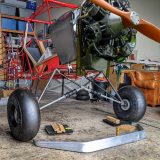
When you can upgrade tires, 26 in. Bushwheel Airstreaks are the best option. They will soak up a lot of bumps and other rough stuff. Not sure if you have the oleo gear, but although it's great to land on, the roll out is on the taxi springs, which is hard on the airframe in rough terrain, including on skis in chopped up snow. Sand beaches are probably smooth enough most places.

Keep it light.
Tue Aug 15, 2017 8:42 pm
Re: Off-airport beginner Q's
There are some 29" Goodyear Airwheels with 5" rims on Alaska List for a $1000. Not sure what size axel but they sure look inviting for your class of airplane.
Wed Aug 16, 2017 8:35 am
Re: Off-airport beginner Q's
Hello Dave,
I'm new to the off airport stuff too. I've learned a lot by following and searching old threads on this site as well as following more experienced pilots into places that I would otherwise not attempt.
Good thing I had those guys with me because I've needed them to help me get my plane out of the soft stuff that 8.50's were not big enough to handle, I agree Hammer, big tires are a good thing. It's not too much fun digging a plane out of a sand bar like I did my Jeep back in the day. I also was one of the last ones in on this occasion, as Gump recommends, so even if you are second or third in stuff can still happen even with years of experience landing ahead of you, be prepared, I wasn't, Thanks Tom and Steve for your help that day,
Mtv and Contact are spot on, practice practice practice, ground effect is your friend. I was flying a pacer then and I learned to fly slow and in control 6" agl on 700' and 800' runways. As aftCG says, practice on different runways, or different grass areas at different airports in different wind conditions. You can get too comfortable on the same grass patch in the same wind all the time. Wind will not always be right on the nose when your off airport so you need to be very comfortable in crosswind situations and with knowing what your plane will do landing or taking off with a tailwind. I practiced at an airport in Iowa last fall with the wind coming over the hangars and buildings creating some unexpected gusts, I got comfortable in these situations with practice.
As I said I've read a lot here and put a lot of what I've read into helping me learn and gain experience. I can't say how important it is to know your plane, because once you get out on your own, the stinkin pucker factor is crazy high, at least for me you don't need the two strikes against you when your trying it on your own by not being as comfortable in your plane as you can.
This is just my 0.02, if that. I thank everyone for taking time to post their experience on this site and helping me learn from others. Have fun and be safe.
Wes.
Post Script: I'm posting my experience because of recent threads I've read. I don't want to be selfish, I don't mind the admonishment. I did put a sandwich in my back pocket so if anyone wants to eat my ass for doing or saying something stupid, you'll have something tasty
I'm new to the off airport stuff too. I've learned a lot by following and searching old threads on this site as well as following more experienced pilots into places that I would otherwise not attempt.
Good thing I had those guys with me because I've needed them to help me get my plane out of the soft stuff that 8.50's were not big enough to handle, I agree Hammer, big tires are a good thing. It's not too much fun digging a plane out of a sand bar like I did my Jeep back in the day.
I also was one of the last ones in on this occasion, as Gump recommends, so even if you are second or third in stuff can still happen even with years of experience landing ahead of you, be prepared, I wasn't, Thanks Tom and Steve for your help that day, Mtv and Contact are spot on, practice practice practice, ground effect is your friend. I was flying a pacer then and I learned to fly slow and in control 6" agl on 700' and 800' runways. As aftCG says, practice on different runways, or different grass areas at different airports in different wind conditions. You can get too comfortable on the same grass patch in the same wind all the time. Wind will not always be right on the nose when your off airport so you need to be very comfortable in crosswind situations and with knowing what your plane will do landing or taking off with a tailwind. I practiced at an airport in Iowa last fall with the wind coming over the hangars and buildings creating some unexpected gusts, I got comfortable in these situations with practice.
As I said I've read a lot here and put a lot of what I've read into helping me learn and gain experience. I can't say how important it is to know your plane, because once you get out on your own, the stinkin pucker factor is crazy high, at least for me
you don't need the two strikes against you when your trying it on your own by not being as comfortable in your plane as you can. This is just my 0.02, if that. I thank everyone for taking time to post their experience on this site and helping me learn from others. Have fun and be safe.
Wes.
Post Script: I'm posting my experience because of recent threads I've read. I don't want to be selfish, I don't mind the admonishment. I did put a sandwich in my back pocket so if anyone wants to eat my ass for doing or saying something stupid, you'll have something tasty
Wed Aug 16, 2017 11:39 am
Re: Off-airport beginner Q's
JP256 wrote:<snip>aftCG wrote:It was pounded into my head 20 years ago to make every landing a spot landing. If I'm not on the ground by the time I roll over the numbers I consider myself to have gone long. Spot landing is one of the few flying skills that will save your life if your engine packs up. Burn gas at your home airport in your plane until you can make the first turn off without any chirping or tire smoke (see skill sets outlined by people above).
Unless your runway is super-short, it might be better to make your "target" the first stripe AFTER the numbers while you're learning to hit the mark every time. It can be embarrassing (or worse) to come up short...
<snip>
I agree with making every landing a spot landing, even on 10,000' runways. But I also agree that when practicing and especially when still learning before becoming 100% consistent, it's better to give yourself an "out" by aiming for a mark farther down the runway.
Some years ago, I was practicing short landings at the old 3V5, Fort Collins Downtown, consistently landing on the leading edge of the numbers, which made turning off at the first turn off 600' later pretty easy. I had no issues with doing that, but my regular CFII (whom I use for BFRs and IPCs) asked me if I would mind using a spot farther down the runway, because he had some students who might try to emulate me, and come up short. So now when I know there's no one else around, I'll still often use the numbers as my touchdown spot, but if there are any others who might be watching, I'll pick a spot farther down the runway.
BTW, my Daddy took out the mains of a B-25 at LaJunta, CO in 1944, landing just a tad short while practicing "assault" landings, what we call short field landings. The runway had a lip a few inches high--the contractor who built it hadn't filled in the area leading up to the runway. The review board exonerated my Daddy and put all the blame on the contractor. I have a series of pictures that were surreptitiously taken from the tower, of the bomber sliding down the runway, doing a slow spin before finally stopping.
Cary
"I have slipped the surly bonds of earth..., put out my hand and touched the face of God." J.G. Magee
Wed Aug 16, 2017 12:02 pm
Re: Off-airport beginner Q's
I agree. Be sure to hit your spot, but the spot doesn't always have to be the start of the runway. I landed in Fort St John yesterday with a 15 mph headwind. I did not stick it on the numbers because I would've had to taxi 7000 feet to the taxiway. I touched down well after the intersection of the 2 runways, still had plenty of room and a bit less distance to taxi.Cary wrote:JP256 wrote:<snip>aftCG wrote:It was pounded into my head 20 years ago to make every landing a spot landing. If I'm not on the ground by the time I roll over the numbers I consider myself to have gone long. Spot landing is one of the few flying skills that will save your life if your engine packs up. Burn gas at your home airport in your plane until you can make the first turn off without any chirping or tire smoke (see skill sets outlined by people above).
Unless your runway is super-short, it might be better to make your "target" the first stripe AFTER the numbers while you're learning to hit the mark every time. It can be embarrassing (or worse) to come up short...
<snip>
I agree with making every landing a spot landing, even on 10,000' runways. But I also agree that when practicing and especially when still learning before becoming 100% consistent, it's better to give yourself an "out" by aiming for a mark farther down the runway.
Some years ago, I was practicing short landings at the old 3V5, Fort Collins Downtown, consistently landing on the leading edge of the numbers, which made turning off at the first turn off 600' later pretty easy. I had no issues with doing that, but my regular CFII (whom I use for BFRs and IPCs) asked me if I would mind using a spot farther down the runway, because he had some students who might try to emulate me, and come up short. So now when I know there's no one else around, I'll still often use the numbers as my touchdown spot, but if there are any others who might be watching, I'll pick a spot farther down the runway.
BTW, my Daddy took out the mains of a B-25 at LaJunta, CO in 1944, landing just a tad short while practicing "assault" landings, what we call short field landings. The runway had a lip a few inches high--the contractor who built it hadn't filled in the area leading up to the runway. The review board exonerated my Daddy and put all the blame on the contractor. I have a series of pictures that were surreptitiously taken from the tower, of the bomber sliding down the runway, doing a slow spin before finally stopping.
Cary
So I guess what I'm saying is, pick a spot and hit it. Doesn't have to be at the numbers or specified spot, just the one you decide to hit at the time of your landing.
Sent from my SM-G870W using Tapatalk
Wed Aug 16, 2017 1:49 pm
Re: Off-airport beginner Q's
A1Skinner wrote:I agree. Be sure to hit your spot, but the spot doesn't always have to be the start of the runway. I landed in Fort St John yesterday with a 15 mph headwind. I did not stick it on the numbers because I would've had to taxi 7000 feet to the taxiway. I touched down well after the intersection of the 2 runways, still had plenty of room and a bit less distance to taxi.
So I guess what I'm saying is, pick a spot and hit it. Doesn't have to be at the numbers or specified spot, just the one you decide to hit at the time of your landing.
Sent from my SM-G870W using Tapatalk
Me too. I land long all the time (10k+ foot runway at my home airfield). I pick a dashed line and land on it. Usually one taxiway before my intended turn off. But regardless of where it is, I pick a point and land on it!
- CamTom12 offline

- Posts: 3705
- Joined: Sun Jul 08, 2012 1:08 pm
- Location: Huntsville
- FindMeSpot URL: https://share.delorme.com/camtom12
- Aircraft: Ruppe Racer
Experimental Pacer
home hand jam "wizard"
Wed Aug 16, 2017 2:39 pm
Re: Off-airport beginner Q's
A1Skinner wrote:Be sure to hit your spot, but the spot doesn't always have to be the start of the runway. I landed in Fort St John yesterday with a 15 mph headwind. I did not stick it on the numbers because I would've had to taxi 7000 feet to the taxiway. I touched down well after the intersection of the 2 runways, still had plenty of room and a bit less distance to taxi.
Brings back a memory. I was landing at General Francisco Mugica* International in Morelia, MX a few months ago and there was an American Airlines jet on taxiway B waiting to take the runway. I flew two thirds of the way down the 11,450 ft runway and finally touched down a couple hundred feet before Alpha, between Bravo and Alpha.
The AA pilot jumping on the radio to say "I like it", was all I really needed to hear.
[*] The good general was one of the leaders of the Mexican revolution, BTW. He was also instrumental in creating the new government post-revolution.
- rw2 offline
- Posts: 1799
- Joined: Sat Dec 22, 2012 1:10 pm
- Location: San Miguel de Allende
- FindMeSpot URL: https://share.delorme.com/LaNaranjaDanzante
- Aircraft: Experimental Maule
Follow my Flying, Cooking and Camping adventures at RichWellner.com
Wed Aug 16, 2017 4:22 pm
Re: Off-airport beginner Q's
JP256 wrote:aftCG wrote:Great topic. My plane is similar, just has 60 more horses involved and a squared off rudder.
My 7ECA has the O-200, so only 35 more horses, and a LOT more weight than the Champ.aftCG wrote:It was pounded into my head 20 years ago to make every landing a spot landing. If I'm not on the ground by the time I roll over the numbers I consider myself to have gone long. Spot landing is one of the few flying skills that will save your life if your engine packs up. Burn gas at your home airport in your plane until you can make the first turn off without any chirping or tire smoke (see skill sets outlined by people above).
Unless your runway is super-short, it might be better to make your "target" the first stripe AFTER the numbers while you're learning to hit the mark every time. It can be embarrassing (or worse) to come up short...aftCG wrote:Learn to calculate your takeoff distance. Your POH will be even worse than mine, but it has some numbers. Look them up. Verify that your plane will match the book. Manufacturers of old planes were known to like a rug about cruise performance but the landing and takeoff distances should be achievable by a pilot with average skills even in an old plane. A C152 will get off the ground in half of what the book says if you fly it correctly.
Don't know about his Champ, but there is absolutely no POH (or any other pilot's manual) for my 1965 Champion 7ECA, and the later Bellanca version is useless, since it gives performance only for the O-235 powered 7ECA. I can't get anywhere near those numbers... So I've been building up a little table of cruise performance data for my own use, and trying to extrapolate the takeoff / landing data based on reduced horsepower, but it's probably nothing that would pass a "legal" review... So I'm pretty conservative at this point.
I didn't realize I was going to scratch up so much dirt by suggesting a threshold touchdown. Blame the punk kid that taught me to fly so many years ago. It wasn't until prepping for my commercial check ride with the 180 degree power off touchdown to a point that anyone ever suggested moving that touchdown point to an agreed spot down the runway a ways.
I was just looking for the PTS standards because I recalled the tolerance being + something pretty tight and - ZERO so that is how I imagine the true requirement for a spot landing. It appears that tolerances have been removed from the PTS so it's up to the DE to see how they feel about it.
With a threshold landing there's skin in the game for sure, and I can't defend that I still do it but I have been right up until now. Old habits do die hard. And yes I screw myself every time I land runway 17 at Tacoma because it's a LONG ways down before the first turn.
----------
I didn't do a very good job in my HP/POH discussion. My 7ECA has been upgraded to an O-320 so I thought I was 60 hp above a C90. I thought all non-dream machine O-200s were 100hp.
The POH is a bit thin, I'll agree. The one I have is a later copy and has a table for 7ECA, 7GCAA and 7GCBC. However, you're correct that all the 7ECA references are for O-235 planes. The 7GCAA table for take off performance, and cruise flight configuration is pretty darn accurate for my plane so I use them.
If you're building up a table of actual values I have a hard time seeing how that could be used against you (I know, I know: FAA). It's not like you're ignoring published factory data - there isn't any.
Thu Aug 17, 2017 8:37 am
Re: Off-airport beginner Q's
Have a spot in mind to land on your off airport LZ, and be able to stick it, but also be ready to bail out on it. Don't become so focused on the spot that you ignore the log laying parallel to your roll out path that is pointed right at your prop (the one you couldn't see on your drag pass).
To sum up, it's sort of like your high school sweetheart. Go ahead and commit, but keep your options open by staying on the lookout for better prospects. [emoji6]
To sum up, it's sort of like your high school sweetheart. Go ahead and commit, but keep your options open by staying on the lookout for better prospects. [emoji6]
Sat Aug 19, 2017 5:43 am
Re: Off-airport beginner Q's
gbflyer wrote:To sum up, it's sort of like your high school sweetheart. Go ahead and commit, but keep your options open by staying on the lookout for better prospects. [emoji6]
Ever spit coffee out of your nose while reading BCP? To quote Larry the Cable Guy:
Now THAT'S funny, I don't care who you are. (Lord, I apologize to all the Pygmies...)

Sat Aug 19, 2017 7:41 am
Re: Off-airport beginner Q's
gbflyer wrote:Have a spot in mind to land on your off airport LZ, and be able to stick it, but also be ready to bail out on it. Don't become so focused on the spot that you ignore the log laying parallel to your roll out path that is pointed right at your prop (the one you couldn't see on your drag pass).
To sum up, it's sort of like your high school sweetheart. Go ahead and commit, but keep your options open by staying on the lookout for better prospects. [emoji6]
It always helps to imagine the salvage operation too, where you have to take the wings off and float everything out on a barge. Then you start thinking like "maybe I should go play where you can get access with a flatbed trailer."

Sat Aug 19, 2017 7:42 am
Re: Off-airport beginner Q's
Haha. Or have a good friend with a big helicopter!Zzz wrote:gbflyer wrote:Have a spot in mind to land on your off airport LZ, and be able to stick it, but also be ready to bail out on it. Don't become so focused on the spot that you ignore the log laying parallel to your roll out path that is pointed right at your prop (the one you couldn't see on your drag pass).
To sum up, it's sort of like your high school sweetheart. Go ahead and commit, but keep your options open by staying on the lookout for better prospects. [emoji6]
It always helps to imagine the salvage operation too, where you have to take the wings off and float everything out on a barge. Then you start thinking like "maybe I should go play where you can get access with a flatbed trailer."
Sent from my SM-G870W using Tapatalk
Sun Aug 20, 2017 8:37 pm
Re: Off-airport beginner Q's
Hammer wrote:Put on bigger tires if you want to play in the sand. Someone else on this forum found out the hard way that 8.50's are not enough tire for that.
BEST ADVICE right here!!!! you might get away with it sometimes but very soon 8.50s and sand bite....
- cstolaircraft offline
- Posts: 523
- Joined: Wed Sep 29, 2010 12:50 pm
- Location: Blackwell, Mo
Mission Pilot in training. C-170B N8098A.
But they that wait upon the Lord shall renew their strength; they shall mount up on wings as eagles... Isaiah 40:31
But they that wait upon the Lord shall renew their strength; they shall mount up on wings as eagles... Isaiah 40:31
Sun Aug 20, 2017 8:51 pm
Re: Off-airport beginner Q's
My friend had bought a taylorcraft with a C90 and 8.50s and made several beach landings on 8.50s one day the winds were up a bit maybe a steady 10 knots he went to the same beach to play while on final the winds suddenly shifted while about 4 ft of the sand cause the plane to drop the left wing and make a rather hard "soft" field landing. Left tire hit first and dug in for a split second and induced a hard left turn right over and ditch... Does he still think that its possible to land there without bigger tires? yes did he wish to have big insurance under him that day YES! If you are going to be on sand GET BIGGER TIRES!!!! 8.50s are great for soft hay fields and such.... not for sand
- cstolaircraft offline
- Posts: 523
- Joined: Wed Sep 29, 2010 12:50 pm
- Location: Blackwell, Mo
Mission Pilot in training. C-170B N8098A.
But they that wait upon the Lord shall renew their strength; they shall mount up on wings as eagles... Isaiah 40:31
But they that wait upon the Lord shall renew their strength; they shall mount up on wings as eagles... Isaiah 40:31
Sun Aug 20, 2017 9:16 pm
Re: Off-airport beginner Q's
All of my off airport work was with stock tires, but I didn't land in river sand. Gust problems can best be handled by dynamic proactive rudder movement and reactivate but quick throttle movement. We are responsible for the control of our aircraft in pretty severe conditions and are given controls adequate to those conditions in well designed aircraft. The control that gives the quickest response is the rudder. Wind overcoming control is usually too much reliance on the slowest response control, the aileron.
- contactflying offline
- Posts: 4972
- Joined: Wed Apr 03, 2013 7:36 pm
- Location: Aurora, Missouri 2H2
Download my free "https://tinyurl.com/Safe-Maneuvering" e-book.
Mon Aug 21, 2017 7:05 am
Re: Off-airport beginner Q's
contactflying wrote:All of my off airport work was with stock tires, but I didn't land in river sand. Gust problems can best be handled by dynamic proactive rudder movement and reactivate but quick throttle movement. We are responsible for the control of our aircraft in pretty severe conditions and are given controls adequate to those conditions in well designed aircraft. The control that gives the quickest response is the rudder. Wind overcoming control is usually too much reliance on the slowest response control, the aileron.
Exactly. Tires can certainly help, but years ago, there was a bear guide on the Alaska Peninsula who ran a Super Cub on 8.50 x 6 tires and landed beaches all the time. Another ran 8.50 x 10 tires on Navajo rims under STC, which made for relatively large diameter, but narrow footprint, and fairly high pressure.
Tires can also become a crutch, leading one to go places he or she shouldn't.
Big tires are indeed a nice insurance policy, but they won't replace good pilot skills.
MTV


DISPLAY OPTIONS
Who is online
Users browsing this forum: No registered users and 4 guests
Latest Features
-
-
Featured Bush Planes
As one of the undisputed legends of bush flying, the Cessna 180 hauls a…Read More -
Aircraft Ownership and Maintenance
9 modification mistakes aircraft owners make when trying to "bush out" their birds—why some…Read More -
Live to Tell
A Minnesota pilot is surprised to learn that the sudden asymmetric drag of an…Read More




Latest Knowledge Base
-
Destinations
Canada offers some of the most spectacular backcountry flying on the continent. Here's what you need to know before you go.Read More -
Safety and Survival
Hope that you never have to use your survival vest but knowing you have it and knowing how to use…Read More -
Destinations
A regional guide with ideas for winter camping destinations in California, Nevada, New Mexico, and Arizona.Read More -
Aircraft
Finding an affordable aircraft that can handle the backcountry for $80K or less? A challenge for sure, but with the…Read More



