Problems concerning maneuvering flight
Thu Jul 30, 2015 9:08 pm
Re: Problems concerning maneuvering flight
Staying in low ground effect over that long runway would have been a lot safer. Once they had gotten well out of ground effect and onto a wooded hill they could not out climb, they should have flown all the way to the crash like Les did with his Stinson and lived.
- contactflying offline
- Posts: 4972
- Joined: Wed Apr 03, 2013 7:36 pm
- Location: Aurora, Missouri 2H2
Download my free "https://tinyurl.com/Safe-Maneuvering" e-book.
Thu Jul 30, 2015 10:12 pm
Re: Problems concerning maneuvering flight
Found this post in a thread from a couple years back:
Grassstrippilot wrote:A while back I came across some information regarding the aerodynamics involved with performing forward slips in aircraft. I thought I had posted it but when this subject came up on another thread, I looked and couldn't find it. So, here it is. We've all heard about the warnings about slipping with full flaps (I can tell you with certainty that it can be done at least in 172s and 182s) and I think most people reference the "blanketing of the elevator". So when I read this, I thought it was very interesting. This was the first time I've ever read an explanation of the aerodynamics of what is happening.
Here’s what Bill Thompson, former Manager of Flight Test & Aerodynamics at Cessna, had to say about the issue of slipping with full flaps in the 172 (Cessna — Wings for The World, by William D. Thompson, Maverick Press, 1991, p. 41):
With the advent of the large slotted flaps in the C-170, C-180, and C-172 we encountered a nose down pitch in forward slips with the wing flaps deflected. In some cases it was severe enough to lift the pilot against his seat belt if he was slow in checking the motion. For this reason a caution note was placed in most of the owner’s manuals under “Landings” reading “Slips should be avoided with flap settings greater than 30 deg. due to a downward pitch encountered under certain combinations of airspeed, side-slip angle, and center of gravity loadings”. Since wing-low drift correction in crosswind landings is normally performed with a minimum flap setting (for better rudder control) this limitation did not apply to that maneuver. The cause of the pitching motion is the transition of a strong wing downwash over the tail in straight flight to a lessened downwash angle over part of the horizontal tail caused by the influence of a relative “upwash increment” from the upturned aileron in slipping flight. Although not stated in the owner’s manuals, we privately encouraged flight instructors to explore these effects at high altitude, and to pass on the information to their students. This phenomenon was elusive and sometimes hard to duplicate, but it was thought that a pilot should be aware of its existence and know how to counteract it if it occurs close to the ground.
You'll notice that beginning with the 1972 model year ('73 for European-built models) 172s have a larger dorsal fin. This apparently eliminated the "pitch-down" problem.
However, there is also an unrelated, more benign phenomenon that Thompson described in newer models in full-flap slips: “a mild pitch ‘pumping’ motion resulting from flap outboard-end vortex impingement on the horizontal tail at some combinations of side-slip angle, power, and airspeed.” This really isn't a problem and it's not limited to Cessnas -- my Sport Cub does it, as well, and it doesn't keep me from slipping with full flaps in either airplane.
So although the 172L’s larger dorsal apparently solved the pitch-down issue, they kept the cautionary note in the POH because of the latter phenomenon.
Unfortunately Cessna contributed to the “end of the world” fear of slips with flaps, by not explaining the pitch-down phenomenon in the manuals; and in fact, many earlier C-172 manuals expressly said that slips with full flap were prohibited. I rummaged through my collection of old Cessna owners manuals:
1958 C-172: “prohibited”
1959 C-175: “prohibited”
1966 C-172F: “prohibited”
1972 C-172L (first year of the big dorsal): “should be avoided”
The manuals and TCDS for these older models have been revised since then, and there is now no legal prohibition against slips with flaps -- but that’s what a lot of us old-timers read back then and remember.
And some further clarification:
The pitch-down that might occur with flap-down slips in Cessnas is not from "elevator blanking." Cessna's aerodynamicist and test pilot said, "The cause of the pitching motion is the transition of a strong wing downwash over the tail in straight flight to a lessened downwash angle over part of the horizontal tail caused by the influence of a relative 'upwash increment' from the upturned aileron in slipping flight."
In other words, in extreme slip conditions some of the upwash from the upturned aileron on the lowered wing might hit the horizontal stabilizer. Flaps cause downwash on the horizontal stabilizer -- that's why retrimming is necessary when flaps are extended. When some of that flap downwash is replaced by upwash from the aileron, there is very suddenly too much nose-down trim, and the nose pitches down.
"Elevator blanking" makes it sound as if the elevators lose effectiveness, and that's not what is happening.
The pitch-down is not a consistent phenomenon in 172s; Cessna test pilots found it "elusive and sometimes hard to duplicate." And apparently the larger dorsal fin from 1972 onward prevents the 172 from yawing far enough in a slip to allow aileron upwash to hit the tail, so the issue is moot.
It's interesting that the old (pre-1972) C-172 owners handbooks (which do not carry the force of law) said slips with full flaps were "prohibited" -- while the current version of the TCDS (which is the "law") only calls for placards saying "Avoid slips with flaps down" (172 thru 172E) or "Avoid slips with flaps extended" (172F thru 172N). The old "prohibited" language is nowhere to be found.
There is no caution against slips with flaps in the 172P and newer, in which maximum flap extension is reduced to thirty degrees.
- Jeredp offline

- Posts: 625
- Joined: Fri Apr 20, 2012 10:31 am
- Location: WA
- FindMeSpot URL: http://share.findmespot.com/shared/face ... 7NYN40QT2I
- Aircraft: Cessna 172
Fri Jul 31, 2015 4:52 am
Re: Problems concerning maneuvering flight
contactflying wrote:Staying in low ground effect over that long runway would have been a lot safer. Once they had gotten well out of ground effect and onto a wooded hill they could not out climb, they should have flown all the way to the crash like Les did with his Stinson and lived.
This is something that makes complete sense to me but no one teaches. In fact, the FAA teaches the opposite by instructing all climb outs be Vy or Vx. If I have a 5000 foot runway (near sea level) and I stay in ground effect the whole time...
1 if the motor konks out, I put the mains on the asphalt 10 feet below me and hit the brakes
2 not enough runway left means I'm doing 100mph and can try a crop duster turn back to the runway
3 all goes well and I get to climb like a bat out of hell

Win, win, win
Flying the plane to the crash site is a psychologically difficult thing to do if you haven't convinced yourself long prior. Early on, I got well behind the power curve with 40 flaps while looking up at a tree line that I was quite sure I wasn't going to clear. I remember thinking "dump the flaps, dive for speed in ground effect and zoom the tree line" but my arms kept pulling back on the yoke trying to eek out some more lift. I hit my wheel pants on the tree tops and soiled my pants. Lots of lessons learned that day.
Fri Jul 31, 2015 5:57 am
Re: Problems concerning maneuvering flight
Jeredp,
Thanks for the extensive explanation of the Cessna pitch up and down situation with full flaps and full slip. I instructed for quite a while with the swept tail, 0-300 C-172 without the dorsal fin on the vertical stabilizer. I taught the full (rudder to the stop) slip and full flap approach to landing without ever having a problem. With full slip and full flap, it will always pitch up and down a bit but will not gain or lose significant airspeed. I think trying to react to it could become a problem.
Bagarre,
I am not the only instructor that teaches, "level the airplane and get it flying well first" go around procedure. Looking at accident reports, I believe the go around is one of the most dangerous techniques around.
What happened in the video was that they started a go around from the bounce at very slow speed and pitched up to the point that the engine could not catch up to the pitch attitude. Other than a rocket, which will go straight up without any wing, powerful airplanes often get into this problem on go around or extreme break off a gun run. Any time pulling back doesn't cause climb, push forward a bit. Give your poor wing a chance to get its kinetic energy breath.
Contact
Thanks for the extensive explanation of the Cessna pitch up and down situation with full flaps and full slip. I instructed for quite a while with the swept tail, 0-300 C-172 without the dorsal fin on the vertical stabilizer. I taught the full (rudder to the stop) slip and full flap approach to landing without ever having a problem. With full slip and full flap, it will always pitch up and down a bit but will not gain or lose significant airspeed. I think trying to react to it could become a problem.
Bagarre,
I am not the only instructor that teaches, "level the airplane and get it flying well first" go around procedure. Looking at accident reports, I believe the go around is one of the most dangerous techniques around.
What happened in the video was that they started a go around from the bounce at very slow speed and pitched up to the point that the engine could not catch up to the pitch attitude. Other than a rocket, which will go straight up without any wing, powerful airplanes often get into this problem on go around or extreme break off a gun run. Any time pulling back doesn't cause climb, push forward a bit. Give your poor wing a chance to get its kinetic energy breath.
Contact
- contactflying offline
- Posts: 4972
- Joined: Wed Apr 03, 2013 7:36 pm
- Location: Aurora, Missouri 2H2
Download my free "https://tinyurl.com/Safe-Maneuvering" e-book.
Fri Jul 31, 2015 12:23 pm
Re: Problems concerning maneuvering flight
This is something that makes complete sense to me but no one teaches. In fact, the FAA teaches the opposite by instructing all climb outs be Vy or Vx.
Agreed, and even worse, many CFIs and other POH quoting old pros who don't understand low ground effect really come down hard on young pilots learning to utilize it and take advantage of it.
" The POH says X flaps, pitch to V speed, and the gods will smite you and we will call you stupid if you vary one iota." "There is no other way, other than what we and the POH tell you."
Yeah right....
To me it's a huge safety issue, and a requirement for those who really want to learn how to fly an airplane.
Gump
Sat Aug 01, 2015 7:36 am
Re: Problems concerning maneuvering flight
Bagarre and Gump,
The problem of trying to climb too fast out of ground effect and not getting the performance we were insured by FAA teaching and the POH has affected every pilot. While not all have hit their wheel pants (a good move at that late point), many have stalled and spun in like in the video. I have never met a pilot who has never had this happen and I have never met an instructor who has not been scared trying to teach the roll on the ground to Vx or Vy as appropriate and then pitch up to Vx or Vy.
The PTS has been changed to require acceleration in ground effect until Vx or Vy as appropriate. However the emphasis is still on getting up high as soon as possible. While the goal is admirable, the mind set is still problematic.
Judgement implies making a choice between more than one option. As pilots in command we need to fairly consider options. An option that is touted as good judgement is automatically suspect.
Contact
The problem of trying to climb too fast out of ground effect and not getting the performance we were insured by FAA teaching and the POH has affected every pilot. While not all have hit their wheel pants (a good move at that late point), many have stalled and spun in like in the video. I have never met a pilot who has never had this happen and I have never met an instructor who has not been scared trying to teach the roll on the ground to Vx or Vy as appropriate and then pitch up to Vx or Vy.
The PTS has been changed to require acceleration in ground effect until Vx or Vy as appropriate. However the emphasis is still on getting up high as soon as possible. While the goal is admirable, the mind set is still problematic.
Judgement implies making a choice between more than one option. As pilots in command we need to fairly consider options. An option that is touted as good judgement is automatically suspect.
Contact
- contactflying offline
- Posts: 4972
- Joined: Wed Apr 03, 2013 7:36 pm
- Location: Aurora, Missouri 2H2
Download my free "https://tinyurl.com/Safe-Maneuvering" e-book.
Sat Aug 01, 2015 9:37 pm
Re: Problems concerning maneuvering flight
Other than lining up with the center line and avoiding putting the down wing into something and going around things that would be dangerous to try to go over, coordination is good.
Dutch rolls teach coordination. Energy management turns teach coordination. The problem with level turns, other than load factor, is that we can flop/slip it over into some angle of bank and just pull back until we make it or stall. No one really cares if the nose is too slow for the angle of bank (slip.). Nobody uses enough rudder to skid (nose too fast for angle of bank.
The lazy 8, before it became an instrument maneuver, and the energy management turn teach coordination. Both aileron and rudder are in constant motion throughout.
Dutch rolls teach coordination. Energy management turns teach coordination. The problem with level turns, other than load factor, is that we can flop/slip it over into some angle of bank and just pull back until we make it or stall. No one really cares if the nose is too slow for the angle of bank (slip.). Nobody uses enough rudder to skid (nose too fast for angle of bank.
The lazy 8, before it became an instrument maneuver, and the energy management turn teach coordination. Both aileron and rudder are in constant motion throughout.
- contactflying offline
- Posts: 4972
- Joined: Wed Apr 03, 2013 7:36 pm
- Location: Aurora, Missouri 2H2
Download my free "https://tinyurl.com/Safe-Maneuvering" e-book.
Sun Aug 02, 2015 7:27 am
Re: Problems concerning maneuvering flight
Consider the mix of maneuvering flight and the most popular type airplane on this site: high wing tandem tailwheel. This is the most difficult airplane to see out of, especially from the instructor seat, and the hardest on skin in a crash. The pilot hits first, the engine comes back in his face, and he is trying to see out from sitting on the floor.
Don't take offense. They are fine airplanes that can go almost anywhere. Just don't put stuff inside that might lure you from looking out all the time and wear a good helmet and fixed or working shoulder harness.
Don't take offense. They are fine airplanes that can go almost anywhere. Just don't put stuff inside that might lure you from looking out all the time and wear a good helmet and fixed or working shoulder harness.
- contactflying offline
- Posts: 4972
- Joined: Wed Apr 03, 2013 7:36 pm
- Location: Aurora, Missouri 2H2
Download my free "https://tinyurl.com/Safe-Maneuvering" e-book.
Sun Aug 02, 2015 9:59 am
Re: Problems concerning maneuvering flight
Consider pipeline patrol or other visual reconnaissance work up a valley and across a fairly high pass. If early, we can expect greater engine thrust for climb. If later in the day in warmer times of the year, we would want to use orographic lift to make the pass. If the wind were wrong for the pipeline or search area, we could wait until the later in the day or the next morning. Or we could use the ridge lift on the ridge on the other side of the valley to get up to the pass and then work backwards or down hill through the down drafts.
In any case we would want to always be aware of the direction of the drainage to lower terrain and always be in position to make an energy management turn to the lower terrain in the valley and down the drainage.
In any case we would want to always be aware of the direction of the drainage to lower terrain and always be in position to make an energy management turn to the lower terrain in the valley and down the drainage.
Last edited by contactflying on Sun Aug 02, 2015 5:15 pm, edited 1 time in total.
- contactflying offline
- Posts: 4972
- Joined: Wed Apr 03, 2013 7:36 pm
- Location: Aurora, Missouri 2H2
Download my free "https://tinyurl.com/Safe-Maneuvering" e-book.
Sun Aug 02, 2015 5:13 pm
Re: Problems concerning maneuvering flight
Consider flying down a pipeline right of way at 100' AGL on a westerly heading in deteriorating weather. The wind is forty from the south. I have already changed to the right seat at the last stop because of the extreme crab necessary. I very much need to keep the right of way in sight as I turn back because I know what obstructions are on the pipeline. I can't pull up for an energy management turn because the ceiling is meybe 200' and I really don't want to lose sight of the ground and right of way. Which way do I fall off the pipeline right of way?
Of course I fall off the target (right of way) downwind to the north. Ten or fifteen degrees will be sufficient because of the increase in ground speed going that way. When I turn back while still in sight of the right of way, the now headwind will give me a very slow and workable rate of closure back to the right of way. As I continue the turn while over the right of way, the now forty knot crosswind will push me right down the pipeline going the other way. This headwind and crosswind component also requires less bank that would a downwind turn. This is important over wires and obstructions. Yes, I am glad the wind is blowing this hard.
Turning upwind first, rather than falling off the target downwind, could kill a pilot in this situation. Yes, he shouldn't be there. However, if he waits for 1,000' ceiling and 3 miles visibility in the midwest, he will not meet the 21 day DOT deadline and his company will lose the contract and he will most likely lose his job. Those who wait for perfect weather usually end up flying in really bad weather because they are now pushing the deadline.
If you don't fly it this week, you will start out next week on the 14th day or more. A stationary front can easily cause non-compliance with the 21 day requirement or cause flying in really bad weather.
Judgement is not always cut and dried.
Of course I fall off the target (right of way) downwind to the north. Ten or fifteen degrees will be sufficient because of the increase in ground speed going that way. When I turn back while still in sight of the right of way, the now headwind will give me a very slow and workable rate of closure back to the right of way. As I continue the turn while over the right of way, the now forty knot crosswind will push me right down the pipeline going the other way. This headwind and crosswind component also requires less bank that would a downwind turn. This is important over wires and obstructions. Yes, I am glad the wind is blowing this hard.
Turning upwind first, rather than falling off the target downwind, could kill a pilot in this situation. Yes, he shouldn't be there. However, if he waits for 1,000' ceiling and 3 miles visibility in the midwest, he will not meet the 21 day DOT deadline and his company will lose the contract and he will most likely lose his job. Those who wait for perfect weather usually end up flying in really bad weather because they are now pushing the deadline.
If you don't fly it this week, you will start out next week on the 14th day or more. A stationary front can easily cause non-compliance with the 21 day requirement or cause flying in really bad weather.
Judgement is not always cut and dried.
- contactflying offline
- Posts: 4972
- Joined: Wed Apr 03, 2013 7:36 pm
- Location: Aurora, Missouri 2H2
Download my free "https://tinyurl.com/Safe-Maneuvering" e-book.
Sun Aug 02, 2015 6:53 pm
Re: Problems concerning maneuvering flight
My instructor taught me to slip a 170B with full flaps he's done it since 63 in all his flying time he only had a problem with it once when he was towing gliders and had 200 ft of rope on the tail. In my experience flying with full flaps and slipping I found adding about 50-75 RPM would fix all elevator oscillations and make the elevator feel very solid as if there was no slip happening. I took my check ride with a cessna test pilot he warned about watching for it but never indicated that it was anything to be super worried about as it was extremely rare and easily fixed with stopping the slip, he also said that he was happy to find someone who used all available resources.
- cstolaircraft offline
- Posts: 523
- Joined: Wed Sep 29, 2010 12:50 pm
- Location: Blackwell, Mo
Mission Pilot in training. C-170B N8098A.
But they that wait upon the Lord shall renew their strength; they shall mount up on wings as eagles... Isaiah 40:31
But they that wait upon the Lord shall renew their strength; they shall mount up on wings as eagles... Isaiah 40:31
Sun Aug 02, 2015 7:31 pm
Re: Problems concerning maneuvering flight
Yep! There are 100's if not 1,000's of people out there that have slipped a 170B with full flaps and nothing happened.
I was one of them until I stopped doing it. And just because you're not dead yet doesn't mean you're doing something the right way.
And just because an aircraft company 60 odd years ago didn't say 'prohibit' but rather 'avoid' doesn't make it a safe maneuver.
I'm not prohibited from hitting towers but I sure as hell avoid them.
And folks can and certainly will continue to fly and slip with full flaps for the rest of their lives with or without an event. It's not a guarantee that it will happen and just because it hasn't happened yet doesn't mean you figured out a way to beat the devil every time.
Head over to the 170 forum and read up about Bruce and Kathy Rhymes. Great people and he was an accomplished pilot. His was not a base to final stall into a spin and they have the GPS track to prove it.
"The last three GPS data points showed the airplane at a groundspeed of about 64 knots, which was well above the stall speed. The GPS data showed that the airplane was well above the 3-degree glidepath to both the runway threshold and the precision approach path indicator location. Wreckage and impact signatures were consistent with a stall and subsequent spin and a near-vertical impact with terrain. However, the reason for the stall could not be determined." The flaps were found set at 40 degrees in the wreckage."
http://www.boundvortex.com/ReadArticle. ... ticleID=34
With the advent of the large slotted flaps in the C-170, C-180, and C-172 we encountered a nose down pitch in forward slips with the wing flaps deflected. In some cases it was severe enough to lift the pilot against his seat belt if he was slow in checking the motion. For this reason a caution note was placed in most of the owner's manuals under "Landings" reading "Slips should be avoided with flap settings greater than 30° due to a downward pitch encountered under certain combinations of airspeed, side-slip angle, and center of gravity loadings". Since wing-low drift correction in cross-wind landings is normally performed with a minimum flap setting (for better rudder control) this limitation did not apply to that maneuver. The cause of the pitching motion is the transition of a strong wing downwash over the tail in straight flight to a lessened downwash angle over part of the horizontal tail caused by the influence of a relative "upwash increment" from the upturned aileron in slipping flight. Although not stated in the owner's manuals, we privately encouraged flight instructors to explore these effects at high altitude, and to pass on the information to their students.
This phenomenon was elusive and sometimes hard to duplicate, but it was thought that a pilot should be aware of its existence and know how to counter-act it if it occurs close to the ground.
When the larger dorsal fin was adopted in the 1972 C-172L, this side-slip pitch phenomenon was eliminated, but the cautionary placard was retained. In the higher-powered C-172P and C-R172 the placard was applicable to a mild pitch "pumping" motion resulting from flap outboard-end vortex impingement on the horizontal tail at some combinations of side-slip angle, power, and airspeed.
Make your own decisions on how to fly but please don't down play the seriousness of full flap slips in a B model 170.
Sorry to hijack this thread but it's an important topic.
I was one of them until I stopped doing it. And just because you're not dead yet doesn't mean you're doing something the right way.
And just because an aircraft company 60 odd years ago didn't say 'prohibit' but rather 'avoid' doesn't make it a safe maneuver.
I'm not prohibited from hitting towers but I sure as hell avoid them.
And folks can and certainly will continue to fly and slip with full flaps for the rest of their lives with or without an event. It's not a guarantee that it will happen and just because it hasn't happened yet doesn't mean you figured out a way to beat the devil every time.
Head over to the 170 forum and read up about Bruce and Kathy Rhymes. Great people and he was an accomplished pilot. His was not a base to final stall into a spin and they have the GPS track to prove it.
"The last three GPS data points showed the airplane at a groundspeed of about 64 knots, which was well above the stall speed. The GPS data showed that the airplane was well above the 3-degree glidepath to both the runway threshold and the precision approach path indicator location. Wreckage and impact signatures were consistent with a stall and subsequent spin and a near-vertical impact with terrain. However, the reason for the stall could not be determined." The flaps were found set at 40 degrees in the wreckage."
http://www.boundvortex.com/ReadArticle. ... ticleID=34
With the advent of the large slotted flaps in the C-170, C-180, and C-172 we encountered a nose down pitch in forward slips with the wing flaps deflected. In some cases it was severe enough to lift the pilot against his seat belt if he was slow in checking the motion. For this reason a caution note was placed in most of the owner's manuals under "Landings" reading "Slips should be avoided with flap settings greater than 30° due to a downward pitch encountered under certain combinations of airspeed, side-slip angle, and center of gravity loadings". Since wing-low drift correction in cross-wind landings is normally performed with a minimum flap setting (for better rudder control) this limitation did not apply to that maneuver. The cause of the pitching motion is the transition of a strong wing downwash over the tail in straight flight to a lessened downwash angle over part of the horizontal tail caused by the influence of a relative "upwash increment" from the upturned aileron in slipping flight. Although not stated in the owner's manuals, we privately encouraged flight instructors to explore these effects at high altitude, and to pass on the information to their students.
This phenomenon was elusive and sometimes hard to duplicate, but it was thought that a pilot should be aware of its existence and know how to counter-act it if it occurs close to the ground.
When the larger dorsal fin was adopted in the 1972 C-172L, this side-slip pitch phenomenon was eliminated, but the cautionary placard was retained. In the higher-powered C-172P and C-R172 the placard was applicable to a mild pitch "pumping" motion resulting from flap outboard-end vortex impingement on the horizontal tail at some combinations of side-slip angle, power, and airspeed.
Make your own decisions on how to fly but please don't down play the seriousness of full flap slips in a B model 170.
Sorry to hijack this thread but it's an important topic.
Sun Aug 02, 2015 8:12 pm
Re: Problems concerning maneuvering flight
Bagarre,
I respect your convictions and should not have mentioned the full flap, full slip technique. I have only found it useful in very low level forced landings. From a thousand feet or more Cessna flaps are very adequate without slip if we use them.
All of us have to go with our convictions. Doubt is the beginning of panic which usually does not end well. We can all learn from each other.
I appreciate your comments. Also those of Robw56 and all others. We cannot read each other's body language and do the foot in mouth thing from time to time. But like the Gaulic warriors mentioned by Caesar, I am "inure to the bog."
Contact
I respect your convictions and should not have mentioned the full flap, full slip technique. I have only found it useful in very low level forced landings. From a thousand feet or more Cessna flaps are very adequate without slip if we use them.
All of us have to go with our convictions. Doubt is the beginning of panic which usually does not end well. We can all learn from each other.
I appreciate your comments. Also those of Robw56 and all others. We cannot read each other's body language and do the foot in mouth thing from time to time. But like the Gaulic warriors mentioned by Caesar, I am "inure to the bog."
Contact
- contactflying offline
- Posts: 4972
- Joined: Wed Apr 03, 2013 7:36 pm
- Location: Aurora, Missouri 2H2
Download my free "https://tinyurl.com/Safe-Maneuvering" e-book.
Mon Aug 03, 2015 7:32 am
Re: Problems concerning maneuvering flight
cstolaircraft,
I wouldn't try to fix the nose pumping that happens in Cessnas with full flaps and strong slip. If we just leave it alone it works out dynamically. I think the problems Bagarre and Robw56 brought up were attempts to fix it with elevator input.
Again, where altitude and time are available we shouldn't need a forward slip with Cessna's good fowler flaps.
If you lose an engine on takeoff or while conducting a maneuvering flight operation, I suggest you go ahead and do every thing you can to get into that spot right there right now. Three times I had that situation and found full flaps and full slip to be appropriate and useful to get into the beginning of very small landing zones. Low level engine failures are six second deals. We can see only the one or even two very close survivable landing zones. The one we want is almost always obvious because of the few choices. We are almost always high and fast. That sounds crazy at 100' but at 100' the LZ is very close. Getting down in the beginning of the LZ can mean saving tin, but most importantly it means saving skin.
Thanks for you comments.
Contact
I wouldn't try to fix the nose pumping that happens in Cessnas with full flaps and strong slip. If we just leave it alone it works out dynamically. I think the problems Bagarre and Robw56 brought up were attempts to fix it with elevator input.
Again, where altitude and time are available we shouldn't need a forward slip with Cessna's good fowler flaps.
If you lose an engine on takeoff or while conducting a maneuvering flight operation, I suggest you go ahead and do every thing you can to get into that spot right there right now. Three times I had that situation and found full flaps and full slip to be appropriate and useful to get into the beginning of very small landing zones. Low level engine failures are six second deals. We can see only the one or even two very close survivable landing zones. The one we want is almost always obvious because of the few choices. We are almost always high and fast. That sounds crazy at 100' but at 100' the LZ is very close. Getting down in the beginning of the LZ can mean saving tin, but most importantly it means saving skin.
Thanks for you comments.
Contact
- contactflying offline
- Posts: 4972
- Joined: Wed Apr 03, 2013 7:36 pm
- Location: Aurora, Missouri 2H2
Download my free "https://tinyurl.com/Safe-Maneuvering" e-book.
Mon Aug 03, 2015 7:54 am
Re: Problems concerning maneuvering flight
Let's move on to something even more controversial, the apparent brisk walk rate of closure approach. I have flown with Anarchisto and have watched a lot of video on this site and I believe many pilots use this technique. It is so natural and we use it every time we come to a road intersection with our automobiles. I think many pilots who think they are depending solely on the airspeed indicator are also observing their rate of closure with the numbers and slowing the airplane accordingly.
I thought many times of having someone monitor the airspeed indicator while I flew the apparent rate of closure approach, but I didn't want to burn the other guys fuel on my research. Could some of you who don't use the airspeed indicator run this test for me? I have always assumed that I continuously slow down over the last eighth of a mile or so because I end up much slower at the numbers than I was at the two hundred feet altitude I started at.
I thought many times of having someone monitor the airspeed indicator while I flew the apparent rate of closure approach, but I didn't want to burn the other guys fuel on my research. Could some of you who don't use the airspeed indicator run this test for me? I have always assumed that I continuously slow down over the last eighth of a mile or so because I end up much slower at the numbers than I was at the two hundred feet altitude I started at.
- contactflying offline
- Posts: 4972
- Joined: Wed Apr 03, 2013 7:36 pm
- Location: Aurora, Missouri 2H2
Download my free "https://tinyurl.com/Safe-Maneuvering" e-book.
Mon Aug 03, 2015 2:32 pm
Re: Problems concerning maneuvering flight
contactflying wrote:cstolaircraft,
I wouldn't try to fix the nose pumping that happens in Cessnas with full flaps and strong slip. If we just leave it alone it works out dynamically. I think the problems Bagarre and Robw56 brought up were attempts to fix it with elevator input.
Again, where altitude and time are available we shouldn't need a forward slip with Cessna's good fowler flaps.
If you lose an engine on takeoff or while conducting a maneuvering flight operation, I suggest you go ahead and do every thing you can to get into that spot right there right now. Three times I had that situation and found full flaps and full slip to be appropriate and useful to get into the beginning of very small landing zones. Low level engine failures are six second deals. We can see only the one or even two very close survivable landing zones. The one we want is almost always obvious because of the few choices. We are almost always high and fast. That sounds crazy at 100' but at 100' the LZ is very close. Getting down in the beginning of the LZ can mean saving tin, but most importantly it means saving skin.
Thanks for you comments.
Contact
From what I understand the problems with cessnas falling out in a full flap slip are from the flaps blanking out the elevator. adding the power was a way for me to increase the effectiveness of it. From my experience with full flaps slips cause the nose to pitch down a good bit causing an increase in airspeed, adding the extra power helps prevent the loss of airspeed while having little effect on the rate of decent.
- cstolaircraft offline
- Posts: 523
- Joined: Wed Sep 29, 2010 12:50 pm
- Location: Blackwell, Mo
Mission Pilot in training. C-170B N8098A.
But they that wait upon the Lord shall renew their strength; they shall mount up on wings as eagles... Isaiah 40:31
But they that wait upon the Lord shall renew their strength; they shall mount up on wings as eagles... Isaiah 40:31
Mon Aug 03, 2015 2:47 pm
Re: Problems concerning maneuvering flight
Yes, increasing power decreases the angle of glide and increases the effectiveness of both rudder and elevator with more prop blast. The full flaps and full slip causes both pitch down and pitch up within limits and the one cancels out the speed effect of the other. It is best dealt with by making our approach the same as we would if it were not happening, that is not reacting to the pumping.
Again, if we are trying to make the beginning of the landing zone using both full flaps and full forward or side slip we either don't want to (precautionary landing) or can't (engine failure) increase power.
Again, if we are trying to make the beginning of the landing zone using both full flaps and full forward or side slip we either don't want to (precautionary landing) or can't (engine failure) increase power.
- contactflying offline
- Posts: 4972
- Joined: Wed Apr 03, 2013 7:36 pm
- Location: Aurora, Missouri 2H2
Download my free "https://tinyurl.com/Safe-Maneuvering" e-book.
Wed Aug 05, 2015 2:38 pm
Re: Problems concerning maneuvering flight
Consider that while race tracking a large field, the crosswind speed increases from five to fifteen mph. While the energy management turn is making the upwind turn into the crosswind very easy, every other turn is downwind. We need to make a note of the last swath number upwind and finish the field making energy management P turns (back and forth) from the last downwind swath.
If we continue race tracking, the downwind turn problem will cause the radius to be greater, the ground speed greater, and the angle of bank needed greater on every other turn. Going over obstructions or wires into a field with a near ninety degree bank is very dangerous. Circling wide enough to get lined up on a long final would also be dangerous. We would lose contact with the field. Changes down there, or just forgetting where an obstruction is, can be very dangerous.
Unfortunately, this very situation occurs often at uncontrolled airports where most pilots use only left turns. For those who use long, dangerous finals, this is not a problem. They can make a wide downwind turn with a medium bank, fly back upwind to the center line extended, and continue the approach to a field they have lost sight of for some time. For those who keep it close enough to keep the airport surface in sight, a dangerous low altitude downwind turn is necessary when wind management does not favor left turns.
A solution I have used fifty years is to always fall off the target (numbers) downwind so as to be able to return to the target upwind. At an uncontrolled field, when wind management does not favor left turns, giving way to all other aircraft is necessary. I have never been in enough of a hurry to want to make low altitude downwind turns. Besides, in slow airplanes, it is dangerous to land short in front of fast airplanes.
If we continue race tracking, the downwind turn problem will cause the radius to be greater, the ground speed greater, and the angle of bank needed greater on every other turn. Going over obstructions or wires into a field with a near ninety degree bank is very dangerous. Circling wide enough to get lined up on a long final would also be dangerous. We would lose contact with the field. Changes down there, or just forgetting where an obstruction is, can be very dangerous.
Unfortunately, this very situation occurs often at uncontrolled airports where most pilots use only left turns. For those who use long, dangerous finals, this is not a problem. They can make a wide downwind turn with a medium bank, fly back upwind to the center line extended, and continue the approach to a field they have lost sight of for some time. For those who keep it close enough to keep the airport surface in sight, a dangerous low altitude downwind turn is necessary when wind management does not favor left turns.
A solution I have used fifty years is to always fall off the target (numbers) downwind so as to be able to return to the target upwind. At an uncontrolled field, when wind management does not favor left turns, giving way to all other aircraft is necessary. I have never been in enough of a hurry to want to make low altitude downwind turns. Besides, in slow airplanes, it is dangerous to land short in front of fast airplanes.
- contactflying offline
- Posts: 4972
- Joined: Wed Apr 03, 2013 7:36 pm
- Location: Aurora, Missouri 2H2
Download my free "https://tinyurl.com/Safe-Maneuvering" e-book.
Thu Aug 06, 2015 9:09 am
Re: Problems concerning maneuvering flight
cstolaircraft wrote:....From what I understand the problems with cessnas falling out in a full flap slip are from the flaps blanking out the elevator. adding the power was a way for me to increase the effectiveness of it. From my experience with full flaps slips cause the nose to pitch down a good bit causing an increase in airspeed, adding the extra power helps prevent the loss of airspeed while having little effect on the rate of decent.
So you're increasing the descent rate with a slip, but have to decrease it by using power to keep airflow over the elevator? Sounds like they would cancel each other out. I've owned two barn-door-flap Cessnas and I find that by pulling the nose up for a lower-than-normal airspeed you can get a helluva descent rate going. You can just hold it until you're back on your desired glideslope, or if required hold it almost all the way to the ground. Then push the nose down to regain enough energy (airspeed) to flare with. Or else arrest the descent rate with a shot of power in the flare.

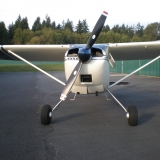
Cessna Skywagon -- accept no substitute!
Thu Aug 06, 2015 2:49 pm
Re ct: Problems concerning maneuvering flight
I agree with Hotrod 180 that a slow, full flap, power/pitch approach works best when we can get it set up. If we need to get down quickly as in the low level forced landing or fire, use everything you can get.
- contactflying offline
- Posts: 4972
- Joined: Wed Apr 03, 2013 7:36 pm
- Location: Aurora, Missouri 2H2
Download my free "https://tinyurl.com/Safe-Maneuvering" e-book.
DISPLAY OPTIONS
Who is online
Users browsing this forum: No registered users and 7 guests
Latest Features
-
-
Featured Bush Planes
As one of the undisputed legends of bush flying, the Cessna 180 hauls a…Read More -
Aircraft Ownership and Maintenance
9 modification mistakes aircraft owners make when trying to "bush out" their birds—why some…Read More -
Live to Tell
A Minnesota pilot is surprised to learn that the sudden asymmetric drag of an…Read More




Latest Knowledge Base
-
Destinations
Canada offers some of the most spectacular backcountry flying on the continent. Here's what you need to know before you go.Read More -
Safety and Survival
Hope that you never have to use your survival vest but knowing you have it and knowing how to use…Read More -
Destinations
A regional guide with ideas for winter camping destinations in California, Nevada, New Mexico, and Arizona.Read More -
Aircraft
Finding an affordable aircraft that can handle the backcountry for $80K or less? A challenge for sure, but with the…Read More



