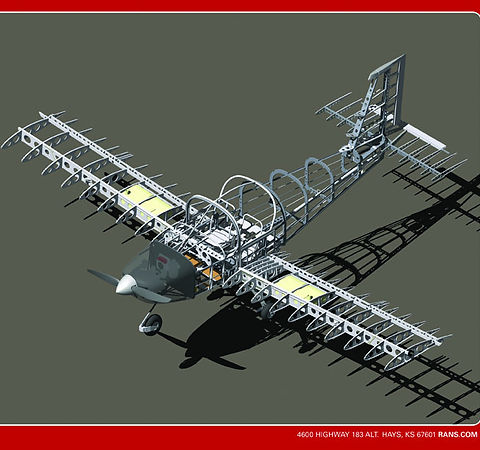
I guess with the S-21 being non-LSA, RANS was going after a little more speed. They quote 75% cruise as 155 mph with the 180 HP Titan 340. Not sure what a projected cruise would be with the new yet to be introduced 135 HP Rotax 915iS that Courierguy mentioned. What's that old adage, there is no such thing as a free lunch ?.
I like the looks of it, but wish it was the same span as the S20 (S21 is one foot shorter per side, and gives up 10 square feet of wing area because of it).
Also, figure a Rans S20 at 1320 GW with a 100 HP Rotax 912 vs Rans S21 with 135 HP Rotax 915 say at 1800 GW has similar power loading. The S20 vs S21 power loading is 13.20 vs 13.33. lbs/hp. That's fairly close and that's not taking into account any actual 915 weight savings (vs Titan 340). Wing loading of course is different.
Ultimately, jumping in and taking a flight around the patch is what counts.
.
In theory there is no difference between theory and practice. In practice there is. Yogi Berra
.
https://en.wikipedia.org/wiki/Aspect_ratio_(aeronautics)
In aeronautics, the aspect ratio of a wing is the ratio of its span to its aerodynamic breadth or chord. A long, narrow wing has a high aspect ratio, whereas a short, stubby wing has a low aspect ratio.[1].
For a given wing area, the aspect ratio, which is proportional to the square of the wingspan, is of particular significance in determining the performance. Roughly, an airplane in flight can be imagined to affect a circular cylinder of air with a diameter equal to the wingspan.[2] A large wingspan is working on a large cylinder of air, and a small wingspan is working on a small cylinder of air. For two aircraft of the same weight but different wingspans the small cylinder of air must be pushed downward by a greater amount than the large cylinder in order to produce an equal upward force. The aft-leaning component of this change in velocity is proportional to the induced drag.