vapilot wrote:If you have the time, you could go down to Moultrie, GA to Maule Flight (http://www.mauleflight.com/Services/) and get checked out.
Battson wrote:Sorry about thread creep.... but this has me interested.
Can anyone concisely explain why Maules are such a handfull on landing, esp. wheelies?
Is it simply the short fuse / lack of rudder surface combo?
Or something 'more complicated', like the distance between the centre of gravity and the mains?

OscarDeuce wrote: I was told the advantage to the oleo strut gear, aside from less weight, is it fits in the ruts left by cars and trucks if you want to land on a dirt road. .........
OscarDeuce wrote:.... I found a Maule pilots forum and there is a lot of discussion about this on there. Opinion seems to range from "if you can grease a Pitts on every time, you might be able to land a Maule and live through it, to "it's just another airplane." .....
hotrod150 wrote: In my experience, if you're stuck in the ruts, you go where the ruts go-- which may or may not be where you want to go.
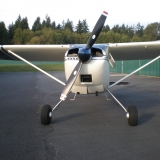
maules.com wrote:There is 22" difference in width and 55lbs weight.
ozy wrote: I am finishing my PPl in the Maule it is a bit of a pick up truck but I like pickup trucks, and this old dog is learning new tricks, I love it.
hotrod150 wrote:Maule spring gear is wider track & maybe tougher, while the oleo gear is narrower but maybe has more options (extended gear etc). Which is better for landing on the rough stuff? I have lots of time in spring gear Cessna's & while tough, they can sometimes be unforgiving as far as descent rate at touch-down goes (boing, boing, boing). Bungee gear ala Supercub or bungee/oleo gear ala Pacer both seem better (more forgiving) in that regard. I don't know if Maule uses bungees in conjunction with the oleo(s), but I wonder how forgiving is the Maule oleo gear vs Maule spring gear? Seems like whichever one does a better job of soaking up the bumps might be the smarter choice, at least for typical BCP use.
dirtstrip wrote:Getting no mention in the comparison of spring and oleo/bungee gear beyond width and normal shock absorption ability is the manner by which each system delivers stress to the airframe. Notice that with the spring gear it is very narrow at the attach point to the fuselage compared to the spread out multiple attach points of the oleo gear. In my opinion no piloting skill can make up the engineering advantage of spreading that twisting force to multiple points if you have to jump on the brakes or stub your wheel in a hole or mound. In this situation, the spring gear "system" is at a disadvantage in strength by using a narrower portion of the fuselage over which it must deliver and spread that twisting force. Narrowing the delivery area at the fuselage is the same as having greater leverage force applied rearward to the outer end of the gear leg. I'll stop here before I start going in to quantum physics as it applies to farm equipment.
dirtstrip wrote:....In my opinion no piloting skill can make up the engineering advantage of spreading that twisting force to multiple points if you have to jump on the brakes or stub your wheel in a hole or mound. ....
hotrod150 wrote:dirtstrip wrote:....In my opinion no piloting skill can make up the engineering advantage of spreading that twisting force to multiple points if you have to jump on the brakes or stub your wheel in a hole or mound. ....
Damage control is an issue I hadn't even thought about. I've seen quite a few Cessna's where the gear leg held up pretty good in a wreck.... however, usually it ended up being partially or completely ripped out of the fuselage causing plenty of damage in that department. The Cubs Maules etc I've seen that suffered similar wrecks usually had the gear all bent up, but the fuselage appeared to be relatively unscathed. Seems easier to repair/replace landing gear than fix a forcibly de-legged fuselage.
Users browsing this forum: No registered users and 0 guests