GravityKnight,
I appreciate your testing these techniques and your comments on the test. I never got around to running those kind of tests because I always used the basic low ground effect takeoff and I was always alone or had a student practicing these techniques.
It is harder to teach or learn good technique in an airplane that has lots of power to weight. In the spray world you always takeoff loaded/overloaded and when you get a bigger engine, you get a bigger load. I had one exception, the old $10,000 piece of junk Stearman with the R-985 450 hp Pratt and Whitney radial. They could only get a 200 gal hopper stuffed into the front seat area.
Again I understand the test of altitude gained over the obstruction for stats. Keep in mind what MTV said about the particular math for your particular airplane. In real life, if you stay in ground effect keeping or dropping the flaps and try to almost hit the obstruction, you will be in the best possible shape for errors, density altitude, weight, wet grass, etc. that come up in real life. Since my life was a series of errors, I know about these things.
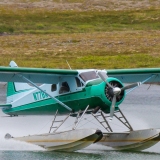
Video: Floatplane fails to clear trees
Sun Oct 18, 2015 12:31 pm
- contactflying offline
- Posts: 4972
- Joined: Wed Apr 03, 2013 7:36 pm
- Location: Aurora, Missouri 2H2
Download my free "https://tinyurl.com/Safe-Maneuvering" e-book.
Sun Oct 18, 2015 1:06 pm
Re: Video: Floatplane fails to clear trees
Mike,
I would be genuinely interested in your thoughts about this "low ground effect" technique in float planes. I was taught (and my ongoing experience has tended to reinforce) that there are some significant differences.
1. For a high wing plane, the extra height from being on floats means there is very little ground effect. Especially on land when the wheels are down on big amphib floats on a high wing plane, it seems that whatever vertical speed you approach at will continue to touch down. There is little or no "air cushion" from ground effect.
2. Because the consequences of inadvertently touching back down after lift off are much greater on water (likely water loop or upset), and the likelihood is greater than over land (especially with glassy water), it is good practice to climb away from the water immediately. If you can't climb a bit away from the water, then put it back down and make another plan, like shuttling people or cargo, or waiting for more favorable conditions.
Thoughts?
Pierre
I would be genuinely interested in your thoughts about this "low ground effect" technique in float planes. I was taught (and my ongoing experience has tended to reinforce) that there are some significant differences.
1. For a high wing plane, the extra height from being on floats means there is very little ground effect. Especially on land when the wheels are down on big amphib floats on a high wing plane, it seems that whatever vertical speed you approach at will continue to touch down. There is little or no "air cushion" from ground effect.
2. Because the consequences of inadvertently touching back down after lift off are much greater on water (likely water loop or upset), and the likelihood is greater than over land (especially with glassy water), it is good practice to climb away from the water immediately. If you can't climb a bit away from the water, then put it back down and make another plan, like shuttling people or cargo, or waiting for more favorable conditions.
Thoughts?
Pierre
- Pierre_R offline


- Posts: 313
- Joined: Mon Sep 30, 2013 3:17 am
- Location: Minden, Northern Nevada
- FindMeSpot URL: https://share.findmespot.com/shared/fac ... 5KFquxzBYq
- Aircraft: 1964 C182 IO550 on Aerocet 3400's.
Aerotrek A220.
TBM 850
Sun Oct 18, 2015 4:17 pm
Re: Video: Floatplane fails to clear trees
Pierre_R wrote:Mike,
I would be genuinely interested in your thoughts about this "low ground effect" technique in float planes. I was taught (and my ongoing experience has tended to reinforce) that there are some significant differences.
1. For a high wing plane, the extra height from being on floats means there is very little ground effect. Especially on land when the wheels are down on big amphib floats on a high wing plane, it seems that whatever vertical speed you approach at will continue to touch down. There is little or no "air cushion" from ground effect.
2. Because the consequences of inadvertently touching back down after lift off are much greater on water (likely water loop or upset), and the likelihood is greater than over land (especially with glassy water), it is good practice to climb away from the water immediately. If you can't climb a bit away from the water, then put it back down and make another plan, like shuttling people or cargo, or waiting for more favorable conditions.
Thoughts?
Pierre
Pierre,
You make some valid points. First, it's important to understand, as you obviously do, that "ground effect" is not just one "effect". In fact, we were all taught that ground effect has it's greatest effect when the wing is within one wing span of the surface, whatever that surface is. And, the closer the wing is to the surface, the stronger the effect is. Conversely, as you noted, if the wing is further from the surface, the ground effect is weaker. Still there, but not as strong. And, as you stated, floats, particularly amphibious floats, by definition move the wing further from the surface.
But, quite often when operating heavy seaplanes off the water, the pilot tries hard to get the airplane into the air before it's really ready to fly, for one simple reason: Aerodynamic drag is considerably less strong than is hydrodynamic drag. So, if we can get the floats out of the water as quickly (and at the slowest possible speed) as possible, and KEEP the airplane in the air after launch, we can immediately lower the nose, keep the airplane in low ground effect (as in VERY low ground effect) as the airplane accelerates through stall speed, and up to a reasonable climb speed.
Frankly, if you can successfully initiate a climb right after coming out of the water in a seaplane, you're either not very heavy or you stayed on the water quite a bit longer than necessary. Now, I should qualify that by stating that there are seaplanes that are significantly overpowered, and many of these planes will indeed climb right out of the water. The Husky is the one that comes immediately to mind.
But, with larger seaplanes, one often needs to work the edges a bit to figure out how to get that plane to launch at the slowest possible speed. That may be a left roll to get one float out of the water, it may be a quick pitch up to cause water to literally push the floats up out of the water, or with one airplane, I found that after getting on the step and up to a certain speed, I could stomp on the left rudder hard, which slewed the plane into a yaw, causing the water to push against the sides of the float bottoms. That pushed the plane up out of the water at minimal speed.
After any of those "tricks", you'd best be getting the nose over, and settle the plane into low ground effect (water effect?) as it accelerates to climb speed. Again, I'm talking heavily loaded airplanes here, not ones that are lightly loaded, though these techniques may in fact help shorten takeoff distance in lightly loaded planes as well.
As to worries about touching down while in ground effect, that's always a risk, but is really not much worse if any than it is in a landplane. Obviously, if you do touch down again, any hope of making a short takeoff is gone, so in a confined area, it's best to pull the power and settle back to displacement taxi, and go back for another try.
As always, it's always best to experiment with these techniques with a very experience seaplane instructor on board, and on a large body of water.
But, the short answer to your question is this: Yes, ground effect does in fact assist the seaplane in getting airborne off the water.
Now, the amphibian on land is a little different situation, since as you point out, the wing is just that much further from the surface. Also, judging ground effect as you settle onto a runway from a descent is difficult at best, particularly when the ground effect is at it's minimum strength. And, acceleration on wheels in an amphib is far quicker than it is on water, so the need to get off the surface at minimum controllable airspeed (MCA) is negligible in this case.
But, getting a seaplane out of the water at absolute MCA and acceleration in low ground effect is absolutely essential to the shortest takeoffs and the most efficient climbs.
When I was working seaplanes with big loads, this process happened on every launch.
MTV


Sun Oct 18, 2015 5:19 pm
Re: Video: Floatplane fails to clear trees
mtv wrote:
Is there a published Vx for your airplane with flaps UP? Most Vx numbers published are in a specified configuration. Change configurations and your Vx will also change. Just be careful that you know the appropriate speed for a specific configuration.
But, yes, accelerating in ground effect to a safer speed will permit a better climb rate. More like Vy. Remember Vy is better climb RATE, whereas Vx is the most altitude gained for a given distance forward.
MTV
I have not seen published data for my wing. I talked to a RANS builder who said typically Vx is 55, and Vy is about 70mph with my setup. He didn't mention flaps. 2 notches out of 4 (5 settings if you include fully up) does seem to help with take off... I leave them up while accelerating to get rid of the drag, then pop them in and the plane pops off the ground nicely. But as far as climbing with them, it does appear that it climbs best, even slow, with 1 notch or none. Either way, I'm pretty far above stall speed, and I found something interesting out the other day.. I went up high, and tried to do a full power stall... I wasn't fully aft with the stick, but I was very steep, and still climbing 4-500fpm at 40mph!! I gave up.... plane is quite challenging to stall with the power on. I added some more VG's in front of the alerons because they were spaced evenly and some articles I've read said generally you run a few more on the ends of the wing.. it now stalls (actual wing drop) with full flaps around 30-33mph with just me in it, and around 35-37 with 0 flaps... pretty good for the faster wing.
I have tried some different things, and I don't see much better FPM at 70 vs a slower climb around 55-60... which is kind of strange. With the zipper big bore I put on, and they way I have my short (too short I believe) prop pitched (55-5600 on take off, 6000 flat and level WOT).. it seems happier to climb slow.. as in, I don't give up much FPM, but can really climb steep which I enjoy - and of course suits places like my strip with obstructions better. I can't remember the last time I flew without noticeable up/down drafts where I could really test to see what netted the best climb though... it's just been that way lately.
And of course depending on the day, I've been able to sustain as good as 1100fpm (around 8000ft altitude) and some days only 800 due to conditions/temp outside.
I need to do more testing obviously, but I'm planning to dump the wheel pants, get larger tires/longer nose fork and a longer prop here pretty soon and I'm sure that will change things.
Last edited by GravityKnight on Sun Oct 18, 2015 6:12 pm, edited 1 time in total.
- GravityKnight offline
- Posts: 266
- Joined: Tue Sep 15, 2015 10:03 am
- Location: Colorado
- Aircraft: RANS S7S / EP912STi /
Robert's gear / 29" ABWs
VG's / T3 / 75" ww
Sun Oct 18, 2015 5:43 pm
Re: Video: Floatplane fails to clear trees
GravityKnight wrote:Now this might have something to do with climbing without flaps... I need to also test building speed in ground effect, and still climbing with 2 notches to compare directly to my original technique.. But the bottom line is that even though I'm using up more runway, and leaving myself less distance to climb.. building energy in ground effect and then trading it for a strong climb netted more altitude. Just as you mentioned. Somehow I already knew this to be true, but had convinced myself I had found the best technique with the way I was doing it.
If I had to guess why,
I would say with a dirty climb (with flap) at Vx from lift-off, you are way back in the drag curve - high angles of attack and lots of power being lost to dragging the aircraft through the air.
Whereas by accelerating in ground effect, cleaning up, and climbing with a zoom, the wing is over the worst of the drag curve and much more of the engine's power is converted into kinetic (and then potential) energy, with less wasted power churning up the air. The aircraft is optimised to fly at higher speeds than Vx. I bet you would also find the more gradually you pull up, the better the result (higher as you cross the obstacle), as once again you're losing less energy to drag.
It is (was?) commonly instructed that climbing with flaps deployed is less effective and yields poorer rates of climb.
Sun Oct 18, 2015 6:18 pm
Re: Video: Floatplane fails to clear trees
GravityKnight wrote:mtv wrote:
Is there a published Vx for your airplane with flaps UP? Most Vx numbers published are in a specified configuration. Change configurations and your Vx will also change. Just be careful that you know the appropriate speed for a specific configuration.
But, yes, accelerating in ground effect to a safer speed will permit a better climb rate. More like Vy. Remember Vy is better climb RATE, whereas Vx is the most altitude gained for a given distance forward.
MTV
I have not seen published data for my wing. I talked to a RANS builder who said typically Vx is 55, and Vy is about 70mph with my setup. He didn't mention flaps. 2 notches out of 4 (5 settings if you include fully up) does seem to help with take off... I leave them up while accelerating to get rid of the drag, then pop them in and the plane pops off the ground nicely. But as far as climbing with them, it does appear that it climbs best, even slow, with 1 notch or none. Either way, I'm pretty far above stall speed, and I found something interesting out the other day.. I went up high, and tried to do a full power stall... I wasn't fully aft with the stick, but pretty close.. I was very steep, and still climbing 4-500fpm at 40mph!! I gave up.... plane is quite challenging to stall with the power on (which I realize isn't totally abnormal). I added some more VG's in front of the ailerons because they were spaced evenly and some articles I've read said generally you run a few more on the ends of the wing.. it now stalls (actual wing drop) with full flaps around 30-33mph with just me in it, and around 35-37 with 0 flaps... pretty good for the faster wing.
I have tried some different things, and I don't see much better FPM at 70 vs a slower climb around 55-60... which is kind of strange. With the zipper big bore I put on, and they way I have my short (too short I believe) prop pitched (55-5600 on take off, 6000 flat and level WOT).. it seems happier to climb slow.. as in, I don't give up much FPM, but can really climb steep which I enjoy - and of course suits places like my strip with obstructions better. I can't remember the last time I flew without noticeable up/down drafts where I could really test to see what netted the best climb though... it's just been that way lately.
And of course depending on the day, I've been able to sustain as good as 1100fpm (around 8000ft altitude) and some days only 800 due to conditions/temp outside.
I need to do more testing obviously, but I'm planning to dump the wheel pants, get larger tires/longer nose fork and a longer prop here pretty soon and I'm sure that will change things.
- GravityKnight offline
- Posts: 266
- Joined: Tue Sep 15, 2015 10:03 am
- Location: Colorado
- Aircraft: RANS S7S / EP912STi /
Robert's gear / 29" ABWs
VG's / T3 / 75" ww
Sun Oct 18, 2015 6:46 pm
Re: Video: Floatplane fails to clear trees
I used and taught the get all wheels off as soon as possible and then low ground effect until as fast as possible before climb for all takeoffs so that the energy was there when unexpectedly needed. Flaps and when to put them down/up/etc. was not a major issue. The technique works well either way. Never having a real handy flap handle or even flaps in a lot of the planes I flew I didn't worry about it. The thousands of takeoffs where the technique was absolutely necessary were in Cobra gunships that had no flaps and Pawnee spray planes which had Tri-pacer size flaps and a little handle on the floor requiring an under the panel dive to work, both overloaded. The thousands of takeoffs flying pipeline patrol were mostly on normal runways. Using the technique for every takeoff here only saved my ass two or three times in over ten thousand hours. I still think it was worth it.
- contactflying offline
- Posts: 4972
- Joined: Wed Apr 03, 2013 7:36 pm
- Location: Aurora, Missouri 2H2
Download my free "https://tinyurl.com/Safe-Maneuvering" e-book.
Mon Oct 19, 2015 8:47 am
Re: Video: Floatplane fails to clear trees
contactflying wrote: ...and Pawnee spray planes which had Tri-pacer size flaps and a little handle on the floor requiring an under the panel dive to work.....
(ssshhhh! don't say that too loud.....)

Cessna Skywagon -- accept no substitute!
Mon Oct 19, 2015 9:08 am
Re: Video: Floatplane fails to clear trees
Actually this summer the faa was'ramping' people on the beach in chinitna bay 8n lake clark n.p. two of them staying at a 850 dollar pernight per person lodge. Makes you wanna say hmmmmmmm........
- Headoutdaplane offline
- Posts: 526
- Joined: Thu May 29, 2008 5:21 pm
- Location: Homer, AK
The winner is the person with the most stories when he dies, not the most gold.
www.belugaair.com
www.belugaair.com
Tue May 24, 2016 6:23 am
Re: Video: Floatplane fails to clear trees
Pretty spectacular video! I don't think he planned it like that, but I like how cool all of them are afterwards. "Hey, why don't we have a drink? First rounds on me."
- elgoatropo offline
- Posts: 46
- Joined: Tue May 13, 2014 11:33 am
- Location: Kenai
Thu Oct 09, 2025 7:12 am
Re: Video: Floatplane fails to clear trees
Original video has been pulled. Anyone know of a copy?

DISPLAY OPTIONS
Who is online
Users browsing this forum: No registered users and 2 guests
Latest Features
-
-
Featured Bush Planes
As one of the undisputed legends of bush flying, the Cessna 180 hauls a…Read More -
Aircraft Ownership and Maintenance
9 modification mistakes aircraft owners make when trying to "bush out" their birds—why some…Read More -
Live to Tell
A Minnesota pilot is surprised to learn that the sudden asymmetric drag of an…Read More


Latest Knowledge Base
-
Destinations
Canada offers some of the most spectacular backcountry flying on the continent. Here's what you need to know before you go.Read More -
Safety and Survival
Hope that you never have to use your survival vest but knowing you have it and knowing how to use…Read More -
Destinations
A regional guide with ideas for winter camping destinations in California, Nevada, New Mexico, and Arizona.Read More -
Aircraft
Finding an affordable aircraft that can handle the backcountry for $80K or less? A challenge for sure, but with the…Read More