Hello all,
I don’t want to start the wheel landing versus 3-point debate, but was hoping for some tips.
I have been mostly a 3-point pilot for years and decided I would really like to get more comfortable with wheel landings. Partly just to have another tool in the tool box, and frankly with gusty winds the idea of being able to get the mains on before stalling sounds appealing.
I started off practicing on grass on calm days and worked up a scheme that works well for me (70 mph on final, full flaps and 1500 rpm).
This weekend I got what I thought would be anice training day with winds 5G15 which varied 30 degrees either side of the runway heading. It was a mess. Using my recipe above I kept bouncing. Finally I decided to bump up the airspeed to 80 (thinking of the quote to add half the gust to your airspeed) and it seemed to soften the descent rate, as expected, but i touched down was so fast that once it became a pretty jarring ride and I would ultimately power up and go.
I would like to blame the runway, but you all land off airport. So, I should be able to land on a flat grass runway even if it isn’t the smoothest.
At 70 with a headwind, I guess that converts to 60ish ground speed, does that give me a different effective descent rate that could explain the bounces?
80 seemed too fast and will burn up a lot of runway and is awful jarring.
Any thoughts or suggestions? What modifications do you make when wheel landing in gusty conditions?
Thanks
Sent from my iPad using Tapatalk
Wheel landings in gusty conditions help
Mon Sep 09, 2019 8:15 pm
Mon Sep 09, 2019 8:31 pm
Re: Wheel landings in gusty conditions help
If you are bouncing then you are to fast. I like to come down the same way as I do for 3 point, but just before touch down I push forward and roll onto the mains. This ensures I'm as slow as I should be, but keeps my tail up for better authority. Hopefully some higher time experts will speak up, but I found this worked well for me.
Mon Sep 09, 2019 9:23 pm
Re: Wheel landings in gusty conditions help
You will get a number of techniques described in this thread - so here's mine:
Personally don't think it's sensible to fly close to the stall speed in gusty conditions, so I wheel it on while the wings are still flying, and use this to push the plane onto the ground. This is not hard to do, in my case, I enjoy the shock absorption which the hydraulically-damped Bearhawk landing gear provides, combined with large bushwheels for shock absorption and (importantly) huge prop clearance. This makes the task easier than with straight sprung undercarriage or short landing gear. In fact, it's almost too easy, too much confidence is a bad thing.
The technique:
I fly the plane in at normal approach speed plus half the gust spread, more if I expect extra mechanical turbulence. I push forward and force the plane onto the ground at more or less any point in the round-out, depending on the wind. This sets the plane up in a nose-low wheeler - killing all the lift from the wings and without any bounce, the landing gear just doesn't bounce unless I really screw up royally. Finally, I dump the flaps to make sure the plane stays on the ground and doesn't try to weathercock any more than necessary.
Personally don't think it's sensible to fly close to the stall speed in gusty conditions, so I wheel it on while the wings are still flying, and use this to push the plane onto the ground. This is not hard to do, in my case, I enjoy the shock absorption which the hydraulically-damped Bearhawk landing gear provides, combined with large bushwheels for shock absorption and (importantly) huge prop clearance. This makes the task easier than with straight sprung undercarriage or short landing gear. In fact, it's almost too easy, too much confidence is a bad thing.
The technique:
I fly the plane in at normal approach speed plus half the gust spread, more if I expect extra mechanical turbulence. I push forward and force the plane onto the ground at more or less any point in the round-out, depending on the wind. This sets the plane up in a nose-low wheeler - killing all the lift from the wings and without any bounce, the landing gear just doesn't bounce unless I really screw up royally. Finally, I dump the flaps to make sure the plane stays on the ground and doesn't try to weathercock any more than necessary.

Mon Sep 09, 2019 9:50 pm
Re: Wheel landings in gusty conditions help
What A1Skinner said is exactly what I have taught for 45 years. The headwind component of the crosswind reduces ground speed and makes landing softer, shorter, and easier. Yes! different. No not harder.
Gust spread affects glideslope not ground speed. The very important fourth control, throttle, effectively deals with sinks and balloons only if we move it...a lot if necessary. In extreme gust spread sink, push it all the way in and then adjust. In extreme gust spread balloon, pull it completely back and then adjust.
As in many maneuvering flight situations, we are better when we move.
Gust spread affects glideslope not ground speed. The very important fourth control, throttle, effectively deals with sinks and balloons only if we move it...a lot if necessary. In extreme gust spread sink, push it all the way in and then adjust. In extreme gust spread balloon, pull it completely back and then adjust.
As in many maneuvering flight situations, we are better when we move.
- contactflying offline
- Posts: 4972
- Joined: Wed Apr 03, 2013 7:36 pm
- Location: Aurora, Missouri 2H2
Download my free "https://tinyurl.com/Safe-Maneuvering" e-book.
Mon Sep 09, 2019 9:55 pm
Re: Wheel landings in gusty conditions help
contactflying wrote:Gust spread affects glideslope not ground speed.
The wing doesn't care about ground speed. It's airspeed which impacts the roundout and flare behaviour of the wing, that's gotta be half of what leads to bounces anyway, the wing still flying.
The other half of bounces being heavy landings, which can happen if the gusts can't be controlled by the throttle. I have had some pretty nasty experiences on this front, on very gusty days when the wind suddenly disappeared. The worst case, I was 100ft in the air and needed full power for what felt like 4 seconds to arrest what can best be described as a free-fall


Tue Sep 10, 2019 1:55 am
Re: Wheel landings in gusty conditions help
Good job. It worked. I have been there too, and it does work. Faster ground speed in stronger headwind component conditions (yes they added that much airspeed) results in far more problems. The OP is having those problems. They are not necessary. If we actually lose the engine in these conditions, we can still get down with slow ground speed speed.
I understand the airspeed is necessary to make the wing fly. Of course we don't want to stall. In strong headwind component, we have to come unglued to stall. The common problems are wing wagging (aileron turns) and directing the prop instead of bracketing the centerline between our legs with rudder and the really really big one, too much airspeed to get the wing to quit flying in low ground effect on the first half of the field. All that headwind to help and still have trouble getting stopped?
I understand the airspeed is necessary to make the wing fly. Of course we don't want to stall. In strong headwind component, we have to come unglued to stall. The common problems are wing wagging (aileron turns) and directing the prop instead of bracketing the centerline between our legs with rudder and the really really big one, too much airspeed to get the wing to quit flying in low ground effect on the first half of the field. All that headwind to help and still have trouble getting stopped?
- contactflying offline
- Posts: 4972
- Joined: Wed Apr 03, 2013 7:36 pm
- Location: Aurora, Missouri 2H2
Download my free "https://tinyurl.com/Safe-Maneuvering" e-book.
Tue Sep 10, 2019 6:49 am
Re: Wheel landings in gusty conditions help
Tnathan wrote:Hello all,
I don’t want to start the wheel landing versus 3-point debate, but was hoping for some tips.
I have been mostly a 3-point pilot for years and decided I would really like to get more comfortable with wheel landings. Partly just to have another tool in the tool box, and frankly with gusty winds the idea of being able to get the mains on before stalling sounds appealing.
I started off practicing on grass on calm days and worked up a scheme that works well for me (70 mph on final, full flaps and 1500 rpm).
This weekend I got what I thought would be anice training day with winds 5G15 which varied 30 degrees either side of the runway heading. It was a mess. Using my recipe above I kept bouncing. Finally I decided to bump up the airspeed to 80 (thinking of the quote to add half the gust to your airspeed) and it seemed to soften the descent rate, as expected, but i touched down was so fast that once it became a pretty jarring ride and I would ultimately power up and go.
I would like to blame the runway, but you all land off airport. So, I should be able to land on a flat grass runway even if it isn’t the smoothest.
At 70 with a headwind, I guess that converts to 60ish ground speed, does that give me a different effective descent rate that could explain the bounces?
80 seemed too fast and will burn up a lot of runway and is awful jarring.
Any thoughts or suggestions? What modifications do you make when wheel landing in gusty conditions?
Thanks
Sent from my iPad using Tapatalk
Sounds to me like it’s time to find an instructor who’s well familiar with your aircraft type.
Internet flight instruction is often worth precisely what you pay for it. Too many subtleties to make it very useful in the situation you’re in.
Opinions.....everybody’s got one. Including me.
MTV

Tue Sep 10, 2019 6:57 am
Re: Wheel landings in gusty conditions help
mtv wrote:Tnathan wrote:Hello all,
I don’t want to start the wheel landing versus 3-point debate, but was hoping for some tips.
I have been mostly a 3-point pilot for years and decided I would really like to get more comfortable with wheel landings. Partly just to have another tool in the tool box, and frankly with gusty winds the idea of being able to get the mains on before stalling sounds appealing.
I started off practicing on grass on calm days and worked up a scheme that works well for me (70 mph on final, full flaps and 1500 rpm).
This weekend I got what I thought would be anice training day with winds 5G15 which varied 30 degrees either side of the runway heading. It was a mess. Using my recipe above I kept bouncing. Finally I decided to bump up the airspeed to 80 (thinking of the quote to add half the gust to your airspeed) and it seemed to soften the descent rate, as expected, but i touched down was so fast that once it became a pretty jarring ride and I would ultimately power up and go.
I would like to blame the runway, but you all land off airport. So, I should be able to land on a flat grass runway even if it isn’t the smoothest.
At 70 with a headwind, I guess that converts to 60ish ground speed, does that give me a different effective descent rate that could explain the bounces?
80 seemed too fast and will burn up a lot of runway and is awful jarring.
Any thoughts or suggestions? What modifications do you make when wheel landing in gusty conditions?
Thanks
Sent from my iPad using Tapatalk
Sounds to me like it’s time to find an instructor who’s well familiar with your aircraft type.
Internet flight instruction is often worth precisely what you pay for it. Too many subtleties to make it very useful in the situation you’re in.
Opinions.....everybody’s got one. Including me.
MTV
Exactly what I was thinking. If the OP was in Alaska I'd say go pay for some dual with Don Lee. I'd be willing to wager that the SWPC has or knows of a good instructor nearby that can train some good technique.
Tue Sep 10, 2019 7:05 am
Re: Wheel landings in gusty conditions help
Variable gusty winds can lead to bouncing or ballooning depending on how the wind changes direction. I plan for needing a lot more runway in these situations and use a higher approach speed adding 1/2 the gust factor to my normal approach. I think above all it just requires a lot of practice because of the complex coordination of rudder, aileron, pitch, and throttle to make the approach to round out a smooth transition. Longitudinal control is everything and carrying more power into the approach makes this easier and gives me more time. When the forward wind changes direction to having more crosswind component I need to be ready to add power to prevent bouncing and correct with more aileron/rudder. The opposite is also true where the wind shifts from a strong crosswind to headwind component causing ballooning where a slight power reduction is often needed with corresponding less aileron/rudder. I try to time the touchdown using throttle when the plane is relatively stable and smooth. As the downwind main touches I anticipate the need to add more aileron/rudder with the reduced airflow on the control surfaces. The upwind main will then make contact and the flaps can be retracted with subsequent brake application. I prefer using wheel landings in gusty winds. The improvement in the forward visibility combined with better directional control make it my preferred method. I think it is unavoidable to make bad landings in these conditions. The wind is just too unpredictable. A small first bounce can be tolerated and the wheel landing salvaged but a large bounce or a second bounce should be either converted to a three point or a go around. Porpoising can result in a disaster.
- Dog is my Copilot offline
- Posts: 433
- Joined: Thu Apr 12, 2018 11:38 am
- Location: Portland
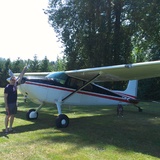
- Aircraft: 1958 Cessna 180A
Tue Sep 10, 2019 12:41 pm
Re: Wheel landings in gusty conditions help
Dog is my Copilot wrote:As the downwind main touches I anticipate the need to add more aileron/rudder with the reduced airflow on the control surfaces. The upwind main will then make contact and the flaps can be retracted with subsequent brake application.
I sincerely hope you got your "upwind main" and "downwind main" crossed up in your description......otherwise, those should be very interesting landings.
See what I mean about internet flight instruction?
MTV
Tue Sep 10, 2019 1:04 pm
Re: Wheel landings in gusty conditions help
Nathan,
What MTV said is true. What we say here is worth what you paid. I also have free worthless techniques if you click my signature box. There is no substitute for good instruction.
I assume you are finished with primary instruction and by now realize from war stories, written material, and especially experience that primary instruction was oriented toward practical test standards rather the most efficient and safest way to fly. You may have noticed that maneuvering flight safety techniques were not covered even though takeoff, landing, and much enroute in mountains takes place there.
So at this point you may be looking for an instructor willing to teach stuff not covered in the PTS or even covered less efficiently there. You may now realize that pitching to Vx or Vy as appropriate may be inappropriate when there is another mile of free low ground effect energy available.
From your post I see that you realize that the faster approach is neither the safer nor even more comfortable approach. You have realized, from experience, that wheeling it on fast is not a good solution to gusty wind conditions.
Like A1Skinner said, your same deceleration to almost 3 point and then level the fuselage is softest, slowest, and therefore safest.. Some instructors do it that way and some don't. Lots of instructors prefer the greater control authority of speed and will teach you to get it down with the wing still flying well, ie push it on and use a lot of brakes to finally get it stopped. Yes! A little scary.
MTV, Mike, is a good instructor. He believes in going as fast as possible rather than as high as possible on takeoff and as slow as possible on landing. Wait, I think the legalistic term is practicable rather than possible. OK.
What MTV said is true. What we say here is worth what you paid. I also have free worthless techniques if you click my signature box. There is no substitute for good instruction.
I assume you are finished with primary instruction and by now realize from war stories, written material, and especially experience that primary instruction was oriented toward practical test standards rather the most efficient and safest way to fly. You may have noticed that maneuvering flight safety techniques were not covered even though takeoff, landing, and much enroute in mountains takes place there.
So at this point you may be looking for an instructor willing to teach stuff not covered in the PTS or even covered less efficiently there. You may now realize that pitching to Vx or Vy as appropriate may be inappropriate when there is another mile of free low ground effect energy available.
From your post I see that you realize that the faster approach is neither the safer nor even more comfortable approach. You have realized, from experience, that wheeling it on fast is not a good solution to gusty wind conditions.
Like A1Skinner said, your same deceleration to almost 3 point and then level the fuselage is softest, slowest, and therefore safest.. Some instructors do it that way and some don't. Lots of instructors prefer the greater control authority of speed and will teach you to get it down with the wing still flying well, ie push it on and use a lot of brakes to finally get it stopped. Yes! A little scary.
MTV, Mike, is a good instructor. He believes in going as fast as possible rather than as high as possible on takeoff and as slow as possible on landing. Wait, I think the legalistic term is practicable rather than possible. OK.
- contactflying offline
- Posts: 4972
- Joined: Wed Apr 03, 2013 7:36 pm
- Location: Aurora, Missouri 2H2
Download my free "https://tinyurl.com/Safe-Maneuvering" e-book.
Tue Sep 10, 2019 2:14 pm
Re: Wheel landings in gusty conditions help
To the OP. As you can see lots of techniques and opinions But good instruction and sh#$loads of practice is what paid off for me. As far as how much xtra speed I carry in gusty winds.... it all came through practice. If you feel too fast it probably is, if you feel too slow it probably is and if it feels manageable give it a shot. You can always (usually) go around.
That being said from my experience getting the mains on the ground in challenging conditions is the most often the easy part. Flying the tail to the ground while slowing and losing rudder effectiveness while transitioning to braking/differential braking and keeping it straight was the hard part for me when I started flying tailwheel planes. At first my instructor was adamant about heels on the floor early in training but later on being spring loaded to use a brake or blast of power to stay on the desired path.
Watch some YouTube groundloop videos, most get their mains on runway just fine but the whole screwshow starts when the tailwheel gets to the ground. I listened to many techniques and tried to do them on my own but it didn’t sink in as good as the instruction I got from a competent (albeit kinda a Ahole) instructor. I was always taught to wheel land and now very rarely do a three pointer just for practice sake.
That being said from my experience getting the mains on the ground in challenging conditions is the most often the easy part. Flying the tail to the ground while slowing and losing rudder effectiveness while transitioning to braking/differential braking and keeping it straight was the hard part for me when I started flying tailwheel planes. At first my instructor was adamant about heels on the floor early in training but later on being spring loaded to use a brake or blast of power to stay on the desired path.
Watch some YouTube groundloop videos, most get their mains on runway just fine but the whole screwshow starts when the tailwheel gets to the ground. I listened to many techniques and tried to do them on my own but it didn’t sink in as good as the instruction I got from a competent (albeit kinda a Ahole) instructor. I was always taught to wheel land and now very rarely do a three pointer just for practice sake.
- TVATIVAK71 offline
- Posts: 114
- Joined: Tue Aug 02, 2016 6:21 pm
- Location: Anchorage
Tue Sep 10, 2019 3:05 pm
Re: Wheel landings in gusty conditions help
I sincerely hope you got your "upwind main" and "downwind main" crossed up in your description......otherwise, those should be very interesting landings.
See what I mean about internet flight instruction?
MTV
Thanks for catching this Mike -. Please read the correction as upwind ailerons into the wind with corresponding rudder to maintain direction control.

Practice makes perfect including writing posts.
Josh
- Dog is my Copilot offline
- Posts: 433
- Joined: Thu Apr 12, 2018 11:38 am
- Location: Portland
- Aircraft: 1958 Cessna 180A
Tue Sep 10, 2019 4:21 pm
Re: Wheel landings in gusty conditions help
Words are tricky. Aileron manages drift while rudder maintains longitudinal axis. Rub tummy while patting head. Aileron and rudder do not correspond with each other at this time. Coordination or correspondence, when precise directed course is necessary, is defeating. We are trying to keep the tail going where the front goes. We are not trying to turn. Coordination or correspondence is useful when turning.
- contactflying offline
- Posts: 4972
- Joined: Wed Apr 03, 2013 7:36 pm
- Location: Aurora, Missouri 2H2
Download my free "https://tinyurl.com/Safe-Maneuvering" e-book.
Tue Sep 10, 2019 7:34 pm
Re: Wheel landings in gusty conditions help
mtv wrote:Dog is my Copilot wrote:As the downwind main touches I anticipate the need to add more aileron/rudder with the reduced airflow on the control surfaces. The upwind main will then make contact and the flaps can be retracted with subsequent brake application.
I sincerely hope you got your "upwind main" and "downwind main" crossed up in your description......otherwise, those should be very interesting landings.
See what I mean about internet flight instruction?
MTV
Thanks but paying someone doesn’t always guarantee you will get your moneys worth either. I have had instruction from 5-6 tailwheel instructors over the years and many of them are notorious instructors you have heard of, which will remain nameless.
1. My first instructor said wheel landings are for air show performers. Forget it. No need to learn wheel landings.
2. One instructor said the exact opposite: 3-points are begging for a ground loop. Floating near stall while losing directional control is a bad plan. Always wheel land with zero pitch and play the throttle to manage descent. Get weight on the mains and full brakes, while working elevator to keep you from nosing over. You do have the plane sort of hog tied, but
3. Next guy. No one else knows pacers like I do, fly a standard pattern when on short final briskly push nose below horizon and add power (1800ish) to arrest descent and shoot for 80-85mph. When you touch, stay off the brakes but push stick full forward and cut the power to keep tail high otherwise you may lose rudder control. You can’t tip her unless you use brakes and you need to stick the plane to the ground with negative aoa. It worked but was really a fly it on strategy and burned a lot of runway.
4. Fly flat pitch at about 70 and 1500rpm when you round out pull back on stick for 3 seconds to arrest descent from 500fpm to 200fpm and then let it return to flat pitch and touch.
They each seem to teach their recipe which is often contradictory to what the previous guy taught. I thought looking at 15kt gusts was moving out of tailwheel endorsement territory. I was trying to pull together all these ideas and work on an approach that will work for me. All went well till the winds picked up. Then again my wife said I had the deck stacked against me: pacer, new bungies, 6x6 tires, bumpy grass runway, and some winds.
Thanks to everyone for your thoughts. Much appreciated.
Sent from my iPad using Tapatalk
Tue Sep 10, 2019 9:04 pm
Re: Wheel landings in gusty conditions help
“They each seem to teach their recipe which is often contradictory to what the previous guy taught. I thought looking at 15kt gusts was moving out of tailwheel endorsement territory. I was trying to pull together all these ideas and work on an approach that will work for me. All went well till the winds picked up. Then again my wife said I had the deck stacked against me: pacer, new bungies, 6x6 tires, bumpy grass runway, and some winds.”
I think it’s good you got a broad perspective of different ways of doing it from the instructors you flew with. When the wind picks up practice, practice. practice. To find what works for YOU. I know that’s pretty much a no sh$t Sherlock thing to say. Not practicing or finding your own way that works for you is gonna keep stacking that deck against your goal of operating in windy conditions. Then again do you really need to fly when it’s windy? If it’s that much of an issue that nothing works then just fly on calm days. No harm in staying in your comfort zone, lots of pilots do that.
Big plus is you got a grass runway to hone YOUR methods before going to not so forgiving pavement. I scared myself a couple of times practicing while employing everything I learned from various instructors. I even groundlooped once. Once.....but I came away with a valuable lesson on limits and hope to never back myself in that kind of corner again. (Sloped beach, windy...needed to gas up. Long story).
Good luck and happy flying.
I think it’s good you got a broad perspective of different ways of doing it from the instructors you flew with. When the wind picks up practice, practice. practice. To find what works for YOU. I know that’s pretty much a no sh$t Sherlock thing to say. Not practicing or finding your own way that works for you is gonna keep stacking that deck against your goal of operating in windy conditions. Then again do you really need to fly when it’s windy? If it’s that much of an issue that nothing works then just fly on calm days. No harm in staying in your comfort zone, lots of pilots do that.
Big plus is you got a grass runway to hone YOUR methods before going to not so forgiving pavement. I scared myself a couple of times practicing while employing everything I learned from various instructors. I even groundlooped once. Once.....but I came away with a valuable lesson on limits and hope to never back myself in that kind of corner again. (Sloped beach, windy...needed to gas up. Long story).
Good luck and happy flying.
- TVATIVAK71 offline
- Posts: 114
- Joined: Tue Aug 02, 2016 6:21 pm
- Location: Anchorage
Wed Sep 11, 2019 12:23 am
Re: Wheel landings in gusty conditions help
You get the test before ever having a chance to study the material. A good instructor can help you expand your envelope of experience in conditions that you'd normally not be competent in.
I will refrain from adding my Internet flight instruction to the thread, but I can tell you that I have landed my 170B in more wind than it's possible to taxi in.
I will refrain from adding my Internet flight instruction to the thread, but I can tell you that I have landed my 170B in more wind than it's possible to taxi in.
Wed Sep 11, 2019 2:13 am
Re: Wheel landings in gusty conditions help
Yes, they are fine with that kind of relative wind. I have landed most two and four place to zero ground run with very adequate relative wind. Angle across makes a lot of difference. Taxi is the exciting part and I have had to have gas truck to taxi upwind to help.
- contactflying offline
- Posts: 4972
- Joined: Wed Apr 03, 2013 7:36 pm
- Location: Aurora, Missouri 2H2
Download my free "https://tinyurl.com/Safe-Maneuvering" e-book.
Wed Sep 11, 2019 6:42 am
Re: Wheel landings in gusty conditions help
TVATIVAK71 wrote:“They each seem to teach their recipe which is often contradictory to what the previous guy taught. I thought looking at 15kt gusts was moving out of tailwheel endorsement territory. I was trying to pull together all these ideas and work on an approach that will work for me. All went well till the winds picked up. Then again my wife said I had the deck stacked against me: pacer, new bungies, 6x6 tires, bumpy grass runway, and some winds.”
I think it’s good you got a broad perspective of different ways of doing it from the instructors you flew with. When the wind picks up practice, practice. practice. To find what works for YOU. I know that’s pretty much a no sh$t Sherlock thing to say. Not practicing or finding your own way that works for you is gonna keep stacking that deck against your goal of operating in windy conditions. Then again do you really need to fly when it’s windy? If it’s that much of an issue that nothing works then just fly on calm days. No harm in staying in your comfort zone, lots of pilots do that.
Big plus is you got a grass runway to hone YOUR methods before going to not so forgiving pavement. I scared myself a couple of times practicing while employing everything I learned from various instructors. I even groundlooped once. Once.....but I came away with a valuable lesson on limits and hope to never back myself in that kind of corner again. (Sloped beach, windy...needed to gas up. Long story).
Good luck and happy flying.
Thanks. I just wondered if there were some more advanced techniques for windy conditions that I hadn’t picked up and thought back country pilots are they guys who know more since they fly some pretty challenging conditions (short, windy rough runways that you may only get one shot at.).
It sounds like I need to keep doing what I was taught and add half the gust. I went back out yesterday in low wind and banged out wheel landings on the hardtop. I thought taking surface condition out of the equation would be educational. They went really well, but I noticed I really land flat and I am not taking the wing as negative as I should. I can get away with this when I land smoothly with low winds. But with a little wind and a rough surface, if the aoa bounces around a little combined with some wind and extra power for gust compensation, wamo I am airborne again. I think my experience the other day just exposed some “sins” in my recipe that I need to work out. Nothing in my body wants to push the stick forward when I am getting shaken like i am going over rumble strips on the highway.
As for weather, waiting for better weather is an option. That’s how my wife and I have been flying for the past 5 years, but I have found that ends up with us sitting in the house on a lot of days our nose dragged friends wouldn’t think twice about flying. And if your plan is to do a cross country. The weather you had when you left is frequently not what you return too. It becomes really easy to say not today. I would rather find a way to expand my comfort zone.
Thanks again for your comments.
Sent from my iPad using Tapatalk
Wed Sep 11, 2019 7:53 am
Re: Wheel landings in gusty conditions help
Yes, getting comfortable and confident with applying nose down elevator pressure in a landing is something that takes a lot of time and practice. Have you practiced by running down the length of the runway up on your mains, with varying the speed and power? That exercise will greatly improve your confidence with planting the mains when the tail is up (buy up I am including everything from the tail-wheel 3 inches off the runway to a slightly nose-down attitude). The next exercise would be to do the same thing but on one main wheel. Spend a lot of time with those exercises (until they are boring) and you will be much more comfortable in a crosswind.
I'm also very big on recommending one or more low-pass or go-a rounds at any backcountry or unfamiliar airstrip. I could go on and on about all the benefits of this maneuver but in regard to this discussion, very often trees and terrain can be causing different wind conditions at different points in the landing environment, especially when some winds are involved it will really up your margin of safety. Fly what would be your normal pattern, approach and go around (departure route) and depending on the conditions fly it first at what ever is an absolutely safe height and then lower until you are fully confident about the conditions.
I'm also very big on recommending one or more low-pass or go-a rounds at any backcountry or unfamiliar airstrip. I could go on and on about all the benefits of this maneuver but in regard to this discussion, very often trees and terrain can be causing different wind conditions at different points in the landing environment, especially when some winds are involved it will really up your margin of safety. Fly what would be your normal pattern, approach and go around (departure route) and depending on the conditions fly it first at what ever is an absolutely safe height and then lower until you are fully confident about the conditions.
- BlackWater offline

- Posts: 58
- Joined: Wed May 14, 2014 2:37 pm
- Location: Santa Rosa
- Aircraft: C 170a
Husky A-1B (now on floats)
DISPLAY OPTIONS
Who is online
Users browsing this forum: No registered users and 1 guest
Latest Features
-
Live to Tell
A Minnesota pilot is surprised to learn that the sudden asymmetric drag of an out-of-rig ski can…Read More -
Creators
Working in some of the Yukon's most beautiful and remote environments, photographer Simon Blakesley captures aircraft in…Read More -
Aircraft Ownership and Maintenance
Upgrading to big tires can make a huge difference in backcountry performance, but with those gains come…Read More -
Tales from Yesteryear
In this tale from bush flying yesteryear, Don Cogger signs up to help Atlee Dodge Jr recovery…Read More


Latest Knowledge Base
-
Destinations
A regional guide with ideas for winter camping destinations in California, Nevada, New Mexico, and Arizona.Read More -
Aircraft
Finding an affordable aircraft that can handle the backcountry for $80K or less? A challenge for sure, but with the…Read More -
Aircraft
01.29.2018 - Zane - Updated tire diameter graphic to add 8.50x10 Guide to tires for use in the backcountry and off-airport landing…Read More -
Pilots
12.22.2013 - Initial article format Operating aircraft on skis and negotiating a snow-covered landscape is an entirely unique skillset and environment.…Read More


