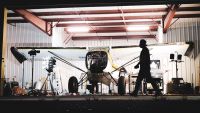
Introducing...The Bull Moose
A recurring lament in the kitplane market is that so few 4-place bushplane designs exist. The few available don't all necessarily have the same mission, either.
 Photo: Murphy Air
Common association of the Moose appearance with its radial cowling.
Photo: Murphy Air
Common association of the Moose appearance with its radial cowling.
What's out there? The short list includes the Bearhawk, the Dream Tundra, the Glasair Sportsman 2+2, Zenith CH801, Wag-Aero Sportsman (PA-14 clone), and more recently, the Airframes Alaska 4-place Super Cub. Canadian-grown Murphy Aircraft has been around for decades, and offered a couple 4-place (or more) models. These aircraft, with their all-metal, pulled rivet construction, are renowned bush flyers. But as it turns out, relatively few of the larger model kits are completed.
For whatever reason, the Moose is seldom seen in the wild. Who knows why? Rumors swirl on the support, customer service quality, and overall company health of the factory, but I think the real reason is simpler: The number of kits being sold and manufactured is low to begin with, because those in the market for aircraft like this likely want to work them, and choose a certified bird like the Beaver, Cessna 185, or 206.
So when a standout completed Experimental Murphy Moose surfaces, and a beautiful one at that, people take notice. It's a rare sight. We all go gaga.
The Murphy Moose is often thought of as an poor man's Experimental Beaver, because of the popularity of powering them with the Russian Vedeneyev M-14 radial. Maybe that is true, but impressions are easily clouded by the emotional response to a radial engine. The Moose airframe can also be coupled with other conventional aircraft engine options, but builder Ray Watson from Spokane, Washington had something greater in mind: The LS3 V8— the engine from the Chevrolet Corvette.
 Photo: Bonnie Cazier
This is what a Chevy LS3 V8 looks like, hung on the nose of a Moose.
Photo: Bonnie Cazier
This is what a Chevy LS3 V8 looks like, hung on the nose of a Moose.
He's named it The Bull Moose, and the process of making it his ultimate aircraft has spawned a new company all in itself, which he calls MooseMods— "Taking the Murphy Moose to another level in power, performance and style."
The result is as awesome as you'd expect: Big power, a more streamlined, aerodynamic look for the resulting engine cowling, use of modern digital engine management technology, and the sound of a V8 that conjures memories of the late Ben Haas' NASCAR-powered CH801. And, he's painted it an eye-catching, beautiful orange color to boot that makes any photo come to life.
While I didn't have the opportunity to shoot any video or action photos for this article due to the Bull Moose undergoing some R&D downtime, rest assured that a follow-up is planned.
 Photo: Bonnie Cazier
Parked in a meadow on an airstrip north of Spokane, the Bull Moose just look right, and checks a lot of boxes for what aircraft owners might want.
Photo: Bonnie Cazier
Parked in a meadow on an airstrip north of Spokane, the Bull Moose just look right, and checks a lot of boxes for what aircraft owners might want.
The Mission of the Moose
I sat down with Ray to ask him a few questions that pilots and other builders might have about his build, the Moose type in general, and aviation auto-conversions:
BP The Murphy Moose is an interesting platform to choose for customization. What was it about the model's specs and characteristics that attracted you? How does it fit your mission?
 Ray Watson of MooseMods
RWFor much of my 40 year flying career, I have flown a series of light and cabin class twins for business and personal use.
Ray Watson of MooseMods
RWFor much of my 40 year flying career, I have flown a series of light and cabin class twins for business and personal use.
In the early 90's when living in the Coeur d'Alene, Idaho area, I was introduced to the backcountry of Idaho by my good friend Herb Millhorn, the featured pilot in "Idaho Exposed" who taught me much about the ins and outs of flying in that unique and challenging environment. Honestly, it was a personal stretch getting used to flying single engine aircraft in areas that I had previously worked hard to stay out of in most of my flying career, but fell in love with that kind of flying!
My former aviation company did a number of upgrades, repairs and rebuilds on backcountry type aircraft, among them Bellanca Scouts, one of which I flew extensively learning all about this type of flying.
What I discovered in flying a small 2 place aircraft, was that while it was very well-suited to that type of flying, like most similar ones in that category, it also represented limitations in payload, fuel capacity, etc. Long story short, the Moose represented for my purposes an equally capable backcountry flyer, but with far more capacity to carry friends, fuel and all that goes with adventure flying. It fits my mission better than expected, being both a very capable short field heavy hauler with over 1,500# useful load, and now with the new LS3 package, a strong climber cruising in the 150-160 MPH range to boot!
With this new engine and propeller combination, it is not only a great backcountry aircraft, but actually a decent cross country traveling machine as well. While no aircraft is one that does everything well, this combination actually comes close!
 Photo: Bonnie Cazier
The Bull Moose baggage/cargo area is expansive, and impressive, especially without the second row seats installed.
Photo: Bonnie Cazier
The Bull Moose baggage/cargo area is expansive, and impressive, especially without the second row seats installed.
The Airframe
BP Does the Bull Moose have any aerodynamic modifications? Any major structural mods that depart from the stock kit plans?
RWNo modifications have been done to the flying surfaces of the Moose, although VG's will be added soon. However the main aerodynamic benefit to this Bull Moose package is the sleek fiberglass cowling with an updraft cooling system, giving a far more streamlined appearance and reduction in drag as compared to the other two main engine choices to date.
As one can imagine, this was a major undertaking with a great deal of attention to aerodynamic function, cooling considerations, and that it needed to present well visually. Must admit...it did turn out cool! Many have quipped that I'd better put a bunch of "NO JET A" stickers near fuel caps since it does look very "Turbine-esque".
 Photo: Bonnie Cazier
The custom cowling designed around the LS3 is gorgeous, almost turbine-like.
Photo: Bonnie Cazier
The custom cowling designed around the LS3 is gorgeous, almost turbine-like.
 Photo: Bonnie Cazier
The updraft cooling for the liquid-cooled LS3 is extremely effective.
Photo: Bonnie Cazier
The updraft cooling for the liquid-cooled LS3 is extremely effective.
From a structural standpoint, the Moose is already a very stout and rugged airframe. That in and of itself was a large contributing factor in my choice.
In that many Moose have now been in service for some time on both wheels and floats, with the kind of rugged use they receive, a few areas have seen some problems. Most notably the tail cone section, with the long moment arm and gross weight involved, has seen some damage from pilot induced operational situations. While we can't fix the pilot issue, it still seemed to make some sense to strengthen that area with some additional stringers, heavier skins, and overlapping skin doublers in that section.
Since then Murphy has come up with a fix themselves. I think that we have exceeded that for our objectives, however customers now have two choices. The tail spring was replaced with a stronger spring steel unit in lieu of the double tube configuration provided by Murphy. Also added was a much stouter internal mounting structure for the forward end of the tail spring.
 Photo: Bonnie Cazier
The Moose tail section and tailwheel spring have been reinforced somewhat.
Photo: Bonnie Cazier
The Moose tail section and tailwheel spring have been reinforced somewhat.
The main gear has also seen some issues, again due to pilot mismanagement, yet a beef up seemed in order.
The first phase of that has been accomplished with some additional external overlapping and heavier extended skin doublers.
The second phase is under design and testing which is an external support structure which will provide additional trailing support for the longer/taller Moose legs and the larger tires typically used.
I want to make clear that the Moose as provided by the Murphy factory is a very stout and capable aircraft, and have no concerns about it for normal operations. What we at MooseMods have developed are structural upgrades to provide an additional margin of strength for those aircraft getting used in active backcountry operations.
 Photo: Bonnie Cazier
Doublers and general beefing-up around the main gear attach points help with a known weak point of the Moose gear.
Photo: Bonnie Cazier
Doublers and general beefing-up around the main gear attach points help with a known weak point of the Moose gear.
The Corvette powerplant
BP It's a serious decision to commit to an automotive engine conversion. Why the LS3? How did you choose your propeller and did the engine have any bearing on that?
RWI'm sure like many who have been in aviation a long time, the notion of alternative power plants to the old technology has been of interest. When getting started on this project I bought two kits, one unassembled Moose kit, the other a Super Rebel (lighter brother to the Moose.) The Super Rebel came with the PSRU and an aluminum small-block Chevy V8 racing engine. I was clear that I wanted a Moose, hence the kit, but wanted to experiment with the automotive engine scenario, hence the other package.
Once I completed the build of the Moose, I installed the V8/PSRU package, and was very pleased with the performance. However, what I didn't like was the carburetor used in that package and the challenges of precise fuel management. After having a serious problem with that particular prototype engine due to an assembly error by a high performance engine shop, I had to go through it before installation. I went back to the drawing board.
 Photo: Bonnie Cazier
The LS3 mated to the Firewall Forward PSRU make quite a combo.
Photo: Bonnie Cazier
The LS3 mated to the Firewall Forward PSRU make quite a combo.
In looking at available options for fuel injection on that engine, the costs were such that I started looking at the electronically controlled fuel injection LS series engines as a possible alternative.
I ended up using the SDS EFI digital management system. I decided upon it in that it provides much easier programming than trying to reconfigure an OEM computer system for the LS3. This allows for several "limp home" features in lieu of system shut down with the OEM unit. It has also allowed for the use of a new throttle body with mechanical throttle linkage in place of the electrically controlled gas pedal configuration provided by the OEM system. This is a huge safety advantage and offers significantly less complication. I found Ross and Barry at SDS to be of great support in configuring the system for the LS3 package as well as some of the early flight testing "tweaking" that was needed. They will be providing this system for our packages as well as ongoing product support.
Another factor was that the performance was so good with the original 450 hp and the PSRU, I didn't want to settle for less power. The early performance results seemed to indicate that this type of package would be very viable for the Moose, so the wheels started turning on creating a package that would be easily replicable. That consideration had me leaning more toward the readily available GM LS3 series engines.
This particular engine is rated for 495 hp at 6,200 RPM. For the Bull Moose application I am using the derated 480hp at 5,200 RPM (take off RPM). That works well with the 2.11:1 PSRU gear reduction with a net prop RPM of roughly 2,500 RPM. In pull/thrust tests the engine/prop combination produced 1,300 lbs of thrust.
One of the things that I liked about the LS series is they were designed for continuous higher RPM operation, as well as a very strong and flat torque curve. Many were in use in NASCAR, Circle Track and other racing type applications, and demonstrated great reliability and performance. In thinking about the business potential, I liked that there were three different LS3 models ranging from 430hp to 525hp that could be good considerations for customers wanting different performance profiles.
 Photo: Bonnie Cazier
The 4-into-1 fat exhaust is enough to make a grown man cry with joy.
Photo: Bonnie Cazier
The 4-into-1 fat exhaust is enough to make a grown man cry with joy.
Since I have a set of aMPHibious floats to eventually mate up with the Bull Moose, I've been learning much from friends flying floats on certified aircraft. One of the biggest complaints I hear is that when operating out of higher elevation lakes at heavier weights, the performance is marginal with available certified engines. That reality is drawing much interest in our package from otherwise dedicated Cessna float-configured owners, coveting the significantly better horsepower and fuel efficiency this package is providing.
I am hoping that having a viable alternative package such as we now have, will benefit Murphy aircraft with increasing interest in the Moose kits. It is likely a year or so before I get the aMPHibs mounted on the Bull Moose, but I will certainly be providing performance information as that configuration comes together.
 Photo: Bonnie Cazier
Lurking under that cowling is the heart of American racing engine tech.
Photo: Bonnie Cazier
Lurking under that cowling is the heart of American racing engine tech.
Propeller Speed Reduction Unit
BP Were there any particular engineering challenges with integrating the LS3 and PSRU?
RWA little background on the unit: the PSRU is the CAM 500 unit produced by Firewall Forward in Ontario, Canada. A very stout, well designed and finely built unit capable of managing up to 700 hp. I enjoyed excellent product support from Archie Dobbins the general manager. I made a recent visit to Eagle Machine in Abbotsford, B.C., who actually produce the unit components; VERY impressed with their knowledge, ability and very high quality of each part involved.
These people really know their stuff. Just start a conversation about metal grades, hardening, etc! I did an inspection of all of the internal components prior to a PSRU unit assembly, and am pleased with the attention to detail and very high quality.
Three items presented themselves as challenges: The bell housing provided by Firewall Forward was designed around the small block Chevy. The LS engine block has all but one of the same transmission attach bosses in the same locations. This required a minor through bolt modification at the 2 o'clock position to mate the gear box portion to the Bell Housing, but works well. I have been speaking with Firewall Forward about a minor modification to the Bell Housing, since this would make the installation process for customers much easier.
Another item was the need to open up the inside mating surface of the Bell Housing to accommodate the larger diameter flywheel on the LS engine. That was a bit of a chore, but Firewall Forward has agreed to do that for our customers. A new Bell Housing mounting modification from the manufacturer would include this modification as well.
The only other matter was determining the size and depth of a spacing adapter for the harmonic dampener in the attachment to the flywheel. The spring loaded dampener carries the collared receiver for the spline drive shaft from the PSRU, much like a shaft from a manual transmission would in an automotive clutch application. This issue was successfully addressed with a beautifully machined part from Firewall Forward. They are, by the way, a great company to work with, so I have great confidence in being able to provide excellent customer support for the LS3 package we are providing.
 Photo: Bonnie Cazier
Big blades
RW My chosen propeller is the 82" Hartzell HC-C3YF-1RF. This prop is used in a number of high powered experimental applications such as the I0-720 powered Comp Air, etc. I consulted with Dick Jacobs and Ken Shisler at Northwest Propeller in Puyallup, WA, where I purchased the prop. This one has a 3" hub extension. I'm very pleased with performance in that it has a deep cord profile for lots of pull.
For this application I really like the 3-bladed setup; smoother and quieter than a larger diameter two blade option. When the airframe is set in a level attitude as it would be in a takeoff role, I have a 22" ground clearance.
 Photo: Bonnie Cazier
The big 3-blade Hartzell is specially chosen for its deeper chord profile and ability to harness high horsepower.
Photo: Bonnie Cazier
The big 3-blade Hartzell is specially chosen for its deeper chord profile and ability to harness high horsepower.
MooseMods—making the best of the Moose design
 BP Was the Bull Moose a planned project by Moose Mods? Or did the project itself precipitate the newly formed company?
RWGreat question...and I had to smile in pondering this process. Honestly, it all began from a desire to have a Moose for backcountry exploring. However as I got deeper into the build and developed an appreciation for this great design, I kept seeing things that I wanted to change for my purposes based on my operations experience and aircraft ownership over the past 40 years. That involved some convenience features (gull wing doors and more glass), and a decent cowling that was simply not available anywhere.
As a change was made in the prototype engine to the new LS3 I would eventually use, it became apparent that this was something that represented some serious interest in the backcountry and float community of flyers. Many liked the package, but understandably did not want to tackle the time consuming and expensive R&D.
 Photo: Bonnie Cazier
A simple, spacious, and fairly traditional panel was chosen for Ray's Moose.
Photo: Bonnie Cazier
A simple, spacious, and fairly traditional panel was chosen for Ray's Moose.
From that point on I decided to continue development with an eye toward eventual marketing of the engine package. After a year of designing and producing the cowl, it was clear that with the effort involved in that, there would be a market for the cowling as a part of the FWF package as well. Given this process, it could be said that the original project morphed into the newly formed company. That was not a difficult decision in that I was very pleased with the outcome of the huge investment of time and resources, plus was looking for a "retirement" business to transition to, hence MooseMods was born.
BP Are you manufacturing MooseMods components yourself? Or providing an integration kit made up of products from other vendors?
RWAs the notion of packaging what I had developed into products for the Moose in particular, I have given great attention to investigating who I could work with as vendors and suppliers, and rely on to take all of this as seriously as I do. That means quality products, produced and delivered on time, in the manner agreed upon.
I admit to perfectionistic inclinations with all things aviation, and in particular how I like to do things in business, and expect that from vendors and suppliers who feel the same. So far so good…and we all seem to agree that "good enough is not good enough"... so I may make that our company motto!
I am clearly not the only one in the aviation business who feels this way, and am pleased to have a network of reliable and conscientious people to work with in this endeavor.
 Photo: Bonnie Cazier
BP What mods do you intend to make available for Moose builders?
RWI mentioned some of the structural mods up above in the airframe-related beef-up mods. Those will be available in fall of 2018. Check in at MooseMods.com for updates.
Another mod is for strut braces on the horizontal stabilizer. That stabilizer is very wide, just under 11', and mounts on a comparatively narrow tail cone platform, with the actual attaching hardware being only 7" wide. I had seen some well-used Moose where the fiberglass fairing at that point had serious cracking due to the flexing that appears to occur; that got me thinking and I designed a simple strut assembly to provide additional support. The exposed strut material is a streamlined aluminum tube that creates little drag. I am not the first one to do something like this, but will make this rather simple mod available to give some support to this critical area as well.
Yet another mod is a 4130 steel tube V brace of greater diameter than the one provided by the factory. In addition to providing significantly additional structural strength, it is very handy and a much stouter hand-hold for hoisting yourself up into the cockpit.
 Photo: Bonnie Cazier
Streamlined struts for the horizontal stabilizer.
Photo: Bonnie Cazier
Streamlined struts for the horizontal stabilizer.
The major mod focus is the current LS3, 480 hp package…firewall forward. It will be provided as either a package of owner assembled components which we have developed which are proven to work well together, up to a "Plug and Play" pre-assembled ready to bolt in place unit. Under development at the moment is one other engine choice, that being the 430hp version of the same LS3 engine. Once that is in place it is conceivable that we'll take a look at the 525hp version, as well as any of these for other high performance applications. Those will be available through another division of the company...LSAeroEngines.

Our 4 into 1 custom exhaust headers are an attractive addition. These are made out of stainless steel with a reversed perforated spark-arresting cone installed in the collector. The cone provides the intended spark arresting, and surprisingly an amount of "bark" reduction as well. Two additional reasons for these: number one is to have minimal heat generating exhaust tubing inside the cowling, the other, frankly, is the cool factor. We have wrapped the header tubes with a fiberglass wrap, and have provided spark plug wires with double titanium sleeves to withstand up to 3,000°F. That provides a significant level of heat protection for the eight individual coil-to-plug wires from the headers.
All of the mods I am making available can be retrofitted, but of course are much easier to install during the initial build. As previously mentioned, what we at MooseMods have developed are structural upgrades to what is already a stout and capable design from Murphy, to provide an additional margin of strength for those aircraft getting used in active backcountry operations.
In the spirit of full disclosure, I am not an engineer. I do understand well however that if you change one thing, many issues may follow. That being said, much attention was given to not simply beefing up one area and therefore transferring a load somewhere else. All modifications are designed to spread loads over expanded areas and to date have proven to be doing the intended job well. Each modification came to be after much discussion with those who do understand well the engineering process, and have contributed greatly to what has been developed. I am simply the idea/common sense element, to which much knowledge from those who know "stuff about that stuff" has been added to assure some viable products.
Performance
BP How does Bull Moose performance compare to a stock Moose, either with a Lycoming 540 or M-14 radial?
RWHaving been around a few other Moose with the more common engines, I am very pleased with the performance we've accomplished in comparison to the other two engine options. It was not the original objective to beat the existing performance available, but rather to develop an alternative power plant option, hopefully at a competitive price, which would fall into the same approximate range of performance. I would have been pleased to have this package perform similarly, yet with more efficiency and ease of management.
While there are still some areas to explore in the flight envelope with power/prop settings, altitudes, loading, etc., at the moment I have a good dependable TAS of 153+ MPH, and a fuel burn of 15 GPH. With most recent testing of power settings, 65% at 6,500 MSL nets 170 MPH TAS with a fuel burn of 16 GPH. I credit the combination of cowling, prop and SDS EFI engine management system for this level of performance.
 Photo: Bonnie Cazier
Often compared to a Beaver, the Moose is actually a Cessna 185 killer. Bracing for 185 owner rage...
Photo: Bonnie Cazier
Often compared to a Beaver, the Moose is actually a Cessna 185 killer. Bracing for 185 owner rage...
My flight testing was done in an area with typically 5,000+ field elevations, during summer months with temperatures in the 80°+F range. In that environment climb rates ranged between 1,500-1,800 FPM with average mid-range loads of fuel and cargo simulating ballast. These numbers are with 26" Goodyear tires and the external horizontal stabilizer strut brace, so some additional drag is present in contrast to the usual Moose. Since completing the initial flight testing I have moved to the Pacific Northwest, and am looking forward to this Spring to begin performance comparisons at lower temps and elevations.
What I have seen for performance with most Moose running the M-14 is something in the neighborhood of 120 MPH TAS, burning 16 GPH. The large frontal area produces significant drag and speed penalty. Of course the appeal of the radial is there, so much depends on what a builder wants overall. The 540 Lycoming applications seem to perform in the 130 MPH range burning around 14 GPH. One I know of can push it to 140MPH, but increases fuel burn to 17 GPH. These numbers will vary to some degree of course from aircraft to aircraft, so for a reliable comparison, one should look at others in the field as well.
Since many will want to know more specifics on engine power settings being used at the moment...here you go:
| Take off | 5,200 RPM |
| Climb | 4,500 RPM |
| Cruise | 4,000 RPM |
Remember the 2.11:1 PSRU factor...so cruise prop RPM is a surprisingly quiet at 1,895 RPM.
The other advantage of the LS3 engine is the very flat torque curve, and at 3,800 RPM it is producing 450 foot pounds of torque. We will be doing some testing of lower engine RPM settings in the 3,600-3,800 RPM range and adjustments to the prop to see how lower engine RPM settings perform in cruise as well.
Cooling system temps stay solid at 176°F; oil temps 165°F in exiting the oil cooler. The updraft cooling system is working very well with an aluminum radiator mounted under the engine, with an auxiliary cooling fan. Ground ops during taxi testing in 80-90 degree F temps were well managed with no increases in temps. Climbs on 90 degree F days…all temps remain at above figures. The point I want to make with this engine package is not to suggest…"We're better than them", but rather that we have a very viable alternative to what is presently the most common engine options. The price point is competitive, even with the more expensive "plug and play" option.
BP I'm sure many builders out there are thinking "what paint did he shoot on that thing? It's gorgeous." So?
RWFor some reason, my early vision of the Moose was to paint it a copper color. I wanted something different and for it to stand out in the backcountry environment. What I came up with is a Jeep color code...Mango Tango Pearl. The combination of fine metal flake and pearl really makes this thing pop in the sun. It can be a challenge to apply…so I left it to a friend in the business…one piece at a time after each assembly was completed. Makes for a nerve wracking assembly...but all went well. I am very pleased with the result and literally everyone comments on it as beautiful/cool, etc. Interior is next on the list.
BP Any plans to attend fly-ins or otherwise be visible this year?
RWOshkosh didn't work out this year due to some continued R&D on the aircraft, but I hope to be at the High Sierra fly-in. Look for the Bull Moose at Moose Creek as a favorite base camp to wander through Idaho this year. Invite me to others!
 Photo: Bonnie Cazier
Aircraft Specifications
| Aircraft specs | |
|---|---|
| Type | Murphy Moose kit |
| Year | Project began 2005, completed in 2008 |
| Engine | LS3 Corvette - 6.2L / 376 in3 V8 |
| PSRU | Firewall Forward CAM 500 |
| Power output | 480hp at 5,200 RPM — 2.11:1 PSRU gear reduction ~ 2,500 prop RPM |
| Propeller | Hartzell 82" Hartzell 3-blade HC-C3YF-1RF |
| Gear | Murphy spring gear from kit |
| Tires/wheels |
|
| Wing | Standard Moose wing |
| Weight empty | 1963 lbs |
| Maximum gross weight | 3500 lbs |
| Useful load | 1537 lbs |
| Fuel capacity | 80 gal |
| Panel | Standard 6-pack |
| Other notable equipment |
|
Full gallery


https://backcountrypilot.org/features/category/featured-bush-planes/moosemods-murphy-bull-moose#sigProGalleria52e0d6abb9