Building on a solid foundation
Few aircraft can match the resume of a Cessna 180 for flying the backcountry. Land and take-off on unimproved areas the size of a football field, cruise at over 150mph, range and endurance to cruise over 1,000 miles, and haul over a half ton; all in an machine that sells on the used market for little more than the price of a new pickup truck.
Skywagon N5074E is a 1959 B model. I've owned it for 5 years, during which time I have flown it over 1,000 hours, modified it to suit my purposes, and started a Part 135 charter operation with it. 74E has been in commercial service for much of its life, including a long stint with a larger Alaskan air taxi prior to my ownership. When I acquired it, it was not in a flyable state; the wings and tail were removed and it had been in storage for several years. With lots of Super Cub time, but no Skywagon experience at all, I purchased it, put it back together, and discovered what a delightful plane it was to fly, all despite warnings from more experienced pilots about the dangers of the large taildragger. Within a year I had accumulated some time and managed to smash it up pretty well, learning a thing or two along the way. I rebuilt it according to my personal philosphy about what a working aircraft should be. Big tires, big power, big wings – everything else is fluff.
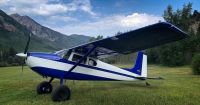
 N5074E parked on the North side of the Brooks Range, Arctic National Wildlife Refuge
Gut it, lighten it
The first order of business was to lighten it up and remove superfluous weight. Having left the factory at around 1,650 lbs, over the years it accumulated an ADF, Loran, multiple GPS’s, marine radio, and an autopilot – boosting the weight to over 1,800 lbs on paper and reducing the useful load to a not very useful 800 lbs or so.
 Mt Shishaldin looming over Shoemaker's Skywagon, Unimak Island, Aleutian IslandsRemoved were many pounds of wet insulation, most of the interior, about 100 yards of no-longer-connected wiring in the belly (along with plenty of dirt, sand, and extra hardware), and nearly all avionics. What remained was one aviation comm, the marine VHF (still very useful in costal Alaska), and a Garmin 296. Also replaced was the heavy old lead battery in the rear compartment – in exchange for a new lightweight firewall-mounted one.
Revisions of rubber
The aircraft had been run on 29" tires with Gar Aero 10" adapters for many years. These tires are extremely wear proof and very tough, plus they increase footprint and rolling size, as well as having good sidewall strength for resistance to rolling the bead when operated on a sidehill. But years of heavy loads and beach corrosion had taken its toll on the three-bolt Cleveland wheels. I replaced them with the excellent Alaskan Bushwheel 10" wheels and 29" Air Hawk tires. I was very happy with this setup for a couple of years, but was offered a deal on some 29x6 Alaskan Bushwheels that I couldn't refuse. At first I wasn't entirely committed to these tires. I operate on pavement in high winds at a couple airports not set up for gravel ops, and will often fly straight to large rock gravel bars or steep beaches. I found that the steep slopes were uncomfortable at first with the doughnut tires, but learned over time to trust them.
 Somewhere on a river, Kodiak island.
I have heard many opinions and anecdotes about the big tires "rolling under" on a steep slope, but have not found it to be a problem. However, I returned one day from Cub flying to find the 180 sitting awfully wing low. In my absence a bear had come along and apparently couldn't resist the taste of Bushwheel. Being unable to permanently repair the tire, I switched back to the 29" Air Hawks, at which point I realized how spoiled I was with the Bushwheels. Doughnut tires reduce airframe and landing gear shock on rough surfaces noticeably. Luckily I was able to scavenge an almost new set of 31" ABW from a Cub that didn't need them any more. With half a season of flying on them, I can say I believe they are the ultimate for an earlier lightweight 180 operating on rough surfaces. Slightly larger and noticeably softer than 29" ABW, they provide the largest margin of safety and resistance to airframe fatigue. Time will tell how they hold up to hard use, but I believe the shorter lifespan and susceptibility to punctures is offset by the advantages. If only 35" tires were approved!
The little wheel
Nearly as important as beefing up the main tires is a larger tailwheel. In fact, in many cases I think having an oversized tailwheel is more important that having monster-sized mains. This became readily apparent after my mechanic removed a bit more metal from my prop than I was comfortable with while dressing the nicks incurred from sustained high power taxi in deep beach sand after submarining my 8" tailwheel.
 The larger tailwheel was unquestionably one of the most valuable additions to the aircraft.
A 10" Scott tailwheel is slightly better, but still buries itself quite easily with a heavy load. The Gar Aero style tube tire and ABW doughnut tire I've found to be about equal, with any suspension advantage going to ABW, and price and wear resistance advantage to Gar Aero.
The 14" XP tailwheel has mixed reviews from other operators, but after only a couple flights in a 185 so equipped, I've since purchased one. The reduced rolling resistance and lower power required to taxi on soft gravel are noticeable.
Snow operations
During the cold part of the year tires are of little use in much of Alaska. The lack of ski fittings and aluminum axles on 74E were testimony that it had never been on skis. After installing F.Atlee Dodge ski fittings, fueling steps and steel axles, I installed Landes Airglas 3000 wheel replacement skis. They provided excellent performance in snow but their lack of turning ability led me to Federal 3500s, and then Airglas 3600 wheel penetration skis.
 Just as important to the working pilot as big tires is set good set of skis.
Penetration skis have one major drawback – drag caused by the wheel protruding through the middle of the ski, along with limited clearance for non-snow surfaces. In sticky or slushy snow they are particularly onerous, however they have advantages too. Simple and rugged, they have surprisingly good performance in deep powder due to their size. Rough, drifted snow or broken ice is best handled by these skis as the wheel penetrating through the center acts as a shock absorber. Plus there are no hydraulic lines, rams, or pumps to leak, blow seals in extreme cold, and add weight and pilot workload. Turns on ice, hardpack and deep snow are easy with the drag of a braked tire. Unlike straight skis, operations on graveled or paved surfaces are made possible.
All skis are a compromise, and the more varied situations and conditions you run in, the more this is true. Though far from ideal in many situations, with a high-performance 180 the Airglas 3600s have adequate performance under a number of different conditions. Finally, like an oversized tailwheel, a tailski helps taxing, turning, and performance by keeping tailwheel drag to a minimum.

Powerplant
When I acquired 74E it had one of the smoothest running engines I’ve ever flown behind. Unfortunately the factory Gold Seal O-470K was well timed out calendarwise, although only mid-time hourly. When the time came to prepare it for Part 135 work I quickly settled on the idea of a higher power engine. While the old one seemed to pull hard with an 88" seaplane prop, more power is almost always good. Good word-of-mouth references, a solid reputation in the industry, reputation for both power and smooth running engines, great customer service, lack of conversion costs, low overhaul cost, and a 2,000 hour TBO (money in the bank for a commercial guy) made the PPonk O-470-50 a no-brainer. At nearly half time on the engine I still couldn’t be happier with that choice. Compressions have remained in the high 70s, oil consumption is minimal and the extra power still puts a smile on my face every time I push the throttle in.
Along with a lightweight 160 HP Cub and the Beaver, a lightweight 180 with a P.Ponk -50 Super Eagle is one of the few planes that feels like it has enough power for most situations. Although 3-blade propellers have a great reputation, 74E still sports an 86" C58. The weight and cost difference between it and a 3 blade McCauley seemed enough to stick with the old long 2-blader. While composite propellers have a great reputation and I would love to try one on a float or ski plane, the danger of downtime in the bush by picking up gravel (a daily hazard on volcanic cinder beds and soft gravel beaches) will keep me from running one on the 180. One operator I know with a Super Cub on 31" tires and 3" extended gear had to send his composite prop across the country for rebuild after a particularly bad rock-nick from a maintained gravel runway. At 2,700 RPM the 86" blades don't howl like they do on an IO-520 @ 2,850 RPM, but are still sufficiently loud enough for me to perform reduced RPM takeoffs from congested areas. Even with a heavy load the extra couple hundred RPM are not missed if taking off from a runway over 1,000 feet long at sea level.
 A scenic but early photo of 74E on the south end of Kodiak Island prior to getting her long wings, Sportsman STOL, Bushwheels, and big tailwheel.
Power-to-lift ratio
The final part of the equation was wing area. When I first acquired her, 74E was a stock-winged bird. After so many hours in Cubs, I was surprised at the ability of the stock Cessna wing, both for clean, fast cruise, and with the help of large Fowler flaps – to fly slow.
Stalls were gentle but clean, with plenty of warning. Flying right to the edge of a stall on short final was no trick, and to be honest – I was perfectly happy with the way it flew. However, I knew that operating as a commercial ship, payload is the name of the game, and so I planned to add ART wing extensions, if for no other reason than to gain the extra 300 lbs of maximum gross weight that the STC allows. Since the extensions come as either plain leading edge or with a Sportsman cuff, I added the Sportsman cuff to the wing first.
Initially, I was not all that pleased with the change in characteristics with the cuff installed. Although stall speed was definitely slower, it was at a much higher angle of attack, unreachable in a landing or take-off configuration. I am still not sure that the STOL kit gives much benefit to take-off or landing, but it does allow you to climb steeper and gives a significant safety margin at high angles of attack. Having flown several float, wheel, and skiplanes both with and without (the same aircraft) Sportsman STOL, Robertson STOL, and wing extensions; I doubt I would install the cuff on a floatplane. You simply cannot rotate enough on either takeoff or landing to use the cuff to your advantage. Skis and floats on the other hand are where both wing extensions and especially drooping ailerons help. There’s a reason de Havilland did what they did! Regardless, on tall tires the leading edge cuff does give some advantage.
 The large wingspan of the WingX equipped 'wagon frames a view from an eastside ridgetop on Kodiak.
I flew the plane for a couple years before finally adding the ART wing extensions. I believe this is really a must-do mod for a commercial operator with an early 180. With the added weight of the Sportsman Stol and the wing extensions, 74E still enjoyed a net gain of 268 lbs of useful load. With a measured weight of 1,677 lbs with 31" tires and all four seats installed, it now has a useful of 1,273 lbs. That means with 4 hours of fuel, pilot, and 50 lbs of survival gear I can still quote over 700 lbs of payload. Most flights don't require more than two hours of fuel, giving even greater weight-lifting capability. It may not compete with a Beaver, but that is comparable to a 206 on floats or most bush-ready 185s.
Miscellany
Other modifications include bubble windows, necessary Cleveland wheels and brakes, Selkirk flat-floor extended baggage (a great mod), F.Atlee Dodge folding rear seats (also a great mod), F.Atlee Dodge windshield V-brace, the aforementioned marine VHF, and LED landing lights. Although initially aimed at a different market, Cessna got it right when they built what turned out to be one of the best aircraft every made for general-purpose backcountry use. With some of the many modifications available to us we can make it even better for our own missions.
| Aircraft specs | |
|---|---|
| Type | Cessna 180B Skywagon |
| Year | 1959 |
| Engine | Continental O-470-50 PPonk Super Eagle |
| Propeller | 86" MacCauley 2-blade |
| Gear | Stock |
| Tires/wheels | 31" Alaskan Bushwheels |
| Wing |
|
| Weight empty | 1,677 lbs |
| Useful load | 1,273 lbs |
| Fuel capacity | 55 gallons |
| More general aircraft type specifications can be found in the Knowledge Base. | |
Photo gallery
Enjoy the complete gallery of photos for N5074E:


https://backcountrypilot.org/features/category/featured-bush-planes/a-working-skywagon-kodiak-alaska#sigProGalleria4f8b2b47e8