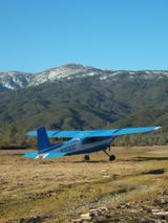
With all the issues of accurate W&B, real world vs book performance I thought it might be a good idea to lay down a performance baseline for my C-180. It has a few mods, but the only relevant ones are the Sportsman STOL... O-470R/ 2 Blade McC Prop... computed 1826lb. It had full main tanks, me and about 10 lb of gear. The filmed events in the video were done with about 6 knots headwind, we redid the T/O and Landing portions the next day with no wind (at least the 10 Degree flap Takeoff, 30 Degree flap takeoff and 40 Degree flap landing). Not a purely scientific test... distances are within 10', temps (~45F degrees) and weights and such just don't matter much. The way I figure it it is an approximation so close 'ballpark' is good enough for me. I'll redo the tests with Big Tires and then when it gets hot to allow for some density altitude issues. I dream of doing the Wing-X kit and a Pponk.... if that happens we'll redo the tests for those.
Is this about what everyone else is seeing?
http://youtu.be/l9JxrXa8XQI
gunny
C-180 Performance Test
Sun Feb 03, 2013 11:41 am
Sun Feb 03, 2013 12:31 pm
Re: C-180 Performance Test
Field elevation?
Thanks for posting this, it gives me something to compare my very stock 180A too.
MM
Thanks for posting this, it gives me something to compare my very stock 180A too.
MM
- mountainmatt offline

- Posts: 2803
- Joined: Sat Apr 11, 2009 2:43 pm
- Location: Colorful Colorado
FlyingPoochProductions
FlyColorado.org
FlyColorado.org
Sun Feb 03, 2013 12:34 pm
Re: C-180 Performance Test
KMWL is 974'.
Sun Feb 03, 2013 2:26 pm
Re: C-180 Performance Test
Of course, the only relevant factor in a short field roll out is how fast the airplane is going at touch down, which is why nailing approach speeds at 1.3 Vso is so critical. Any over that will materially increase the roll out. But since Vso is dependent on weight, if you're running light, you can safely approach at a much slower airspeed than if you're running at gross. Higher density altitudes will result in higher TAS for the same IAS, which obviously means a faster ground speed and longer roll out, as well.
Both density altitude and weight will materially affect take off performance as well--often much more than we realize.
Fundamentally, to know how your airplane will perform at a given weight and at a given density altitude, you have to fly it under those conditions. It's nearly impossible to accurately extrapolate how it will perform, from running light tests at a low density altitude.
But the testing is fun, right?
Cary
Both density altitude and weight will materially affect take off performance as well--often much more than we realize.
Fundamentally, to know how your airplane will perform at a given weight and at a given density altitude, you have to fly it under those conditions. It's nearly impossible to accurately extrapolate how it will perform, from running light tests at a low density altitude.
But the testing is fun, right?
Cary
"I have slipped the surly bonds of earth..., put out my hand and touched the face of God." J.G. Magee
Sun Feb 03, 2013 2:49 pm
Re: C-180 Performance Test
Cary-
It was fun. But I think you may have missed the point. I am trying to do just as you suggest. I wanted to establish a baseline.... not use a book number. I'll redo the tests at high density altitudes and weights (at least for here) and that will give me a better idea of what it will actually do rather than pulling it out of a chart from 1958. But from a scientific standpoint I could actually pull out the conversion factors and apply them to my numbers to achieve an extrapolation as you suggest... this is done all the time. Not every test program hits every test point.
As for approach speeds, I mentioned in the video that they were all done at 60 mph to the flare. We'll see how the airplane handles at higher weights and that has the potential of materially affecting the roll out. The difference in roll out distance can plainly be seen in the landings at various flap settings.
cheers,
gunny
It was fun. But I think you may have missed the point. I am trying to do just as you suggest. I wanted to establish a baseline.... not use a book number. I'll redo the tests at high density altitudes and weights (at least for here) and that will give me a better idea of what it will actually do rather than pulling it out of a chart from 1958. But from a scientific standpoint I could actually pull out the conversion factors and apply them to my numbers to achieve an extrapolation as you suggest... this is done all the time. Not every test program hits every test point.
As for approach speeds, I mentioned in the video that they were all done at 60 mph to the flare. We'll see how the airplane handles at higher weights and that has the potential of materially affecting the roll out. The difference in roll out distance can plainly be seen in the landings at various flap settings.
cheers,
gunny
Sun Feb 03, 2013 3:48 pm
Re: C-180 Performance Test
Cary wrote:Of course, the only relevant factor in a short field roll out is how fast the airplane is going at touch down, which is why nailing approach speeds at 1.3 Vso is so critical. Any over that will materially increase the roll out. But since Vso is dependent on weight, if you're running light, you can safely approach at a much slower airspeed than if you're running at gross. Higher density altitudes will result in higher TAS for the same IAS, which obviously means a faster ground speed and longer roll out, as well.
Both density altitude and weight will materially affect take off performance as well--often much more than we realize.
Fundamentally, to know how your airplane will perform at a given weight and at a given density altitude, you have to fly it under those conditions. It's nearly impossible to accurately extrapolate how it will perform, from running light tests at a low density altitude.
But the testing is fun, right?
Cary
Actually, 1.3 Vso is REALLY fast on a landing approach, at least for a speed over the threshold, assuming you are actually trying to land short.
There are several factors that complicate this:
Airspeed instrument error at high AOA is typically pretty high. Varies with A/C type and installation, but the only way you can find out for sure is to go fly the airplane...THAT airplane. Find out what indicated airspeed YOUR airplane checks out at. And, I'm sure the fans of the speed indexers are going to chime in here, and same applies to those devices....find out where your airplane stalls.
Second, power ON stall speed is always slower than power off stall speed. Vso is power OFF stall speed. A really short field approach is going to generally be done with at least a little power. So, now you also need to find out what your power ON stall speed is. Not only that, but what does the airplane tell you when you approach that speed/configuration?
Aircraft weight does in fact affect stall speed, but the actual difference in weight of most of these small airplanes between GW and "normal" operating weight really isn't all that huge, and thus stall speed differences aren't THAT huge. We can get into a discussion of semantics here, but the point is, as in discussions of the indexers, these are not F/A 18s where the max weight to landing weight varies MASSIVELY. Our stall speeds change a little between normal landing weights and max weight, but....not huge differences. Fly and test at the weights you are most likely landing in, as he notes he's doing.
In fact, a true short field approach and landing should be flown (from fairly close in on final) at 1.0 to 1.1 Vso, NOT at 1.3 Vso, which will cause that airplane to float forever.
If you are really, actually landing in short spots, 1.3 is REALLY fast on short final.
And, it's great to see someone out there doing some actual testing to see what their airplane can do. These old airplanes often don't offer a lot of information in the POH.
FWIW
MTV


Sun Feb 03, 2013 4:10 pm
Re: C-180 Performance Test
MTV-
Well said sir! Anecdotes only go so far. Some 'ballpark' facts take you a bit further! Short field landings aren't pretty and smooth...roller touchdowns are not the goal here. A real world idea of what the capabilities of the airplane and its pilot are...
I can't wait to see what, if any, impact the Big Tires have on performance. I have to wait... don't have jacks that can put the airplane that high:) (Actually I do, but its a time issue).
gunny
Well said sir! Anecdotes only go so far. Some 'ballpark' facts take you a bit further! Short field landings aren't pretty and smooth...roller touchdowns are not the goal here. A real world idea of what the capabilities of the airplane and its pilot are...
I can't wait to see what, if any, impact the Big Tires have on performance. I have to wait... don't have jacks that can put the airplane that high:) (Actually I do, but its a time issue).
gunny
Sun Feb 03, 2013 4:58 pm
Re: C-180 Performance Test
Nice gunny! I could get my 56 w sportsman an r motor off pretty consistently within less than 200 at sea level. Sometimes in less than 100. Not sure If it coincides w your testing but if u dump your flaps soon as u touch down you can stop shorter. Gets the weight on wheels faster. I'm sure you knew that. Probably not part o the test. Cool man. Curious to see change in 29's. I'm going that route on my 55 soon. Thanks for posting.
Sun Feb 03, 2013 8:32 pm
Re: C-180 Performance Test
I like video's like this. Fun and informative. Would be cool if more ppl posted videos like this and explained all mods and performance changes. Thanks for posting.
- Crzyivan13 offline
- Posts: 1811
- Joined: Sat Nov 24, 2012 9:50 pm
- Location: Ohio- OI27 Checkpoint Charlie
- FindMeSpot URL: https://share.delorme.com/EvanDavis
- Aircraft: 1957 Cessna 182A
Sun Feb 03, 2013 8:45 pm
Re: C-180 Performance Test
[emphasis mine]Agreed--I'm talking about the final approach leg, not the over-the-fence speed, which I agree should be just above Vso.Actually, 1.3 Vso is REALLY fast on a landing approach, at least for a speed over the threshold, assuming you are actually trying to land short.
I'm a little curious why 60 mph with each flap setting. I would think if 60 mph is a good stable IAS with no flaps, you should be able to reduce the approach speed markedly with flaps. Granted that the last 30/40 are more drag than lift, nonetheless I'd expect a slower speed would work.
Can't speak for a 180, but on my P172D, using my AOA gauge, I note about 5 mph difference at the same AOA reading between running at gross and running relatively light (just me and half tanks). Not huge, but notable. Again FWIW.
Cary
"I have slipped the surly bonds of earth..., put out my hand and touched the face of God." J.G. Magee
Sun Feb 03, 2013 8:51 pm
Re: C-180 Performance Test
Gunny wrote:With all the issues of accurate W&B, real world vs book performance I thought it might be a good idea to lay down a performance baseline for my C-180. It has a few mods, but the only relevant ones are the Sportsman STOL... O-470R/ 2 Blade McC Prop... computed 1826lb. It had full main tanks, me and about 10 lb of gear. The filmed events in the video were done with about 6 knots headwind, we redid the T/O and Landing portions the next day with no wind (at least the 10 Degree flap Takeoff, 30 Degree flap takeoff and 40 Degree flap landing). Not a purely scientific test... distances are within 10', temps (~45F degrees) and weights and such just don't matter much. The way I figure it it is an approximation so close 'ballpark' is good enough for me. I'll redo the tests with Big Tires and then when it gets hot to allow for some density altitude issues. I dream of doing the Wing-X kit and a Pponk.... if that happens we'll redo the tests for those.
Is this about what everyone else is seeing?
http://youtu.be/l9JxrXa8XQI
gunny
Looks fine. Where you going you need better performance than that? Save the $$$
G'Day...Rob
- OregonMaule offline

- Posts: 6977
- Joined: Fri Sep 01, 2006 9:44 pm
- Location: Orygun
My SPOT page
"They who can give up essential liberty to obtain a little temporary safety, deserve neither liberty nor safety". Ben Franklin
http://en.wikiquote.org/wiki/Benjamin_Franklin
"They who can give up essential liberty to obtain a little temporary safety, deserve neither liberty nor safety". Ben Franklin
http://en.wikiquote.org/wiki/Benjamin_Franklin
Sun Feb 03, 2013 9:45 pm
Re: C-180 Performance Test
Gunny:
Thanks for the video and info.
As to comparisons, hard to compare. I have a 59 180, but I am at 5,000 feet and it has a P-Ponk 520 and it does not have the Sportsman. I have only flown a few times at very low altitudes (couple of trips to Oshkosh) but it sure is a different bird at that altitude.
A while back I wrote down some numbers, but they were all at gross. I wanted worst case numbers.
Takeoff with 20 degrees flaps, no wind and gross weight is about 675ft.
Landing with 40 degrees flaps, no wind and gross weight is about 475ft.
Also need to take into account skill set of pilot. Quite a few pilots on this website that I expect could beat those numbers especially on the landing side. The book for a 59 says I should be able to land in 375ft at gross at 5,000 feet, but there is no way I could consistently do that. My takeoff is better than book, but I have the bigger engine.
Did you have the airplane before the Sportsman was installed? If so, any report on the changes from the conversion?
Thanks!! Larry
Thanks for the video and info.
As to comparisons, hard to compare. I have a 59 180, but I am at 5,000 feet and it has a P-Ponk 520 and it does not have the Sportsman. I have only flown a few times at very low altitudes (couple of trips to Oshkosh) but it sure is a different bird at that altitude.
A while back I wrote down some numbers, but they were all at gross. I wanted worst case numbers.
Takeoff with 20 degrees flaps, no wind and gross weight is about 675ft.
Landing with 40 degrees flaps, no wind and gross weight is about 475ft.
Also need to take into account skill set of pilot. Quite a few pilots on this website that I expect could beat those numbers especially on the landing side. The book for a 59 says I should be able to land in 375ft at gross at 5,000 feet, but there is no way I could consistently do that. My takeoff is better than book, but I have the bigger engine.
Did you have the airplane before the Sportsman was installed? If so, any report on the changes from the conversion?
Thanks!! Larry
Sun Feb 03, 2013 10:51 pm
Re: C-180 Performance Test
Those calm wind numbers are in the ballpark with what I have seen, the only anomoly being that it seems like the difference in performance I see between the 6-8 kt headwind and calm conditions are more significant than you noted. Full fuel, just me I am off in 425' calm, 325-350' with 6-8 kt headwind. The displaced threshhold is exactly 500' at the airport I fly out of so it is pretty easy to judge the distance that the tires break the ground. MIne is a 53 with MASA STOL kit, a tired O470L and an 82" MacCauley prop. I am at about 60' Elevation. Temperature makes a little difference too. One thing I noticed improves takeoff distance considerably is to keep the tailwheel as close to, or on the runway as possible. Seems like larger tires would really help performance and keep the tailwheel from taking too much of a beating.
I have a bigger issue getting it on as short as it can get off. Getting the speed just right so you hit your spot with no bounce so you can get right on the brakes has been a challenge for me. Without any cross or headwind I am usually down and stopped past the reference line in about 450', to 500' on a bad day, but seems like unless I hang her a bit on the prop and just drop her in 3 point I either bounce it or float 50-100 feet past my touchdown point more often than not. Sometimes everything works just right and I can get it stopped in 330' past the threshold, but not consistently. I'd really like to get to the point of being able to consistently land it in 300' or less. Just takes practice, I guess.
Flynengr
I have a bigger issue getting it on as short as it can get off. Getting the speed just right so you hit your spot with no bounce so you can get right on the brakes has been a challenge for me. Without any cross or headwind I am usually down and stopped past the reference line in about 450', to 500' on a bad day, but seems like unless I hang her a bit on the prop and just drop her in 3 point I either bounce it or float 50-100 feet past my touchdown point more often than not. Sometimes everything works just right and I can get it stopped in 330' past the threshold, but not consistently. I'd really like to get to the point of being able to consistently land it in 300' or less. Just takes practice, I guess.
Flynengr
Mon Feb 04, 2013 12:15 am
Re: C-180 Performance Test
This is good stuff, fun to compare and learn what other similar planes are doing.
I would just add (with all the VSO talk) build your own speed card. If your wing has been modified, toss the POH speeds. Find the MCA for your wing and go from there.
I would just add (with all the VSO talk) build your own speed card. If your wing has been modified, toss the POH speeds. Find the MCA for your wing and go from there.
- Terry offline
- Posts: 1365
- Joined: Sat Nov 10, 2007 9:11 pm
- Location: Willamette Valley
- FindMeSpot URL: http://share.findmespot.com/shared/face ... 4GzPHI6t1d
Mon Feb 04, 2013 5:05 am
Re: C-180 Performance Test
Thanks guys for the comments, questions and comparisons. All good stuff!
-I do want to get some numbers for the present config, dumping flaps on landing, but this first test was a baseline. And the airplane came with the Sportsman cuff, so I don't have 'before' number. Having your 'own' performance card gives you peace of mind you just can't get otherwise... at least it does for me;)
-Interesting difference with flynengr's numbers... MWL is just about 1000' MSL. I'll try the tail low takeoff and see if that makes a difference.
-88H, I was wondering what the performance might be at higher elevations.... someday I want to head to the mountains and with my baseline/mod numbers I can get a warm fuzzy about operating at higher elevations/density altitudes.
-Rob, are you kiddin.... whats the point if you can't tinker;) I didn't buy a 185 so I could do this and buy gas too.... or maybe it was the Beaver I didn't buy so I could do this!
-Cary, I used 60 mph as the over the fence speed because the wing feels good at that speed with zero flap, with the Sportsman it doesn't really stall, but develops a serious mush/descent rate around 45 mph or so. The technique I think is important includes enough energy on the airplane to maintain elevator control throughout the landing... you can see that I landed short on the 0 flap landing.... I held it off until it started to mush at each flap setting... you can see that impact on the location of each touchdown spot. I wanted to compare aircraft feel at those speeds with an outside the window look at performance.... flap 40 was by far the best (this is not the case in other airplanes I've flown... I wanted to know if a lower flap setting gives a better feel). Does that answer your question? BTW, I love AOA.... swear by it.... but am not totally convinced that you can get an accurate AOA without a vane... and I have yet to see a vane type AOA system for light GA.
-The weird thing was the fact that 30 degree flap for takeoff was a little bit better for ground roll... I did not expect that at all. I've done a lot of teaching in a big ol round motor twin and going through the flap settings, 10,20 lower the stall speed, 30,40 actually increase stall speed (demonstrating the lift to drag effect). This result was counter-intuitive to me.
I'll keep you posted on the numbers I get as this goes on! Thanks for participating!
gunny
-I do want to get some numbers for the present config, dumping flaps on landing, but this first test was a baseline. And the airplane came with the Sportsman cuff, so I don't have 'before' number. Having your 'own' performance card gives you peace of mind you just can't get otherwise... at least it does for me;)
-Interesting difference with flynengr's numbers... MWL is just about 1000' MSL. I'll try the tail low takeoff and see if that makes a difference.
-88H, I was wondering what the performance might be at higher elevations.... someday I want to head to the mountains and with my baseline/mod numbers I can get a warm fuzzy about operating at higher elevations/density altitudes.
-Rob, are you kiddin.... whats the point if you can't tinker;) I didn't buy a 185 so I could do this and buy gas too.... or maybe it was the Beaver I didn't buy so I could do this!
-Cary, I used 60 mph as the over the fence speed because the wing feels good at that speed with zero flap, with the Sportsman it doesn't really stall, but develops a serious mush/descent rate around 45 mph or so. The technique I think is important includes enough energy on the airplane to maintain elevator control throughout the landing... you can see that I landed short on the 0 flap landing.... I held it off until it started to mush at each flap setting... you can see that impact on the location of each touchdown spot. I wanted to compare aircraft feel at those speeds with an outside the window look at performance.... flap 40 was by far the best (this is not the case in other airplanes I've flown... I wanted to know if a lower flap setting gives a better feel). Does that answer your question? BTW, I love AOA.... swear by it.... but am not totally convinced that you can get an accurate AOA without a vane... and I have yet to see a vane type AOA system for light GA.
-The weird thing was the fact that 30 degree flap for takeoff was a little bit better for ground roll... I did not expect that at all. I've done a lot of teaching in a big ol round motor twin and going through the flap settings, 10,20 lower the stall speed, 30,40 actually increase stall speed (demonstrating the lift to drag effect). This result was counter-intuitive to me.
I'll keep you posted on the numbers I get as this goes on! Thanks for participating!
gunny
DISPLAY OPTIONS
Who is online
Users browsing this forum: No registered users and 0 guests
Latest Features
-
Live to Tell
A Minnesota pilot is surprised to learn that the sudden asymmetric drag of an out-of-rig ski can…Read More -
Creators
Working in some of the Yukon's most beautiful and remote environments, photographer Simon Blakesley captures aircraft in…Read More -
Aircraft Ownership and Maintenance
Upgrading to big tires can make a huge difference in backcountry performance, but with those gains come…Read More -
Tales from Yesteryear
In this tale from bush flying yesteryear, Don Cogger signs up to help Atlee Dodge Jr recovery…Read More


Latest Knowledge Base
-
Destinations
A regional guide with ideas for winter camping destinations in California, Nevada, New Mexico, and Arizona.Read More -
Aircraft
Finding an affordable aircraft that can handle the backcountry for $80K or less? A challenge for sure, but with the…Read More -
Aircraft
01.29.2018 - Zane - Updated tire diameter graphic to add 8.50x10 Guide to tires for use in the backcountry and off-airport landing…Read More -
Pilots
12.22.2013 - Initial article format Operating aircraft on skis and negotiating a snow-covered landscape is an entirely unique skillset and environment.…Read More


