Several folks have mentioned using cam-straps or ratchet straps for tie downs.
I've never trusted these things for anything more than keeping my dirt bike in the bed of the pickup, and even then I back them up with another system, but what the hey...let's test them. I destroyed two in the name of curiosity. (Yes...that's a statistically irrelevant sample, I know.)
The first cam-strap was from the hardware store, and not the most robust model available. It broke at 700 lb. without any shock load.
The second cam-strap was a high end model with much thicker webbing, beefier hooks, and better stitching. Pretty much the beefiest cam-strap I've seen for sale. It broke at 1,200 lb., no shock load.
Both straps broke at the interface of the cam and the strap, which I anticipated. The cam focuses all of the energy onto a small piece of webbing and essentially melts through it under pressure. In both cases the metal hooks, hokey as they seem, did not distort before the webbing severed.
Neither cam-strap was new, but they were both in good shape and without visible degradation. I'm sure there are stronger (and weaker) cam-straps out there.
Ratchet straps are theoretically stronger, as the interface between hardware and strap has more surface area and therefore will dissipate the energy over a larger area...providing the ratchet mechanism doesn't fail first... But I've looked at a lot of ratchet straps, and there's no reason to believe that won't happen. Most of those ratchets are pretty hokey.
Regardless, the problem I have with these systems is both the poor design from a riggers' point of view, a complete and total lack of quality control. Unlike using cordage and hardware from known manufactures who continually test their product and know it will be used for safety-of-life applications, you have no idea what the quality of the webbing or hardware or stitching on these pre-fab devices really is. Each and every unit is a crap shoot, and the "rated to" on the package is most likely a best-case scenario, or based on the strongest component of the system, or just completely fabricated.
That said, I think an interesting question is "how much is enough"?
700 lb. seems pretty marginal to me, but in reality that's more than most improvised ground-anchors will hold.
A 1200 lb. breaking strength isn't anything to brag about in the world of rigging, and no sane person would ever trust their 200 lb life to a 1200 lb rated line, but when you're standing at the winch watching the load cell spool up, it's not a negligible amount of energy. It's more than enough to make you question the integrity of your safety goggles.
Will an airplane wing create 1200 lb. of energy (without shock loading)? If so, under what conditions?
Must be some engineer types on here who can give a back-of-the napkin explanation of the forces involved. I'd be really curious to know what's a reasonable amount of force to expect, and what's an exceptional amount of force to see. For the sake of the forum, I guess a C185 or C206 wing would be the maximum.
"By the numbers" and "seat of the pants" input welcome. Tornado-force winds are out of play.
Cam-strap tie downs...good enough?
Mon Sep 07, 2015 4:24 pm


Mon Sep 07, 2015 5:26 pm
Re: Cam-strap tie downs...good enough?
Here is my take on it and it is worth the paper it's not written on!!
Say a 185 with the wind blowing 50 mph straight on would have 0 wt on your ropes as it is just about to fly, that is to say if it flew at 50.
I do know that 2 guys holding down the wings on a M6 Maule can hold it on the ground @ 70 mph, so I am going to assume(ass U and ME)
that the pull on the wings of my Maule was less than 300lbs because both of these guys were pretty small??
That is as far as my WAG goes , I had 3 185's and a cub all flying at once in Yakutat when the wind was blowing at about 80, and they were all tied down with 5/8 cotton ropes!!
There ya go!!
Have been tying mine down with ratchet straps for a # of years and so far have not lost one. The last few I have had them in the hangar and it sure does take the stress off of going out and seeing if they are still there!!
Say a 185 with the wind blowing 50 mph straight on would have 0 wt on your ropes as it is just about to fly, that is to say if it flew at 50.
I do know that 2 guys holding down the wings on a M6 Maule can hold it on the ground @ 70 mph, so I am going to assume(ass U and ME)
that the pull on the wings of my Maule was less than 300lbs because both of these guys were pretty small??
That is as far as my WAG goes , I had 3 185's and a cub all flying at once in Yakutat when the wind was blowing at about 80, and they were all tied down with 5/8 cotton ropes!!
There ya go!!
Have been tying mine down with ratchet straps for a # of years and so far have not lost one. The last few I have had them in the hangar and it sure does take the stress off of going out and seeing if they are still there!!
- M6RV6 offline

- Posts: 2313
- Joined: Mon Feb 25, 2008 5:52 pm
- Location: Rice Wa. 82WN Magee Creek AERODROME
- FindMeSpot URL: http://share.findmespot.com/shared/face ... sWKXuhKlg2
Have as much Fun as is Safe, and Keep SMILIN! GT,
Mon Sep 07, 2015 8:52 pm
Re: Cam-strap tie downs...good enough?
They work fine, I've seen some major winds, enough to total a plane tied down with clothes line like rope, couple planes tied down with standard ratchet straps did just fine (+60kt winds).
If you're a belt and suspends guy, cut the hooks off and put carabiners on.


If you're a belt and suspends guy, cut the hooks off and put carabiners on.
- NineThreeKilo offline
- Retired
- Posts: 1679
- Joined: Thu Dec 31, 2009 8:16 pm
- Location: _
Mon Sep 07, 2015 9:11 pm
Re: Cam-strap tie downs...good enough?
NineThreeKilo wrote:They work fine, I've seen some major winds, enough to total a plane tied down with clothes line like rope, couple planes tied down with standard ratchet straps did just fine (+60kt winds).
If you're a belt and suspends guy, cut the hooks off and put carabiners on.
I have a set of tie down straps which use the cam locks. They have worked fine in some pretty horrendous winds, in the neighborhood of 60 knots. If I know those winds are coming, I've been known to also use 1/2" nylon rope with a hurricane knot, as double ties. When the 60 knot winds hit OSH the Saturday before Airventure this year, I had just finished re-staking the tent and hadn't gotten to the airplane to add the rope ties. The airplane twisted slightly in its ties, but nothing came loose, even with its tail to the wind. So from an anecdotal standpoint, I haven't any experience to tell me that cam lock straps or ratchet straps are any less effective than properly tied ropes of sufficient size, and they're sure convenient.
Cary
Cary
"I have slipped the surly bonds of earth..., put out my hand and touched the face of God." J.G. Magee
Tue Sep 08, 2015 10:42 am
Re: Cam-strap tie downs...good enough?
Hammer wrote:....Both straps broke at the interface of the cam and the strap, which I anticipated. The cam focuses all of the energy onto a small piece of webbing and essentially melts through it under pressure. In both cases the metal hooks, hokey as they seem, did not distort before the webbing severed.....
Hammer, from another thread I know that you're working on a knotless rope tie-down system. I don't recall if you posted a pic of the device used for tensioning, but have you tested your ropes while rigged through it?


Cessna Skywagon -- accept no substitute!
Tue Sep 08, 2015 11:01 am
Re: Cam-strap tie downs...good enough?
Hammer, from another thread I know that you're working on a knotless rope tie-down system. I don't recall if you posted a pic of the device used for tensioning, but have you tested your ropes while rigged through it?
Yes Hotrod. I was going to test it to destruction but chickened out when I reached 4,200 pounds. No damage or slipping at that load. In theory it would break around 5,000 pounds, but it was just too much energy for me to be comfortable with while standing there at the winch.
The system I'm talking about works like a Chinese finger trap. It's been used in the tree industry for a long time, and essentially it spreads the load out over a much larger piece of the line.
I'll post a pathetic but hopefully informative video when I'm able.
Tue Sep 08, 2015 12:55 pm
Re: Cam-strap tie downs...good enough?
Thanks for doing this Hammer. You don't happen to have any "NRS straps" you could test? I've thought about using them for tie downs but never could decide if I believed the 1500lb lashing capacity.


Tue Sep 08, 2015 1:39 pm
Re: Cam-strap tie downs...good enough?
What ever you do, DO NOT use chains, EVER!

Tue Sep 08, 2015 3:35 pm
Re: Cam-strap tie downs...good enough?
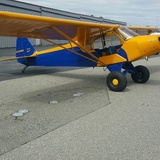
Here is what I use. I got them for free, anyway. We use them in our industry (Cell Tower's) for Work Positioning. The rope is rated at 7,667 lbs MBS, if I recall correctly. A couple of 45kn caribiners attached and its all good. A little heavy I suppose but worth it to me.
Petzl Grillon adjustable lanyard.

Petzl Grillon adjustable lanyard.
- Aviatorpa11 offline
- Posts: 136
- Joined: Mon Sep 03, 2007 1:05 pm
- Location: Pleasant Grove, CA
- Aircraft: 1947 Piper PA-11
Tue Sep 08, 2015 4:00 pm
Re: Cam-strap tie downs...good enough?
Aviatorpa11 wrote:Here is what I use. I got them for free, anyway. We use them in our industry (Cell Tower's) for Work Positioning. The rope is rated at 7,667 lbs MBS, if I recall correctly. A couple of 45kn caribiners attached and its all good. A little heavy I suppose but worth it to me.
Petzl Grillon adjustable lanyard.
Those are pretty darn nice...same thing I use for work positioning on canopy systems. But I had to pay for mine...
I'm kinda surprised nobody's stolen them yet.
Tue Sep 08, 2015 4:11 pm
Re: Cam-strap tie downs...good enough?
whee wrote:Thanks for doing this Hammer. You don't happen to have any "NRS straps" you could test? I've thought about using them for tie downs but never could decide if I believed the 1500lb lashing capacity.
I do in fact.
One brand new, never used NRS brand strap broke at 700 lbs. MUCH lower than I expected.
Tue Sep 08, 2015 6:52 pm
Re: Cam-strap tie downs...good enough?
Wow. That is way lower that I expected. Guess I need to start changing out my aging raft rigging. Thanks again!
DISPLAY OPTIONS
Who is online
Users browsing this forum: No registered users and 0 guests
Latest Features
-
Live to Tell
A Minnesota pilot is surprised to learn that the sudden asymmetric drag of an out-of-rig ski can…Read More -
Creators
Working in some of the Yukon's most beautiful and remote environments, photographer Simon Blakesley captures aircraft in…Read More -
Aircraft Ownership and Maintenance
Upgrading to big tires can make a huge difference in backcountry performance, but with those gains come…Read More -
Tales from Yesteryear
In this tale from bush flying yesteryear, Don Cogger signs up to help Atlee Dodge Jr recovery…Read More


Latest Knowledge Base
-
Destinations
A regional guide with ideas for winter camping destinations in California, Nevada, New Mexico, and Arizona.Read More -
Aircraft
Finding an affordable aircraft that can handle the backcountry for $80K or less? A challenge for sure, but with the…Read More -
Aircraft
01.29.2018 - Zane - Updated tire diameter graphic to add 8.50x10 Guide to tires for use in the backcountry and off-airport landing…Read More -
Pilots
12.22.2013 - Initial article format Operating aircraft on skis and negotiating a snow-covered landscape is an entirely unique skillset and environment.…Read More


