Two points to ponder in this post. AOPA's daily briefing today covers a blog post by Mike Busch regarding carbon monoxide in aircraft. http://blog.aopa.org/opinionleaders/201 ... ent-killer /I've almost always had one of those color dot type detectors in airplanes I've owned but to be honest I have not replaced them on anything like a regular basis and I also haven't got the slightest idea what to look for on the cardboard dot with low levels of CO in the cockpit. I think this is serious enough to warrant asking; "what's the best way to monitor CO"?
Second point here is from personal experience. I was flying as safety pilot for one of my partners in our C-172 on a salmon delivery flight from Kelso to Santa Rosa back in the '90s. I think he had three or four 10 pound Chinook in a big styro cooler in the back seat. Trouble was that he had packed them in dry ice and I didn't think to check. Along about Eugene I began to feel slightly hypoxic in spite of the fact that we were only at about 9500msl and that normally doesn't effect me at all. I'm sitting there wondering what's up when a warning bell went off in my head. So I asked. His eyes got as big as saucers and we immediately opened the wing root vents and both windows. Turns out he was feeling pretty drowsy himself and was wondering if he was dying or something. He was 82 y/o at the time. In a matter of minutes we both had clear heads and continued on with our flight. It could have turned out otherwise.
CO is way more dangerous than CO2 but both can kill you.
Carbon Monoxide and Carbon Dioxide
Fri Oct 24, 2014 3:46 pm
Fri Oct 24, 2014 6:08 pm
Re: Carbon Monoxide and Carbon Dioxide
Yes, carbon monoxide can be a killer. I was once gassed in a 206. Passengers asked me to land, because they were really miserable airsick. We happened to be near an airstrip, so I landed. By the time I had the airplane parked, I was puking.....had a piercing headache for a couple days after.
In my recent annual inspection, the mechanics found a crack in my muffler, which, once the heater was turned on, would have routed CO into the cockpit. Fortunately, Cub cockpits are so drafty, it might not be an issue......
My Cub doesn't have an electrical system, so I'm using the CO detectors with a brown dot under a plastic cover. I have had a CO leak where one of those worked.....they turn black when exposed, and the change is noticeable. The problem with these detectors is that you have to LOOK at them, and the tendency is to mount them in places where they aren't as likely to get noticed.
In my last airplane, I installed one of the CO Guardian units.....right after that 206 incident happened. Those units constantly sample the cabin air, using a small fan, and they have both an aural and a visible (light) alert.
If my airplane had an electrical system, I'd install one of those again. But, for now, I'm just putting the stick on ones, stuck to the side of my GPS....where I'm pretty likely to notice a change.
MTV
In my recent annual inspection, the mechanics found a crack in my muffler, which, once the heater was turned on, would have routed CO into the cockpit. Fortunately, Cub cockpits are so drafty, it might not be an issue......
My Cub doesn't have an electrical system, so I'm using the CO detectors with a brown dot under a plastic cover. I have had a CO leak where one of those worked.....they turn black when exposed, and the change is noticeable. The problem with these detectors is that you have to LOOK at them, and the tendency is to mount them in places where they aren't as likely to get noticed.
In my last airplane, I installed one of the CO Guardian units.....right after that 206 incident happened. Those units constantly sample the cabin air, using a small fan, and they have both an aural and a visible (light) alert.
If my airplane had an electrical system, I'd install one of those again. But, for now, I'm just putting the stick on ones, stuck to the side of my GPS....where I'm pretty likely to notice a change.
MTV


Fri Oct 24, 2014 6:36 pm
Re: Carbon Monoxide and Carbon Dioxide
One of the first things I bought was a Pocket CO carbon monoxide detector. It runs on a button cell battery and is Velcro'd to the A-pillar in front of my head. I have flown lots of club airplanes with the cards but for me I don't think they would get my attention. The Pocket CO and other like it beep loudly and light up and will grab your attention, gave me some peace of mind before I put my family in the plane that we had one less thing to worry about. Also is interesting to learn how leaky your plane is... on steeper climbs I have seen the CO level climb up to levels approaching 50ppm temporarily, but in level light <15ppm is "normal". I suspect a longer exhaust pipe would reduce those numbers.
- scottf offline

- Posts: 650
- Joined: Fri Mar 23, 2012 9:56 am
- Location: Meridian, ID
- FindMeSpot URL: http://share.findmespot.com/shared/face ... cbQCpIqefS
Fri Oct 24, 2014 9:07 pm
Re: Carbon Monoxide and Carbon Dioxide
I've been gassed bad from a cracked heater baffle. I had a black dot and I was too loopy to stop rationalizing its significance for about 10 minutes. I propped the door open in a cold snap in the winter for the rest of the half hour ride home. I spent 3 days in bed with an anvil hammered behind my eye sockets. I wasn't fit to spit by the time I had landed.
Thirty years later, I carry a half dozen chem indictors and replace them on a whim. I have a residential CO indicator as well. The chem dot is placed next to the oil pressure so I see it all the time.
The comment about CO during a Vx climb is very true. The problem disappears on my 182 at Vy however.
Thirty years later, I carry a half dozen chem indictors and replace them on a whim. I have a residential CO indicator as well. The chem dot is placed next to the oil pressure so I see it all the time.
The comment about CO during a Vx climb is very true. The problem disappears on my 182 at Vy however.
Sat Oct 25, 2014 12:30 am
Re: Carbon Monoxide and Carbon Dioxide
I have one of these Otis CO units. Works great. Reads down to single digits.
http://www.amazon.com/gp/product/B00FGH ... UTF8&psc=1

I was a paramedic in my previous career. If you or anyone you know ever feels ill from exposure to CO, get them to a hospital ASAP. If you ever feel ill to the point of having any lingering symptoms go to an emergency department now. Early symptoms are fatigue, head ache, nausea and vomiting. You feel sick because your brain is being injured. CO poisoning can take a long time (hours to days depending on factors) to reverse even with proper treatment.
CO binds to red blood cells with 250 times greater attraction than O2. This prevents the blood from carrying enough oxygen. The brain is the most sensitive organ in the body so when deprived of oxygen you get the headache, nausea and lethargy. Treatment is high flow oxygen at15 liters/minute through a non-rebreather mask and blood gas labs until the CO is at acceptable levels. This can take hours to days. In moderate to severe cases (and really the best overall treatment) a hyperbaric chamber is required.
One final and important point. DO NOT rely on a pulse-oxymeter to determine that you're okay. The oxymeter reads blood cell saturation. In the case of CO poisoning, your blood is saturated with CO and O2 so the oxymeter will read 100% even when you're ill.
http://www.amazon.com/gp/product/B00FGH ... UTF8&psc=1
I was a paramedic in my previous career. If you or anyone you know ever feels ill from exposure to CO, get them to a hospital ASAP. If you ever feel ill to the point of having any lingering symptoms go to an emergency department now. Early symptoms are fatigue, head ache, nausea and vomiting. You feel sick because your brain is being injured. CO poisoning can take a long time (hours to days depending on factors) to reverse even with proper treatment.
CO binds to red blood cells with 250 times greater attraction than O2. This prevents the blood from carrying enough oxygen. The brain is the most sensitive organ in the body so when deprived of oxygen you get the headache, nausea and lethargy. Treatment is high flow oxygen at15 liters/minute through a non-rebreather mask and blood gas labs until the CO is at acceptable levels. This can take hours to days. In moderate to severe cases (and really the best overall treatment) a hyperbaric chamber is required.
One final and important point. DO NOT rely on a pulse-oxymeter to determine that you're okay. The oxymeter reads blood cell saturation. In the case of CO poisoning, your blood is saturated with CO and O2 so the oxymeter will read 100% even when you're ill.
Last edited by 4Whitey on Sat Oct 25, 2014 12:35 am, edited 1 time in total.

Sat Oct 25, 2014 12:34 am
Re: Carbon Monoxide and Carbon Dioxide
Or, for less than $22 (includes free Prime shipping):
http://www.amazon.com/Kidde-KN-COPP-B-L ... =pd_cp_e_1
bumper
http://www.amazon.com/Kidde-KN-COPP-B-L ... =pd_cp_e_1
bumper

bumper
Minden, NV
Husky A1-B
Minden, NV
Husky A1-B
Sat Oct 25, 2014 8:54 am
Re: Carbon Monoxide and Carbon Dioxide
bumper wrote:Or, for less than $22 (includes free Prime shipping):
http://www.amazon.com/Kidde-KN-COPP-B-L ... =pd_cp_e_1
bumper
I flew with one of these for years in my Savannah. I found it useful for finding leaks and the alarm was loud enough to hear through the headset. Also liked the price.
tom
- Savannah-Tom offline
- Posts: 891
- Joined: Mon Mar 06, 2006 3:26 pm
- Location: Corvallis, OR
Sat Oct 25, 2014 10:15 am
Re: Carbon Monoxide and Carbon Dioxide
I have used the stick on chem detectors in the past, but I immediately ordered one of these when I read that article.
http://www.gassniffer.com/draeger-pac-3500-single-gas-co.html
I really wanted one that would read CO% in addition to just alarming. This has both.
http://www.gassniffer.com/draeger-pac-3500-single-gas-co.html
I really wanted one that would read CO% in addition to just alarming. This has both.

Sat Oct 25, 2014 2:04 pm
Re: Carbon Monoxide and Carbon Dioxide
Mister701 wrote:Second point here is from personal experience. I was flying as safety pilot for one of my partners in our C-172 on a salmon delivery flight from Kelso to Santa Rosa back in the '90s. I think he had three or four 10 pound Chinook in a big styro cooler in the back seat. Trouble was that he had packed them in dry ice and I didn't think to check. Along about Eugene I began to feel slightly hypoxic in spite of the fact that we were only at about 9500msl and that normally doesn't effect me at all. I'm sitting there wondering what's up when a warning bell went off in my head. So I asked. His eyes got as big as saucers and we immediately opened the wing root vents and both windows. Turns out he was feeling pretty drowsy himself and was wondering if he was dying or something. He was 82 y/o at the time. In a matter of minutes we both had clear heads and continued on with our flight. It could have turned out otherwise.
Humans exhale about 200 ml of CO2 per breath. Times 12 breaths per minute times 60 minutes gives us 144,000 ml/hour. At about 2Kg/m^3 that should come to about .3 kg/hour or .7 pounds per hour. So, to match the CO2 output of a single person you would have to be burning through about 15 pounds of dry ice per day. You can check my math, but I don't think that the dry ice was the problem.
- Geoffrey Thorpe offline

- Posts: 50
- Joined: Wed Feb 05, 2014 7:14 am
- Location: Trenton
Sat Oct 25, 2014 9:00 pm
Re: Carbon Monoxide and Carbon Dioxide
That's the one I have, also, only Velcro'd to the panel, the yellow thing on the left side of the panel here:scottf wrote:One of the first things I bought was a Pocket CO carbon monoxide detector. It runs on a button cell battery and is Velcro'd to the A-pillar in front of my head. I have flown lots of club airplanes with the cards but for me I don't think they would get my attention. The Pocket CO and other like it beep loudly and light up and will grab your attention, gave me some peace of mind before I put my family in the plane that we had one less thing to worry about. Also is interesting to learn how leaky your plane is... on steeper climbs I have seen the CO level climb up to levels approaching 50ppm temporarily, but in level light <15ppm is "normal". I suspect a longer exhaust pipe would reduce those numbers.
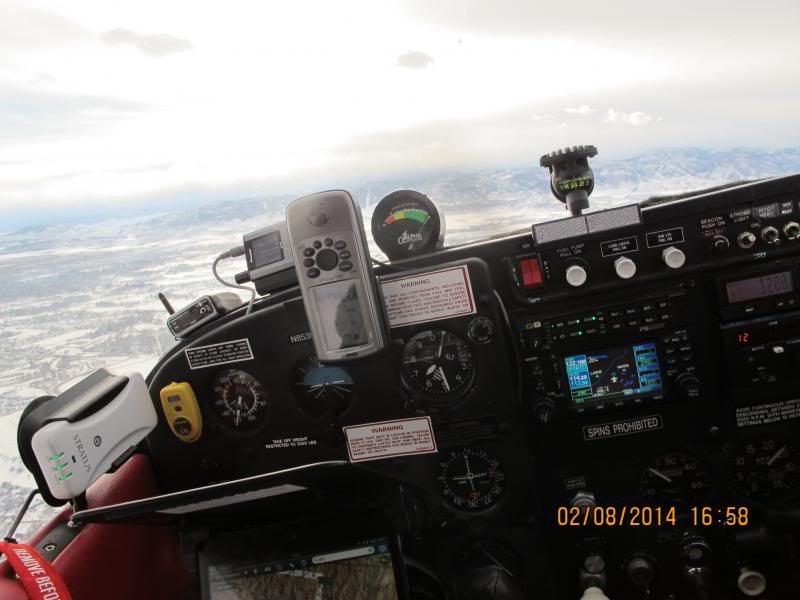
I haven't noticed it reacting in flight, but on several occasions when I've had to wait in a line to depart with the pilot's window open, it has showed a slightly elevated reading on its "panel". It's never been enough to sound the alarm, however.
Cary
"I have slipped the surly bonds of earth..., put out my hand and touched the face of God." J.G. Magee
Sat Oct 25, 2014 9:41 pm
Re: Carbon Monoxide and Carbon Dioxide
Cary wrote:That's the one I have, also, only Velcro'd to the panel, the yellow thing on the left side of the panel here:scottf wrote:One of the first things I bought was a Pocket CO carbon monoxide detector. It runs on a button cell battery and is Velcro'd to the A-pillar in front of my head. I have flown lots of club airplanes with the cards but for me I don't think they would get my attention. The Pocket CO and other like it beep loudly and light up and will grab your attention, gave me some peace of mind before I put my family in the plane that we had one less thing to worry about. Also is interesting to learn how leaky your plane is... on steeper climbs I have seen the CO level climb up to levels approaching 50ppm temporarily, but in level light <15ppm is "normal". I suspect a longer exhaust pipe would reduce those numbers.
I haven't noticed it reacting in flight, but on several occasions when I've had to wait in a line to depart with the pilot's window open, it has showed a slightly elevated reading on its "panel". It's never been enough to sound the alarm, however.
Cary
wow! There is way to much going on with that setup!


- piperpainter offline

- Posts: 968
- Joined: Sat Nov 29, 2008 10:57 pm
- Location: Auburn, WA
- Aircraft: C-205
Was Backcountry Mooney M20C
Sat Oct 25, 2014 10:04 pm
Re: Carbon Monoxide and Carbon Dioxide
Thanks for that Geoffrey. I suppose it might well have been imagination.....or lack of sleep.Geoffrey Thorpe wrote:Mister701 wrote:Second point here is from personal experience. I was flying as safety pilot for one of my partners in our C-172 on a salmon delivery flight from Kelso to Santa Rosa back in the '90s. I think he had three or four 10 pound Chinook in a big styro cooler in the back seat. Trouble was that he had packed them in dry ice and I didn't think to check. Along about Eugene I began to feel slightly hypoxic in spite of the fact that we were only at about 9500msl and that normally doesn't effect me at all. I'm sitting there wondering what's up when a warning bell went off in my head. So I asked. His eyes got as big as saucers and we immediately opened the wing root vents and both windows. Turns out he was feeling pretty drowsy himself and was wondering if he was dying or something. He was 82 y/o at the time. In a matter of minutes we both had clear heads and continued on with our flight. It could have turned out otherwise.
Humans exhale about 200 ml of CO2 per breath. Times 12 breaths per minute times 60 minutes gives us 144,000 ml/hour. At about 2Kg/m^3 that should come to about .3 kg/hour or .7 pounds per hour. So, to match the CO2 output of a single person you would have to be burning through about 15 pounds of dry ice per day. You can check my math, but I don't think that the dry ice was the problem.
Sun Oct 26, 2014 3:47 am
Re: Carbon Monoxide and Carbon Dioxide
Damn, Cary. Don't forget to look outside every once in a while.
We're out there, too!

We're out there, too!
Sun Oct 26, 2014 8:02 pm
Re: Carbon Monoxide and Carbon Dioxide
A big advantage in the spray planes I flew was that none of them had heat muffs. The hole in the floor, where heat was to enter, always had a tin can lid over it. Spreading dry fertilizer and seed over defoliated trees in the winter was cold, but you could see the whole exhaust system. Some of the Pawnees had a long straight stack on each side. Probably illegal but they didn't have the carb heat shroud either. Lycoming 0-540 and didn't fly in cold rain, snow, or sleet.
I used the paper thing in pipeline airplanes. Brentco had pretty airplanes with pretty paint and interior and immaculate paperwork, but the actual maintenance was budgeted/scary.
I used the paper thing in pipeline airplanes. Brentco had pretty airplanes with pretty paint and interior and immaculate paperwork, but the actual maintenance was budgeted/scary.
- contactflying offline
- Posts: 4972
- Joined: Wed Apr 03, 2013 7:36 pm
- Location: Aurora, Missouri 2H2
Download my free "https://tinyurl.com/Safe-Maneuvering" e-book.
Sun Oct 26, 2014 8:37 pm
Re: Carbon Monoxide and Carbon Dioxide
Cannon wrote:Damn, Cary. Don't forget to look outside every once in a while.
We're out there, too!
piperpainter wrote:wow! There is way to much going on with that setup!
Youse guys are making fun of me again!
Cary
"I have slipped the surly bonds of earth..., put out my hand and touched the face of God." J.G. Magee
DISPLAY OPTIONS
Who is online
Users browsing this forum: No registered users and 7 guests
Latest Features
-
Live to Tell
A Minnesota pilot is surprised to learn that the sudden asymmetric drag of an out-of-rig ski can…Read More -
Creators
Working in some of the Yukon's most beautiful and remote environments, photographer Simon Blakesley captures aircraft in…Read More -
Aircraft Ownership and Maintenance
Upgrading to big tires can make a huge difference in backcountry performance, but with those gains come…Read More -
Tales from Yesteryear
In this tale from bush flying yesteryear, Don Cogger signs up to help Atlee Dodge Jr recovery…Read More


Latest Knowledge Base
-
Destinations
A regional guide with ideas for winter camping destinations in California, Nevada, New Mexico, and Arizona.Read More -
Aircraft
Finding an affordable aircraft that can handle the backcountry for $80K or less? A challenge for sure, but with the…Read More -
Aircraft
01.29.2018 - Zane - Updated tire diameter graphic to add 8.50x10 Guide to tires for use in the backcountry and off-airport landing…Read More -
Pilots
12.22.2013 - Initial article format Operating aircraft on skis and negotiating a snow-covered landscape is an entirely unique skillset and environment.…Read More


