===============================================
Steve,
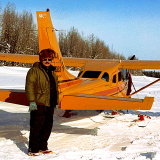
Not painful at all--the only painful part was losing a really nice airplane, but as a friend pointed out "I love that plane dearly, right up till it tries to kill me--then, I'll use it up as necessary to walk away".
And NO!!!! I did not stall it in. Had it been stalled, there'd been a whole lot more damage. Note that the prop and cowling are untouched.
I was at around 5,500 feet msl in the White Mountains, north of Fairbanks, when the crank broke at the #2 rod journal. Later, it was determined that this was one of the "good" crankshafts
 .
.I was just crossing a ridge (under a 6,000 foot broken layer), headed north when the engine failed, and reversing course seemed to offer slightly better terrain. In retrospect, that was the right thing to do.
I was troubleshooting the engine failure (immediate action items), gliding downhill, about matching the slope of the hill, and about 500 feet agl.
Somewhere during that process, there was a distinct "clank", the prop stopped and I ceased trouble shooting. I shut off the fuel valve, the mags, and master at that point and focused on landing.
There was nowhere flat to park, so as the hill leveled off, I was going to land. I headed for a recently burned area to reduce the "tree factor".
The touchdown was on a fairly decent downslope (I didn't have enough height to turn into the hill, and don't know if I'd want to do so in any case.) I had kept up a bit of extra speed toward the end of the glide, since the plane was right near the forward limit, and I wanted enough elevator authority to produce a flare.
I flared, the plane slid about 30 feet, and the right float stubbed into a tussock. The area I landed in (actually the whole mountainside) was very tussocky, with tussocks as high as mid thigh in places. My right float hit one of those.
At that point, the airplane apparently tumbled, and came rightside up, parked.
Prior to touchdown, I'd reached up and given the BAS harness a yank to lock it up and leaned into the straps to keep it locked.

I don't remember the plane going over. I suspect there was significant G forces there. In any case, the only damage I suffered was a pretty significant divit to the back of my right leg, left by the adjustment crank on the pilots seat. My legs must have flailed a good bit in the tumble.
I got out of the plane, waited for it to cool down, got back in, turned on the radio, and called on 121.5. A Japan Air 747 crew answered immediately, and relayed my call for assistance to Fairbanks. I asked them to send a Helitack helicopter from Alaska Fire Service, which they did.
That evening, my wife had relatives in town, on a cruise, and we were supposed to meet them for dinner. Gina instructed me sternly not to talk about the crash, so that they would have a chance to talk. Worked perfectly--she drove to dinner, we had a nice dinner, and I got pretty sloshed. Her relatives probably still think I'm a really happy, but simple minded drunk, based on the possum eating bumblebees grin on my clock all evening.
What would I have done different?
After going up there later, and looking at the tussocks in that area, I doubt there's any way you could successfully land anywhere out there, even on level ground. This is really lumpy stuff.
If I had it to do again, I'm not sure what I'd do differently, frankly, except fish that day instead of work.
There's no doubt the floats took a lot of the impact, as did the extremities of the plane.
The engine was sending signals, but they were very subtle ones. Any other pilot wouldn't have noticed the signals, but I had over 3,400 hours in that plane, and I knew there was something up. Three different, and very competent mechanics looked at it, but couldn't come up with anything. And, I can't critisize their recommendation to fly it. I should have grounded it, frankly, but the signs weren't that gross.
After it puked, I'm not sure I'd do much different. It was pretty obvious from the git go that it wasn't going to be pretty. I carried extra speed into the flare for energy to pick the nose up. Plane was empty, going north to pick up a crew. Very forward CG.
I think in these circumstances, IF YOU COULD pull it off precisely, maybe landing upslope would be better than down, but I really didn't have that option. I was low to the ground when it started, and the slope of the hill pretty much equaled my glide path. Had I turned it out to try and turn around, I'd probably have stalled it or at best not had enough energy to flare at the bottom.
I touched at about 45 knots indicated, in a Robertson STOL equipped airplane (stall speed advertised as 37). 30 Degrees of flap down.
Any time something like this happens, there are always things to learn, and its a tragedy to use up a good airplane without learning anything so any ideas or thoughts are welcome.
The plane is now flying again, by the way. It was a retirement project for the fellow who bought the wreck--owner of a large salvage operation in Omak, WA.
There are various sayings about landings:
Any landing you can walk away from is a good landing.
Any landing where you can still open the doors is a darn good landing
Any landing where you can use the airplane the next day is a great landing.
This definitely wasn't a great landing, by that definition.
My subsequent landings have all been slightly better to date.
The final irony: I picked this airplane up brand new from a dealer on July 5, 1986. I parked it on July 4, 1996. Apparently, the warranty was only good for ten years.
MTV



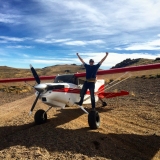

 and yes, I have a set of BAS harness in my 172