Ted Waltman, a colorado SQ-2 pilot, penned a knowledge base article for us on routes for crossing the Colorado Rockies:
https://backcountrypilot.org/knowledge- ... tal-divide
As always, these articles are living documents and any useful knowledge or feedback will be incorporated in future edits.
Crossing Colorado's Continental Divide
Tue Aug 28, 2018 2:50 pm
Re: Crossing Colorado's Continental Divide
This is an awesome article!!
Tue Aug 28, 2018 3:41 pm
Re: Crossing Colorado's Continental Divide
Outstanding article! I've been over much of those routes in bits and pieces, and I can't find anything to dispute. I think part of Ted's disclaimer, though, should be in great big bright red letters!
As those of us who fly in the mountains, whether regularly or casually, know, what is gospel today may be impossible tomorrow, because the mountains make their own weather. Always, there should be a Plan B, Plan C, and ultimately a lay over as realistic alternatives. Yeah, there may be plenty of places to put down in an emergency, but that can sure muck up a vacation!
One thing I'd like to mention: if one of the alternate plans is to go IFR, that means some pretty high MEAs, above the capability of many airplanes, and definitely requiring oxygen all the way. My airplane, for instance, can make it to 15,000', but it's a real stretch, so I won't accept an IFR routing that takes me above 14,000'. The only IFR route I know of that allows that is the "southern La Veta" route from GOSIP to Alamosa (14,000' MEA), with a dogleg southwest of Alamosa along V368 to BRAZO, V211 to Durango (13,000' MEA). I've taken that route multiple times to visit my Sis in Durango, and honestly the toughest part of it is over La Veta Pass along V83-210 when the winds get up around 30 knots.
If on the other hand, an airplane can easily climb to 17,000', then there are a number of alternative IFR routes with MEAs at or a little less than 17,000'. But take care--now you're in the oxygen deprivation zone, where good oxygen equipment and slavish checking of the pilot's pulse ox levels is essential. The time of useful consciousness (TUC) at 17,000' is only about 25 minutes, for young, fit, military aviators--and I doubt that very many of us fit into those categories!
Cary
"Please take everything here with a large dose of skepticism. Do your own follow up research. These routes are merely one item amongst many factors to consider for your go/no-go decision to cross the Divide."
As those of us who fly in the mountains, whether regularly or casually, know, what is gospel today may be impossible tomorrow, because the mountains make their own weather. Always, there should be a Plan B, Plan C, and ultimately a lay over as realistic alternatives. Yeah, there may be plenty of places to put down in an emergency, but that can sure muck up a vacation!
One thing I'd like to mention: if one of the alternate plans is to go IFR, that means some pretty high MEAs, above the capability of many airplanes, and definitely requiring oxygen all the way. My airplane, for instance, can make it to 15,000', but it's a real stretch, so I won't accept an IFR routing that takes me above 14,000'. The only IFR route I know of that allows that is the "southern La Veta" route from GOSIP to Alamosa (14,000' MEA), with a dogleg southwest of Alamosa along V368 to BRAZO, V211 to Durango (13,000' MEA). I've taken that route multiple times to visit my Sis in Durango, and honestly the toughest part of it is over La Veta Pass along V83-210 when the winds get up around 30 knots.
If on the other hand, an airplane can easily climb to 17,000', then there are a number of alternative IFR routes with MEAs at or a little less than 17,000'. But take care--now you're in the oxygen deprivation zone, where good oxygen equipment and slavish checking of the pilot's pulse ox levels is essential. The time of useful consciousness (TUC) at 17,000' is only about 25 minutes, for young, fit, military aviators--and I doubt that very many of us fit into those categories!
Cary
"I have slipped the surly bonds of earth..., put out my hand and touched the face of God." J.G. Magee
Tue Aug 28, 2018 8:17 pm
Re: Crossing Colorado's Continental Divide
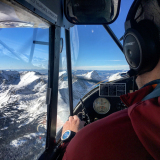
And in the winter, be ready to ride the wave!!!!
Now that I get paid to tow people through the rotor, it’s a whole new relationship
Now that I get paid to tow people through the rotor, it’s a whole new relationship

Tue Sep 11, 2018 8:28 am
Re: Crossing Colorado's Continental Divide
Minor updates to the guide. I've put it on the homepage. Good job, Ted!
- Zzz offline


- Posts: 2854
- Joined: Fri Oct 08, 2004 11:09 pm
- Location: northern
- Aircraft: Swiveling desk chair
Half a century spent proving “it is better to be thought a fool than to open your mouth and remove all doubt.”
Tue Sep 11, 2018 3:47 pm
Re: Crossing Colorado's Continental Divide
Really great article and having the ability to place a route in ForeFlight is excellent. Great work!
Joe
Joe
Wed Sep 12, 2018 1:14 pm
Re: Crossing Colorado's Continental Divide
Ted mentioned using common sense to modify route between waypoints. I would go even further. I would do a map recon for ingress and egress of each pass. No, I don't fly as high, but can you be sure you will be able to retain that altitude? In a downdraft should we try to retain altitude? In an emergency can we quickly identity and safely maneuver to the drainage that will take us safely to the Gulf of Mexico or the Pacific?
- contactflying offline
- Posts: 4972
- Joined: Wed Apr 03, 2013 7:36 pm
- Location: Aurora, Missouri 2H2
Download my free "https://tinyurl.com/Safe-Maneuvering" e-book.
Sat Sep 15, 2018 4:25 pm
Re: Crossing Colorado's Continental Divide
My sincere "THANK YOU" for everyone's input and comments!
For sure, as "ContactFlying" says, always have an "out" planned for each pass and even your general area as the trip progresses. Weather in the mountains changes faster than you would imagine, often blocking your "turn-around" option as well.
It is a rare day indeed in the winter when the winds aren't blowing 30+ up high. I suppose one could get over the rocks in the winter, but I confess that I've never tried. Spring, summer and fall--yep.
I never make an absolute commitment for any specific date. The winds (primarily) and weather (occasionally) dictate whether any route is practical. This spring, for instance, I didn't get over to the Moab area at all despite several tries.
I'd never do IFR. As Cary points out, the MEA's are just too high for the direct routes. I did do the Southern La Veta Pass route IFR once (on a nice VFR day just for practice. The MEA was 14,000' if I recall correctly in the Alamosa area.
Thank you again folks!
For sure, as "ContactFlying" says, always have an "out" planned for each pass and even your general area as the trip progresses. Weather in the mountains changes faster than you would imagine, often blocking your "turn-around" option as well.
It is a rare day indeed in the winter when the winds aren't blowing 30+ up high. I suppose one could get over the rocks in the winter, but I confess that I've never tried. Spring, summer and fall--yep.
I never make an absolute commitment for any specific date. The winds (primarily) and weather (occasionally) dictate whether any route is practical. This spring, for instance, I didn't get over to the Moab area at all despite several tries.
I'd never do IFR. As Cary points out, the MEA's are just too high for the direct routes. I did do the Southern La Veta Pass route IFR once (on a nice VFR day just for practice. The MEA was 14,000' if I recall correctly in the Alamosa area.
Thank you again folks!
- tedwaltman offline


- Posts: 345
- Joined: Sat May 17, 2014 7:51 pm
- Location: Lakewood
- FindMeSpot URL: https://share.delorme.com/tedwaltman
- Aircraft: Experimental Super Cub
DISPLAY OPTIONS
Who is online
Users browsing this forum: No registered users and 0 guests
Latest Features
-
Live to Tell
A Minnesota pilot is surprised to learn that the sudden asymmetric drag of an out-of-rig ski can…Read More -
Creators
Working in some of the Yukon's most beautiful and remote environments, photographer Simon Blakesley captures aircraft in…Read More -
Aircraft Ownership and Maintenance
Upgrading to big tires can make a huge difference in backcountry performance, but with those gains come…Read More -
Tales from Yesteryear
In this tale from bush flying yesteryear, Don Cogger signs up to help Atlee Dodge Jr recovery…Read More


Latest Knowledge Base
-
Destinations
A regional guide with ideas for winter camping destinations in California, Nevada, New Mexico, and Arizona.Read More -
Aircraft
Finding an affordable aircraft that can handle the backcountry for $80K or less? A challenge for sure, but with the…Read More -
Aircraft
01.29.2018 - Zane - Updated tire diameter graphic to add 8.50x10 Guide to tires for use in the backcountry and off-airport landing…Read More -
Pilots
12.22.2013 - Initial article format Operating aircraft on skis and negotiating a snow-covered landscape is an entirely unique skillset and environment.…Read More


