I am now waiting for my 3rd cylinder to come back from overhaul. #5 was overhauled in 2019 overhaul shop said it was the last time it could be done. 2020 #1 had a crack a from barrel to head. 2023 #2 had worn out valve guides, was overhauled. Right now #6 is at the shop for 44/80 leaking past exhaust valve. Log book review indicates that the chrome cylinders 1,2,5,6 were channel chromed in 1998. cylinder 6 was not new in 1998 but overhauled. At removal it had over 1100 hours tach time, I ran it about 750 hours of those since 2017. But, I find that tach time is well under actual run time, I have logged over 800 hours since I got the plane in 2017. my cruise RPM is 2200 or so.
Asking around, I wondered how many hours a big continental gets on a cylinder before its used up. I have had many answers stating that continental cylinders never make 2000hrs, that 1100 to 1300 on a new cylinder is about its life expectancy.
How many hours does everyone get from NEW cylinders on a 0-520?
Cylinder life
Fri Nov 07, 2025 6:51 pm
- StillLearning offline

- Posts: 417
- Joined: Mon Nov 05, 2018 6:22 pm
- Location: Salmon
- Aircraft: Cessna 180 Skywagon 1953
Fri Nov 07, 2025 8:35 pm
Re: Cylinder life
I've got a an i0-520 in my 185 with just over 1900 hours on all 6 original jugs. Never had a jug off and still making great compression all around. I got it with 1500 of those hours already on it and it was at a commercial floatplane outfit. Their policy was that they didn't do any significant leaning. Just enough that you're not dumping raw fuel out the exhaust was how Pete put it to me. I pretty much follow the POH for how I've handled the engine the last 400 hours, and I probably take it pretty easy on my engine compared to some, I cruise at 22-23 squared. It's my belief that you get better engine life (hour wise) with more regular flying, as in you're more likely to get 1800 hours on an engine if you put those 1800 hours on in 9 years instead of 40. Prior to this plane my partner and I ran an 0-470 past TBO on 6 original jugs too. All that being said, from what I've heard from my circle of dudes, I think my experience is the exception rather than the norm.
Last edited by Fraser Farmer on Sat Nov 08, 2025 12:59 pm, edited 1 time in total.
- Fraser Farmer offline

- Posts: 388
- Joined: Tue May 13, 2014 10:38 pm
- Location: Abbotsford
- Aircraft: 1977 Cessna 185
Fri Nov 07, 2025 8:39 pm
Re: Cylinder life
I'll say too, that heating and cooling has a major effect on top end life. The guys locally doing the coastal routes up the inlets talk about killing engines pretty quick with their routes. They get it hot going up and over a mountain range and then cool it right off descending into the next inlet.
- Fraser Farmer offline
- Posts: 388
- Joined: Tue May 13, 2014 10:38 pm
- Location: Abbotsford
- Aircraft: 1977 Cessna 185
Sat Nov 08, 2025 5:22 am
Re: Cylinder life
Shock cooling is the big killer of any jug, even more so in the bigger bore engines and the Conti's do seem a bit more susceptible. However as FF has wise pointed out if cooling is properly managed its not always the case and his experience is evidence of that. Try to plan a longer descent profile at a lower rate rate of descent, maintaining some power at a lower RPM and let the temps reduce in a more leisurely rate.

Sat Nov 08, 2025 6:47 am
Re: Cylinder life
High temperature is the nemesis of aircraft cylinder design. Some aluminum alloys lose as much as 50% of strength at 400F. Mike Busch authored an excellent article several years ago titled "Separation Anxiety", an excellent short read on this subject.
As for anecdotal data, I have run Superiors on my O-470R for over 4000 hours. Run to TBO twice, (once 200 over as it was the dead of winter) with no cylinder removals between. 80% of the operating time was at 0F down to -35F (coldest was -45 on a let down into the Forty-Mile drainage east of Fairbanks, needless to say I climbed back up into the "warm" inversion). Proper "winterization" is obviously required for these operations as well as proper multi-probe systems ensuring accurate engine parameters. My mission (radio telemetry) required ascents followed by descents all day long, typically a climb to 10-12K, followed by a descent to the surface which elevation varied greatly depending on operating region. Never had a "shock cooling" event in all that time, nor a cylinder failure.
TR
As for anecdotal data, I have run Superiors on my O-470R for over 4000 hours. Run to TBO twice, (once 200 over as it was the dead of winter) with no cylinder removals between. 80% of the operating time was at 0F down to -35F (coldest was -45 on a let down into the Forty-Mile drainage east of Fairbanks, needless to say I climbed back up into the "warm" inversion). Proper "winterization" is obviously required for these operations as well as proper multi-probe systems ensuring accurate engine parameters. My mission (radio telemetry) required ascents followed by descents all day long, typically a climb to 10-12K, followed by a descent to the surface which elevation varied greatly depending on operating region. Never had a "shock cooling" event in all that time, nor a cylinder failure.
TR

Sat Nov 08, 2025 7:52 am
Re: Cylinder life
I take care of my cylinders, but it appears that the previous owner(s) did not. My engine had/ has a hodge podge of old cylinders on it. Cylinders 1,2,5,6 were chrome cylinders overhauled in 1998, channel chrome. Overhaul of engine was 1998, but it does not specify what cylinders 3 and 4 were installed. 2011 cylinders 3 and 4 replaced with new ECI, It got a new crank in 2014 after it was wrecked by the previous owner, a second time, with prop strike. At that tear down cylinders 1,2,5 and 6 were honed and new rings installed. Pretty sure #5 had a burned exhaust valve when i bought it, overhaul shop said this was the last time it could be overhauled. #1 was an ancient old cylinder that cracked, #2 had worn out valve guides, #6 was low compression this year, leaking bad past the exhaust valve but also past the rings.
Knowing what i know now, I should have done a top overhaul in 2019.
Looking through the engine logs, it missed annuals a few times since 1998, it didn't fly much from 1999 to 2011. It flew 9 hours from 2000 to 2004. Whomever was running it was burning valves regularly, and wrecked it twice.
I was just curious what other experiences people have with longevity, one mechanic I talked to said that Continental cylinders rarely make 2000 hours even when run by guys that know how to properly run the engine. One 135 guy I know has been going through cylinders on his "new" engine since install, but has run 2 previous engines to TBO without ever changing a cylinder.
Knowing what i know now, I should have done a top overhaul in 2019.
Looking through the engine logs, it missed annuals a few times since 1998, it didn't fly much from 1999 to 2011. It flew 9 hours from 2000 to 2004. Whomever was running it was burning valves regularly, and wrecked it twice.
I was just curious what other experiences people have with longevity, one mechanic I talked to said that Continental cylinders rarely make 2000 hours even when run by guys that know how to properly run the engine. One 135 guy I know has been going through cylinders on his "new" engine since install, but has run 2 previous engines to TBO without ever changing a cylinder.
- StillLearning offline
- Posts: 417
- Joined: Mon Nov 05, 2018 6:22 pm
- Location: Salmon
- Aircraft: Cessna 180 Skywagon 1953
Sat Nov 08, 2025 8:39 am
Re: Cylinder life
Your profile sez a 53 180, I'm curious which engine you're running.
My 53 has a 470K, factory reman from 1993.
Nothing in the logbook about any cylinders being removed before i owned it,
but I've had three cylinders off, (one 10 years ago, two more 2 years ago).
I'm way over TBO, about 2100 hours smoh,
and all the cylinders were 70/80 or better at the last annual.
FWIW I live in the cool pacific northwest, and I run her pretty easy, usually 22 squared so about 65% or a bit less,
so I rarely see high cylinder temps.
Maybe that's the key to longevity?
My 53 has a 470K, factory reman from 1993.
Nothing in the logbook about any cylinders being removed before i owned it,
but I've had three cylinders off, (one 10 years ago, two more 2 years ago).
I'm way over TBO, about 2100 hours smoh,
and all the cylinders were 70/80 or better at the last annual.
FWIW I live in the cool pacific northwest, and I run her pretty easy, usually 22 squared so about 65% or a bit less,
so I rarely see high cylinder temps.
Maybe that's the key to longevity?
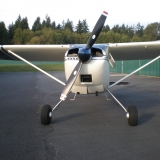
Cessna Skywagon -- accept no substitute!
Sat Nov 08, 2025 9:08 am
Re: Cylinder life
I'll add my experience on my 1977 C180K O470-U, which is 8.6 compression and redlines at 2400 RPM designed to meet European noise abatement rules, factory new with chrome cylinders installed in Anchorage in1994. I purchased in 2007. Over the years I have pulled five cylinders for various reasons, burned #3 exhaust valve, worn valve guides on #2, bad leak on #6 old base O-ring (black and was cracked) verses the new orange color O-rings. #4 plugs so oily that I bought fine wire plugs and later replaced as the cylinder was completely worn out. Engine at 2340 tach hours now and #5 my rock star is original and the coldest running cylinder. I pulled them all myself. No regrets on not doing a Top O/H. Ly-Con is currently building me an exchange O/H on a first run core.
Sat Nov 08, 2025 4:57 pm
Re: Cylinder life
I could say that back in 1998 the average life of a cylinder was 35-200 hours,all for the same reason - soft exhaust guides.
My factory reman in1998 showed signs of trouble at about 35 hours.Continental said to run it until they said otherwise.
Coming out of Charlotte Lake with just my dad & I felt like 2 floats full of water.
Called my mechanic & he found only 1 cylinder with compression - rest with zero or very close,cause exhaust guides worn large enough to support nothing.
Continental’s reply,despite notifying them at 35 hours of the issue & following their instructions warranty was zero.
Mechanic had all 6 cylinders overhauled & harder exhaust guides installed.
No burnt or stressed valves & run 24 square with book value fuel flows.
Overhauled cylinders are still on our io520D,compression numbers are acceptable with no leakage past guides.
Daryl
My factory reman in1998 showed signs of trouble at about 35 hours.Continental said to run it until they said otherwise.
Coming out of Charlotte Lake with just my dad & I felt like 2 floats full of water.
Called my mechanic & he found only 1 cylinder with compression - rest with zero or very close,cause exhaust guides worn large enough to support nothing.
Continental’s reply,despite notifying them at 35 hours of the issue & following their instructions warranty was zero.
Mechanic had all 6 cylinders overhauled & harder exhaust guides installed.
No burnt or stressed valves & run 24 square with book value fuel flows.
Overhauled cylinders are still on our io520D,compression numbers are acceptable with no leakage past guides.
Daryl
Sat Nov 08, 2025 5:18 pm
Re: Cylinder life
I run an O-520. Usually I cruise at 17 to 18" and 2300rpm. On climb out I've been running it harder than I used to, now I run 2400 to 2500 rpm and about 22". Only briefly will do I ever see CHT's up to 400, once they are getting close to that I'm giving it a little more fuel and pitching for about 100mph, by that time I've climbed about 4000 to 5000'. Usually its only cylinders 3 or 4 that get the hottest, meanwhile the other 4 are 360 to 380. In cruise I often get CHT's in the 340 range and all withing 20 to 30 degrees of each other.
I never chop and drop, I usually do a shallow descent by pulling MP gradually.
I never chop and drop, I usually do a shallow descent by pulling MP gradually.
- StillLearning offline
- Posts: 417
- Joined: Mon Nov 05, 2018 6:22 pm
- Location: Salmon
- Aircraft: Cessna 180 Skywagon 1953
Sat Nov 08, 2025 7:31 pm
Re: Cylinder life
I have very little experience with Continentals, just one 0470-R in an airboat. However, I had a Lycoming 0-435-1 and I had lots of cylinder problems with that. All of my failures were cracks from a valve to a sparkplug hole. They never did lose all compression, never had a failure, they would just get soft and when pulled I could see the crack.
I now have a Franklin that had all six cyls replaced within a couple of hundred hours of when I got it. I had one that kept sticking a valve stem and I pulled it and had new guides put in, new valves and it is good now. Now I have another that is soft and I will have to get after it this winter, air test says leakage into the crankcase so broken or stuck rings seems likely.
I really envy those who go thousands of hours with no issues.
I now have a Franklin that had all six cyls replaced within a couple of hundred hours of when I got it. I had one that kept sticking a valve stem and I pulled it and had new guides put in, new valves and it is good now. Now I have another that is soft and I will have to get after it this winter, air test says leakage into the crankcase so broken or stuck rings seems likely.
I really envy those who go thousands of hours with no issues.
Tue Nov 18, 2025 3:01 pm
Re: Cylinder life
There are tons of factors that can affect cylinder life.
One big one is the exhaust valve leakage almost always has to do with the roto-coil wearing out and causing the valve to stop rotating and developing a hot spot.
Bore scoping these exhaust valves every other oil change can mitigate the #1 cause of cylinder removal. If you notice the valve stops rotating, the rotocoil can be replaced and the valve lapped with the cylinder in place relatively cheaply.
Big bore continentals mostly run full throttle, 2500RPM, LOP (lean of peak) on Cirrus's. As long as the exhaust valves are monitored, and temperatures are appropriately controlled with fuel flow, they usually live close to or beyond TBO. I just sold my SR22 that had 1,400 hrs on all 6 original jugs, and still had good compression and oil consumption.
The second most common reason I have seen for cylinder removal is stuck oil control rings. This seems to be more common on planes that fly infrequently, and I am not sure what exactly causes this.
On Carbed engines (and some injected engines) you can't run LOP so you have to enrichen to reduce temps.
One big one is the exhaust valve leakage almost always has to do with the roto-coil wearing out and causing the valve to stop rotating and developing a hot spot.
Bore scoping these exhaust valves every other oil change can mitigate the #1 cause of cylinder removal. If you notice the valve stops rotating, the rotocoil can be replaced and the valve lapped with the cylinder in place relatively cheaply.
Big bore continentals mostly run full throttle, 2500RPM, LOP (lean of peak) on Cirrus's. As long as the exhaust valves are monitored, and temperatures are appropriately controlled with fuel flow, they usually live close to or beyond TBO. I just sold my SR22 that had 1,400 hrs on all 6 original jugs, and still had good compression and oil consumption.
The second most common reason I have seen for cylinder removal is stuck oil control rings. This seems to be more common on planes that fly infrequently, and I am not sure what exactly causes this.
On Carbed engines (and some injected engines) you can't run LOP so you have to enrichen to reduce temps.
DISPLAY OPTIONS
Who is online
Users browsing this forum: No registered users and 0 guests
Latest Features
-
Live to Tell
A Minnesota pilot is surprised to learn that the sudden asymmetric drag of an out-of-rig ski can…Read More -
Creators
Working in some of the Yukon's most beautiful and remote environments, photographer Simon Blakesley captures aircraft in…Read More -
Aircraft Ownership and Maintenance
Upgrading to big tires can make a huge difference in backcountry performance, but with those gains come…Read More -
Tales from Yesteryear
In this tale from bush flying yesteryear, Don Cogger signs up to help Atlee Dodge Jr recovery…Read More


Latest Knowledge Base
-
Destinations
A regional guide with ideas for winter camping destinations in California, Nevada, New Mexico, and Arizona.Read More -
Aircraft
Finding an affordable aircraft that can handle the backcountry for $80K or less? A challenge for sure, but with the…Read More -
Aircraft
01.29.2018 - Zane - Updated tire diameter graphic to add 8.50x10 Guide to tires for use in the backcountry and off-airport landing…Read More -
Pilots
12.22.2013 - Initial article format Operating aircraft on skis and negotiating a snow-covered landscape is an entirely unique skillset and environment.…Read More


