Double puck brakes....
Tue Jul 04, 2023 6:05 am
Double puck brakes....
I have the opportunity to pick up a set of double puck wheels and brakes ...1956 Cessna 182...8:00 mains....mix of hard and soft field runways...not a hard core back woods aviator...1800 foot grass lengths...are the pros sufficient to offset any negatives..weight is minor and my annual is coming up so not a major downtime or cost to install...one comment in the threads suggest excessive brake application can lead to locking the tire and severing the valve stem...a rather unpleasant prospect...! What I want to avoid is the natural desire to “upgrade” and bring with it more risk than reward.....btw the brakes I have are working fine....
- Airdave100 offline

- Posts: 126
- Joined: Sun Jun 08, 2014 6:10 pm
- Location: Fredericksburg
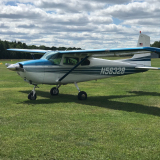
- Aircraft: 1956 Cessna 182....N5632B
Tue Jul 04, 2023 6:57 am
Re: Double puck brakes....
Airdave100 wrote:....What I want to avoid is the natural desire to “upgrade” and bring with it more risk than reward.....btw the brakes I have are working fine....
"If it ain't broke, don't fix it" comes to mind.
That said, if you ever want to put on bigger tires,
the STC for those might include a requirement for "heavy duty brakes" or similar.
Cessna Skywagon -- accept no substitute!
Tue Jul 04, 2023 7:36 am
Re: Double puck brakes....
Agree with hotrod; if it ain't broke........ Our 56 182 had single puck with GY 8.50s and did pretty well; but, we added 22" Desser (4 ply) smoothies for backcountry fun so added ABW dbl puck and really like them. Home base is paved so 40-50% TO/landings are on paved RW with no issues-yet...2+ yrs. We run 15 PSI in Dessers.
- flyingjack offline
- Posts: 349
- Joined: Thu May 19, 2016 8:21 am
- Location: Erie
- Aircraft: Husky/T206H
Tue Jul 04, 2023 7:46 am
Re: Double puck brakes....
Applying brake (in this example a resistance on a rotating object) induces a torque vector in the direction of the rotation. Employed in a conventional (tailwheel) configuration, the weight on the tailwheel is reduced when the braking resistance is applied as the mass in motion attempts to rotate about the axis in which the resistance is applied (assuming the resistance is equal to both main wheels thus no yaw induced). The same forces are in play on a tricycle (nose wheel) configuration, however, once the nose wheel contacts the ground as it picks up its designed portion of the weight of the aircraft shed by the reducing lift vector of the wing, the weight on the nose gear is increased. With increased rotational resistance (braking) the weight on the nose wheel and associated support, (struts, firewall attach, and airframe) are increased as there is a rotational force and a moment arm (distance from resistance application to the nose gear attachment). An analogy is placing a pipe on a wrench to apply more rotational force. Something will eventually move given enough applied force, unfortunately it may not be the part you were trying to remove. It may distort the part, the wrench itself or the pipe as you may exceed its design parameters. Most components are engineered and thus manufactured to meet a specific purpose. Changing one seemingly minor component usually effects interacting components. Just a thought. Risk/Reward is the proper question indeed.
Tue Jul 04, 2023 12:15 pm
Re: Double puck brakes....
Why not?
The planes I flew with very powerful brakes, a Stinson with upgraded disks and a few PC12s, just get use to them on a longer runway first, before you take them in anywhere short enough you NEED brakes, after you and the brakes are seeing eye to eye, it’s no factor
It’s like a proper high HP vehicle, you can still drive it like driving miss daisy, but it’s nice to know you got that power if you need or want it, same with brakes
The planes I flew with very powerful brakes, a Stinson with upgraded disks and a few PC12s, just get use to them on a longer runway first, before you take them in anywhere short enough you NEED brakes, after you and the brakes are seeing eye to eye, it’s no factor
It’s like a proper high HP vehicle, you can still drive it like driving miss daisy, but it’s nice to know you got that power if you need or want it, same with brakes
- NineThreeKilo offline
- Retired
- Posts: 1678
- Joined: Thu Dec 31, 2009 8:16 pm
- Location: _
Tue Jul 04, 2023 7:16 pm
Re: Double puck brakes....
Double Pucks are Awesome. You don't have to use them but when you do need some braking power you'll have it available and it could save you in the event of a long landing, or when you want to go into a really short strip. I love my double pucks. $pendy but worth it if you have the dollars.
Josh
Josh
- Dog is my Copilot offline
- Posts: 433
- Joined: Thu Apr 12, 2018 11:38 am
- Location: Portland
- Aircraft: 1958 Cessna 180A
Wed Jul 05, 2023 4:39 am
Re: Double puck brakes....
Thanks to all for the advice….I also feel I got a short lesson in mech engineering and torque vectors….which I know understand. Seems to makes sense to add…as said…why not…if you accept and respect the fact that you have added “power” to a system greater than the original design…one of our members uses Zoom Reserve as a means of explaining accessible energy…so too are DP brakes perhaps in the reverse….just cause you have them doesn’t mean you need to stomp them on all landings…but if things get ugly sure would be nice to have….appreciate the Community…
- Airdave100 offline
- Posts: 126
- Joined: Sun Jun 08, 2014 6:10 pm
- Location: Fredericksburg
- Aircraft: 1956 Cessna 182....N5632B
Wed Jul 05, 2023 3:24 pm
Re: Double puck brakes....
The next question to ask yourself is do I still have aluminum axles.Further down the rabbit hole you will find two doors.One is marked steel, the other Titanium.. 
Wed Jul 05, 2023 3:35 pm
Re: Double puck brakes....
Ok….I know I have solid aluminum not hollow……..not steel or titanium…so do I need this upgrade as well……?
- Airdave100 offline
- Posts: 126
- Joined: Sun Jun 08, 2014 6:10 pm
- Location: Fredericksburg
- Aircraft: 1956 Cessna 182....N5632B
Thu Jul 06, 2023 6:58 am
Re: Double puck brakes....
I would have a conversation with your IA. He will most likely say that he recommends steel but not required unless you are going with larger tires.Titanium's most noticeable effect would be on your wallet, although I must admit I keep looking at it.
Fri Jul 07, 2023 7:51 am
Re: Double puck brakes....
Airdave100 wrote:Ok….I know I have solid aluminum not hollow……..not steel or titanium…so do I need this upgrade as well……?
I understand the troubles with aluminum axles has been the hollow ones.
While I'd rather have hollow steel axles, my 180 has sold aluminum ones & I'm good with that.
Cessna Skywagon -- accept no substitute!
Mon Jul 10, 2023 4:37 pm
Re: Double puck brakes....
Double puck brakes will not really contribute to more lockups. They will change your brake feel substantially, and take a bit of getting used to. You will have more available braking for the same amount of pedal pressure, but you will also have more pedal travel because you are moving more volume of fluid before the pressure ramps up.
If anything, you'll probably notice you need to deflect MORE pedal to get the same braking, and right on the edge of lockup you should have a more fine control over the amount of braking applied. Also with more pad area on the same rotor, you are likely to get more effective braking available before lockup because you will be able to apply more friction with less pressure. As the pressure ramps up, the lockup is more abrupt.
Basically, other than weight, and the fact that you can get your rotors hotter, all good things.
If anything, you'll probably notice you need to deflect MORE pedal to get the same braking, and right on the edge of lockup you should have a more fine control over the amount of braking applied. Also with more pad area on the same rotor, you are likely to get more effective braking available before lockup because you will be able to apply more friction with less pressure. As the pressure ramps up, the lockup is more abrupt.
Basically, other than weight, and the fact that you can get your rotors hotter, all good things.
- WorkingWarbirds offline
- Posts: 92
- Joined: Thu May 12, 2016 9:21 pm
- Location: Upland
- Aircraft: Champion 7GCBC
Mooney M20E
Globe Swift
Tue Jul 11, 2023 5:25 am
Re: Double puck brakes....
Thanks again for all the comments and counsel….I’m going to install them next week when we take Old Blue down for the annual….like any change or upgrade a period of exploration seems right….
- Airdave100 offline
- Posts: 126
- Joined: Sun Jun 08, 2014 6:10 pm
- Location: Fredericksburg
- Aircraft: 1956 Cessna 182....N5632B
Wed Sep 20, 2023 6:32 pm
Re: Double puck brakes....
Installed the double pucks yesterday…wow…did the steel axels as well…they feel great …subtle power in the pedals…first few grass landings noticeably shorter…total of 4 pounds additional weight…thanks for the advice….
- Airdave100 offline
- Posts: 126
- Joined: Sun Jun 08, 2014 6:10 pm
- Location: Fredericksburg
- Aircraft: 1956 Cessna 182....N5632B
DISPLAY OPTIONS
Who is online
Users browsing this forum: No registered users and 0 guests
Latest Features
-
-
Featured Bush Planes
As one of the undisputed legends of bush flying, the Cessna 180 hauls a…Read More -
Aircraft Ownership and Maintenance
9 modification mistakes aircraft owners make when trying to "bush out" their birds—why some…Read More -
Live to Tell
A Minnesota pilot is surprised to learn that the sudden asymmetric drag of an…Read More




Latest Knowledge Base
-
Destinations
Canada offers some of the most spectacular backcountry flying on the continent. Here's what you need to know before you go.Read More -
Safety and Survival
Hope that you never have to use your survival vest but knowing you have it and knowing how to use…Read More -
Destinations
A regional guide with ideas for winter camping destinations in California, Nevada, New Mexico, and Arizona.Read More -
Aircraft
Finding an affordable aircraft that can handle the backcountry for $80K or less? A challenge for sure, but with the…Read More



