So here is a set of 4 actual data points for you:
I am the maint officer for a flying club. We currently have 4 aircraft and NEVER preheat them. We are in NJ, it gets very cold here on a lot of days between December and beginning of April. The planes are parked outside 24x7x365. It is about 1/2 mile to taxi out from tie-down to end of main runway. These planes fly between 200 and 450 hours each per year.
Plane # 1: 172N - 2850 hours SMOH - Still turned static RPM when we sold it, good compressions.
Plane # 2: 172SP - 2740 hours SNEW - Still turns static RPM, compressions are good
Plane # 3: 172SP - 1450 hours SMOH - Still turns static - compressions good
Plane # 4: 172N - 2050 SNEW - Still on static - compressions good
What we do instead of pre-heat, is run AeroShell 20W50 and change the oil religiously at 50 hours, use the Challenger oil filter system, and fly these things many times a week. We watch oil analysis reports and correct any small problems before they flare up.
Personal opinion, this preheating thing is an old wives tale in practice if you warm the engine by idling/taxiing before takeoff AND fly regularly. The single best thing you can do for your airplane's engine? Get a partner or 2 or 3, just so it will fly more often.
Yeah, I get the pre-heat argument, but - there is a difference between theory and practice, especially in practice - Yogi Berra
Engine Preheating
Mon Feb 29, 2016 1:00 pm
Engine Preheating
The following is from a Lycoming email list. I'm providing this as information only and have my own opinions on pre-heating which are contrary. However I thought this was interesting and may provide for some good (lively) discussion:
- blackrock offline
- Posts: 1576
- Joined: Tue Jan 29, 2008 6:54 pm
- Location: Elko, NV
- FindMeSpot URL: http://share.findmespot.com/shared/face ... BFmtASxjeV
- Aircraft: Bearhawk
Mon Feb 29, 2016 1:16 pm
Re: Engine Preheating
blackrock wrote:The following is from a Lycoming email list. I'm providing this as information only and have my own opinions on pre-heating which are contrary. However I thought this was interesting and may provide for some good (lively) discussion:So here is a set of 4 actual data points for you
lol. yeah. And anyone who knows anything about statistics will definitely agree that you can extrapolate safety based on four data points.

- rw2 offline

- Posts: 1799
- Joined: Sat Dec 22, 2012 1:10 pm
- Location: San Miguel de Allende
- FindMeSpot URL: https://share.delorme.com/LaNaranjaDanzante
- Aircraft: Experimental Maule
Follow my Flying, Cooking and Camping adventures at RichWellner.com
Mon Feb 29, 2016 1:26 pm
Re: Engine Preheating
I doubt the dude from New Joysee knows what very cold is!! Cold maybe, but not the cold we get here or north of here.
About -20 windchill here this morning and you won't catch me flying either of my planes without a thurough pre-heat. Heck, I run 20W50 Phillips along with Cam Guard in the 172 and even with this oil, if the engine isn't preheated, it turns over like it has gear oil in it.
Vehicles have a way of clattering for a few seconds when they are started in the cold. That noise sure doesn't sound like it is good for any engine.
Everyone has an opinion but personally for the little money it costs to preheat, I'll preheat.
About -20 windchill here this morning and you won't catch me flying either of my planes without a thurough pre-heat. Heck, I run 20W50 Phillips along with Cam Guard in the 172 and even with this oil, if the engine isn't preheated, it turns over like it has gear oil in it.
Vehicles have a way of clattering for a few seconds when they are started in the cold. That noise sure doesn't sound like it is good for any engine.
Everyone has an opinion but personally for the little money it costs to preheat, I'll preheat.
Mon Feb 29, 2016 1:53 pm
Re: Engine Preheating
Troll email from the looks of it.
Seems suspicious. Very gregarious email with little information that seems useful to me.
Survey says:
I have no response to it! Moving on to more important things...bye!
Seems suspicious. Very gregarious email with little information that seems useful to me.
Survey says:
I have no response to it! Moving on to more important things...bye!

CFII, MEI, CFISES, ATPME, IA/AP, RPPL, Ski&Amphib ops, RHC mechanic cert, RHC SC— 3000TT
Mon Feb 29, 2016 4:43 pm
Re: Engine Preheating
If it was "very cold" in New Jersey he would not even be able to start the airplane. Most of those "450 to 500 hours" would undoubtedly be flown during (what we would call) mild weather.
At -30C (-22F), which is my personal limit for safety and comfort, I would not think of starting the O-320 without pre-heat. The pre-heat also helps to keep the engine compartment dry and probably helps with corrosion prevention.
I think those "statistics", if true, show that flying the airplane often is a major factor in engine longevity.
At -30C (-22F), which is my personal limit for safety and comfort, I would not think of starting the O-320 without pre-heat. The pre-heat also helps to keep the engine compartment dry and probably helps with corrosion prevention.
I think those "statistics", if true, show that flying the airplane often is a major factor in engine longevity.
- NunavutPA-12 offline

- Posts: 123
- Joined: Sat Feb 22, 2014 8:52 pm
- Location: Kugluktuk
Mon Feb 29, 2016 4:46 pm
Re: Engine Preheating
Oh, I'll bet those New Jersey types are out there flying all the time at temps below + 20 F. RIGHT!
And, by the way, Aeroshell does not produce a 20 W 50 oil.
Another "internet expert".
MTV
And, by the way, Aeroshell does not produce a 20 W 50 oil.
Another "internet expert".
MTV


Mon Feb 29, 2016 5:20 pm
Re: Engine Preheating
mtv wrote:And, by the way, Aeroshell does not produce a 20 W 50 oil.
lol! nice catch!
- rw2 offline
- Posts: 1799
- Joined: Sat Dec 22, 2012 1:10 pm
- Location: San Miguel de Allende
- FindMeSpot URL: https://share.delorme.com/LaNaranjaDanzante
- Aircraft: Experimental Maule
Follow my Flying, Cooking and Camping adventures at RichWellner.com
Mon Feb 29, 2016 6:22 pm
Re: Engine Preheating
8GCBC wrote:Troll email from the looks of it.
Seems suspicious. Very gregarious email with little information that seems useful to me.
Survey says:
I have no response to it! Moving on to more important things...bye!
The email is sincere and the poster is legitimate and held in high regard by those who know him. Please don't discount him offhand. I do not know the person, but I have looked into this and he is as stated in the email. Yeah, so he misquoted 20/50 instead of 15/50 but who among us hasn't made a similar error at some point.
The historical temps for that location are not as cold as many of us see but they aren't warm either and are certainly cold enough to thoroughly cold soak an engine:

So while this information is contrary to how I operate (I preheat if below 40F unless in the rare event I can't preheat), I thought it was interesting and appreciate points of view that differ from mine or the accepted norm so that's why I posted. I agree that regular operation plays a big role in these numbers as was said by NunavutPA-12.
Of course this is all anecdotal information at this point, but none the less is an interesting data set and there is no obvious reason to doubt the integrity of the email post.
BR
- blackrock offline
- Posts: 1576
- Joined: Tue Jan 29, 2008 6:54 pm
- Location: Elko, NV
- FindMeSpot URL: http://share.findmespot.com/shared/face ... BFmtASxjeV
- Aircraft: Bearhawk
Mon Feb 29, 2016 6:36 pm
Re: Engine Preheating
I always wondered about the pre heating thing and how cold was cold enough to actually need it.
My flying limit is 20 degrees (East Coaster here) and I just pull the prop thru a dozen or so times to break the oil film.
If it's -15 degrees outside and the engine is cold soaked (-15 degrees thru and thru), how long do you have to pre-heat in order to bring the crank bearings up to a safe temperature? I would think a very very long time.
I'm thinking of the forced air heaters I see.
The internal oil heaters might be very different.
I remember when I was living in Pittsburgh and cleaning carpets. I had no place to put the cleaning chemicals or even the equipment so I had to leave it in the van. Even on the worse winter nights where it'd hit -20, a simple 100 watt lightbulb was enough to keep the equipment from freezing. So, an engine heater might be doing more than I think.
My flying limit is 20 degrees (East Coaster here) and I just pull the prop thru a dozen or so times to break the oil film.
If it's -15 degrees outside and the engine is cold soaked (-15 degrees thru and thru), how long do you have to pre-heat in order to bring the crank bearings up to a safe temperature? I would think a very very long time.
I'm thinking of the forced air heaters I see.
The internal oil heaters might be very different.
I remember when I was living in Pittsburgh and cleaning carpets. I had no place to put the cleaning chemicals or even the equipment so I had to leave it in the van. Even on the worse winter nights where it'd hit -20, a simple 100 watt lightbulb was enough to keep the equipment from freezing. So, an engine heater might be doing more than I think.
Mon Feb 29, 2016 6:51 pm
Re: Engine Preheating
Interesting information there Mike, as you said up front - likely to generate discussion.
Personally, I run Aeroshell W100 year round, mostly because Phillips 20W50 is hard to get locally. I use an sump-pad preheater, which doesn't take long to warm the oil to operating temp. The rest of the engine follows shortly.
For me, starting at much below zero (without preheat) is something I avoid when I can. It takes a full battery, everything moves very slowly, and I am convinced you can feel and hear the difference (damage). I'm no expert, but I prefer to preheat because I think the factual and probable benefits outweigh the downsides.
Working with analysis and statistics a lot, I have to concur with some of what's been said:
Four points isn't a meaningful dataset, and
Correlation does not imply causation
For instance - how often is the weather good enough to fly around that part of the USA, when it's that cold? Are they doing 90% of their hours in summer? You get the idea, we haven't got anywhere near enough information to draw any conclusion.
Moreover, I know of a whole range of aero engines which have gone to almost 3000hrs, Lycoming and a few TCM, with little rhyme or reason. My point is, the preheat or lack-thereof may have nothing to do with the great service life they are enjoying.
Personally, I run Aeroshell W100 year round, mostly because Phillips 20W50 is hard to get locally. I use an sump-pad preheater, which doesn't take long to warm the oil to operating temp. The rest of the engine follows shortly.
For me, starting at much below zero (without preheat) is something I avoid when I can. It takes a full battery, everything moves very slowly, and I am convinced you can feel and hear the difference (damage). I'm no expert, but I prefer to preheat because I think the factual and probable benefits outweigh the downsides.
Working with analysis and statistics a lot, I have to concur with some of what's been said:
Four points isn't a meaningful dataset, and
Correlation does not imply causation
For instance - how often is the weather good enough to fly around that part of the USA, when it's that cold? Are they doing 90% of their hours in summer? You get the idea, we haven't got anywhere near enough information to draw any conclusion.
Moreover, I know of a whole range of aero engines which have gone to almost 3000hrs, Lycoming and a few TCM, with little rhyme or reason. My point is, the preheat or lack-thereof may have nothing to do with the great service life they are enjoying.
Last edited by Battson on Mon Feb 29, 2016 6:57 pm, edited 1 time in total.
Mon Feb 29, 2016 6:52 pm
Re: Engine Preheating
Don't some folks put a 100Watt light bulb under their cowling cover/blanket?
- soyAnarchisto offline


- Posts: 1975
- Joined: Fri Aug 19, 2011 1:23 pm
- Location: Boulder, CO
- Aircraft: 1955 Cessna 180
Mon Feb 29, 2016 8:39 pm
Re: Engine Preheating
FYI, Lycoming recommends engine pre heat when ambient temperatures are below 10 degrees F or 20 degrees F for some engines. So, based on average low temps presented for Morristown, it would appear that they're not starting (at least not very often) their engines at temperatures below which the engine manufacturer recommends pre heat. And, in fact, since those temperatures are typically only present early in the day, even fewer starts probably happen even close to those temps.
Which is why I still say "internet expert". If this guy was actually starting engines in COLD temperatures, he would never post such an ill informed statement.
One of the problems about the internet is that many people read something like this, but don't bother to do the requisite research to understand whether the poster's point is valid in their own case. So, someone reads this, and assumes that this will save him/her a lot of trouble, so they don't pre-heat their engine. But, they live in central Minnesota.....and the first day they start their engine, it's -2 F. They do some damage to their engine, but it's not real apparent. Etc.
So, this guy is still full of crap. His point is that pre-heating an aircraft engine isn't necessary, based on his extensive experience, but he in fact is not operating in conditions which the manufacturer of the engine even suggests pre heat.
I've operated airplanes regularly in very cold temperatures (our cold cutoff was -40) and I promise you that, contrary to what this gent is saying, engine pre heat is essential in temperatures below 20 degrees F. In fact, I pre heat at temps below 30 F.
FWIW....just another "internet expert"
MTV
Which is why I still say "internet expert". If this guy was actually starting engines in COLD temperatures, he would never post such an ill informed statement.
One of the problems about the internet is that many people read something like this, but don't bother to do the requisite research to understand whether the poster's point is valid in their own case. So, someone reads this, and assumes that this will save him/her a lot of trouble, so they don't pre-heat their engine. But, they live in central Minnesota.....and the first day they start their engine, it's -2 F. They do some damage to their engine, but it's not real apparent. Etc.
So, this guy is still full of crap. His point is that pre-heating an aircraft engine isn't necessary, based on his extensive experience, but he in fact is not operating in conditions which the manufacturer of the engine even suggests pre heat.
I've operated airplanes regularly in very cold temperatures (our cold cutoff was -40) and I promise you that, contrary to what this gent is saying, engine pre heat is essential in temperatures below 20 degrees F. In fact, I pre heat at temps below 30 F.
FWIW....just another "internet expert"
MTV
Last edited by mtv on Tue Mar 01, 2016 10:22 am, edited 1 time in total.
Mon Feb 29, 2016 8:48 pm
Re: Engine Preheating
mtv wrote:FYI, Lycoming recommends engine pre heat when ambient temperatures are below 20 degrees F. So, based on average low temps presented for Morristown, it would appear that they're not starting (at least not very often) their engines at temperatures below which the engine manufacturer recommends pre heat. And, in fact, since those temperatures are typically only present early in the day, even fewer starts probably happen even close to those temps.
Which is why I still say "internet expert". If this guy was actually starting engines in COLD temperatures, he would never post such an ill informed statement.
One of the problems about the internet is that many people read something like this, but don't bother to do the requisite research to understand whether the poster's point is valid in their own case. So, someone reads this, and assumes that this will save him/her a lot of trouble, so they don't pre-heat their engine. But, they live in central Minnesota.....and the first day they start their engine, it's -2 F. They do some damage to their engine, but it's not real apparent. Etc.
So, this guy is still full of crap. His point is that pre-heating an aircraft engine isn't necessary, based on his extensive experience, but he in fact is not operating in conditions which the manufacturer of the engine even suggests pre heat.
I've operated airplanes regularly in very cold temperatures (our cold cutoff was -40) and I promise you that, contrary to what this gent is saying, engine pre heat is essential in temperatures below 20 degrees F. In fact, I pre heat at temps below 30 F.
FWIW....just another "internet expert"
MTV
Well said, Mike. Agreed. The dude is full of €£ap. There is little context to support the email's conclusion.
CFII, MEI, CFISES, ATPME, IA/AP, RPPL, Ski&Amphib ops, RHC mechanic cert, RHC SC— 3000TT
Mon Feb 29, 2016 8:49 pm
Re: Engine Preheating
If it's +30F or below, my Lycoming is very hard to start without preheating. There is little doubt in my mind that it's easier on the machinery to preheat it. I'm certainly no expert, but listening/watching it grind slowly until it starts can't be nearly as good for it as having it spin like it's a nice summer day and catch on the 3rd or 4th blade. Maybe it won't make a huge difference in ultimate longevity, but as inexpensive as engine heaters are in comparison to engines (less than 2% in my case, cost of engine vs. Reiff standard heater system), I'll preheat.
Cary
Cary
"I have slipped the surly bonds of earth..., put out my hand and touched the face of God." J.G. Magee
Mon Feb 29, 2016 8:55 pm
Re: Engine Preheating
Bagarre wrote:I just pull the prop thru a dozen or so times to break the oil film.
I'm not an expert by any means but I had heard this was worse than just cranking it cold. Something about scraping the oil film off of parts or something.
- CamTom12 offline

- Posts: 3705
- Joined: Sun Jul 08, 2012 1:08 pm
- Location: Huntsville
- FindMeSpot URL: https://share.delorme.com/camtom12
- Aircraft: Ruppe Racer
Experimental Pacer
home hand jam "wizard"
Mon Feb 29, 2016 8:59 pm
Re: Engine Preheating
CamTom12 wrote:Bagarre wrote:I just pull the prop thru a dozen or so times to break the oil film.
I'm not an expert by any means but I had heard this was worse than just cranking it cold. Something about scraping the oil film off of parts or something.
That's after preserving oils are run. Tape a note "Do not turn prop"!
Before start is fine and encouraged to check compression and move oil around.
CFII, MEI, CFISES, ATPME, IA/AP, RPPL, Ski&Amphib ops, RHC mechanic cert, RHC SC— 3000TT
Tue Mar 01, 2016 9:56 am
Re: Engine Preheating
Bagarre wrote:
If it's -15 degrees outside and the engine is cold soaked (-15 degrees thru and thru), how long do you have to pre-heat in order to bring the crank bearings up to a safe temperature? I would think a very very long time.
I'm thinking of the forced air heaters I see.
The internal oil heaters might be very different.
Sir,
I have a Tanis preheat on one plane and on the 172 I use a 'milkhouse heater' Its just a small electric heater I riveted a dryer vent assemly on. I can either use a shot section of 4" ducting or a dryer vent house. I put it through the bottom of my cowling, drape a sleeping bag over the cowl, and let it heat soak for 45 minutes or more. Of course this time is variable according to the outside temps. I rarely fly if it is -10 or more. Once it gets that cold I figure if I have a problem I probably won't be a very happy camper stranded out in the boonies.
If you are interested in a picture of what I have just PM me and I can send you a text pic or email pic.
Tue Mar 01, 2016 10:10 am
Re: Engine Preheating
8GCBC wrote:CamTom12 wrote:Bagarre wrote:I just pull the prop thru a dozen or so times to break the oil film.
I'm not an expert by any means but I had heard this was worse than just cranking it cold. Something about scraping the oil film off of parts or something.
That's after preserving oils are run. Tape a note "Do not turn prop"!
Before start is fine and encouraged to check compression and move oil around.
Ummmm, actually, no. In fact, all you're doing by pulling the prop through prior to a cold start is in fact scraping all the oil off the mating metal parts inside the engine, so that when you actually start the engine, you have lots of metal to metal contact.....not good. Which is also the reason they say not to move the prop once it's pickled....why scrape all the oil off mating parts?
So, you pull your engine through a few revolutions to "loosen it up" (which by the way, doesn't "loosen" anything), but that slow turning doesn't generate enough movement in your oil pump to actually move much oil. So, it's not like you're pre lubing the engine either.
Do not pull the engine through prior to engine start in cool conditions. Just get in the thing and start it. Simple, and the best approach.
MTV
Tue Mar 01, 2016 10:35 am
Re: Engine Preheating
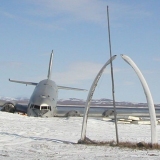
I once watched a guy launch off from Kotzebue on a cold (-30 to -40F range) winter day in his C185 or C206 (I can't remember). Ran down the runway, got airborne and climbed up a few hundred feet, then bam! Loud noise and smoke, and he coasted back to the end of the runway.
He was not a local, the airplane had been parked outside all night not heated or engine covered, and he had preheated with a Herman-Nelson only long enough to make the case feel warm to touch. The engine tore itself apart from oil starvation. The airplane was towed into a heated hangar only minutes after landing, and hours later when they started tearing into the engine they found all the oil. Still frozen into a big cold, hard ball in the sump.
Back in my Cub days in Barrow we would winter camp out at different sites for "fun" just because. Most times we used the old ways, and drained the oil into a metal bucket so we could heat it the morning. We could get that pot 'pert near red hot, and a bunch of oil bubbling away in there, but still have a huge lump of frozen oil that just would not change over to a liquid state. It takes a lot of time.
My Golden Rule for up North was always, "The colder it gets, the slower I go."
Gump
He was not a local, the airplane had been parked outside all night not heated or engine covered, and he had preheated with a Herman-Nelson only long enough to make the case feel warm to touch. The engine tore itself apart from oil starvation. The airplane was towed into a heated hangar only minutes after landing, and hours later when they started tearing into the engine they found all the oil. Still frozen into a big cold, hard ball in the sump.
Back in my Cub days in Barrow we would winter camp out at different sites for "fun" just because. Most times we used the old ways, and drained the oil into a metal bucket so we could heat it the morning. We could get that pot 'pert near red hot, and a bunch of oil bubbling away in there, but still have a huge lump of frozen oil that just would not change over to a liquid state. It takes a lot of time.
My Golden Rule for up North was always, "The colder it gets, the slower I go."
Gump
Tue Mar 01, 2016 10:42 am
Re: Engine Preheating
mtv wrote:
Ummmm, actually, no. In fact, all you're doing by pulling the prop through prior to a cold start is in fact scraping all the oil off the mating metal parts inside the engine, so that when you actually start the engine, you have lots of metal to metal contact.....not good. Which is also the reason they say not to move the prop once it's pickled....why scrape all the oil off mating parts?
So, you pull your engine through a few revolutions to "loosen it up" (which by the way, doesn't "loosen" anything), but that slow turning doesn't generate enough movement in your oil pump to actually move much oil. So, it's not like you're pre lubing the engine either.
Do not pull the engine through prior to engine start in cool conditions. Just get in the thing and start it. Simple, and the best approach.
MTV
First time this was explained to me. I can not believe that turning a propeller a few minutes before start up is going to remove enough oil? Where is all that oil going? Suddenly disappearing into air?
Nope. Don't believe it's bad.
CFII, MEI, CFISES, ATPME, IA/AP, RPPL, Ski&Amphib ops, RHC mechanic cert, RHC SC— 3000TT
DISPLAY OPTIONS
Who is online
Users browsing this forum: No registered users and 3 guests
Latest Features
-
Live to Tell
A Minnesota pilot is surprised to learn that the sudden asymmetric drag of an out-of-rig ski can…Read More -
Creators
Working in some of the Yukon's most beautiful and remote environments, photographer Simon Blakesley captures aircraft in…Read More -
Aircraft Ownership and Maintenance
Upgrading to big tires can make a huge difference in backcountry performance, but with those gains come…Read More -
Tales from Yesteryear
In this tale from bush flying yesteryear, Don Cogger signs up to help Atlee Dodge Jr recovery…Read More


Latest Knowledge Base
-
Destinations
A regional guide with ideas for winter camping destinations in California, Nevada, New Mexico, and Arizona.Read More -
Aircraft
Finding an affordable aircraft that can handle the backcountry for $80K or less? A challenge for sure, but with the…Read More -
Aircraft
01.29.2018 - Zane - Updated tire diameter graphic to add 8.50x10 Guide to tires for use in the backcountry and off-airport landing…Read More -
Pilots
12.22.2013 - Initial article format Operating aircraft on skis and negotiating a snow-covered landscape is an entirely unique skillset and environment.…Read More


