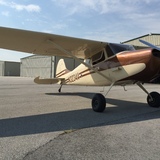
Today, I took Jim Dulin aka "contactflying" up on his offer to get "hands on" experience of the things he wrote about in his E-Book. We didn't do all of it, but I have to say I'm impressed. I simply would have never believed my aircraft was capable of such things. After a few demonstrations and a few uncontrollable Holy Bleeping Crap's subsided. It started to make sense and sink in. Jim was a really good sport about it, I'm very glad we got together and he was willing to share his knowledge and experience with this rookie. I so very grateful to have a basic understanding of a skill that could very well save me, my family, and my airplane. If worse comes to worse. The energy management turn in all cases is going to make me a better safer pilot.
Thanks Again Jim!!!
Expanding (my) Experiences Contact Style
Mon Mar 28, 2016 5:58 pm
Expanding (my) Experiences Contact Style
Last edited by jmurtap on Mon Mar 28, 2016 6:36 pm, edited 1 time in total.
Mon Mar 28, 2016 6:29 pm
Re: Expanding (my) Experiences Contact Style
Sounds like fun! I really hope to fly with Jim someday.

Mon Mar 28, 2016 6:42 pm
Re: Expanding (my) Experiences Contact Style
Jason did a fine job handling a fine airplane. He and an older pilot in a Stinson at Iowa Falls are the only two pilots who actually approach slow enough to make ol contact get a little impatient. They both appreciated how the apparent brisk walk rate of closure lets them go a little faster way out and still causes effective slowing on short final. I look forward to flying with him again soon.
- contactflying offline
- Posts: 4972
- Joined: Wed Apr 03, 2013 7:36 pm
- Location: Aurora, Missouri 2H2
Download my free "https://tinyurl.com/Safe-Maneuvering" e-book.
Wed Mar 30, 2016 6:11 am
Re: Expanding (my) Experiences Contact Style
When I get an airplane I plan ok coming down. Hopefully sometime late this summer.
- cstolaircraft offline
- Posts: 523
- Joined: Wed Sep 29, 2010 12:50 pm
- Location: Blackwell, Mo
Mission Pilot in training. C-170B N8098A.
But they that wait upon the Lord shall renew their strength; they shall mount up on wings as eagles... Isaiah 40:31
But they that wait upon the Lord shall renew their strength; they shall mount up on wings as eagles... Isaiah 40:31
Wed Mar 30, 2016 7:08 am
- contactflying offline
- Posts: 4972
- Joined: Wed Apr 03, 2013 7:36 pm
- Location: Aurora, Missouri 2H2
Download my free "https://tinyurl.com/Safe-Maneuvering" e-book.
Wed Mar 30, 2016 8:07 am
Re: Expanding (my) Experiences Contact Style
Jim,
What airport do you fly out of?
What airport do you fly out of?
Wed Mar 30, 2016 12:14 pm
Re: Expanding (my) Experiences Contact Style
Aurora, Missouri 2H2.
- contactflying offline
- Posts: 4972
- Joined: Wed Apr 03, 2013 7:36 pm
- Location: Aurora, Missouri 2H2
Download my free "https://tinyurl.com/Safe-Maneuvering" e-book.
Wed Mar 30, 2016 8:11 pm
Re: Expanding (my) Experiences Contact Style
I have kicked around the idea of offering to buy him a plane ticket here to Anchorage to be able to get some dual with him in my pacer. I ordered his paperback book several years ago and have read it through more than once. Now that I'm getting some time in the plane and getting used to how it flies, I've been putting some of what he teaches in the book into practice. Not sure I entirely understand the brisk walk apparent rate of closer approach, but I'm learning how the controls feel at different speeds and almost never look at the ASI on approach anymore.
- Student BCP offline
- Posts: 334
- Joined: Mon Oct 08, 2007 6:50 pm
- Location: Eagle River
- Aircraft: PA 22/20
Wed Mar 30, 2016 9:30 pm
Re: Expanding (my) Experiences Contact Style
Student BCP,
When flying at a thousand feet , targets on the ground appear to be closing with us slowly. It makes little difference what our airspeed or goundspeed is. When we get lower and closer, however, targets like the numbers appear to speed up.
The apparent brisk walk rate of closure approach makes use of this optical illusion to cause a gradual reduction in airspeed and groundspeed from about a quarter mile out and about five hundred feet up.
All we do is use elevator to keep this normal apparent brisk walk from speeding up on short final. We use the throttle to maintain glide angle.
Because we are slowing, to maintain the apparent brisk walk, and getting slower as we get lower and closer, we will have to keep adding more power.
If we maintain apparent speed with elevator and glide angle with power , it delivers us to the numbers slow enough to land with just a bit of flair. We have eliminated the need to round out and hold off. If a bit too fast, we will have to pull throttle before touchdown. If right on apparent brisk walk, we will pull power at touchdown.
In a strong headwind component, we will have little ground speed and higher airspeed. In a tailwind, we will probably go behind the power curve requiring lots of power to maintain glide angle.
Done correctly there we do not approach high ground effect stall speed until in low ground effect. If we get too slow and shake and mush, we add power to touch down softly.
If we have to round out or make a gravity thrust hold off, we know we need to go slower next time. Short final is where the apparent brisk walk becomes a stampede if we don't control the rate of closure with elevator.
I hope to make it up that way sometime. Have fun,
Contact
When flying at a thousand feet , targets on the ground appear to be closing with us slowly. It makes little difference what our airspeed or goundspeed is. When we get lower and closer, however, targets like the numbers appear to speed up.
The apparent brisk walk rate of closure approach makes use of this optical illusion to cause a gradual reduction in airspeed and groundspeed from about a quarter mile out and about five hundred feet up.
All we do is use elevator to keep this normal apparent brisk walk from speeding up on short final. We use the throttle to maintain glide angle.
Because we are slowing, to maintain the apparent brisk walk, and getting slower as we get lower and closer, we will have to keep adding more power.
If we maintain apparent speed with elevator and glide angle with power , it delivers us to the numbers slow enough to land with just a bit of flair. We have eliminated the need to round out and hold off. If a bit too fast, we will have to pull throttle before touchdown. If right on apparent brisk walk, we will pull power at touchdown.
In a strong headwind component, we will have little ground speed and higher airspeed. In a tailwind, we will probably go behind the power curve requiring lots of power to maintain glide angle.
Done correctly there we do not approach high ground effect stall speed until in low ground effect. If we get too slow and shake and mush, we add power to touch down softly.
If we have to round out or make a gravity thrust hold off, we know we need to go slower next time. Short final is where the apparent brisk walk becomes a stampede if we don't control the rate of closure with elevator.
I hope to make it up that way sometime. Have fun,
Contact
- contactflying offline
- Posts: 4972
- Joined: Wed Apr 03, 2013 7:36 pm
- Location: Aurora, Missouri 2H2
Download my free "https://tinyurl.com/Safe-Maneuvering" e-book.
DISPLAY OPTIONS
Who is online
Users browsing this forum: No registered users and 18 guests
Latest Features
-
Live to Tell
A Minnesota pilot is surprised to learn that the sudden asymmetric drag of an out-of-rig ski can…Read More -
Creators
Working in some of the Yukon's most beautiful and remote environments, photographer Simon Blakesley captures aircraft in…Read More -
Aircraft Ownership and Maintenance
Upgrading to big tires can make a huge difference in backcountry performance, but with those gains come…Read More -
Tales from Yesteryear
In this tale from bush flying yesteryear, Don Cogger signs up to help Atlee Dodge Jr recovery…Read More


Latest Knowledge Base
-
Destinations
A regional guide with ideas for winter camping destinations in California, Nevada, New Mexico, and Arizona.Read More -
Aircraft
Finding an affordable aircraft that can handle the backcountry for $80K or less? A challenge for sure, but with the…Read More -
Aircraft
01.29.2018 - Zane - Updated tire diameter graphic to add 8.50x10 Guide to tires for use in the backcountry and off-airport landing…Read More -
Pilots
12.22.2013 - Initial article format Operating aircraft on skis and negotiating a snow-covered landscape is an entirely unique skillset and environment.…Read More


