I was just wondering what peoples opinions were on flint tip tanks for a cessna 170B. I see mtv runs them but I could not tell if they are tip extensions or the tanks that go in the existing outer wing. I have been considering wingX tips but would shure like more fuel what i dont like about flint tanks is all that weight hanging on the end of my wings. if you look at the end of the wings on a rough float takeoff it looks to me that the spars are getting enough abuse without an extra 80lb hanging out there.
6 hours fuel would sute me fine though, anyone know if you can legally install 175 wings i have heard they are the same cessna part# but find it hard to believe because every one would have them.
extra fuel
Sat Aug 11, 2007 11:14 pm

tricycles are for little girls
Sun Aug 12, 2007 10:14 am
This doesn't really answer your question, but for most people I think the larger capacity tanks create as many problems as they solve. Granted, I'm as ignorant as a summer day is long, but most of you already know that.
For one thing, unless you're planning IFR flights that require somewhat heroic alternates, flying for five straight hours sounds like a real good way to hate flying. If you take into account that most people will benefit from landing every three hours or so, carrying fuel cans inside the cockpit seems to me to be a much cleaner solution. Since you're talking about a 170, I think it's safe to assume you're not going to be carrying four people and extra fuel, thus the space in the cockpit isn't an issue.
The biggest problem with tip tanks (or similar) is, in addition to the expense of installing them and maintaining them, you have to carry them around all the time. Empty or full, they add weight. If you keep them empty except on rare occasions when you need the fuel, they run the risk of rusting, and they still add weight. If you keep them full even when you don't need the extra range, you severely handicap your airplane by making it haul a bunch of useless weight into the air for no purpose.
Granted, landing and pumping fuel from jerry cans into your wing tanks is a lot more hassle, but look at the advantages: four jerry cans and a manual fuel pump will cost about as much as the two Cessna approved fuel caps your tip tanks will require, and when you don't need the extra capacity, you don't have to lug any of it into the sky.
just a thought.
For one thing, unless you're planning IFR flights that require somewhat heroic alternates, flying for five straight hours sounds like a real good way to hate flying. If you take into account that most people will benefit from landing every three hours or so, carrying fuel cans inside the cockpit seems to me to be a much cleaner solution. Since you're talking about a 170, I think it's safe to assume you're not going to be carrying four people and extra fuel, thus the space in the cockpit isn't an issue.
The biggest problem with tip tanks (or similar) is, in addition to the expense of installing them and maintaining them, you have to carry them around all the time. Empty or full, they add weight. If you keep them empty except on rare occasions when you need the fuel, they run the risk of rusting, and they still add weight. If you keep them full even when you don't need the extra range, you severely handicap your airplane by making it haul a bunch of useless weight into the air for no purpose.
Granted, landing and pumping fuel from jerry cans into your wing tanks is a lot more hassle, but look at the advantages: four jerry cans and a manual fuel pump will cost about as much as the two Cessna approved fuel caps your tip tanks will require, and when you don't need the extra capacity, you don't have to lug any of it into the sky.
just a thought.


Sun Aug 12, 2007 3:56 pm
Flint does not make a wing extension tank for the C-170. The only extensions they make are for the 206. Mine are the internal tanks, which slide inside the end of the wing.
They don't add that much weight. I've forgotten, but it's less than 20 pounds total.
They won't corrode when empty, because they are fiberglass.
You might be able to get a field approval for 175 wings, but I seriously doubt it these days. There is an outfit (Del Air) in California that has an stc (I believe) to modify your tanks to the same configuration as the long range 172/175 tanks.
ravi--you are missing the point. With a 170 and an O-360, you'll burn around ten gallons an hour in cruise. With 37 gallon tanks, that implies that I'm not going to be ABLE to fly 3 hours AND meet my personal minimum fuel reserve of one hour. So, now you have a 2.5 hour airplane, and in the west, that sucks. I did a trip today that wouldn't have worked, and would have required me to make another fuel stop in really sporty winds. With the wing tanks, piece of cake, and my longest leg was 3.1.
At the time I did my tip tanks, I looked at converting to C-175 tanks. I figured the cost (due to labor) would be the same. I agonized over it for a while, and finally decided to go for the maximum capacity for the money, which was the Flint tanks.
If I were on floats all the time, I'd opt for the 175 tanks, just because they're easier to reach to fuel on floats.
Remember also, that fuel in the wings, even the tips, is not felt by the structure of the airplane in turbulence, since the loads are carried in the wing itself.
On the surface, however, that weight out there does impose some stresses. I try not to land with much if any fuel in the tips. That's generally easy to accomplish on any leg of 3 hours.
At today's fuel prices, tankering fuel from places where its cheapest can save a lot of $$$.
As to carrying gas inside the cockpit in plastic cans, metal cans, or any other kind of cans--it's not that great an idea. I started to say it's just plain stupid, but I've done it myself enough times, I thought I'd back off a bit. It stinks up the plane's interior, it is VERY potentially dangerous, and the fueling from cans itself can be disastrous as well.
Yes, it's cheap. Note that there is no way an air taxi operator can or will carry fuel in the cockpit. While its' a regulation, it's also a GREAT idea not to do so.
MTV
They don't add that much weight. I've forgotten, but it's less than 20 pounds total.
They won't corrode when empty, because they are fiberglass.
You might be able to get a field approval for 175 wings, but I seriously doubt it these days. There is an outfit (Del Air) in California that has an stc (I believe) to modify your tanks to the same configuration as the long range 172/175 tanks.
ravi--you are missing the point. With a 170 and an O-360, you'll burn around ten gallons an hour in cruise. With 37 gallon tanks, that implies that I'm not going to be ABLE to fly 3 hours AND meet my personal minimum fuel reserve of one hour. So, now you have a 2.5 hour airplane, and in the west, that sucks. I did a trip today that wouldn't have worked, and would have required me to make another fuel stop in really sporty winds. With the wing tanks, piece of cake, and my longest leg was 3.1.
At the time I did my tip tanks, I looked at converting to C-175 tanks. I figured the cost (due to labor) would be the same. I agonized over it for a while, and finally decided to go for the maximum capacity for the money, which was the Flint tanks.
If I were on floats all the time, I'd opt for the 175 tanks, just because they're easier to reach to fuel on floats.
Remember also, that fuel in the wings, even the tips, is not felt by the structure of the airplane in turbulence, since the loads are carried in the wing itself.
On the surface, however, that weight out there does impose some stresses. I try not to land with much if any fuel in the tips. That's generally easy to accomplish on any leg of 3 hours.
At today's fuel prices, tankering fuel from places where its cheapest can save a lot of $$$.
As to carrying gas inside the cockpit in plastic cans, metal cans, or any other kind of cans--it's not that great an idea. I started to say it's just plain stupid, but I've done it myself enough times, I thought I'd back off a bit. It stinks up the plane's interior, it is VERY potentially dangerous, and the fueling from cans itself can be disastrous as well.
Yes, it's cheap. Note that there is no way an air taxi operator can or will carry fuel in the cockpit. While its' a regulation, it's also a GREAT idea not to do so.
MTV


Sun Aug 12, 2007 4:54 pm
extra fuel
Harry at Del-Air does indeed modify tanks for extra capacity.I believe the mod adds about 20 gals.He moves the filler neck outboard of it's present location and adds a section to the tank.I have a 175 but the last time I talked to him his stc did not cover it.Give him a call he is an interesting guy. Bill
Sun Aug 12, 2007 5:24 pm
I'm pretty sure the flint tanks on our 210 are wing extensions also. It's only been a couple of years, but so far they have been trouble free. I'm in the habit of emptying them as soon as there is room in the mains. I use them so much that there is no need to worry about them sitting empty for long. You can always fill the tips and transfer to keep them exercised. With the 210, there is an increase in gross weight so you don't lose useful load. It's nice to go somewhere and drop off or pick up and return without having to get fuel. If you chose to only fly short legs, that's fine. With aux tanks, now you don't have to plan your stops where there is fuel.
Tue Aug 14, 2007 4:54 pm
I put Harry Delicker's LONG range tanks in my 170-B with the 180hp conversion. My recommendation is to ONLY use the EXTENDED range version if you are planning on them at all.
Harry prefers that you send in your old tanks and he simply adds another tank of the same style of manufacture as the original tank by welding it onto the outer end of your tank, after making holes in the top and bottom of the end of your origninal tank for fuel to flow in and air to flow out.
The Extended range version extends the fuel tank out one more rib on each side for a total of 15 more gallons. The LONG range tanks go out two ribs on each side for a total of 30 more gallons. Problem is that you reuse the "solid" rib on the outside of the fuel tank "torque box". That solid rib fits if you only go out one rib, but it is TOO long to easily fit on the next station out due to wing attach reinforcements on the front spar.
Moving that solid rib out that one extra rib cost me, in my estimation, a good 30% to 40% more time and trouble. I only went that far because a friend of mine said, "You will bet more money when you go to sell if you have LONGE range tanks." Well, that may be true some day, but the extended range would have sill put me back over the four hour range.
I researched all the available tanks and settled on Harry's because of several reasons. You do not need to modify the fuel delivery system. You do not need to wire in any electrical pumps to transfer fuel, and you do not end up with all that kinetic energy inherent keeping TIP tanks under control. I also did not want to put the fuel behind me inside the cabin.
If you have a notion to call Harry at Delair, be sure to allocate several hours to your education on the history and background of small planes. I have occasionally called with a question only to get a three hour seminar.
Harry prefers that you send in your old tanks and he simply adds another tank of the same style of manufacture as the original tank by welding it onto the outer end of your tank, after making holes in the top and bottom of the end of your origninal tank for fuel to flow in and air to flow out.
The Extended range version extends the fuel tank out one more rib on each side for a total of 15 more gallons. The LONG range tanks go out two ribs on each side for a total of 30 more gallons. Problem is that you reuse the "solid" rib on the outside of the fuel tank "torque box". That solid rib fits if you only go out one rib, but it is TOO long to easily fit on the next station out due to wing attach reinforcements on the front spar.
Moving that solid rib out that one extra rib cost me, in my estimation, a good 30% to 40% more time and trouble. I only went that far because a friend of mine said, "You will bet more money when you go to sell if you have LONGE range tanks." Well, that may be true some day, but the extended range would have sill put me back over the four hour range.
I researched all the available tanks and settled on Harry's because of several reasons. You do not need to modify the fuel delivery system. You do not need to wire in any electrical pumps to transfer fuel, and you do not end up with all that kinetic energy inherent keeping TIP tanks under control. I also did not want to put the fuel behind me inside the cabin.
If you have a notion to call Harry at Delair, be sure to allocate several hours to your education on the history and background of small planes. I have occasionally called with a question only to get a three hour seminar.
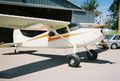
53 C-170-B+
It is better to be late in this world, than early in the next.
It is better to be late in this world, than early in the next.
Wed Aug 15, 2007 10:13 am
That's the aspect of small guy aviation businesses that I think is great. If the day ever comes when that kind of customer interaction is totally lost, it's gonna suck.
- Zzz offline


- Posts: 2855
- Joined: Fri Oct 08, 2004 11:09 pm
- Location: northern
- Aircraft: Swiveling desk chair
Half a century spent proving “it is better to be thought a fool than to open your mouth and remove all doubt.”
Wed Aug 15, 2007 5:43 pm
Fuel in cockpit
As to carrying gas inside the cockpit in plastic cans, metal cans, or any other kind of cans--it's not that great an idea. I started to say it's just plain stupid, but I've done it myself enough times, I thought I'd back off a bit. It stinks up the plane's interior, it is VERY potentially dangerous, and the fueling from cans itself can be disastrous as well.
I just need to comment on this.
Now, I agree, to a certain extent of what you're saying. Sure, it can get stinky if you've got leaky cans (which shouldn't be used) and is dangerous in the presence of sparks or open flames if you have leaky cans. As to fueling from cans, if it's done correctly it's no more risky than pulling up to the fuel pump on the ramp.
Here in interior Alaska, it's standard practice to fuel from cans and it's not uncommon to haul extra gas inside the cockpit. You need to keep in mind that aircraft fueling stations around the state are few and far between. If you're on floats, they're even more hard to come by.
Personally, I always use one of those water separating funnels for every drop of fuel that goes in my plane regardless of where it comes from. It's a little slower fueling but it catches all the particulates and will grab most if not all the water. I have hauled fuel in the cockpit...with the lids on tight and sealed it's no different than hauling a jug of water...that is, unless you have an in-flight fire to the extent the jugs are melted, but then you'd probably have other concerns.
I will be flying 15 gallon plastic barrels of av-gas and boat gas out to Moose camp this fall and I will be flying gas out to our remote property so we can start building a cabin in the spring. I will make sure the barrels are sealed and that any drips are wiped up before they get put in my plane.
My brother files for an air-carrier here in Alaska and he routinely flies either four or five 55 gallon barrels (per trip) of fuel out to the lodges for heating and equipment gas. Of course, it's only fuel...no passengers. Without being able to haul fuel in the cabins of planes, we'd have to sit home twiddling out thumbs.
Alaska is a big state and once you get 10 miles out of town you're on your own...you'd better have enough gas to get where you're going...and in many cases, that requires stoping at a gravel strip, sand bar or lake to dump some more gas in the plane.
I understand that things are different in the lower 48 where gas stations are more readily available and the need to fill from jugs or carry extra gas in the cabin isn't as necessary as it is here but to come out and almost say that hauling gas in cabin (or filling from jugs) is plain stupid isn't a fair generalization of those of us who have to do it and have been doing it sucessfully since the first pilot arrived to explore the state. As with anything, if it's done correctly, the risk goes way down. I am lucky that my plane has long range tanks but I have, on occasion, found it necessary to haul a bit extra to get me back home after spending a few hours looking for game.
Personally, I'd much rather spend $50 on some well sealing fuel cans and a filtering funnel than I would to spend $5000 on some long range tanks that would seldom be used.
- Capt. Kirk offline

- Posts: 154
- Joined: Thu Jul 05, 2007 3:31 pm
- Location: Fairbanks, Alaska
1970 @#%&* M4 220C on Edo 2440
Wed Aug 15, 2007 6:59 pm
Well, having spent twenty years flying commercially in the interior of Alaska, I can almost agree with you. Remember, I did say that I've done it myself, that is carry cans inside an airplane.
If you are in Fairbanks, you might note that a Pacer was burned to the ground at Chena Marina a few years ago--fueling from plastic cans.
As to leaky cans, ALL plastic cans I've met, with few exceptions, leak. When you go up in altitude or down, pressures change, and some vapors leak. Metal cans are better, but hard on the interior, and they rust.
See a LOONNNNGG thread on this subject (fueling from cans) on this forum. There ARE dangers.
As noted, I've fueled from cans. I am well aware of the fuel scarcity in Alaska, having flown in Alaska for thirty years. THAT is WHY I installed long range tanks in my airplane, actually.
Carry your $50 cans inside all you like, but be aware that pouring gas through those mickey mouse "filter funnels" isn't going to protect you 100 % from a static discharge, which has nothing to do with open flames.
MTV
If you are in Fairbanks, you might note that a Pacer was burned to the ground at Chena Marina a few years ago--fueling from plastic cans.
As to leaky cans, ALL plastic cans I've met, with few exceptions, leak. When you go up in altitude or down, pressures change, and some vapors leak. Metal cans are better, but hard on the interior, and they rust.
See a LOONNNNGG thread on this subject (fueling from cans) on this forum. There ARE dangers.
As noted, I've fueled from cans. I am well aware of the fuel scarcity in Alaska, having flown in Alaska for thirty years. THAT is WHY I installed long range tanks in my airplane, actually.
Carry your $50 cans inside all you like, but be aware that pouring gas through those mickey mouse "filter funnels" isn't going to protect you 100 % from a static discharge, which has nothing to do with open flames.
MTV
Wed Aug 15, 2007 7:46 pm
Thu Aug 16, 2007 10:15 am
MTV,
I agree that there's only a certain amount of pressure those plastic cans can handle and, when they don't seal, explosive vapors are getting pumped into the cabin...that's not good. I've seen some of my plastic cans swell up like a blow fish (not in my plane...in the back of my truck) due thermal expansion of the fuel. I'm sure the same thing happens as a result of altitude but I don't normally fly that high. Only when I open the vent does the pressure bleed down... this tells me that I've got a good sealing can.
I also agree that static electricity is a major concern as it is with all types of fueling activities. I haven't heard about that Pacer burning (I keep my plane at chena marina) but I beleive it. I also heard of a twin buring (and the hanger it was in) because a Dr. decided it was a good idea to start the plane inside and taxi out of the hanger (this happened in Calif).
I take every precaution when fueling. I make sure that there is contact made between the airframe, funnel and fuel can at all times during fueling. I touch the funnel and the can to the airframe before the fuel cap is removed. I don't want my plane burning to the ground but there are times when fueling from a can is unavoidable and when I do, I do it very deliberate and cautious as I'm sure you do when you need to fuel from a can. I don't have a death wish and I don't want to loose my plane...but I do want to use my plane and sometimes that requires extra fuel beyond the amount I can carry in the wings.
I am thinking about a trip to King Salmon this fall and, if I go, I'll likely throw in a couple 5 gallon jugs of fuel to be safe. I could fuel up in McGrath but I'd end up shuttling fuel from the ramp to the plane anyway so why not pay less per gallon and haul it myself.
I agree that there's only a certain amount of pressure those plastic cans can handle and, when they don't seal, explosive vapors are getting pumped into the cabin...that's not good. I've seen some of my plastic cans swell up like a blow fish (not in my plane...in the back of my truck) due thermal expansion of the fuel. I'm sure the same thing happens as a result of altitude but I don't normally fly that high. Only when I open the vent does the pressure bleed down... this tells me that I've got a good sealing can.
I also agree that static electricity is a major concern as it is with all types of fueling activities. I haven't heard about that Pacer burning (I keep my plane at chena marina) but I beleive it. I also heard of a twin buring (and the hanger it was in) because a Dr. decided it was a good idea to start the plane inside and taxi out of the hanger (this happened in Calif).
I take every precaution when fueling. I make sure that there is contact made between the airframe, funnel and fuel can at all times during fueling. I touch the funnel and the can to the airframe before the fuel cap is removed. I don't want my plane burning to the ground but there are times when fueling from a can is unavoidable and when I do, I do it very deliberate and cautious as I'm sure you do when you need to fuel from a can. I don't have a death wish and I don't want to loose my plane...but I do want to use my plane and sometimes that requires extra fuel beyond the amount I can carry in the wings.
I am thinking about a trip to King Salmon this fall and, if I go, I'll likely throw in a couple 5 gallon jugs of fuel to be safe. I could fuel up in McGrath but I'd end up shuttling fuel from the ramp to the plane anyway so why not pay less per gallon and haul it myself.
mtv wrote:Well, having spent twenty years flying commercially in the interior of Alaska, I can almost agree with you. Remember, I did say that I've done it myself, that is carry cans inside an airplane.
If you are in Fairbanks, you might note that a Pacer was burned to the ground at Chena Marina a few years ago--fueling from plastic cans.
As to leaky cans, ALL plastic cans I've met, with few exceptions, leak. When you go up in altitude or down, pressures change, and some vapors leak. Metal cans are better, but hard on the interior, and they rust.
See a LOONNNNGG thread on this subject (fueling from cans) on this forum. There ARE dangers.
As noted, I've fueled from cans. I am well aware of the fuel scarcity in Alaska, having flown in Alaska for thirty years. THAT is WHY I installed long range tanks in my airplane, actually.
Carry your $50 cans inside all you like, but be aware that pouring gas through those mickey mouse "filter funnels" isn't going to protect you 100 % from a static discharge, which has nothing to do with open flames.
MTV
- Capt. Kirk offline
- Posts: 154
- Joined: Thu Jul 05, 2007 3:31 pm
- Location: Fairbanks, Alaska
1970 @#%&* M4 220C on Edo 2440
Thu Aug 16, 2007 10:37 am
Fuel cans
As stated earlier this was hashed out in an earlier thread, but for those who need to carry cans in their plane and want sturdy plastic cans rather than steel, Transport Canada has approved the cans listed below:
http://www.sceptermilitary.com/fuel_containers/
I have four of them and have turned them upside down, had them at 11,000 ft and never have had any amount of leakage. Once the top is locked I have never detected any vapors either.
They ain't cheap but they are really sturdy.
No commercial interest.
TD
http://www.sceptermilitary.com/fuel_containers/
I have four of them and have turned them upside down, had them at 11,000 ft and never have had any amount of leakage. Once the top is locked I have never detected any vapors either.
They ain't cheap but they are really sturdy.
No commercial interest.
TD
Thu Aug 16, 2007 11:30 am
Re: Fuel cans
Interesting...thanks for posting that link. Do they sell direct or where can a person get a few of these?
TomD wrote:As stated earlier this was hashed out in an earlier thread, but for those who need to carry cans in their plane and want sturdy plastic cans rather than steel, Transport Canada has approved the cans listed below:
http://www.sceptermilitary.com/fuel_containers/
I have four of them and have turned them upside down, had them at 11,000 ft and never have had any amount of leakage. Once the top is locked I have never detected any vapors either.
They ain't cheap but they are really sturdy.
No commercial interest.
TD
- Capt. Kirk offline
- Posts: 154
- Joined: Thu Jul 05, 2007 3:31 pm
- Location: Fairbanks, Alaska
1970 @#%&* M4 220C on Edo 2440
Thu Aug 16, 2007 12:05 pm
cans
I got mine from the dealer in Kamloops, BC He dropped them off in Langely and I picked them up there.
If you go to:
http://www.sceptermilitary.com/contact/
You will see the contact info and they can direct you to a dealer in your area or ship them to you.
Also this is the distributor list:
http://www.sceptermilitary.com/fuel_con ... tributors/
I know places like Kenmore Air Harbor carries them in the parts shop.
TD
If you go to:
http://www.sceptermilitary.com/contact/
You will see the contact info and they can direct you to a dealer in your area or ship them to you.
Also this is the distributor list:
http://www.sceptermilitary.com/fuel_con ... tributors/
I know places like Kenmore Air Harbor carries them in the parts shop.
TD
Thu Aug 16, 2007 12:51 pm
Re: cans
Thanks Tom,
I just sent them an e-mail to check their price and to see if there are any available close to Fairbanks.
I just sent them an e-mail to check their price and to see if there are any available close to Fairbanks.
TomD wrote:I got mine from the dealer in Kamloops, BC He dropped them off in Langely and I picked them up there.
If you go to:
http://www.sceptermilitary.com/contact/
You will see the contact info and they can direct you to a dealer in your area or ship them to you.
Also this is the distributor list:
http://www.sceptermilitary.com/fuel_con ... tributors/
I know places like Kenmore Air Harbor carries them in the parts shop.
TD
- Capt. Kirk offline
- Posts: 154
- Joined: Thu Jul 05, 2007 3:31 pm
- Location: Fairbanks, Alaska
1970 @#%&* M4 220C on Edo 2440
Thu Aug 16, 2007 1:39 pm
Kirk,
I don't understand. If you often carry fuel inside your plane, then why do you state that LR tanks wouldn't be used very often?
While I don't live in Alaska, it's when I'm traveling that I use / need the range. When I'm traveling, I don't have room for fuel in the cabin. I'm not adverse to carrying fuel in the plane, I think that if the proper measures are taken, then just like anything else the risk can be managed.
Fuel carried in cans can't be used without landing and fuel in aux tanks is accessable while flying.
I bet your Maule has four fuel tanks doesn't it.
I don't understand. If you often carry fuel inside your plane, then why do you state that LR tanks wouldn't be used very often?
While I don't live in Alaska, it's when I'm traveling that I use / need the range. When I'm traveling, I don't have room for fuel in the cabin. I'm not adverse to carrying fuel in the plane, I think that if the proper measures are taken, then just like anything else the risk can be managed.
Fuel carried in cans can't be used without landing and fuel in aux tanks is accessable while flying.
I bet your Maule has four fuel tanks doesn't it.
Thu Aug 16, 2007 3:04 pm
a64pilot wrote:Kirk,
I don't understand. If you often carry fuel inside your plane, then why do you state that LR tanks wouldn't be used very often?
While I don't live in Alaska, it's when I'm traveling that I use / need the range. When I'm traveling, I don't have room for fuel in the cabin. I'm not adverse to carrying fuel in the plane, I think that if the proper measures are taken, then just like anything else the risk can be managed.
Fuel carried in cans can't be used without landing and fuel in aux tanks is accessable while flying.
I bet your Maule has four fuel tanks doesn't it.
A64,
You're right, my plane has 4 tanks but since I've got it on floats, to be legal, I am not supposed to put any fuel in the aux outboard wing tanks. So, for all you FAA types that are reading this, I've never ever put fuel in those aux tanks, no sir, not me.
I like to keep about an hour of extra fuel on the plane for a particular trip. I never know when I'm going to have to divert somewhere for some reason or another and having some extra is just a good idea. So, with 63 uesable and say 11 gal per hour, I've got 5.7 hours of flying or 4.7 with my reserve. That gives me 2.3 hrs each way. When I get to a place, I'm going to want to fly around and explore (usually) so it would be easy to burn up an hour or two of gas just messing around before the return trip home. When I said "LR tanks that wouldn't be used very often", I wasn't talking about me...I was thinking more about the person who only occasionly flies into fuel-less areas beyond the endurance of a single fill-up. If a person flew out to the bush (beyond their range) once every couple years, it wouldn't really make economic sense for that person to spend X thousands to increase the fuel capacity of their plane when they can be careful and use jerry cans. If a person, such as yourself, needs the inside space for people and gear then it would make good sense to go ahead and add extra capacity to their plane.
In the spring I intend to fly several barrels of avgas out to our remote lake property which is only a 45 minute flight from home. Once I get a stash of fuel out there, my ability to explore farther out will be greatly simplified...I'll have my own little filling station there.
- Capt. Kirk offline
- Posts: 154
- Joined: Thu Jul 05, 2007 3:31 pm
- Location: Fairbanks, Alaska
1970 @#%&* M4 220C on Edo 2440
Thu Aug 16, 2007 3:43 pm
mtv wrote:Kirk,
I've never heard of a Maule that couldn't carry fuel in the outboards on floats. Is that an M-4 thing??? I've flown M-5, M-6 and M-7 on floats and never saw that restriction.
MTV
Yeah, it pertains to an M4. Actually, the way things were written in the past was that an M4 couldn't be put on floats if it had the aux tanks installed. My dad wanted to put it on floats but gave up because he didn't want to take the aux tanks back out. My mechanic called Maule and Maule worked with the FAA to clarify and rewrite things. I've got an ammendment in my paperwork that allows the floats with the tanks but prohibits having any fuel in them. It flies fine with fuel in the tanks...um, I mean hypothetically.
- Capt. Kirk offline
- Posts: 154
- Joined: Thu Jul 05, 2007 3:31 pm
- Location: Fairbanks, Alaska
1970 @#%&* M4 220C on Edo 2440
DISPLAY OPTIONS
Who is online
Users browsing this forum: No registered users and 3 guests
Latest Features
-
Live to Tell
A Minnesota pilot is surprised to learn that the sudden asymmetric drag of an out-of-rig ski can…Read More -
Creators
Working in some of the Yukon's most beautiful and remote environments, photographer Simon Blakesley captures aircraft in…Read More -
Aircraft Ownership and Maintenance
Upgrading to big tires can make a huge difference in backcountry performance, but with those gains come…Read More -
Tales from Yesteryear
In this tale from bush flying yesteryear, Don Cogger signs up to help Atlee Dodge Jr recovery…Read More


Latest Knowledge Base
-
Destinations
A regional guide with ideas for winter camping destinations in California, Nevada, New Mexico, and Arizona.Read More -
Aircraft
Finding an affordable aircraft that can handle the backcountry for $80K or less? A challenge for sure, but with the…Read More -
Aircraft
01.29.2018 - Zane - Updated tire diameter graphic to add 8.50x10 Guide to tires for use in the backcountry and off-airport landing…Read More -
Pilots
12.22.2013 - Initial article format Operating aircraft on skis and negotiating a snow-covered landscape is an entirely unique skillset and environment.…Read More


