I can name a few things about each of these construction techniques that appeal to me.
There's something about the ease of framing with chromoly tubing and the pliability of fabric.
There's something about the reliability and rigidity of aluminum and rivets, and corrosion can't hide inside tubes.
Composite has an incredible strength to weight ration, and has amazing strain resistance.
I can't say as though it will be a deciding factor in what kit I choose, as other factors are more important, but it will still be interesting to hear what you guys think.
What's easier to repair? What's most hail resilient? If a bear licks your Cessna tail until it's a pretzel, can you repair it with duct tape? Will a rock impact and subsequent water exposure cause your composite fuselage to form a goiter?
Fabric vs metal vs composite
Tue Feb 01, 2011 11:16 pm

Wed Feb 02, 2011 1:37 am
Re: Fabric vs metal vs composite
Depends on what your mission is.
I think for a back country or little runabout plane I like fabric. Easy to repair and is more resistant to ice and doesnt weight much
For a X/C machine, composite, fast light and clean
For a weekend warrior bird, aluminum, it seems to handle sitting around better then the other two.
I think for a back country or little runabout plane I like fabric. Easy to repair and is more resistant to ice and doesnt weight much
For a X/C machine, composite, fast light and clean
For a weekend warrior bird, aluminum, it seems to handle sitting around better then the other two.
- NineThreeKilo offline
- Retired
- Posts: 1678
- Joined: Thu Dec 31, 2009 8:16 pm
- Location: _
Wed Feb 02, 2011 7:38 am
Re: Fabric vs metal vs composite
nine three kilo pretty much summed it up.
Having said that I do like the ease of being able to make minor repairs on fabric while in the boonies. But also think that due to being fabric that same plane is much easier damaged due to it being fabric......can't win either way. Metal probably has hte ability to stand up to the elements better in various enviroments. Especially if on is not able to find a hanger.
I currently own a metal (Cessna 172) and a fabric (Aeronca Champ) plane. I seem to have to be much more careful around the Champ when it comes worrying about putting a hole in the fabric.
To be honest I went through the same decision making process as your are doing now and for me I felt that a metal plane would be better for my use. I fly out of my own strip and since I'm in northern Mn I fly wheels, floats, and (eventually) skis so I wanted something that was quite versatile.
I ended up buying a Murphy Rebel kit and hopefully will be able to complete and fly it one day.
Now if I had to do it all over and had LOTS of money I may change my mind and build a Carbon Cub. But only because of its extreme performance not because of the fact it is made of a different construction process.
Good Luck,
Keith
Having said that I do like the ease of being able to make minor repairs on fabric while in the boonies. But also think that due to being fabric that same plane is much easier damaged due to it being fabric......can't win either way. Metal probably has hte ability to stand up to the elements better in various enviroments. Especially if on is not able to find a hanger.
I currently own a metal (Cessna 172) and a fabric (Aeronca Champ) plane. I seem to have to be much more careful around the Champ when it comes worrying about putting a hole in the fabric.
To be honest I went through the same decision making process as your are doing now and for me I felt that a metal plane would be better for my use. I fly out of my own strip and since I'm in northern Mn I fly wheels, floats, and (eventually) skis so I wanted something that was quite versatile.
I ended up buying a Murphy Rebel kit and hopefully will be able to complete and fly it one day.
Now if I had to do it all over and had LOTS of money I may change my mind and build a Carbon Cub.
But only because of its extreme performance not because of the fact it is made of a different construction process.Good Luck,
Keith

Wed Feb 02, 2011 8:49 pm
Re: Fabric vs metal vs composite
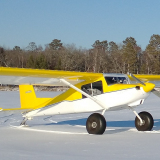
I went with fabric this time around. I agree with the ease of field repairs. If you're going to build your own, that's the beauty, it can be whatever you want.
BTW, this Saturday I'm doing the first flight of the little bird you see in my avatar photo. Wish me luck.
BTW, this Saturday I'm doing the first flight of the little bird you see in my avatar photo. Wish me luck.
Wed Feb 02, 2011 9:32 pm
Re: Fabric vs metal vs composite
I have no metal experience in building. My first project was a Europa, now for sale incidentally - N141EW http://www.customflightcreations.com/id11.html
Lot of people hate fiberglass work. I love it. It is so forgiving - if you screw up a part (smaller ones at least), you can just cut it out and do it again. It allows you to fabricate cool parts pretty easily. Not hard to learn, etc. I make customer fiberglass stuff quite often from the basic skills I learned on that project.
Made a contoured stiffener/flange for the bottom of my custom panel
Made a cargo platform for my rear cockpit of my S7

Have made fairings, repaired friends Jeep hard tops, etc. Its handy stuff.
I have enjoyed working with fabric as well. But it's not as versatile a skill.
As you have said, I don't think it should be a determinig factor for your build. They all have their strong points. The reality is - in a tube and fabric plane - you will get to do a little of it all anyway - fabric, metal work, AND a little fiberglass work on the cowl.
Lot of people hate fiberglass work. I love it. It is so forgiving - if you screw up a part (smaller ones at least), you can just cut it out and do it again. It allows you to fabricate cool parts pretty easily. Not hard to learn, etc. I make customer fiberglass stuff quite often from the basic skills I learned on that project.
Made a contoured stiffener/flange for the bottom of my custom panel
Made a cargo platform for my rear cockpit of my S7
Have made fairings, repaired friends Jeep hard tops, etc. Its handy stuff.
I have enjoyed working with fabric as well. But it's not as versatile a skill.
As you have said, I don't think it should be a determinig factor for your build. They all have their strong points. The reality is - in a tube and fabric plane - you will get to do a little of it all anyway - fabric, metal work, AND a little fiberglass work on the cowl.

2009 Rans S-7S Sold,
Folsom, CA
http://picasaweb.google.com/emmetw
http://oneechowhiskey.wordpress.com
https://vimeo.com/emflys/videos
Folsom, CA
http://picasaweb.google.com/emmetw
http://oneechowhiskey.wordpress.com
https://vimeo.com/emflys/videos
Wed Feb 02, 2011 11:48 pm
Re: Fabric vs metal vs composite
I have built 3 tube n fabric planes, 2 aluminum planes and about 30 composite planes, namely Lancairs. I prefer the composite structures whether glass or carbon because of its incredible strength, durability and resistance to the elements. It would be interesting to have a cub built of carbon fiber as a monocoque construction and compare it in weight and flying characteristics to a standard cub. I think the real advantage would be in the wing design where as the composite wing would have less drag and the airfoil shape is consistant from root to tip. The composite wing would be a wet wing allowing fuel cells to simply be a part of the wing and not an added cell which adds weight. The carbon cub is not really built of carbon, it just has a carbon cowling, wingtip bows, some stringers and floor panels. Not to take anything away from that plane as it is an awesome aircraft! But I think the real downside of a cub built exclusively of carbon fiber would be the price. You would need to use pre impregnated carbon cloth (prepreg) to obtain the lightest weight parts and the prepreg carbon is about $70.00+ a square yard. On a plane that has a 180 sq. ft. wing and the lay-up schedule was a 2 core 1, that would require at least a 120 yards of carbon at about $70.00 a yard. That doesn't include the spars, ribs, ailerons and flaps, then add in the labor costs, R&D costs, profits, etc. That may not be everyones cup of tea but I think it would be a fun comparison.

Thu Feb 03, 2011 8:03 am
Re: Fabric vs metal vs composite
Cool Mike. Interesting question: Why do you think the Glastar was built as a fiberglass shell on steel tube? Or with an aluminum wing for that matter. I am sure there was a reason, I just don't know what that is. Or are you saying you could never get close to the weight of tube/fabric without going all carbon?
I do love glassing carbon. It wets out so nicely. I made a few custom carbon parts on my 1st S7 to reduce weight when enlarging the baggage bay. Super light and great to work with. But it was carbon BID I had left over from like 2000 when it was much cheaper!
I do love glassing carbon. It wets out so nicely. I made a few custom carbon parts on my 1st S7 to reduce weight when enlarging the baggage bay. Super light and great to work with. But it was carbon BID I had left over from like 2000 when it was much cheaper!
2009 Rans S-7S Sold,
Folsom, CA
http://picasaweb.google.com/emmetw
http://oneechowhiskey.wordpress.com
https://vimeo.com/emflys/videos
Folsom, CA
http://picasaweb.google.com/emmetw
http://oneechowhiskey.wordpress.com
https://vimeo.com/emflys/videos
Thu Feb 03, 2011 8:51 pm
Re: Fabric vs metal vs composite
The Glastar composite shell is made of fiberglass using poly/vinylester resins which are inexpensive and when used in a structual application it has to be built a lot thicker and heavier than Epoxy resin parts to achieve the same strength. We refer to that old fiberglass method as "boat technology" due to the fact that most all boats are built to those standards. The aluminum wing is very inexpensive to build and it is light weight.
If you remember the Pulsar plane, it was built with prepreg fiberglass and I think it was only a 1 core 1 lay-up with a 1/8" foam core. It was extremely light weight and got its strength from the monocoque fuselage design.
If money weren't a concern, a plane like the Cub could be built from 100% carbon fiber prepreg using CNC cut molds to produce an aerodynamically clean fuselage and wing that would weigh the same or lighter than a standard Cub. The benefits would be increased speed, better handling characteristics, zero airframe maintenance and it would never need to have new fabric. The belly area could have 1 additional layer of Kevlar to repel rocks.
Let our check books be our guide!
If you remember the Pulsar plane, it was built with prepreg fiberglass and I think it was only a 1 core 1 lay-up with a 1/8" foam core. It was extremely light weight and got its strength from the monocoque fuselage design.
If money weren't a concern, a plane like the Cub could be built from 100% carbon fiber prepreg using CNC cut molds to produce an aerodynamically clean fuselage and wing that would weigh the same or lighter than a standard Cub. The benefits would be increased speed, better handling characteristics, zero airframe maintenance and it would never need to have new fabric. The belly area could have 1 additional layer of Kevlar to repel rocks.
Let our check books be our guide!
Thu Feb 03, 2011 9:09 pm
Re: Fabric vs metal vs composite
The Pulsar, totally. I think that and the kitfox were the first kitplanes that really caught my eye.
The Europa was similar. Early kits were pre wirecut foam core and wet layup skins. Later (and my kit) were a molded wing that was beautiful and light. one person could carry it around no problem.
It seems very out of place to have an all composite "cub" but it would be cool for sure. Of course just the mold cutting/development would be pretty penny!
The Europa was similar. Early kits were pre wirecut foam core and wet layup skins. Later (and my kit) were a molded wing that was beautiful and light. one person could carry it around no problem.
It seems very out of place to have an all composite "cub" but it would be cool for sure. Of course just the mold cutting/development would be pretty penny!
2009 Rans S-7S Sold,
Folsom, CA
http://picasaweb.google.com/emmetw
http://oneechowhiskey.wordpress.com
https://vimeo.com/emflys/videos
Folsom, CA
http://picasaweb.google.com/emmetw
http://oneechowhiskey.wordpress.com
https://vimeo.com/emflys/videos
DISPLAY OPTIONS
Who is online
Users browsing this forum: No registered users and 0 guests
Latest Features
-
-
Featured Bush Planes
As one of the undisputed legends of bush flying, the Cessna 180 hauls a…Read More -
Aircraft Ownership and Maintenance
9 modification mistakes aircraft owners make when trying to "bush out" their birds—why some…Read More -
Live to Tell
A Minnesota pilot is surprised to learn that the sudden asymmetric drag of an…Read More


Latest Knowledge Base
-
Destinations
Canada offers some of the most spectacular backcountry flying on the continent. Here's what you need to know before you go.Read More -
Safety and Survival
Hope that you never have to use your survival vest but knowing you have it and knowing how to use…Read More -
Destinations
A regional guide with ideas for winter camping destinations in California, Nevada, New Mexico, and Arizona.Read More -
Aircraft
Finding an affordable aircraft that can handle the backcountry for $80K or less? A challenge for sure, but with the…Read More