Backcountry Pilot • Flap Settings Strong Winds

Flap Settings Strong Winds

Share tips, techniques, or anything else related to flying.
50 postsPage 2 of 31, 2, 3

Re: Flap Settings Strong Winds

One cross wind tip I learned recently. Most runways, especially paved ones, have a definit crown to them. So in a strong cross wind, land and taxi on the upwind side of the centerline. That keeps your upwind wing down after both tires are planted. Of course if you're on the downwind side of the centerline, it's just the opposite. :shock:

Phil
Bear_Builder offline
User avatar
Posts: 344
Joined: Thu Aug 23, 2007 10:14 am
Location: North Pole
FindMeSpot URL: http://share.findmespot.com/shared/face ... sYc5J8KHOS

Re: Flap Settings Strong Winds

Vick,

The problem with landing on a taxiway or infield at SOME airports is that some controllers and airport managers frown on that. Such was the case at the airport I landed in the example I gave. In fact, one of the folks who discovered this was actually an FAA Ops Inspector at the FSDO. Tower violated him for landing on a taxiway in a big wind.

That technique may work in may or even most places, but just be advised that if the tower or airport manager has a thing about it, you may get cited.

MTV
mtv offline
Knowledge Base Author
User avatar
Posts: 10515
Joined: Sat Feb 25, 2006 1:47 am
Location: Bozeman

Re: Flap Settings Strong Winds

mtv wrote:Vick,

The problem with landing on a taxiway or infield at SOME airports is that some controllers and airport managers frown on that. Such was the case at the airport I landed in the example I gave. In fact, one of the folks who discovered this was actually an FAA Ops Inspector at the FSDO. Tower violated him for landing on a taxiway in a big wind.

That technique may work in may or even most places, but just be advised that if the tower or airport manager has a thing about it, you may get cited.

MTV


No doubt MTV, not advocating it as a routine practice. But a valid option, assuming you're equipped and capable, should the circumstances warrant it. Not to mention that if you've declared an emergency - and I've declared many - a tower will give you anything you need to get you safely on deck.
Vick offline
User avatar
Posts: 823
Joined: Fri Jan 06, 2006 2:21 pm
Location: Grass Valley, CA
FindMeSpot URL: http://share.findmespot.com/shared/face ... WUk8CX06AP
Solum Volamus

Re: Flap Settings Strong Winds

I'm betting a citation for landing on a taxiway is a lot cheaper than a ground loop. :P

Phil
Bear_Builder offline
User avatar
Posts: 344
Joined: Thu Aug 23, 2007 10:14 am
Location: North Pole
FindMeSpot URL: http://share.findmespot.com/shared/face ... sYc5J8KHOS

Re: Flap Settings Strong Winds

Phil,

True enough. The point there was that there was another airport 2.5 miles away with a large runway pointed right into the wind.

My only point is that many pilots seem to think they can land on taxiways, etc. You can if you declare an emergency, of course. But if you declare an emergency, land on a taxiway, the tower can ask you to explain your actions. In the case of another perfectly good airport that close, the argument was there simply was no "real" emergency. And, I sure couldn't argue that point.

Again, the point is, before you go getting someone's underwear in a knot, LOOK AROUND. There could well be a much better option than a taxi way right nearby.

MTV
mtv offline
Knowledge Base Author
User avatar
Posts: 10515
Joined: Sat Feb 25, 2006 1:47 am
Location: Bozeman

Re: Flap Settings Strong Winds

Wow! What a polite and civil discussion. And plenty of good advice too.

I'm always in the learning mode, so let me put in my $54.79 (that's two cents adjusted for inflation) and see what responses I can get to help me improve my technique. I'd rather spend my money on fuel than avoidable repairs.

I usually opt for landing my Maule at the slowest possible ground speed, and that means flaps (maybe not max) and a 3-point touchdown.

I don't mind wheel landings, but when you use the low or no flap setting a bit more speed is required to keep the tailwheel off the ground. This expands the risky speed range in which a ground loop is possible. And even if you make a successful wheel landing and can maintain directional control with rudder, you still have to transition through the same slower speed range as for a 3-point after you get the tail down. The difference is that having the flaps down (assuming that you don't dump them just after touchdown) may affect rudder authority. So far I haven't been able to determine what effect the flaps have in this regard, so I'm open to replies from those with more experience than I have.

I also use any means possible to reduce the crosswind effect, like landing diagonally on wide runways, and I wouldn't be opposed to using a taxiway or infield option if conditions are really bad. One good thing about these alternatives is that, if the wind is too strong to handle it as a crosswind, the off-runway landing roll when headed directly into it is VERY SHORT. Of course gusty and shifty wind conditions are a different matter that seem to call for a combination of skill and luck.
Jack offline
User avatar
Posts: 11
Joined: Wed Dec 20, 2006 3:35 pm
Location: La Quinta, CA
I used to have a handle on life, but it broke.

Re: Flap Settings Strong Winds

Jack,

A wise old pelican once told me that his preferred landings in Maules would ALWAYS be a wheel landing. I listened. So far, I can't disagree.

BUT, understand that a wheel landing need not place the aircraft in contact with the ground at ANY higher forward speed than a three point. The tail low wheel landing accomplishes this quite nicely, and offers most of the good points of both types of landing.

MTV
mtv offline
Knowledge Base Author
User avatar
Posts: 10515
Joined: Sat Feb 25, 2006 1:47 am
Location: Bozeman

Re: Flap Settings Strong Winds

OK, I'm trying to learn stuff here, and I appreciate the feedback. But I still have questions.

When I do a wheel landing, regardless of flap setting, I have to be going faster at touchdown than when I do a 3-point with the same flap setting. This is perhaps owing to my misunderstanding of aerodynamics and how lift is generated. If I slow to 2kts above stall speed (just before touchdown, in ground effect), the tailwheel of my airplane hits the ground before the mains. I think of this as a 3-point landing even if it was a 1-then-2-more-point landing. (It is probably a bad idea from the aspect of tailwheel longevity, but that is for another forum topic).

If I maintain sufficient speed to keep the tailwheel off the ground when the mains touch (assuming that I have arrested the rate of descent with a small amount of pitch up) - the airspeed is a good deal higher than for the 3-point landing described above. That is what I think of as a wheel landing - the airspeed can only be reduced to the point where the attitude required to achieve a near zero descent doesn't quite put the tailwheel on the ground before the mains (is that the "tail-low" technique you mean?) - BUT the airspeed is still significantly above that where the tailwheel touches first. And to be clear, this may only be 5 knots, but since the energy involved changes with the square of the speed that could be significant, especially during the very critical time when you have put the A/C weight on the mains and are subject to the unstable forces that may cause a ground loop.

Now, if I had some 29" bush wheels, instead of the wimpy little 8.50s I am stuck with, I could probably wheel land with a sufficiently slow airspeed to make the difference negligible. And (Santa are you listening) if I had some 31" or even 36" tires, I suspect I would only do wheel landings.

So, if I'm missing something here, please elaborate. In my career I got paid to work out technical stuff for the space programs and situations where it was all theory until we flew it. Now, I'm interested in getting the test results before I conduct the experiment (with my own keester and A/C as collateral).

Again thanks for the help.
Jack offline
User avatar
Posts: 11
Joined: Wed Dec 20, 2006 3:35 pm
Location: La Quinta, CA
I used to have a handle on life, but it broke.

Re: Flap Settings Strong Winds

Jack, I think you have it right. A wheel landing will always have the tail higher than a 3 point. This means that the angle of attack has to be higher for the 3 point. Greater angle equals greater lift, so, for a given weight, the tail landing speed will be smaller. That's my physics, and I'm sticking to it.
tom
Savannah-Tom offline
User avatar
Posts: 891
Joined: Mon Mar 06, 2006 3:26 pm
Location: Corvallis, OR

Re: Flap Settings Strong Winds

If you're flying a 180/185 just keep this in mind, with full flaps (4 notches) you can lose rudder authority in a gusty crosswind. You won't know it until it's too late. Use a stabilized approach with twenty degrees of flaps and then decide whether to use a three point or wheelie....pilot's choice. The closer you get to a direct 90 degree crosswind the less it matters. Keep the windward wing down! You'll need as much rudder as you can get once those wheels hit the ground. Gusting winds are seldom, if ever, straight down the runway. Dump the flaps the second you land. Yes, a 180 will have you for lunch in gusting winds.
Last edited by TJ Carr on Thu May 21, 2009 6:47 pm, edited 1 time in total.
TJ Carr offline
Posts: 37
Joined: Wed Feb 18, 2009 6:11 pm
Location: East Haddam, CT

Re: Flap Settings Strong Winds

another 2 cents!! :o When I land my M6 or RV6 I always land it on the wheels, in saying that I believe that if you are tail low and are going to 3 point it, if at about the time you are one the ground you push forward and come up on your wheels you have taken away your lift or lowered the angle of attack so the wing will not fly?? Especially if you have dumped the flaps! you are slow enough that a little brake and rudder and aileron should work [-o< So far it has for me =D> I can't say this about all planes but it works for me in the ones that I have flown.
[-X I should say except for a 207 when you are light then it stands up on the nose wheel and turns into the wind and does lots of other stuff until you get it stopped :mrgreen: , I guess I should say a 337 does the same thing but worse!!! [-X [-o< but these are planes with the tail wheel on the wrong end so they shouldn't even be mentioned here #-o #-o
Now I'm just learning to fly this 195 and I have not got up the courage to try a 3 point with it yet as I like to see the runway when I get there! [-o<
I'm not going to argue to much about landing faster on wheels than you do when you 3 point it but i think if you push it over at the point you would stall on the 3 point you will still be able to pick the tail up :lol: I know that I can pick up the tail on most anything long before it will fly off the ground #-o
What ever you do enjoy :-" , don't make the learning curve a 90 degree bend ](*,) Be safe and have fun!! \:D/
GT
M6RV6 offline
User avatar
Posts: 2313
Joined: Mon Feb 25, 2008 5:52 pm
Location: Rice Wa. 82WN Magee Creek AERODROME
FindMeSpot URL: http://share.findmespot.com/shared/face ... sWKXuhKlg2
Have as much Fun as is Safe, and Keep SMILIN! GT,

Re: Flap Settings Strong Winds

Hmmm.... It looks like I stirred up a lot of good comments. And not one of them called me an idiot (fooled the lot of you, I see). I do appreciate the inputs, and I will try to incorporate all your helpful suggestions in my continuing effort to improve my technique. My goal is to get so proficient at landings that I can open my eyes during the process.

Thanks to all who contributed.
Jack offline
User avatar
Posts: 11
Joined: Wed Dec 20, 2006 3:35 pm
Location: La Quinta, CA
I used to have a handle on life, but it broke.

Re: Flap Settings Strong Winds

My opinion has changed after living in a place called "Windy Pass" for the last 4 1/2 years 8)

I started out with less flaps (10 or 20) and a higher approach speed as I had been taught. I am now convinced that - for me at least - that is a bunch of hooey. I now use the same flap setting and speeds as always, though I will add 1/2 the gust spread, and seldom want or need 40 degrees in those conditions (30 is enough.) I don't see any improvement in control authority with minimum flaps (in various Cessnas anyways) and if I'm going to ground loop I prefer to be going as slow as possible :shock: I haven't lost control on landing yet so I'm either right or lucky.
onceAndFutr_alaskaflyer offline
Posts: 1319
Joined: Sun Apr 23, 2006 4:23 pm
Location: Keweenaw Peninsula, Michigan and Carson Valley, Nevada

Re: Flap Settings Strong Winds

It is true that GENERALLY, you won't land any slower by doing a tail low wheel landing than by doing a three point. But, the point is, as Once&futr notes, to touch as slow as possible, THEN retain control.

ALL of this varies to some degree with the type of airplane, the length of the gear, the size of tires, etc. Some airplanes you can easily (with power) touch down tailwheel first. That's bad practice no matter where you do it.

There are a couple advantages of wheel landings:

1) You can SEE where you're going after touchdown.

2) You have good rudder authority, as opposed to having the rudder largely blanked by fuselage/flaps, etc.

3) By raising the tail at the touch, you REDUCE the AOA of the wing dramatically, virtually killing most lift from the wings.

4) With the tail up, maximum weight is on the mains, providing the most positive and effective braking.

The "traditional" style wheel landing technique, however (as in wheel it on at cruise pitch attitude and speed, or nearly so) makes absolutely no sense to me. Once that airplane touches the ground, it must decelerate to a stop. The faster you touch down, the longer it takes to decelerate to that stop, and the more opportunities there are to get crosswise.

Rembember, the only time your airplane is going to get bent is when it comes into contact with the ground (okay, in flight breakups occur, so stay out of thunderstorms :? ), so minimize the deceleration time, keep it under POSITIVE control while in contact with the ground and decelerating, and everything should work well.
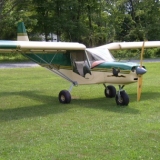
But, again, this is the internet. One size does not fit all aircraft, except in generalities, and the above is all generalities.


Everyone should practice wheel landings AND three points in their airplanes, as well as both types of landing with full flaps, half and no flaps.

And, one wheel landings, etc.

Then, use what you are the most comfortable and competent with, and what seems to work best for your airplane type. Talk to others who own YOUR type airplane and see what they've figured out (NOT what they've heard from some screwball like me).

And, have fun.

MTV
mtv offline
Knowledge Base Author
User avatar
Posts: 10515
Joined: Sat Feb 25, 2006 1:47 am
Location: Bozeman

Re: Flap Settings Strong Winds

Hey mtv, would you mind giving me a little advice? You have talked about different landings techniques here and I have been trying to understand what I can do to improve mine. My M5 has relatively narrow gear, a big flat side and tail, and is tail heavy. With my Luscombe it was a piece of cake to bring the tail up quickly on take off but the Maule just about requires two hands to do that. So I take off on three points. That is also part of the reason I prefer to three point landings. The forward control pressure is considerably more than the Luscombe and I find it challenging to balance that pressure against the finesse required to keep the plane on it's mains. My POH recommends against wheel landings although I have read here on the forum that other Maule drivers regularly use that technique. I have about 250 hours with the Maule and have found that any crosswind component demands my upmost attention. Noticably more so than in the Luscombe or other taildraggers I have flown. Any thoughts? Any other Maule drivers experience this with their birds? As I am writing this I am thinking I ought to have the plane weighed to check if it is balanced correctly.
Skystrider offline
User avatar
Posts: 1232
Joined: Wed Jan 24, 2007 1:44 pm
Location: Saylorsburg
Aircraft: Zenith CH701 w/ Jabiru 3300

Re: Flap Settings Strong Winds

Skystryder
I have only flown a M5 180 twice and there was no wind?? :lol:
Next time up try leaving the trim wheel in cruize and exercize those forearms just a little :shock:
Then when you get to the ground all you have to do is release a little back pressure and you are on the wheels!Maybe [-o<
Turn that trim wheel about another 2 turns forward for take off and it should pick up the tail for you!Maybe [-o<
Another thing to try as MTV mentioned was try 1 wheel landing, The fellow who showed me how said and demonstrated putting the upwind wheel down on the tarmac then you have to use the rudder as you already have aileron up on the upwind side holding the wing down. use the rudder to keep it straight. when you can't keep the other wing (downwind side) up, it's time to use the brakes and get it stopped
you should rid yourself of all flaps if you have used them about the same time. I guess you would call it a 1,2 3 wheel landing but the wheels are in a different order than all the other kinds of landings :D
I'm glad that at 250 hrs in the Maule that you are asking ?s and still willing to learn.
I had the chance to run into Orin Hudson in ANC. at the show up there and he explained to me that just about every landing I make should be a 123 landing and should be about a 1/2 bubble off?? (WHEEL LANDING)
reason!
1the gear is much softer on one gear than 2! (less rebound)
#1 main should be 1" closer to the runway than the #2 main.
When the #1 tire touches it causes some drag and will straighten the airframe so that when #2 main touches you will be lined up with your momentum and the runway(1/2 bubble off), you will have slowed down that much without using any braking, if you do this with a tail low at just the same speed as a 3 point stall landing you will now be up on your mains with the tail off the ground. =D> MAYBE
I have tried it with the 195 and I made an amazingly nice greaser. I have done it once, so I think I will not do anymore to ruin my percentages of this type of landing as now I can say it works 100% of the time for me [-X
I am going to try it with the M6 with the bushwheels and see if it works there also?? Maybe that is what I do when I make a good landing is just screwing up what I thought I was trying to do in the first place??!! #-o
Have fun and I hope this helps someone and if not I tried. :roll:
GT
M6RV6 offline
User avatar
Posts: 2313
Joined: Mon Feb 25, 2008 5:52 pm
Location: Rice Wa. 82WN Magee Creek AERODROME
FindMeSpot URL: http://share.findmespot.com/shared/face ... sWKXuhKlg2
Have as much Fun as is Safe, and Keep SMILIN! GT,

Re: Flap Settings Strong Winds

I can't comment on Maules, but the Citabria I learned in was much different to land depending on ballance. Solo, with the ballance near the forward limit, wheel landings were a breeze, but I had to work to get a good greaser 3 point. With my instructor in the back it was the opposite. 3 points were a breeze but it was rare I could do a wheel landing without at least one small bounce. The reason is that the farther behind the mains the CG is the more likely the tail is to continue downward after the mains touch. That increases the angle of attack and your airborn again.

I've also heard of the trick of trimming so you need some back pressure to maintain speed on final to help with wheel landings, but I've never flown anything with heavy enough controls to need that. I typically hear that recommended by 180/185 pilots.

Phil
Bear_Builder offline
User avatar
Posts: 344
Joined: Thu Aug 23, 2007 10:14 am
Location: North Pole
FindMeSpot URL: http://share.findmespot.com/shared/face ... sYc5J8KHOS

Re: Flap Settings Strong Winds

You tail wheel guys are making me glad the little wheel is on the wrong end of my plane. :lol:

tom
Savannah-Tom offline
User avatar
Posts: 891
Joined: Mon Mar 06, 2006 3:26 pm
Location: Corvallis, OR

Re: Flap Settings Strong Winds

Skystrider,

Well, the Maule Guru lurks on here, and I'm hopeful that Jeremy will pipe up. I am NOT a Maule expert, though I've flown them a few hundred hours.

M6RV6 is right on the trim...use the trim to help you out. This works on Cessna 180/185 and also on my 170, which has VERY light elevator forces. It'll also work on a Maule. On final, once established in your descent, with flaps, roll in some nose down trim, such that you are having to hold back pressure. Now, at the touch, power to idle and relax the back pressure. As soon as the back pressure is relaxed, now come forward with the yoke to pin the plane on its mains.

I do not recommend messing with the flaps until you are really comfortable with the plane. If it makes you happy, go for it, but be advised that's a really busy time.

Find a good Maule instructor in your neighborhood, and give it a whirl.

MTV
mtv offline
Knowledge Base Author
User avatar
Posts: 10515
Joined: Sat Feb 25, 2006 1:47 am
Location: Bozeman

Re: Flap Settings Strong Winds

Savannah-Tom wrote:You tail wheel guys are making me glad the little wheel is on the wrong end of my plane. :lol:

tom


Amen to that! Got home from the tradeshow 2 weeks ago to winds 300 at 10 gusting 18, active runway is 01 (now renumbered to 02). Landing was a non-event with the little 150. But it sure was squirrely taxiing with the gusts hitting that big straight tail. :D

Phil

P.S. back to the original topic: I used full flaps, the extra drag helps kill any extra floating and I pulled them in as soon as I was firmly down.
Bear_Builder offline
User avatar
Posts: 344
Joined: Thu Aug 23, 2007 10:14 am
Location: North Pole
FindMeSpot URL: http://share.findmespot.com/shared/face ... sYc5J8KHOS

DISPLAY OPTIONS

PreviousNext
50 postsPage 2 of 31, 2, 3

Who is online

Users browsing this forum: No registered users and 3 guests

Latest Features

Latest Knowledge Base