OK, I am confused by some discussions on other forums as to whether floats provide positive or negative lift. Most agree that floats due to their shape are an airfoil and that they create a lot of drag.
Apparently since the airfoil shape is upside down as compared to the wing it creates negative lift. Also the floats are installed so that they are pointed 2 to 6 degrees downward in cruise flight. This seems couter intuitve to me and I am still hoping there is some positive lift to the floats.
Floatplanes usually have a higher gross weight compared to the wheeled versions of the same plane. Is this because of the extra lift provided by floats or because the airframes are beefed up with float kits?
Any comments on this?
Floats as an airfoil provide positive or negative lift
Sun Jun 28, 2009 9:19 am
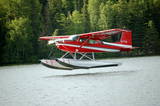
Rick's Cessna 180 float plane video http://www.youtube.com/watch?v=g6my0FM9F_Q
Sun Jun 28, 2009 12:22 pm
Re: Floats as an airfoil provide positive or negative lift
This is an interesting subject because the industry always claims that the floats "lift" their own weight. The float is clearly an inverted "wing" as they are curved on the bottom, and flat on the top. I would say that they are no different than any curved object, and will create lift in the direction of the low pressure, in this case downward.
You are correct that the floats are also pointed nose down in level flight. The floats have to be mounted at a positive angle to the wing or the plane can never rotate off the water, so it is true that once the wing is in level cruise, the floats will be pointed nose down somewhere around 2-6 degrees.
I'm not sure that the performance lost when floats are installed would be so dramatic if they were "lifting" their own weight. Climb rate is normally half of the normal rate on wheels at the same weight, and since the floats are supposedly lifting their own weight(give or take 5-600lbs on your C180) you would expect the plane should climb far better on floats than wheels.
You are correct that the floats are also pointed nose down in level flight. The floats have to be mounted at a positive angle to the wing or the plane can never rotate off the water, so it is true that once the wing is in level cruise, the floats will be pointed nose down somewhere around 2-6 degrees.
I'm not sure that the performance lost when floats are installed would be so dramatic if they were "lifting" their own weight. Climb rate is normally half of the normal rate on wheels at the same weight, and since the floats are supposedly lifting their own weight(give or take 5-600lbs on your C180) you would expect the plane should climb far better on floats than wheels.
Sun Jun 28, 2009 3:20 pm
Re: Floats as an airfoil provide positive or negative lift
I would like to see the data that the floats lift their own weight.I suppose one could argue that if the hull will raise the plane onto the step it will also try to lift the float in the air.It would be an interesting wind tunnel experiment.My Legend cub is 1320 gross on wheels due to LSA rules but allowed to go to 1430 on floats which I don't uderstand at all.It is the same airframe floats or wheels so why not just allow the higher gross.
Bill
Bill
Sun Jun 28, 2009 4:42 pm
Re: Floats as an airfoil provide positive or negative lift
I have a theory that if you try to make a float plane go fast the floats point down more and cause more drag. If you slow them down the plane mushes along and that puts the floats at a more positive angle increasing the lift on the float, thus more efficent. Seems like my 180 on EDO 2705's is more like 8 degrees negitive, but that is just from memory, haven't had them on for a while.........
- Redbaron180 offline
- Posts: 147
- Joined: Sun Jan 09, 2005 10:12 am
- Location: Lopez Island WA
Your word is a lamp unto my feet and a light unto my path. Ps. 119:105
Sun Jun 28, 2009 5:29 pm
Re: Floats as an airfoil provide positive or negative lift
willyb wrote:I would like to see the data that the floats lift their own weight.I suppose one could argue that if the hull will raise the plane onto the step it will also try to lift the float in the air.It would be an interesting wind tunnel experiment.My Legend cub is 1320 gross on wheels due to LSA rules but allowed to go to 1430 on floats which I don't uderstand at all.It is the same airframe floats or wheels so why not just allow the higher gross.
Bill
I think you will find that many of the V speeds are reduced when the aircraft is put on floats, thus reducing the loads on the structure, then they allow a bit more weight to let the aircraft be usable.
Not all aircraft get the increase, but those that do are usually 5%.
I would say the only time the floats are "lifting", is when the nose is pointed way up, with the wing at high angles of attack. Most floatplanes don't have a "break" when they stall, they just mush with the nose high. I think that this is because the floats are creating some lift(more like the hand out the car window).
Mon Jun 29, 2009 6:45 am
Re: Floats as an airfoil provide positive or negative lift
Ah, the ancient argument: Is it Bernoulli or is it Newton? 
Actually, there are MANY different factors that influence (as in limit) maximum gross weight. In the case of aircraft designs that carry a higher allowable gross weight on floats as compared to the same aircraft on wheels, the difference is most likely the landing loads imparted to the fuselage by the landing gear, NOT from any real or imagined lift created by the floats.
All aircraft landing gears and fuselage structures must undergo drop testing, or equivalent testing to verify that the structure can absorb and survive the loads imparted by a "firm" landing.
Oh, yeah, the FAA Engineering Office where the certification was done may have a significant influence on whether the GW increases on floats as well....
MTV
Actually, there are MANY different factors that influence (as in limit) maximum gross weight. In the case of aircraft designs that carry a higher allowable gross weight on floats as compared to the same aircraft on wheels, the difference is most likely the landing loads imparted to the fuselage by the landing gear, NOT from any real or imagined lift created by the floats.
All aircraft landing gears and fuselage structures must undergo drop testing, or equivalent testing to verify that the structure can absorb and survive the loads imparted by a "firm" landing.
Oh, yeah, the FAA Engineering Office where the certification was done may have a significant influence on whether the GW increases on floats as well....
MTV


DISPLAY OPTIONS
Who is online
Users browsing this forum: No registered users and 3 guests
Latest Features
-
-
Featured Bush Planes
As one of the undisputed legends of bush flying, the Cessna 180 hauls a…Read More -
Aircraft Ownership and Maintenance
9 modification mistakes aircraft owners make when trying to "bush out" their birds—why some…Read More -
Live to Tell
A Minnesota pilot is surprised to learn that the sudden asymmetric drag of an…Read More




Latest Knowledge Base
-
Destinations
Canada offers some of the most spectacular backcountry flying on the continent. Here's what you need to know before you go.Read More -
Safety and Survival
Hope that you never have to use your survival vest but knowing you have it and knowing how to use…Read More -
Destinations
A regional guide with ideas for winter camping destinations in California, Nevada, New Mexico, and Arizona.Read More -
Aircraft
Finding an affordable aircraft that can handle the backcountry for $80K or less? A challenge for sure, but with the…Read More



