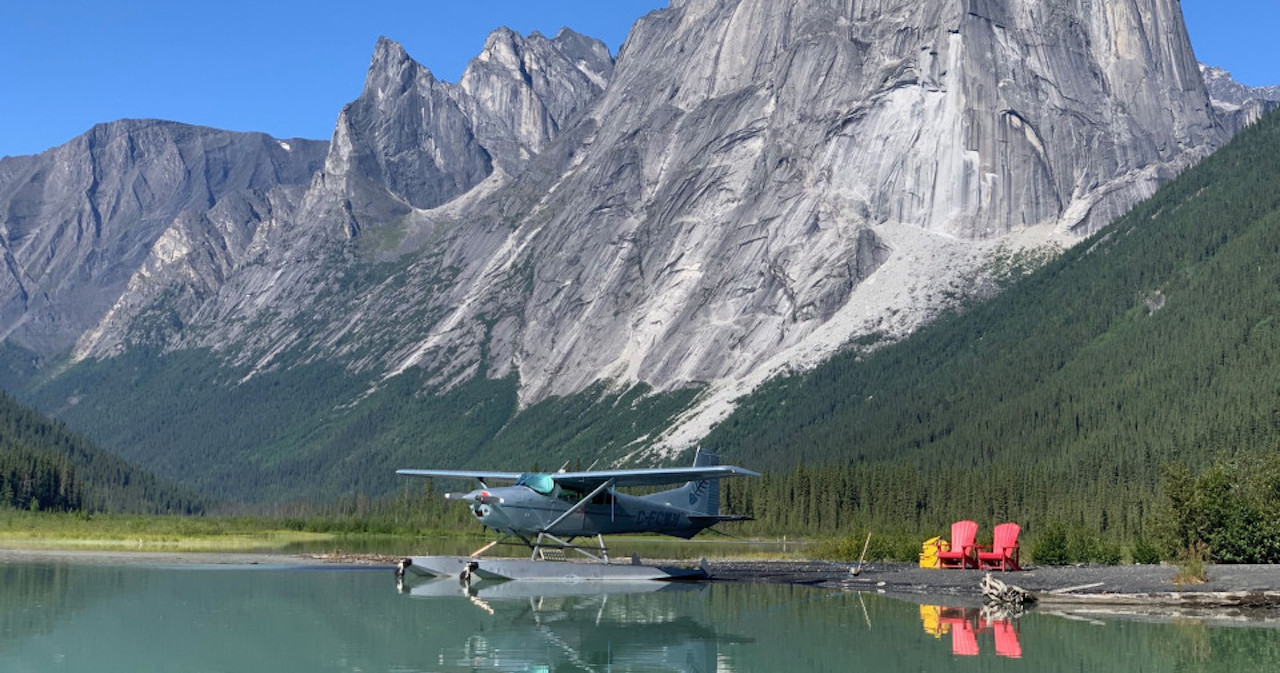
Forward slip with flaps
Wed Aug 26, 2020 12:28 am
Forward slip with flaps
Any concerns about this with floats on short final?
Last edited by stinsoner on Thu Aug 27, 2020 1:57 am, edited 1 time in total.

the stinsoner
Wed Aug 26, 2020 8:20 am
Re: Ving slip with flaps
Not sure what you mean by "ving slip"...


Wed Aug 26, 2020 8:43 am
Re: Ving slip with flaps
Sorry, how about using the side slip to increase rate of descent on short final with a floatplane...
the stinsoner
Wed Aug 26, 2020 9:07 am
Re: Ving slip with flaps
The slip to lose altitude without increasing airspeed is called forward slip here, but side slip elsewhere. if you have no crosswind, I would think you would want to align the nose with the direction of travel just before touchdown. If using bank to prevent crosswind drift while using rudder to align longitudinal axis with the direction of travel, I would think you might want to level wing just before touchdown and rudder turn into the wind to control drift.
I am not a float pilot. Meybe MTV or one of the float pilots could help here. I would think touching down on one float would be a lot more pivoting than touching down on one wheel.
I am not a float pilot. Meybe MTV or one of the float pilots could help here. I would think touching down on one float would be a lot more pivoting than touching down on one wheel.
- contactflying offline
- Posts: 4972
- Joined: Wed Apr 03, 2013 7:36 pm
- Location: Aurora, Missouri 2H2
Download my free "https://tinyurl.com/Safe-Maneuvering" e-book.
Wed Aug 26, 2020 9:08 am
Re: Ving slip with flaps
JP256 wrote:Not sure what you mean by "ving slip"...
He is from Sveedan
- qmdv offline

- Posts: 3635
- Joined: Wed Feb 15, 2006 10:22 pm
- Location: Payette
- FindMeSpot URL: http://share.findmespot.com/shared/face ... I5tqEOk0rc
- Aircraft: Cessna 182
Wed Aug 26, 2020 10:59 am
Re: Ving slip with flaps
OK, "side slip". 
A seaplane instructor (in Sweden) told me not to use "side slip" when flaps are engaged.
WHY?
A seaplane instructor (in Sweden) told me not to use "side slip" when flaps are engaged.
WHY?
the stinsoner
Wed Aug 26, 2020 11:14 am
Re: Ving slip with flaps
Actually this is the first place I've ever heard a side slip refered to as a "forward slip". I've used side slips many, many time operating sailplanes and an assortment of other aircraft. However right or wrong I''ve never had the need to employ a side slip, Ving slip or forward slip operating a float plane. That said I don't play on lakes that would be considered "confined" so the 40 degress of flap available on my 170B is more than adaquate for descent path management. The wisedog's I listen too have suggested it could bring a tear or two to your eyes and not for the faint of heart.
Wed Aug 26, 2020 11:25 am
Re: Ving slip with flaps
Side slip and forward slip are the same uncoordinated flight condition aerodynamically, they just differ in the ground/wind track relationship. Forward slip is what people use to present more drag and increase rate of decent. Side slip is what people use to compensate for a crosswind.
I have forward slipped the Rans S-7 on wheels with full flaps. It works great. Not sure how floats would change the performance of that. You probably should not touch down on one float though. I'd be relaxing the slip and returning to level, straight flight before touchdown on wheels or floats.
The question is not without merit. The 170B was placarded for no slips with full flaps, and several people have collected empirical evidence of the tail blanking. I guess the nose will drop dramatically when that happens, and if you're on short final... Maybe that is why OP is asking.
I have forward slipped the Rans S-7 on wheels with full flaps. It works great. Not sure how floats would change the performance of that. You probably should not touch down on one float though. I'd be relaxing the slip and returning to level, straight flight before touchdown on wheels or floats.
The question is not without merit. The 170B was placarded for no slips with full flaps, and several people have collected empirical evidence of the tail blanking. I guess the nose will drop dramatically when that happens, and if you're on short final...
Maybe that is why OP is asking.
Wed Aug 26, 2020 11:29 am
Re: Ving slip with flaps
I now flying a Rans S7 with Full Lotus.
Full flapsed the decent is 500 feet/min, when trottling of the Rotax 912.
I need, duty small ponds, more descent without building speed.
Full flapsed the decent is 500 feet/min, when trottling of the Rotax 912.
I need, duty small ponds, more descent without building speed.
the stinsoner
Wed Aug 26, 2020 12:18 pm
Re: Ving slip with flaps
Its always interesting I find to learn new "terms & conditions" for universally applied techniques.
A side slip is what I was taught in light GA aircraft to control descent path angle by increasing fuselage drag in a forward direction, forward slip is an equally apt discription. The term I've always associated with the managment of a crosswind condition thru angular positioning of the fuselage body is a "crab". The crab angle is transitioned into an upwind wing down condition as one transitions into the flair thereby maintaining runway centerline and any manage lateral drift in the landing zone.
When I was much younger and engaged as a tow pilot at the local gliding club we used "massive" side slips with the Super Cub and Citabria. However like the 170B we never employed a side slip with the L19. It had a 60 degree land flaps position, was essentially the same wing as a 170B and may very well have offered a "deeply religious" experience if tried.
Let the learning continue, the BCP community offers a wealth of knowledge that I find rewarded and informative.
A side slip is what I was taught in light GA aircraft to control descent path angle by increasing fuselage drag in a forward direction, forward slip is an equally apt discription. The term I've always associated with the managment of a crosswind condition thru angular positioning of the fuselage body is a "crab". The crab angle is transitioned into an upwind wing down condition as one transitions into the flair thereby maintaining runway centerline and any manage lateral drift in the landing zone.
When I was much younger and engaged as a tow pilot at the local gliding club we used "massive" side slips with the Super Cub and Citabria. However like the 170B we never employed a side slip with the L19. It had a 60 degree land flaps position, was essentially the same wing as a 170B and may very well have offered a "deeply religious" experience if tried.
Let the learning continue, the BCP community offers a wealth of knowledge that I find rewarded and informative.
Wed Aug 26, 2020 12:36 pm
Re: Ving slip with flaps
The answer to your question will depend on your aircraft. And there is a LOT of confusion and mis information regarding slips with flaps deployed.
BUT, slips on floats? I’ve never heard a recommendation against slips on floats, unless it was an aircraft specific restriction.
I have no information on the experimental you noted. That’s why they call them experimental.....it’s up to the pilot to determine what’s safe.
But, first, Zane’s comment is accurate: a slip is a slip. The ground track determines if it’s a side or fwd. slip.
In any case, the reason slips with flaps deployed is of concern with some aircraft is because the flaps MAY cause disturbed airflow over the horizontal tail, possibly creating a tail stall. Those are generally not recommended close to dirt.
Cessnas with big flaps and 40 degree deflection often come up in this discussion. That said, they’re all over the place. Early Cessnas, such as the 170B, Cessna “recommended against” slips with full flaps deployed. That is NOT a prohibition, by the way. Many early Cessnas had that type admonition. At some point, Cessna changed that to “Slips with flaps deployed is prohibited”. Since the same model, just different model years offer both, I suspect this is largely a CYA.
Note that the 206 does not prohibit slips with flaps deployed. Go figure.
The C-180/185 on most skis has an admonition “Slips with skis installed are prohibited”. But I’ve never seen or heard of same on floats. But if an airframe, such as a 185 has a “No slips with flaps deployed” on wheels, the same will apply on floats.
That said, I’ve slipped most Cessnas on floats, but as noted above, these things come down enthusiastically in any case.
MTV
BUT, slips on floats? I’ve never heard a recommendation against slips on floats, unless it was an aircraft specific restriction.
I have no information on the experimental you noted. That’s why they call them experimental.....it’s up to the pilot to determine what’s safe.
But, first, Zane’s comment is accurate: a slip is a slip. The ground track determines if it’s a side or fwd. slip.
In any case, the reason slips with flaps deployed is of concern with some aircraft is because the flaps MAY cause disturbed airflow over the horizontal tail, possibly creating a tail stall. Those are generally not recommended close to dirt.
Cessnas with big flaps and 40 degree deflection often come up in this discussion. That said, they’re all over the place. Early Cessnas, such as the 170B, Cessna “recommended against” slips with full flaps deployed. That is NOT a prohibition, by the way. Many early Cessnas had that type admonition. At some point, Cessna changed that to “Slips with flaps deployed is prohibited”. Since the same model, just different model years offer both, I suspect this is largely a CYA.
Note that the 206 does not prohibit slips with flaps deployed. Go figure.
The C-180/185 on most skis has an admonition “Slips with skis installed are prohibited”. But I’ve never seen or heard of same on floats. But if an airframe, such as a 185 has a “No slips with flaps deployed” on wheels, the same will apply on floats.
That said, I’ve slipped most Cessnas on floats, but as noted above, these things come down enthusiastically in any case.
MTV


Wed Aug 26, 2020 1:15 pm
Re: Ving slip with flaps
Mapleflt wrote:The term I've always associated with the managment of a crosswind condition thru angular positioning of the fuselage body is a "crab". The crab angle is transitioned into an upwind wing down condition as one transitions into the flair thereby maintaining runway centerline and any manage lateral drift in the landing zone.
The crab is a maneuver distinct from the side slip in that the nose is allowed to point into the wind instead of aligned with the runway. It's generally what airlines use (I think) in high wind conditions because it's more comfortable for passengers to feel like they're traveling sideways than it is to be banked and uncoordinated. So, you choose between side slip or crab for crosswind compensation.
Wed Aug 26, 2020 1:17 pm
Re: Ving slip with flaps
stinsoner wrote:I now flying a Rans S7 with Full Lotus.
Full flapsed the decent is 500 feet/min, when trottling of the Rotax 912.
I need, duty small ponds, more descent without building speed.
I asked this before, but are the Full Lotus more or less draggy on water than traditional rigid V-hull floats? Seems like once you touch water on traditional floats, the drag is so great that it's like super brakes.
Wed Aug 26, 2020 3:39 pm
Re: Ving slip with flaps
Zane,
I’ve only flown one plane on Full Lotus floats. There didn’t seem to be a significant additional initial drag on touchdown, compared to metal floats.
MTV
I’ve only flown one plane on Full Lotus floats. There didn’t seem to be a significant additional initial drag on touchdown, compared to metal floats.
MTV
Wed Aug 26, 2020 6:04 pm
Re: Ving slip with flaps
In a slip, you are turning the fuselage broadside to the relative wind. In a floatplane, you’re also turning the floats broadside to the relative wind. I would suggest that less aggressive slipping with a floatplane would net the same drag increase as a full slip, that is, slipping as hard as you can until you run out of travel on the rudder, in the same airplane on wheels. I’d be reluctant to use full rudder in a slip in my 185 While on floats. I haven’t experimented with that to the edge of the envelope.
Also, floatplanes tend to be less stable in yaw. There is more surface area ahead of the center of yaw while on floats. This could make spin entry more likely, and recovery less likely.
As MTV said, go out where you have some altitude and test your airplane. There is some risk that you will enter a flight condition that you can’t recover from. There are flight test procedures in the experimental world for safely finding the edges of the aircraft’s limitations. I can’t help you there.
Also, floatplanes tend to be less stable in yaw. There is more surface area ahead of the center of yaw while on floats. This could make spin entry more likely, and recovery less likely.
As MTV said, go out where you have some altitude and test your airplane. There is some risk that you will enter a flight condition that you can’t recover from. There are flight test procedures in the experimental world for safely finding the edges of the aircraft’s limitations. I can’t help you there.
Wed Aug 26, 2020 11:13 pm
Re: Ving slip with flaps
Zane,
the Full Lotus will be like a hook if You take the stick/wheel into Your stomach.
Otherwise they are like very big skis.
the Full Lotus will be like a hook if You take the stick/wheel into Your stomach.
Otherwise they are like very big skis.
the stinsoner
Thu Aug 27, 2020 7:55 am
Re: Forward slip with flaps
Aerodynamically, I don't see any reason you couldn't slip your plane. I would say take it up high and test it out.
I caution against slipping on short final due to the greater risk of touching down with the longitudinal axis not aligned with the flight path, side loading the float. Add that to the potential of a high sink rate, the plane will likely flip over. Very least break something.
Your Lotus floats appear as though they may be more forgiving when it comes to misalignment. But I wouldn't purposely test that theory.
This is more food for thought..............
The question I ask newly minted float pilots is "Why incur that risk?"
Most float planes are capable of high sink rates without slipping. Due to the increased drag, it requires more energy (power and/or airspeed) to arrest that sink rate. More energy than the new float pilot is used to, compared to their experience on wheels.
Most float planes require more water to takeoff than to land, more so for the new float pilot still trying to perfect their technique.
Of course, there are always exceptions. Just trying to highlight some of the risks so that a pilot can make an educated decision.
I caution against slipping on short final due to the greater risk of touching down with the longitudinal axis not aligned with the flight path, side loading the float. Add that to the potential of a high sink rate, the plane will likely flip over. Very least break something.
Your Lotus floats appear as though they may be more forgiving when it comes to misalignment. But I wouldn't purposely test that theory.
This is more food for thought..............
The question I ask newly minted float pilots is "Why incur that risk?"
Most float planes are capable of high sink rates without slipping. Due to the increased drag, it requires more energy (power and/or airspeed) to arrest that sink rate. More energy than the new float pilot is used to, compared to their experience on wheels.
Most float planes require more water to takeoff than to land, more so for the new float pilot still trying to perfect their technique.
Of course, there are always exceptions. Just trying to highlight some of the risks so that a pilot can make an educated decision.
Thu Aug 27, 2020 1:04 pm
Re: Forward slip with flaps
^What risk?
A slip is like having flaps that you can retract in an instant. My Citabria has no flaps and I'm pretty sure Jughead will attest that I'm not exactly crippled without them. As long as you "retract" the slip before you flare the response will be instant.
I'm in the crowd that says a slip is a slip. Forward and side adjectives just confuse things. It's a cross controlled maneuver and in any condition where the wind isn't straight down the runway (that is most days) I can take credit for both on any given approach.
As for slipping a plane with flaps there is an urban legend going way back that a C172 will swap ends with full flaps and an aggressive slip. I have seen some C172 POHs where it says slips are prohibited but I can't tell you which years that applies to and it has been 15 years since I saw one. For the N model I flew my CFI reinstatement ride in the examiner asked about it. The POH says "avoid slips with full flaps". It wouldn't say that if the plane had ANY tendency to go tail first or do anything else dangerous, and I've never met anyone who claimed to have turned a C172 into an upside down canard.
I have slipped a 30 degree C172 heavily to see what it does and there is some bobbing due to the blanking of the tail (as someone posted above). No dirty seat cushions resulted.
Like most things that CFIs tell us, they don't apply to every plane or every model. There is no reason to assume it carries over to your [insert aircraft]. Did Full Lotus ever publish anything about slips? If not, take it up high and try it out.
A slip is like having flaps that you can retract in an instant. My Citabria has no flaps and I'm pretty sure Jughead will attest that I'm not exactly crippled without them. As long as you "retract" the slip before you flare the response will be instant.
I'm in the crowd that says a slip is a slip. Forward and side adjectives just confuse things. It's a cross controlled maneuver and in any condition where the wind isn't straight down the runway (that is most days) I can take credit for both on any given approach.
As for slipping a plane with flaps there is an urban legend going way back that a C172 will swap ends with full flaps and an aggressive slip. I have seen some C172 POHs where it says slips are prohibited but I can't tell you which years that applies to and it has been 15 years since I saw one. For the N model I flew my CFI reinstatement ride in the examiner asked about it. The POH says "avoid slips with full flaps". It wouldn't say that if the plane had ANY tendency to go tail first or do anything else dangerous, and I've never met anyone who claimed to have turned a C172 into an upside down canard.
I have slipped a 30 degree C172 heavily to see what it does and there is some bobbing due to the blanking of the tail (as someone posted above). No dirty seat cushions resulted.
Like most things that CFIs tell us, they don't apply to every plane or every model. There is no reason to assume it carries over to your [insert aircraft]. Did Full Lotus ever publish anything about slips? If not, take it up high and try it out.
Thu Aug 27, 2020 1:35 pm
Re: Forward slip with flaps
Cessna's 40 degree of flaps is so good that they should never need full rudder to the stop forward slip with full flaps, yet most airplane pilots have a habit of floating halfway across the forced landing zone before touchdown. In that case, 75% of forced landings, full flaps and full rudder to the stop slip would have been a big help. So I taught full flaps and full rudder to the stop to get into the beginning of the forced landing zone in whatever the student was training in including Cessnas. Yes, the nose pitches up and down a quite a bit, but the airplane never becomes uncontrollable in any way.
Like the steep energy management turn where the nose goes well down naturally in the turning part, pilots are uncomfortable with the pitch down at first. They become comfortable with iterations and the useful effect.
Like the steep energy management turn where the nose goes well down naturally in the turning part, pilots are uncomfortable with the pitch down at first. They become comfortable with iterations and the useful effect.
- contactflying offline
- Posts: 4972
- Joined: Wed Apr 03, 2013 7:36 pm
- Location: Aurora, Missouri 2H2
Download my free "https://tinyurl.com/Safe-Maneuvering" e-book.
DISPLAY OPTIONS
Who is online
Users browsing this forum: No registered users and 15 guests
Latest Features
-
-
Featured Bush Planes
As one of the undisputed legends of bush flying, the Cessna 180 hauls a…Read More -
Aircraft Ownership and Maintenance
9 modification mistakes aircraft owners make when trying to "bush out" their birds—why some…Read More -
Live to Tell
A Minnesota pilot is surprised to learn that the sudden asymmetric drag of an…Read More


Latest Knowledge Base
-
Destinations
Canada offers some of the most spectacular backcountry flying on the continent. Here's what you need to know before you go.Read More -
Safety and Survival
Hope that you never have to use your survival vest but knowing you have it and knowing how to use…Read More -
Destinations
A regional guide with ideas for winter camping destinations in California, Nevada, New Mexico, and Arizona.Read More -
Aircraft
Finding an affordable aircraft that can handle the backcountry for $80K or less? A challenge for sure, but with the…Read More