Hi everyone,
I'm a relatively new member, and new to flying as well. I bought a '58 Tri-pacer last summer with the intention of getting my pilot's license, and on Monday I acheived my goal and passed my flight test for my private license.
Up until now, all of my flying has been from a paved 5000' airstrip, with the exception of a few shorter paved strips on my cross country trips during my training. Now that I've got my PPL I'd like to learn to fly in and out of shorter grass and gravel strips.
I guess the place to start would be to find the longest, lowest grass strip I can find, with no obstacles, and start working my way up to shorter, higher strips with obstacles. Just wondering if any of you veterans have any advice for me, and I'm also wondering what I should be carrying for survival equipment.
Thanks in advance,
Randy
Getting started in backcountry flying.
Fri Apr 23, 2010 3:27 pm

Fri Apr 23, 2010 4:24 pm
Re: Getting started in backcountry flying.
In terms of survival equipment, just do a search on this site for "survival equipment" or "survival" or some other appropriate set of words, and you will get numerous suggestions on what equipment to bring into the back country.
Regarding training, first get a set of tires for your airplane commensurate with the types of terrain that you want to go into. 8.50s would seem like a good choice for what your plane might be capable of. Then make sure that your plane has the appropriate power for the elevations, terrain and TO conditions that you will encounter, and then find a good instructor that is willing to take you into backcountry strips and finally off-airport landings.
Get your confidence and skills up, but don't become overly confident. Practice, Practice, Practice.
Search through this website for previous posts that will be helpful to you, but get out there and practice those takeoffs, landings, and approaches.
Regarding training, first get a set of tires for your airplane commensurate with the types of terrain that you want to go into. 8.50s would seem like a good choice for what your plane might be capable of. Then make sure that your plane has the appropriate power for the elevations, terrain and TO conditions that you will encounter, and then find a good instructor that is willing to take you into backcountry strips and finally off-airport landings.
Get your confidence and skills up, but don't become overly confident. Practice, Practice, Practice.
Search through this website for previous posts that will be helpful to you, but get out there and practice those takeoffs, landings, and approaches.
Nizina

Fri Apr 23, 2010 4:28 pm
Re: Getting started in backcountry flying.
Congrats. Tri Pacer is a good plane. Where in Alberta do you live.
Tim
Tim
- qmdv offline

- Posts: 3633
- Joined: Wed Feb 15, 2006 10:22 pm
- Location: Payette
- FindMeSpot URL: http://share.findmespot.com/shared/face ... I5tqEOk0rc
- Aircraft: Cessna 182
Fri Apr 23, 2010 5:35 pm
Re: Getting started in backcountry flying.
There are several Tri-Pacer guys around here.

My recommendation is:
1) Read books on mountain flying to familiarize yourself with the concepts, even if you don't plan on doing much serious mountain flying. Two of the best mountain flying books[1, 2] were authored by guys who have since been killed flying in the mountains, so that should tell you that it's a formidable challenge. The concepts are extensions of all the things that normally kill pilots, like flying into terrain, density altitude, aircraft performance, et al.
2) Find an instructor who has done it (mountains, dirt, grass) and continues to do it. Your specific type aircraft is not really as important as the skills you develop for different types of takeoffs, approaches, slower flight, and performance planning, etc. That stuff will stay with you for whatever machine you operate. Most grass strips can be done easily with 6.00, 7.00, or 8.00 tires, and the surface will probably be much less a consideration than obstacle clearance and climb performance.
Good luck and congratulations on your certificate!
My recommendation is:
1) Read books on mountain flying to familiarize yourself with the concepts, even if you don't plan on doing much serious mountain flying. Two of the best mountain flying books[1, 2] were authored by guys who have since been killed flying in the mountains, so that should tell you that it's a formidable challenge. The concepts are extensions of all the things that normally kill pilots, like flying into terrain, density altitude, aircraft performance, et al.
2) Find an instructor who has done it (mountains, dirt, grass) and continues to do it. Your specific type aircraft is not really as important as the skills you develop for different types of takeoffs, approaches, slower flight, and performance planning, etc. That stuff will stay with you for whatever machine you operate. Most grass strips can be done easily with 6.00, 7.00, or 8.00 tires, and the surface will probably be much less a consideration than obstacle clearance and climb performance.
Good luck and congratulations on your certificate!
- Zzz offline


- Posts: 2857
- Joined: Fri Oct 08, 2004 11:09 pm
- Location: northern
- Aircraft: Swiveling desk chair
Half a century spent proving “it is better to be thought a fool than to open your mouth and remove all doubt.”
Fri Apr 23, 2010 5:46 pm
Re: Getting started in backcountry flying.
Thanks guys, qmdv I am in Sylvan Lake, AB but my plane is based at CYQF (Red Deer Regional Airport.) I think I might have a hard time finding an experienced backcountry instructor, most of the instructors around here are young and don't have much experience off pavement. I've joined the local flying club and I'm hoping I can talk some of the old timers into taking me under their wing. In the mean time I'll continue to read up, and start practicing on some of the milder grass strips around here.
Fri Apr 23, 2010 5:58 pm
Re: Getting started in backcountry flying.
Here's a picture of one of the strips I'd like to eventually fly in to. It's at Ram Falls, elevation 5350' length 3300 feet. I'm thinking I'll need to build up some experience before I attempt this one though.

Fri Apr 23, 2010 6:01 pm
Re: Getting started in backcountry flying.
Congratulations on earning your certificate! Your journey has begun.
The PA-22 is actually a pretty capable airplane when you keep it light. I have a 1957 with 150hp. We've been to a lot of the Idaho strips over the years.
Try and find a mentor, back in the 80's I flew with some really talented folks in Alaska. The amount of knowledge they passed on is amazing, it has surely kept me alive more than once. By a mentor, I mean someone who's been there done that, they may not necessarily be an instructor. Ton's of good info here and on the Supercub.org site. Your idea of starting conservative is right on.
Also, fairly sure that you're kind of stuck with smallish tires on a -22.
Have fun.
JW
The PA-22 is actually a pretty capable airplane when you keep it light. I have a 1957 with 150hp. We've been to a lot of the Idaho strips over the years.
Try and find a mentor, back in the 80's I flew with some really talented folks in Alaska. The amount of knowledge they passed on is amazing, it has surely kept me alive more than once. By a mentor, I mean someone who's been there done that, they may not necessarily be an instructor. Ton's of good info here and on the Supercub.org site. Your idea of starting conservative is right on.
Also, fairly sure that you're kind of stuck with smallish tires on a -22.
Have fun.
JW
Fri Apr 23, 2010 6:20 pm
Re: Getting started in backcountry flying.
Unlike some planes (such as mine) which has several sizes of tires approved on the type certificate, the TCDS only allows for 6.00 tires on Tripacers. Some other basis of approval needed (what that means in Canada I have no idea  )
)
)Last edited by onceAndFutr_alaskaflyer on Fri Apr 23, 2010 6:32 pm, edited 1 time in total.
- onceAndFutr_alaskaflyer offline
- Posts: 1319
- Joined: Sun Apr 23, 2006 4:23 pm
- Location: Keweenaw Peninsula, Michigan and Carson Valley, Nevada
Fri Apr 23, 2010 6:23 pm
Re: Getting started in backcountry flying.
I was just going to suggest ram falls. A friend of mine went out of there on a 29c deg day with a 65 hp chief but said the pucker factor was 10+ the density altitude was about the same as his service ceiling! there are several other forestry strips in the area with varying degrees of dificulty most of them are on the alberta air facilities map if you can get your hands on one. I am planing a trip out there in may or june pm me if you want to meet up somewere.
The pacer is a under rated airplane in my opinion and is capible of most of those strips with the rite pilot, I know a real good instructor in sask. but he is super busy so is hard to get time with let me know if you cant find anyone closer ill give you his number.
The pacer is a under rated airplane in my opinion and is capible of most of those strips with the rite pilot, I know a real good instructor in sask. but he is super busy so is hard to get time with let me know if you cant find anyone closer ill give you his number.

tricycles are for little girls
Fri Apr 23, 2010 6:28 pm
Re: Getting started in backcountry flying.
AB_Summit wrote:Here's a picture of one of the strips I'd like to eventually fly in to. It's at Ram Falls, elevation 5350' length 3300 feet. I'm thinking I'll need to build up some experience before I attempt this one though.
What a beautiful spot! I'll need to look for that one next time I fly through.
- onceAndFutr_alaskaflyer offline
- Posts: 1319
- Joined: Sun Apr 23, 2006 4:23 pm
- Location: Keweenaw Peninsula, Michigan and Carson Valley, Nevada
Fri Apr 23, 2010 6:55 pm
Re: Getting started in backcountry flying.
No expert here, I was in your same shoes a few years ago, here are some of the things I practice regularly.
Slow flight- At a safe altitude just mush along making turns while holding your altitude.
Tight turns- Full power climb at 80mph and start a fairly steep turn while adding flaps.
Horsing it off- Yarding back with the yoke and grabbing a handful of flaps to leave the ground at minimal speed and then leveling off to stay in ground effect while picking up air speed.
Spot landings- Hit your mark close to the beginning of the strip.
Fuel management- put the effort into knowing exactly how much fuel is in your tanks and your burn rate (half tanks compared to full tanks are huge in my plane).
Have fun and keep pushing yourself in small steps.
Slow flight- At a safe altitude just mush along making turns while holding your altitude.
Tight turns- Full power climb at 80mph and start a fairly steep turn while adding flaps.
Horsing it off- Yarding back with the yoke and grabbing a handful of flaps to leave the ground at minimal speed and then leveling off to stay in ground effect while picking up air speed.
Spot landings- Hit your mark close to the beginning of the strip.
Fuel management- put the effort into knowing exactly how much fuel is in your tanks and your burn rate (half tanks compared to full tanks are huge in my plane).
Have fun and keep pushing yourself in small steps.
- Terry offline
- Posts: 1365
- Joined: Sat Nov 10, 2007 9:11 pm
- Location: Willamette Valley
- FindMeSpot URL: http://share.findmespot.com/shared/face ... 4GzPHI6t1d
Fri Apr 23, 2010 7:28 pm
Re: Getting started in backcountry flying.
AB Summit, piling on here, but congratulations on your licence to learn, and your good attitude about how to procede.
Our fearless leader "Zed" offered up some excellent suggestions. To build on this a bit, one book that many find helpful is Sparky Imeson's "Mountain Flying Bible" (~$37USD from Sporty's). Whilst emphasising mountain issues, including Density Altitude, it also offers up many good backcountry tips, and the issues tend to be intertwined.
Another helpful tool which I've pimped on other strings/forums is the TOPCOMP Takeoff Performance Computer: It's a six-slide nomographic device, which takes account of: Pressure Altitude, Temperatue ,Runway surface, Runway slope, headwind/tailwind, gross weight %, based upon sealevel gross weight takeoff at standard conditions, which you can calibrate for YOUR aeroplane and technique, not just the "official" POH numbers, which were often written by the marketing department not the engineering department. (~$23USD from Sporty's). The beauty of this device is, because it's an analog slide, it gives you a feel for which number is driving the equation, and which you can control or influence. I've got "a few thousand" takeoffs at Density Altitudes >5k, and I still use the device occasionally, especially at new backcountry strips, or if I think I might be pushing the envelope a bit.
And I've flown my old C-172 on wimpy 6.00x6 tyres in and out of some VERY interesting places; these days I'm mostly flying the cubscout Supercub on 26" Goodyears, but don't be at all intimidated by the Tripacer: It's more about technique and skill than equipment.
Thanks. cubscout
Our fearless leader "Zed" offered up some excellent suggestions. To build on this a bit, one book that many find helpful is Sparky Imeson's "Mountain Flying Bible" (~$37USD from Sporty's). Whilst emphasising mountain issues, including Density Altitude, it also offers up many good backcountry tips, and the issues tend to be intertwined.
Another helpful tool which I've pimped on other strings/forums is the TOPCOMP Takeoff Performance Computer: It's a six-slide nomographic device, which takes account of: Pressure Altitude, Temperatue ,Runway surface, Runway slope, headwind/tailwind, gross weight %, based upon sealevel gross weight takeoff at standard conditions, which you can calibrate for YOUR aeroplane and technique, not just the "official" POH numbers, which were often written by the marketing department not the engineering department. (~$23USD from Sporty's). The beauty of this device is, because it's an analog slide, it gives you a feel for which number is driving the equation, and which you can control or influence. I've got "a few thousand" takeoffs at Density Altitudes >5k, and I still use the device occasionally, especially at new backcountry strips, or if I think I might be pushing the envelope a bit.
And I've flown my old C-172 on wimpy 6.00x6 tyres in and out of some VERY interesting places; these days I'm mostly flying the cubscout Supercub on 26" Goodyears, but don't be at all intimidated by the Tripacer: It's more about technique and skill than equipment.
Thanks. cubscout
Fri Apr 23, 2010 9:31 pm
Re: Getting started in backcountry flying.
Congrats AB...you now have a permit to learn to fly..as others have mentioned. Practice, practice, practice until you and the machine are one. Practice slow flight, short TO's and LDG's, hitting your spot while landing, and take real notice how your plane performs in different DA's, temps, configurations, crosswinds, and altitudes. Again try to find someone who has experience with this kind of flying and learn all you can from them. Also get Sparky's book (and others), buy or borrow some videos. Get all of the perspectives of this type of flying you can. Remember we all started just as you have...fly safe and have fun!
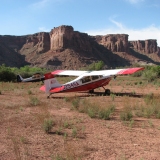
'05 7GCBC High Country Explorer
The faster I go , the farther behind I get.
The faster I go , the farther behind I get.
Fri Apr 23, 2010 9:41 pm
Re: Getting started in backcountry flying.
Congrats on getting 'er done. In a nutshell, short field technique is speed control, at least that's where to start. Learning what your plane will do in a given situation is practice.
Airspeed, Altitude, Brains. You need 2 of the 3!
The Oldtech
The Oldtech
Sat Apr 24, 2010 4:01 am
Re: Getting started in backcountry flying.
Practice is the most important thing. On my Pacer the addition of VG's gave me a lot more
aileron control at low speeds and a slower stall speed. VG's and your prop twisted to climb will do wonders.
Dave
aileron control at low speeds and a slower stall speed. VG's and your prop twisted to climb will do wonders.
Dave

Sat Apr 24, 2010 7:41 am
Re: Getting started in backcountry flying.
Taking a pilot who is familiar with the individual strip along with you could also be very valueable. I flew a Pacer with 150hp around Idaho for a few years and they are a great airplane for this type of flying if you manage weight properly. My prop was pitched at 56 and this seemed like a nice comprimise between speed and climb. Keep us posted on your progress.
Sat Apr 24, 2010 8:14 am
Re: Getting started in backcountry flying.
Here's another strip I'd like to fly into, it's not quite as spectacular as Ram Falls but it's closer and should be a little less challenging. It's the Clearwater River strip, 3300' long at 4100' elevation. I was thinking of pulling my camper out to this strip some day and using it as a base for some mountain flying. But again I need a little more experience first.

Sat Apr 24, 2010 9:00 am
Re: Getting started in backcountry flying.
Randy :
Congrats on your new ticket - Get a copy of Mountain Flying Bible and read and carry it everywhere in the airplane. Land up hill and takeoff down hill whenever possible -wind permitting.
Get s set of traffic cones or old tires (paint tires so you can see them) and go out to your favorite training runway. Set a cone along side of runway where it marks your touchdown point -- move down the runway say 1000 ft. and set out second cone, marker or old painted tire.The key is the landing -read and pratice the landing to put the wheels on the ground at the "landing marker" --Use Sparky's "Spot Landing " every time and get used to using what you've learned.
The takeoff is next after you master the landing . Using soft field technical slightly lift the nose and let airplane on mains for the length of your 1000 ft. mark -say at 35-45 indicated .Just enough to hold the nose off -not to actually fly off .Pull the power back and hold the yoke back and nose will settle when speed over elevator decreeses . Do this several times on say 3-4 thousand ft runway to get the feel. If operators handbook says use 10-20 degrees of flap set it and try another run down the runway with and short lift off and level off when mains are off ground couple of feet. Accerelate to your best climb speed and pull up .I don't retract flaps until I'm on downwind -then slowly -and reset your trim to best climb speed. Go out to pratice area and gain some altitude and lets do some slow flight for a extended period maybe
using a road or highway for referance -don't try to slow airplane up untilit stalls .Keep praticeing until you can do shallow banked turns in slow flight 360 right and left without loosing
altitude . Keep your sight picture and watch outside. As time goes in your log book these things will become much more accustom and start looking for places to .The pictures you've included look more than adquate for a Tri pacer. Try and fly with other pilots that fly out to these strips -1-2 or more airplanes.
Blue Skies and Tailwinds.
Bill Reid
Congrats on your new ticket - Get a copy of Mountain Flying Bible and read and carry it everywhere in the airplane. Land up hill and takeoff down hill whenever possible -wind permitting.
Get s set of traffic cones or old tires (paint tires so you can see them) and go out to your favorite training runway. Set a cone along side of runway where it marks your touchdown point -- move down the runway say 1000 ft. and set out second cone, marker or old painted tire.The key is the landing -read and pratice the landing to put the wheels on the ground at the "landing marker" --Use Sparky's "Spot Landing " every time and get used to using what you've learned.
The takeoff is next after you master the landing . Using soft field technical slightly lift the nose and let airplane on mains for the length of your 1000 ft. mark -say at 35-45 indicated .Just enough to hold the nose off -not to actually fly off .Pull the power back and hold the yoke back and nose will settle when speed over elevator decreeses . Do this several times on say 3-4 thousand ft runway to get the feel. If operators handbook says use 10-20 degrees of flap set it and try another run down the runway with and short lift off and level off when mains are off ground couple of feet. Accerelate to your best climb speed and pull up .I don't retract flaps until I'm on downwind -then slowly -and reset your trim to best climb speed. Go out to pratice area and gain some altitude and lets do some slow flight for a extended period maybe
using a road or highway for referance -don't try to slow airplane up untilit stalls .Keep praticeing until you can do shallow banked turns in slow flight 360 right and left without loosing
altitude . Keep your sight picture and watch outside. As time goes in your log book these things will become much more accustom and start looking for places to .The pictures you've included look more than adquate for a Tri pacer. Try and fly with other pilots that fly out to these strips -1-2 or more airplanes.
Blue Skies and Tailwinds.
Bill Reid
- 182 STOL driver offline
- Posts: 1529
- Joined: Tue Apr 22, 2008 8:27 pm
Sat Apr 24, 2010 12:05 pm
Re: Getting started in backcountry flying.
In mountain flying, the rule is to fly in the morning or evening. This is not just because of density altitude. The varied terrain around backcountry strips can translate into unpredictable winds, and it is exacerbated by the heat of the day.
I learned the hard way to check for wind conditions at both ends of the strip before taking off. Idaho is particularly bad for this because the steep canyon walls develop strong thermals on the side facing the sun with a corresponding downdraft somewhere near the thermal. In between the downdraft and the thermal is some very intense wind on the ground. I now quit even earlier in the morning than I used to, and in addition to looking at any wind sock I now look at the leaves in the treetops along the sides of the full length of the strip before taking off.
The most helpful advice for me that I ever read on this site was to bring a good book. I believe it applies to all kinds of flying everywhere at all times. If there's any doubt, stay on the ground and flip pages until you're happy with the conditions. If you're bored out of your skull you will have nothing better to do than to think up ways to rationalize taking off.
I learned the hard way to check for wind conditions at both ends of the strip before taking off. Idaho is particularly bad for this because the steep canyon walls develop strong thermals on the side facing the sun with a corresponding downdraft somewhere near the thermal. In between the downdraft and the thermal is some very intense wind on the ground. I now quit even earlier in the morning than I used to, and in addition to looking at any wind sock I now look at the leaves in the treetops along the sides of the full length of the strip before taking off.
The most helpful advice for me that I ever read on this site was to bring a good book. I believe it applies to all kinds of flying everywhere at all times. If there's any doubt, stay on the ground and flip pages until you're happy with the conditions. If you're bored out of your skull you will have nothing better to do than to think up ways to rationalize taking off.
Sat Apr 24, 2010 7:03 pm
Re: Getting started in backcountry flying.
182 STOL driver wrote:.....Go out to pratice area and gain some altitude and lets do some slow flight for a extended period maybe
using a road or highway for referance -don't try to slow airplane up untilit stalls .Keep praticeing until you can do shallow banked turns in slow flight 360 right and left without loosing altitude .....
I'm more of a back-forty pilot than a true back-country pilot, but I wonder about the repeated references to "slow flight" as it applies to real-life flying. Are we talking about true "slow flight"- aka "minimum controllable airspeed"? The slow flight I was taught involved operating well on the back side of the power curve, generally at less than power-off stall airspeed, where a reduction in power or increase in attitude resulted in a stall. This is not the mode I care to be operating in while maneuvering to land in tight quarters-- esp in a mountainous environment with tricky wind conditions. I would instead emphasize what I call "maneuvering flight"-- generally in the neighborhood of 1.3 to 1.5 x Vso.
Eric
Cessna Skywagon -- accept no substitute!
DISPLAY OPTIONS
Who is online
Users browsing this forum: No registered users and 30 guests
Latest Features
-
Live to Tell
A Minnesota pilot is surprised to learn that the sudden asymmetric drag of an out-of-rig ski can…Read More -
Creators
Working in some of the Yukon's most beautiful and remote environments, photographer Simon Blakesley captures aircraft in…Read More -
Aircraft Ownership and Maintenance
Upgrading to big tires can make a huge difference in backcountry performance, but with those gains come…Read More -
Tales from Yesteryear
In this tale from bush flying yesteryear, Don Cogger signs up to help Atlee Dodge Jr recovery…Read More


Latest Knowledge Base
-
Destinations
A regional guide with ideas for winter camping destinations in California, Nevada, New Mexico, and Arizona.Read More -
Aircraft
Finding an affordable aircraft that can handle the backcountry for $80K or less? A challenge for sure, but with the…Read More -
Aircraft
01.29.2018 - Zane - Updated tire diameter graphic to add 8.50x10 Guide to tires for use in the backcountry and off-airport landing…Read More -
Pilots
12.22.2013 - Initial article format Operating aircraft on skis and negotiating a snow-covered landscape is an entirely unique skillset and environment.…Read More


