this was posted on the maule owners facebook page.
https://www.youtube.com/watch?v=l8EwvDT ... ce=message
I hear a lot about wingtip vortices but have never given much thought to helicopters..... i will now
I know it is not a big concern in the backcountry, but I fugured it was worth passing on
Roamer
helicopter vortices
Sun Feb 01, 2015 2:20 pm
- Steelroamer offline

- Posts: 119
- Joined: Fri May 09, 2014 3:10 pm
- Location: Kenora
- FindMeSpot URL: https://maps.findmespot.com/s/D8VB
- Aircraft: maule M6 on Floats
Sun Feb 01, 2015 3:00 pm
Re: helicopter vortices
To me it look's like it could be P-Factor pulling the nose over.
I say that because i read a accident report of a RV-3 and it did that. (the Pilot had no RV-3 time)
I have NO experience as a Pilot, Just my thought's.
I say that because i read a accident report of a RV-3 and it did that. (the Pilot had no RV-3 time)
I have NO experience as a Pilot, Just my thought's.
- ExperimentalAviator offline
- Posts: 677
- Joined: Tue Apr 15, 2014 8:02 am
- Location: Plains
Sun Feb 01, 2015 6:14 pm
helicopter vortices
It looked like he was landing. Not much p factor with no power applied. I have no Cirrus time though.
Edit: I read the accident report, the student pilot applied power for a go around after encountering bumpy air. You could be right.
Edit: I read the accident report, the student pilot applied power for a go around after encountering bumpy air. You could be right.
Mon Feb 02, 2015 7:11 am
Re: helicopter vortices
By the clock on the video the Cirrus was 26 seconds behind the Black Hawk. Those things scare me. Heavy helicopters from the Yakima Fireing center land at yakima and the tower tells me Caution Wake Turbulence heavy helicopters I wait about 5 minutes.

tcj
Mon Feb 02, 2015 8:12 am
Re: helicopter vortices
For those who fly helicopters, that is why we are supposed to avoid normal traffic patterns, including down the runway. Yes, airplanes need to avoid helicopters as well.
- contactflying offline
- Posts: 4972
- Joined: Wed Apr 03, 2013 7:36 pm
- Location: Aurora, Missouri 2H2
Download my free "https://tinyurl.com/Safe-Maneuvering" e-book.
Mon Feb 02, 2015 8:56 am
Re: helicopter vortices
I would be a little surprised if the major factor was the Blackhawk. Admittedly that is a heavy hilo but my experience is that a helicopter that is in translational lift doesn't have that much vortices. Could it be the student pilot didn't have the rough air experience to deal with turbulent air?
- Redbaron180 offline
- Posts: 147
- Joined: Sun Jan 09, 2005 10:12 am
- Location: Lopez Island WA
Your word is a lamp unto my feet and a light unto my path. Ps. 119:105
Mon Feb 02, 2015 9:41 am
Re: helicopter vortices
Cirrus pilots are becoming the punching bag of the aviation industry, maybe that "true believer" faith that technology can substitute for skill.
I don't think a helicopter departure 30 seconds earlier is going to caused the crash. Over-reacting to any perceived or imagined turbulence will. In our legal culture of "all misfortune must be someone else's fault", I can see where this is going to go.
I don't think a helicopter departure 30 seconds earlier is going to caused the crash. Over-reacting to any perceived or imagined turbulence will. In our legal culture of "all misfortune must be someone else's fault", I can see where this is going to go.
'74 7GCBC, 26" ABW, Aera 660 feeding G5 and FC-10 FF.
Mon Feb 02, 2015 9:44 am
Re: helicopter vortices
The NTSB preliminary report: http://www.ntsb.gov/_layouts/ntsb.aviat ... 1730&key=1
- ExperimentalAviator offline
- Posts: 677
- Joined: Tue Apr 15, 2014 8:02 am
- Location: Plains
Mon Feb 02, 2015 11:21 am
Re: helicopter vortices
There's a lengthy series of posts in the AOPA forum ("red board") about this accident. I have no doubt about the helicopter's downwash contribution to the accident, although there was a 26 second lapse between when the helicopter departed and the Cirrus crashed. Here's what I posted there this morning (too lazy to retype it here  ):
):
In some of the comments in the helicopterforum, it is said that most fixed wing pilots are pretty ignorant about the effects of helicopter downwash, because they aren't taught much about it. I agree. Although as I said, my instructor back in 1972 warned me about staying away, he didn't go into great detail. The lesson was just stay away--but how far, and for how long? So I tend to be very leery around helicopters, and it's paid dividends. Their downwash is amazingly powerful.
Examples:
*A few months ago at FNL, there was a largish civilian helicopter (I didn't recognize the make) doing hover practice at the north run-up area. As I was taxiing toward there and had already passed A4 before I saw him, as I got closer to the run-up area, I stopped. As it happened, the helicopter which had been facing north turned in its hover to face west, and the pilot saw me waiting there. He announced, "Cessna on taxiway Alpha, we'll back off so that you can pass." I thanked him, and then slowly taxied forward, as he backed away from the pad and settled into the grass. Even then, although he had powered down enough to settle onto the surface, his downwash from that distance, roughly 150' or so, was noticeable as I taxied past.
*Last year the runways, taxiways, and ramps of GXY were resurfaced. They were not quite finished when I taxied out for an IPC with my instructor. When we returned, the access to my hangar was completely blocked, so we tied down on the ramp. A largish civilian helicopter (I think a Bell 206 or similar) came in from the west, hovering about 20' in the air, but for one reason or another then backed slowly in the hover a couple hundred feet before landing. I watched with concern, as his track while he was backing was only about 75' south of where my airplane was tied down. I saw the wings start rocking, and then the large plastic barricades nearby were picked up and scattered, one of them missing my airplane by only a few feet (like in maybe 3'). After he landed, I went over to chew him out. He was so apologetic, and no damage had been done, that what started out with me being pretty p/o'd ended in a nice conversation. He acknowledged that he should have known better than to hover in that manner near other aircraft.
*Several years ago, I took an intro lesson in a Schweizer trainer (same model as shown on the ramp in the accident video). The instructor discussed that even that little helicopter's downwash is very significant, so good piloting demands looking out for what is around it, using minimum power to hover taxi near other aircraft, etc. He did the hover taxiing, of course, but at one point in the lesson, we did do some hovering over the grass near the runway. I was surprised at how much dust we kicked up, as it was a thick grass area.
If nothing else, we as fixed wing pilots need to be very aware that helicopter downwash is extraordinarily dangerous. In the situation we've been discussing, the better decision would have been for the Cirrus pilot to go around at pattern height again, before coming around to land. Unfortunately, in all likelihood that didn't occur to him, as by his training so far, he equated the Blackhawk's rotor wash with wingtip vortices, and they're not the same thing.
Cary
):In some of the comments in the helicopterforum, it is said that most fixed wing pilots are pretty ignorant about the effects of helicopter downwash, because they aren't taught much about it. I agree. Although as I said, my instructor back in 1972 warned me about staying away, he didn't go into great detail. The lesson was just stay away--but how far, and for how long? So I tend to be very leery around helicopters, and it's paid dividends. Their downwash is amazingly powerful.
Examples:
*A few months ago at FNL, there was a largish civilian helicopter (I didn't recognize the make) doing hover practice at the north run-up area. As I was taxiing toward there and had already passed A4 before I saw him, as I got closer to the run-up area, I stopped. As it happened, the helicopter which had been facing north turned in its hover to face west, and the pilot saw me waiting there. He announced, "Cessna on taxiway Alpha, we'll back off so that you can pass." I thanked him, and then slowly taxied forward, as he backed away from the pad and settled into the grass. Even then, although he had powered down enough to settle onto the surface, his downwash from that distance, roughly 150' or so, was noticeable as I taxied past.
*Last year the runways, taxiways, and ramps of GXY were resurfaced. They were not quite finished when I taxied out for an IPC with my instructor. When we returned, the access to my hangar was completely blocked, so we tied down on the ramp. A largish civilian helicopter (I think a Bell 206 or similar) came in from the west, hovering about 20' in the air, but for one reason or another then backed slowly in the hover a couple hundred feet before landing. I watched with concern, as his track while he was backing was only about 75' south of where my airplane was tied down. I saw the wings start rocking, and then the large plastic barricades nearby were picked up and scattered, one of them missing my airplane by only a few feet (like in maybe 3'). After he landed, I went over to chew him out. He was so apologetic, and no damage had been done, that what started out with me being pretty p/o'd ended in a nice conversation. He acknowledged that he should have known better than to hover in that manner near other aircraft.
*Several years ago, I took an intro lesson in a Schweizer trainer (same model as shown on the ramp in the accident video). The instructor discussed that even that little helicopter's downwash is very significant, so good piloting demands looking out for what is around it, using minimum power to hover taxi near other aircraft, etc. He did the hover taxiing, of course, but at one point in the lesson, we did do some hovering over the grass near the runway. I was surprised at how much dust we kicked up, as it was a thick grass area.
If nothing else, we as fixed wing pilots need to be very aware that helicopter downwash is extraordinarily dangerous. In the situation we've been discussing, the better decision would have been for the Cirrus pilot to go around at pattern height again, before coming around to land. Unfortunately, in all likelihood that didn't occur to him, as by his training so far, he equated the Blackhawk's rotor wash with wingtip vortices, and they're not the same thing.
Cary
"I have slipped the surly bonds of earth..., put out my hand and touched the face of God." J.G. Magee
Mon Feb 02, 2015 12:27 pm
Re: helicopter vortices
I had a bit of an exciting experience some years back with rotor downwash. 
I was approaching our airport as an Erickson Air Crane was leaving the area after a low approach. Those things are huge, so realizing I needed to give him a wide berth I slowed way down on the 45, and let at least a full minute pass between the time he overflew the runway and when I approached.
Everything was fine until I was below tree level and had a pretty significant upset and roll to the left. It was instantaneous.
My upset training kicked in, and I righted the ship right away, but I can see how someone who wasn't paying attention or didn't have any upset training could have had a bad day.
I've landed many times behind big heavy jets at big airports, but I've never experienced anything like that. It definitely opened my eyes.
I was approaching our airport as an Erickson Air Crane was leaving the area after a low approach. Those things are huge, so realizing I needed to give him a wide berth I slowed way down on the 45, and let at least a full minute pass between the time he overflew the runway and when I approached.
Everything was fine until I was below tree level and had a pretty significant upset and roll to the left. It was instantaneous.
My upset training kicked in, and I righted the ship right away, but I can see how someone who wasn't paying attention or didn't have any upset training could have had a bad day.
I've landed many times behind big heavy jets at big airports, but I've never experienced anything like that. It definitely opened my eyes.

Mon Feb 02, 2015 12:51 pm
Re: helicopter vortices
After reading the NTSB report it seems like one of the errors may have been choosing to land long due to the wake turbulence, which made him fly right through the worst of it low and slow. If there was room to land as short as possible that might have been a better option, though if he was anything like me during my first solo, where I wanted to land and where I landed were not always the same, in which case another minute of waiting may have made all the difference.
- scottf offline
- Posts: 650
- Joined: Fri Mar 23, 2012 9:56 am
- Location: Meridian, ID
- FindMeSpot URL: http://share.findmespot.com/shared/face ... cbQCpIqefS
Mon Feb 02, 2015 1:01 pm
Re: helicopter vortices
Good public relations are easy to lose with a helicopter. It is so possible to be cool by landing up close and personal. What needs to happen is to land as far out as possible and walk into the FBO. Helicopters need a blade tied down, not the skids. Using white out or brown out procedures, you can get down without a lot of fuss. A helicopter cannot hover, however, without dusting off every nearby person and vehicle. Our medical evacuation call sign was "Dustoff," hint, hint. We landed very close to our work in the field. But, we maintained all standoff possible at civilian airports.
scottf is correct about the error of landing long and flying through the disturbed air. Some confusion may have come from the fact that the worst disturbance is at a hover. From transitional lift and faster, it becomes more organized like that caused by fixed wing aircraft. Sky Cranes have five really big wings going very fast.
scottf is correct about the error of landing long and flying through the disturbed air. Some confusion may have come from the fact that the worst disturbance is at a hover. From transitional lift and faster, it becomes more organized like that caused by fixed wing aircraft. Sky Cranes have five really big wings going very fast.
- contactflying offline
- Posts: 4972
- Joined: Wed Apr 03, 2013 7:36 pm
- Location: Aurora, Missouri 2H2
Download my free "https://tinyurl.com/Safe-Maneuvering" e-book.
Mon Feb 02, 2015 4:37 pm
Re: helicopter vortices
SR20 encountered turbulent air (wing dropped), attempted to go around, pitched up and then stalled and cartwheeled.
I wonder if he had full aileron against the bank and stalled a wing in that rapid pitch up. Also, student pilot so he may not have had the presence of mind to try and level the wings with rudder and allow the airspeed to increase after going full power before honking back on the nose. That's a pretty dynamic situation, I hope he recovers(ed).
Blackhawks will run about 15-16 thousand pounds in an unloaded, training type scenario. Not a light weight.
I've got a picture of a CFD model of rotor vortices in forward flight at work. I'll try to remember to take a picture and post it in here. It's pretty wild how everything interacts.
I wonder if he had full aileron against the bank and stalled a wing in that rapid pitch up. Also, student pilot so he may not have had the presence of mind to try and level the wings with rudder and allow the airspeed to increase after going full power before honking back on the nose. That's a pretty dynamic situation, I hope he recovers(ed).
Blackhawks will run about 15-16 thousand pounds in an unloaded, training type scenario. Not a light weight.
I've got a picture of a CFD model of rotor vortices in forward flight at work. I'll try to remember to take a picture and post it in here. It's pretty wild how everything interacts.
- CamTom12 offline

- Posts: 3705
- Joined: Sun Jul 08, 2012 1:08 pm
- Location: Huntsville
- FindMeSpot URL: https://share.delorme.com/camtom12
- Aircraft: Ruppe Racer
Experimental Pacer
home hand jam "wizard"
Mon Feb 02, 2015 6:25 pm
Re: helicopter vortices
Karmutzen wrote:I don't think a helicopter departure 30 seconds earlier is going to caused the crash. Over-reacting to any perceived or imagined turbulence will. In our legal culture of "all misfortune must be someone else's fault", I can see where this is going to go.
Don't kid yourself about the strength of the vortices from a relatively heavy helo like a Blackhawk, even in translational lift - they're massive and incredibly powerful. Going to have to try to find some video I saw a few years back...
- CapnMike offline
- Posts: 842
- Joined: Wed Mar 05, 2014 11:25 am
- Location: Kamas, Utah and Sandpoint, Idaho
"If my wings should fail me Lord, please meet me with another pair" - Led Zeppelin
"It's all going in my report..." - CapnMike
"It's all going in my report..." - CapnMike
Mon Feb 02, 2015 9:18 pm
Re: helicopter vortices
I have had two experiences with helicopter down washes.
1- I saw an R44 come in to hover just after a very dry snowfall. There was a student and an instructor on board. They came into the site at a fairly high altitude and began to lower down. The rotor air went down to the ground and ran along the ground for a remarkable distance and was clearly visible with the light blowing snow. As they lowered down something changed and much of the snow/air began to rise and get recycled by the blades. Very spectacular to watch.
2- I was doing my run up and a big 61 helicopter was on the compass rose after being rebuilt, he was about 150 feet away. I could see leaves and such being blown past me and the wings were rocking a bit. The 61 pilot said he was going to zero torque until after I took off. I did my run up and departed and I still felt a little burble about 1200 ft down the runway.
Very powerful those helicopters.
KenW
1- I saw an R44 come in to hover just after a very dry snowfall. There was a student and an instructor on board. They came into the site at a fairly high altitude and began to lower down. The rotor air went down to the ground and ran along the ground for a remarkable distance and was clearly visible with the light blowing snow. As they lowered down something changed and much of the snow/air began to rise and get recycled by the blades. Very spectacular to watch.
2- I was doing my run up and a big 61 helicopter was on the compass rose after being rebuilt, he was about 150 feet away. I could see leaves and such being blown past me and the wings were rocking a bit. The 61 pilot said he was going to zero torque until after I took off. I did my run up and departed and I still felt a little burble about 1200 ft down the runway.
Very powerful those helicopters.
KenW
- 175 magnum offline
- Posts: 546
- Joined: Sun Mar 28, 2010 2:13 pm
- Location: surrey bc canada
Tue Feb 03, 2015 12:53 am
Re: helicopter vortices
By the pitch angle on departure and moderate altitude of Loveland, I'd surmise that the UH was pulling in a good deal of power. Although it transitioned to forward flight rather quickly, there would have been a lot of upset air where they applied significant takeoff power. I've made the mistake of getting caught in that as chalk 2, 3, etc.
Brett
Brett
Tue Feb 03, 2015 6:01 am
Re: helicopter vortices
Some time in the mid 1980's, a cessna 182 departing Reaford NC airport, encountered vortices from a recently departed Chinook. The plane was flipped upside down shortley after leaving the ground. The surviving pilot gave me a first hand account of the accident and a strong warning, "wait for several minutes after a heli departs". I have followed his advice and have no close calls or scary stories of my own to tell, thanks to his hair raising tale.
Tue Feb 03, 2015 8:51 am
Re: helicopter vortices
http://www.aopa.org/asf/ntsb/narrative. ... 0810X20446
Exact same kind of thing happened to a friend of mine. Landing a supercub my friend encountered a helicopter on hovertaxi moving down a parallel taxiway opposite direction. Yeehaa rodeo on.
Exact same kind of thing happened to a friend of mine. Landing a supercub my friend encountered a helicopter on hovertaxi moving down a parallel taxiway opposite direction. Yeehaa rodeo on.
Tue Feb 03, 2015 11:52 am
Re: helicopter vortices
This wasn't exactly the video I was looking for, but it's fun and kind of fits this website... 
This next clip is a great video, however - and I think it does a great job of showing the difference between down wash and rotor tip vortices in a hover and rotor disk vortices on a helicopter in forward flight as in the previous video.
In a hover, the vortices produced (representing the full weight of the helicopter being lifted) are getting tightly stacked, one on top of the other, hitting the ground and spreading out around the hovering chopper. People, aircraft and objects that come into that area are subjected to the full lift of the heavy chopper repeatedly and continuously as that ring of tightly-stacked vortices expands around it. Contrast that with the same helicopter in forward flight or a similarly weighted fixed-wing aircraft, where an encounter is likely to be with a single vortex for a brief moment.
A helicopter pulling a lot of collective and beginning to move through translational lift will have the highest angle of attack on the blades (especially the retreating blades) and be producing the strongest rotor tip vortices, which will still be tightly stacked as it begins to move forward. Not where you want to be in a light aircraft, even a couple minutes later!
This next clip is a great video, however - and I think it does a great job of showing the difference between down wash and rotor tip vortices in a hover and rotor disk vortices on a helicopter in forward flight as in the previous video.
In a hover, the vortices produced (representing the full weight of the helicopter being lifted) are getting tightly stacked, one on top of the other, hitting the ground and spreading out around the hovering chopper. People, aircraft and objects that come into that area are subjected to the full lift of the heavy chopper repeatedly and continuously as that ring of tightly-stacked vortices expands around it. Contrast that with the same helicopter in forward flight or a similarly weighted fixed-wing aircraft, where an encounter is likely to be with a single vortex for a brief moment.
A helicopter pulling a lot of collective and beginning to move through translational lift will have the highest angle of attack on the blades (especially the retreating blades) and be producing the strongest rotor tip vortices, which will still be tightly stacked as it begins to move forward. Not where you want to be in a light aircraft, even a couple minutes later!
- CapnMike offline
- Posts: 842
- Joined: Wed Mar 05, 2014 11:25 am
- Location: Kamas, Utah and Sandpoint, Idaho
"If my wings should fail me Lord, please meet me with another pair" - Led Zeppelin
"It's all going in my report..." - CapnMike
"It's all going in my report..." - CapnMike
Tue Feb 03, 2015 5:56 pm
Re: helicopter vortices
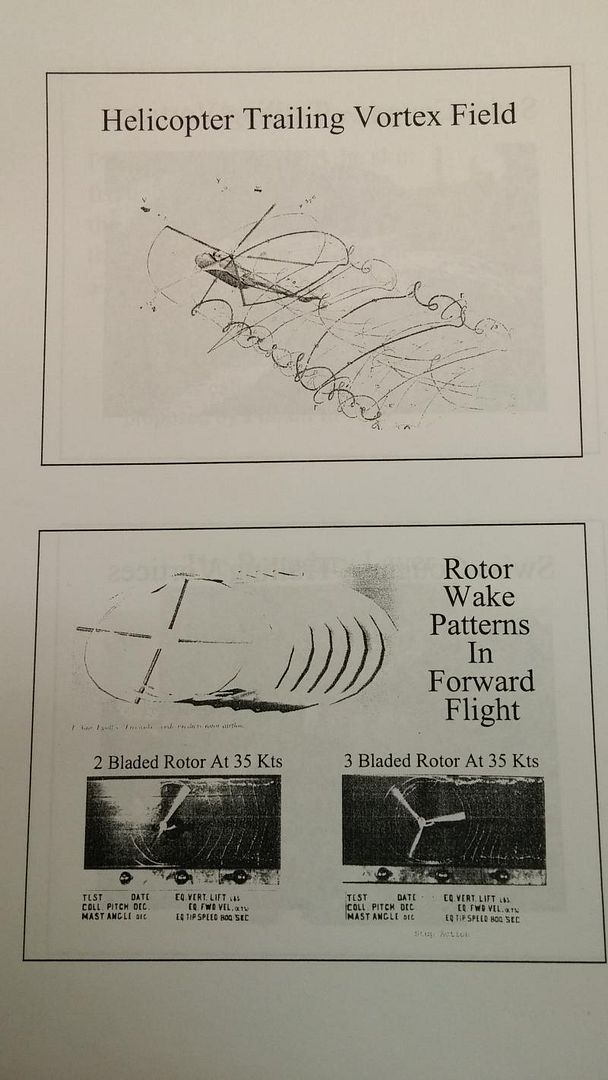
Sorry for the potato quality photos, but here are those vortex pics I promised.
Thrust is a product of the mass flow through the rotor and it's change in velocity. Changing the velocity of a mass of air creates a vortex sheet behind each blade that's proportional in size to the velocity change it produced
In a hover, a helicopter's total flow through the rotor is entirely induced by the blades, creating a big vortex sheet from each blade which descend below and in ground effect will stack up on each other. Dangerous place to be near in a light aircraft.
In forward flight, the helicopter's translational speed causes an increase in mass flow rate through the disk and the required change in velocity to maintain a constant thrust decreases tremendously. As the induced velocity decreases, so do the vortex sheets made by each rotor blade. They also swirl through each other and tend to fold up a distance behind the helicopter, kind of like an airplane.
Here's a hover depiction. This is depicting an OGE hover:

And here's forward flight:
Thrust is a product of the mass flow through the rotor and it's change in velocity. Changing the velocity of a mass of air creates a vortex sheet behind each blade that's proportional in size to the velocity change it produced
In a hover, a helicopter's total flow through the rotor is entirely induced by the blades, creating a big vortex sheet from each blade which descend below and in ground effect will stack up on each other. Dangerous place to be near in a light aircraft.
In forward flight, the helicopter's translational speed causes an increase in mass flow rate through the disk and the required change in velocity to maintain a constant thrust decreases tremendously. As the induced velocity decreases, so do the vortex sheets made by each rotor blade. They also swirl through each other and tend to fold up a distance behind the helicopter, kind of like an airplane.
Here's a hover depiction. This is depicting an OGE hover:
And here's forward flight:
- CamTom12 offline
- Posts: 3705
- Joined: Sun Jul 08, 2012 1:08 pm
- Location: Huntsville
- FindMeSpot URL: https://share.delorme.com/camtom12
- Aircraft: Ruppe Racer
Experimental Pacer
home hand jam "wizard"
DISPLAY OPTIONS
Who is online
Users browsing this forum: No registered users and 1 guest
Latest Features
-
Live to Tell
A Minnesota pilot is surprised to learn that the sudden asymmetric drag of an out-of-rig ski can…Read More -
Creators
Working in some of the Yukon's most beautiful and remote environments, photographer Simon Blakesley captures aircraft in…Read More -
Aircraft Ownership and Maintenance
Upgrading to big tires can make a huge difference in backcountry performance, but with those gains come…Read More -
Tales from Yesteryear
In this tale from bush flying yesteryear, Don Cogger signs up to help Atlee Dodge Jr recovery…Read More


Latest Knowledge Base
-
Destinations
A regional guide with ideas for winter camping destinations in California, Nevada, New Mexico, and Arizona.Read More -
Aircraft
Finding an affordable aircraft that can handle the backcountry for $80K or less? A challenge for sure, but with the…Read More -
Aircraft
01.29.2018 - Zane - Updated tire diameter graphic to add 8.50x10 Guide to tires for use in the backcountry and off-airport landing…Read More -
Pilots
12.22.2013 - Initial article format Operating aircraft on skis and negotiating a snow-covered landscape is an entirely unique skillset and environment.…Read More


