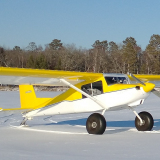
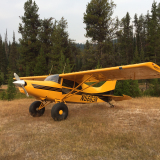
Keep in mind that I'm not a decent tail dragger pilot, but here's my advice for learning to land, which I've published here and there for years. It's what I used when I was instructing. There's nothing new there, but it may help. There're a couple of comments that are only applicable to trikes, but overall, it works.
How to land an airplane. Sometimes I think, “stop me if I’ve told you this before”, because I’ve written so many times about how to land—or how to solve landing problems. But here we go again. If you and I were to ride together, this is how I’d tell you to do it.
First, you need to have good control of your approach speed. Your approach speed on final should be 1.3 Vso—and Vso means the stall speed in the landing configuration. So if on this landing you’re using full flaps, and on the next one you use only 10 degrees, then adjust your approach speed accordingly. Since you don’t have any power to work with, that means adjusting the pitch. That also means that if you are following the approach speed recommendations in a late model POH, you need to use the slowest recommended approach speed. If the POH says 60-70 knots, use 60, for instance. But why not use the Vso and calculate from there?
Here you’re asking, why not a faster speed than 1.3 Vso? Simple—your landings will be better if you use 1.3 Vso. Trust me—it’s true.
You’re also wondering why we’re not talking about the whole pattern. Well, if you slow down on downwind and more on base so that you’re at 1.3 Vso on final, or if you enter the pattern on base and slow down so that you’re at 1.3 Vso on final, or if you do a straight-in approach so that you’re at 1.3 Vso on final, it really doesn’t matter. What is important is that you’re at 1.3 Vso on final.
Next, you need to know the sight picture for the flare. Here’s how to determine what it should be. On a normal take off, you raise the nose when the airplane is ready to fly. Memorize that, because that’s the sight picture you’ll want when you flare to land, not higher, not lower, but that same sight picture.
So now we’ll divide your landings into 3 parts: approach, leveling off, and landing flare.
So you’re on final approach, using whatever flaps you want to use for this landing, and you’re using 1.3 Vso. Trim for that speed!!!!! Trimming for the approach is as important as trimming for other aspects of flying. If you don’t trim properly, you are an interested passenger, not a pilot. No excuses—you must trim!
When you get within 10-15 feet of the runway surface, level off. Don’t raise the nose, level it, just like when you were flying in the pattern on downwind. Then wait. Don’t get anxious to do anything else—wait!
Meanwhile, look toward the end of the runway—it makes it easier than if you look closer to the airplane.
Soon the airplane will start to settle naturally, because without any power added, that’s what it does. When it starts to settle, raise the nose to that same sight picture that you had on take off. The airplane will slow more, continue to settle, and voila!, you’ll touch down!
You’re not finished. Continue to hold the nose up by gradually pulling the yoke/stick back as the airplane slows, and then gently lower it to the runway. Maintain directional control with the rudder pedals, and let the airplane slow, maybe with a little braking. But don’t get anxious to do much of anything else, because this is landing, not touch and goes, not “how quickly can I get the flaps up”, or how soon I can take off the carburetor heat.
As you become more proficient, you’ll meld the 3 steps into a continuous sort of action, but until then, consciously dividing it into 3 parts will make your landings so much better. Now go land!
Cary
kinda jealous, I wish I was out there doing laps in a T-craft.