Backcountry Pilot • Maule question

Maule question

A general forum for anything related to flying the backcountry. Please check first if your new topic fits better into a more specific forum before posting.
37 postsPage 2 of 21, 2

Re: Maule question

I'm certainly not an expert on Maules, Pipers, or anything in between, but here are a few tidbits regarding the similarities and differences (as far as I know :D ):
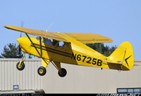
1. The way I heard it was that B.D. Maule started by literally taking a Piper Pacer and modifying it. They are very similar in some respects and even share the same design and identical measurements in many places. Most people would not call a Pacer a STOL airplane, but they can be made into a pretty good backcountry airplane.
2. They use the same airfoil, but have different wing designs (metal vs. fabric, different spar and rib design, drag bracing vs. structural skin, etc.).
3. Maule has a few wingspan variations and they have made them longer over the years, but the "short wings" found on stock M4,5, some M7s is only about a 19" longer than a Pacer (29' 3" vs. 30' 10"). The longest Maule wing is something like 33' 8", which is still shorter than a cub at 36'. Unlike stock Pacers and Cubs, most later Maules have really big flaps and ailerons out to the end to help with STOL and slow flight.
4. Maules are normally heavier than Cubs and even Pacers. They tend to have a lot more instrumentation, more seats, cargo doors, metal wings, extra fuel tanks, etc. Those things don't help STOL, but are great for long distance with more passengers and gear.
5. Maules tend to have bigger engines and much bigger flaps to help them with STOL operations.

Everything is a trade-off.

chrisg offline
Airstrip Database Manager
User avatar
Posts: 220
Joined: Tue Jan 01, 2008 9:04 pm
Location: Coeur d'Alene, Idaho
Chris
http://www.shortfield.com - Backcountry Airstrip Database
https://discord.gg/HNHKeDE - Groundfall - Bush Flying Video Game

Re: Maule question

After watching the keys, how could someone with only 2 hands even play that??
L-19 offline
Posts: 505
Joined: Sat Jan 30, 2010 2:04 am
Location: Wisconsin
Blessed are the curious, for they shall have great adventures!

Re: Maule question

[/quote]

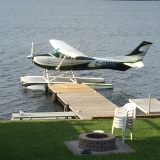
Sorry if that sounded a bit condescending, didn't mean to insult. Thing is, after hearing that Maules were a STOL airplane, and then witnessing this "dog performance", and then asking around about it, I was advised that Maules on floats were NOT STOL, due to the low AOA. They NEED the tailwheel to get enough AOA to get off short.

That's what was explained to me by knowledgeable bush pilots. Do I have the wrong impression/info??
Wup, you sure the airfoils are the same?[/quote]
No problem - no offense taken. I don't know what constitutes STOL, my Maule on had a 78" prop, which is a poor seaplane prop - and got off pretty quickly. I was told the difference would be substantial with a bigger and more aggressive prop. I can say when it had 1000 lbs in it and a lot was in the back, it definitely took a lot longer to get off.

Can anyone chime in as to what they consider STOL distance including the clearance over a 50'obstacle?
gear offline
User avatar
Posts: 250
Joined: Wed Jan 28, 2009 4:49 pm
Location: Winnipeg

Re: Maule question

Decided I'd better get the real response to the Beethoven player piano off my chest, so here goes...

That pretty much proves my point. The video is a good demonstration of a player piano playing Beethoven, but a horrible attempt if the goal was to play like Beethoven.

There was no differentiation in force of keystrokes, all were pounded as if the entire piece was written to be played fortissimo, which it wasn't. Beethoven's music made extensive use of the full range of dynamism available to him. Score here for those that want to parse this statement...

http://www.scores4free.com/beethoven/be ... p67-a4.pdf

It is probably similar to what would happen if you installed an autoland capability in a bush plane. You could probably make it work, and it would probably land as short as a relatively poor pilot of the same aircraft, but it is not really believable that it would be possible to program Paul Claus into an autoland...
Troy Hamon offline
User avatar
Posts: 913
Joined: Tue Apr 06, 2010 8:27 am
Location: King Salmon
FindMeSpot URL: http://share.findmespot.com/shared/face ... 04iX0FXjV2
Aircraft: Piper PA-22

Re: Maule question

The thing that interested me about the maule is that with the same wing span and airfoil it was performing at significantly higher speeds with a much lower stall that my pacer. I have stock pacer wings but have been considering sullivan wing tips. Also, Trimmer is working on an STC to move ailerons out to the end and extend the flaps. (slow progress on that) My thoughts are when i start this mod process if i can copy the maule wing, maybe even allow for the -7 degree flap movement I can get similar performance. its never going to be a cub but Maule touts over a 50ft obsticle in 700 feet at gross which is good back country performance and then cruising at 135knts. a pacer is 250 to 300 lbs lighter than a Maule too.
dplunkt offline
User avatar
Posts: 72
Joined: Sun Sep 25, 2011 4:39 pm
Location: pennsylvania

Re: Maule question

But an M7 has 3 or 4 feet of wing beyond pacer wings...that will make a big difference...
Troy Hamon offline
User avatar
Posts: 913
Joined: Tue Apr 06, 2010 8:27 am
Location: King Salmon
FindMeSpot URL: http://share.findmespot.com/shared/face ... 04iX0FXjV2
Aircraft: Piper PA-22

Re: Maule question

[I have a couple questions about Maule wings and flaps...
first, a Maule can set the flap to -7 degrees. What is the use of the negative setting?
Does the Maule wing use the sme airfoil as a cub?]

I've flown my Maule MX-7-180 for 13+ years as well as a Super Cub. The -7 degree flap setting on the Maule is supposed to reduce the drag of the high lift wing and produce a few more mph in cruise. I've tested it several times and it results in a small increase of 2-3 mph in cruise.

The Maule wing does not use the same airfoil as a cub.

They are significantly different in terms of empty weight and power-to-weight ratio. My Maule's basic empty weight is 1409 lbs on wheels while a PA-18-150 has a basic empty weight of about 932 lbs. My Maule's power-to-weight ratio is 0.11 while the PA-18-150 is 0.13. I can't speak for a M-7-235 Maule's power-to-weight ratio since I don't have the basic empty weight data. Other considerations between the two takeoff distances on floats would be the types of floats and props on each aircraft, loading, wind and water condition and pilot experience. It's not meaningful to compare them without knowing those factors.
andy offline
User avatar
Posts: 79
Joined: Thu Oct 23, 2008 4:18 pm
Location: Lake James
Aircraft: 1986 Maule MX-7-180

Re: Maule question

From My research a maule has the US35B wing, the super cub has the US35 wing, not a nickels difference between the two in the rib shape. The maules wing probably started as Pacer wing then grew longer, just not as long as a SC wing, yet. Don't all three wings have the same measurement between the spars at the wing root?
goldfinch offline
Posts: 79
Joined: Tue Jun 10, 2008 10:25 pm
Location: LEWISTON,Idaho
wings, cary me over the big rocks

Re: Maule question

goldfinch wrote:From My research a maule has the US35B wing, the super cub has the US35 wing, not a nickels difference between the two in the rib shape. The maules wing probably started as Pacer wing then grew longer, just not as long as a SC wing, yet. Don't all three wings have the same measurement between the spars at the wing root?


Yeah, that's my understanding too, but I can't say for sure because I don't have a Maule wing (or rib) to compare with my Piper wing. I do know that the chord, spar spacing, attach points and bolt sizes are all the same.

From what I understand Maule uses a "modified USA35B airfoil" and that is also what Piper used. I'm not sure what was modified, but this discussion (http://www.supercub.org/forum/archive/index.php/t-21944.html) says that the "upper ordinates of the airfoil by 4%" changed.

I don't know $#!t and I'm not trying to dispute anyone's statements...I'm just curious about the whole thing because I've also wondered how to make a Pacer perform more like a Maule.
chrisg offline
Airstrip Database Manager
User avatar
Posts: 220
Joined: Tue Jan 01, 2008 9:04 pm
Location: Coeur d'Alene, Idaho
Chris
http://www.shortfield.com - Backcountry Airstrip Database
https://discord.gg/HNHKeDE - Groundfall - Bush Flying Video Game

Re: Maule question

What is STOL performance?

I don't know. Guess that there is a definition somewhere. Most likely the Maule isn't a TRUE STOL. All I know is ....

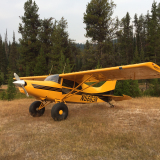
....my M-5-210-C ....at gross wt. on a 60 degree day at 470ft msl, no wind.... will lift off in 700ft and clear a 50 ft. obstacle within 1,100 ft.

Just me(180lbs) and 40 gallons of fuel on the same day... one notch of flaps....she will lift off in 300ft. make a 360 degree turn while remaining within 500 ft. horizontally of the the lift off point....touch down and stop within 250ft. on a hard surface runway.

With 66 gallons of gas I can fly non-stop for over 5 hours with reserve: cruise close to 120kts ....while hauling me, my son and a couple hundred pounds of camping gear in the back end.

Good enough for me. :shock:

Bob
z3skybolt offline
Posts: 569
Joined: Tue Apr 08, 2008 9:23 pm
Location: Warrenton, Missouri
Living the Dream

Re: Maule question

Take off and land in 300'-400' @ 4000' 2 people 3/4 fuel in my M6-235 sounds stol-ish to me!
maulmaniac offline
User avatar
Posts: 43
Joined: Fri Dec 09, 2005 8:35 pm
Location: Idaho city , Idaho

Re: Maule question

2000 ft msl, 74 degrees, 2300lbs, no wind. Off in 400ft, thru 3000ft msl by the end of a 3000 ft gravel strip. MT7-235.

Gets me where I need to go. I have no cub experience so one of those might get me where I need to go too.

Dr.Mike
Dr.Mike offline
Posts: 13
Joined: Fri Jul 01, 2011 3:27 pm
Location: Redding, CA
N824GP

Re: Maule question

IMHO, STOL needs to have some sort of a multiplier, or factor, or constant to make all the comparisons worth a crap. A C-130 that blasts out of a 2000 foot dirt strip with 100,000 pounds of cargo aboard is more STOL to me than a tired 172 with a solo pilot that can lurch off into ground effect in 1000 feet.

Perhaps it should be related to the number of wingspans it takes to take off and/or land. Perhaps it should be multiples of takeoff weight or payload or ratio of weight to payload. Perhaps some combination of all.

I'm fairly sure there are a few trained aero engineers swimming in these waters, camouflaged to look like ordinary redneck bushwhackers. Maybe one of those high brain function types can do the entire aviation world a favor, and come up with a credible formula of some sort that can be used as a standard, to assign a numerical value to an airplane's STOL capability.

Whatever you come up with, it would probably be fair to say that the stock PA-18-150 should be the "1.00" benchmark. I really hate to feed the bears in that community, but that airplane clearly makes the most sense as the benchmark. The Fieseler Storch and maybe the Helio will probably be somewhat better and the 206 will be worse, but the PA-18 is the de facto standard to which other STOL aircraft will always be compared.

Any takers? Solving one of aviation's great mysteries and resolving the ultimate BCP question/argument?
EZFlap offline
User avatar
Posts: 2226
Joined: Thu Aug 13, 2009 9:21 am
.

Re: Maule question

STOL:short takeoff and landing: (DOD/NATO) The ability of an aircraft to clear a 50-foot (15 meters) obstacle within 1,500 feet (450 meters) of commencing takeoff or in landing, to stop within 1,500 feet (450 meters) after passing over a 50-foot (15 meters) obstacle. Also called STOL.
Department of Defense Dictionary of Military and Associated Terms (JP 1-02)[2]
"STOL (Short Take Off and Landing). STOL performance of an aircraft is the ability of aircraft to take off and clear a 50-foot obstruction in a distance of 1,500 feet from beginning the takeoff run. It must also be able to stop within 1,500 feet after crossing a 50-foot obstacle on landing."
Dictionary of Aeronautical Terms[3]
"An aircraft that, at some weight within its approved operating weight, is capable of operating from a STOL runway in compliance with the applicable STOL characteristics and airworthiness, operations, noise, and pollution standards" and ""aircraft" means any machine capable of deriving support in the atmosphere"
Transport Canada[4][5] and Arizona Department of Transportation[6]
"A STOL aircraft is an aircraft with a certified performance capability to execute approaches along a glideslope of 6 degrees or steeper and to execute missed approaches at a climb gradient sufficient to clear a 15:1 missed approach surface at sea level... A STOL runway is one which is specifically designated and marked for STOL aircraft operations, and designed and maintained to specified standards."
US Federal Aviation Administration[7]
"Heavier-than-air craft that cannot take off and land vertically, but can operate within areas substantially more confined than those normally required by aircraft of the same size. Derived from short takeoff and landing aircraft."
McGraw-Hill Dictionary of Scientific & Technical Terms[8]
"short takeoff and landing aircraft (STOL), heavier-than-air craft, capable of rising from and descending to the ground with only a short length of runway, but incapable of doing so vertically. The precise definition of an STOL aircraft has not been universally agreed upon. However, it has been tentatively defined as an aircraft that upon taking off needs only 1,000 ft (305 m) of runway to clear a 50-ft (15-m) obstacle at the end of that distance and upon landing can clear the same obstacle and then land within 1,000 ft."
Columbia Encyclopedia[1]
"The STOL mode of flight is one during which an airplane taking off or landing is operated at climb-out and approach speeds lower than the conventionally accepted margins of airspeed above the power-off stalling speed of the airplane."
Lieutenant Colonel Walter P. Maiersperger, USAF (Ret)[9]
Stickman offline
User avatar
Posts: 105
Joined: Wed Oct 04, 2006 4:37 pm
Location: Wasilla
Aircraft: Cessna 180

Re: Maule question

EZFlap wrote:IMHO, STOL needs to have some sort of a multiplier, or factor, or constant to make all the comparisons worth a crap. A C-130 that blasts out of a 2000 foot dirt strip with 100,000 pounds of cargo aboard is more STOL to me than a tired 172 with a solo pilot that can lurch off into ground effect in 1000 feet.


A C-130 has a gross weight of 155,000 and an operating weight (weight before fuel, pax, and cargo) of about 90,000. The shortest field I've been in and out of in Afghanistan is 3,800ft long and 3,900ft elevation. For that strip we had to use "assault" takeoff and landing procedures and were limited to 130,000 gross weight. With the fuel we had on board we could only take out about 9,000lbs of cargo. I know you were just throwing numbers out as an example but I couldn't resist :D . A C-130 wouldn't take 100,000lbs of cargo out of any strip.
robw56 offline
User avatar
Posts: 3263
Joined: Thu Jan 18, 2007 9:30 pm
Location: Ward
Aircraft: 1957 C-180A

Re: Maule question

robw56 wrote:The shortest field I've been in and out of in Afghanistan is 3,800ft long and 3,900ft elevation. For that strip we had to


I humbly yield to a far greater authority on the subject. Thank you sincerely for your service and sacrifice overseas =D>

Apparently stickman has found several decent definitions of STOL, even though they are all a little different. Still, it seems that perhaps someone can come up with a useful numerical formula to quantify the competitive level of an aircraft's STOL performance . The PA-18 can easily beat the 1500 foot/50 foot obstacle test; hell, my old wheezing 172 can do that... so the minute I cheerfully boast that my 172 is in the same STOL category as the PA-18, those SC guys would just have a purple and orange conniption.

Wait a minute, now that sounds like fun, pissing those guys off like that... (I still owe some of them a good sharp poke) :evil:
EZFlap offline
User avatar
Posts: 2226
Joined: Thu Aug 13, 2009 9:21 am
.

Re: Maule question

A few thoughts...
Cubs don't use the US35B airfoil - they use the US35BMod
airfoil. The mod increases camber, increases the negative AOA of zero lift, and increases the pitching moment, thereby requiring more tail download for stability.

The following statement from another post is correct.
"(http://www.supercub.org/forum/archive/i ... 21944.html) says that the "upper ordinates of the airfoil by 4%" changed".

They were increased by 4% from the US35B airfoil to provide spar clearance for use with a standard spar depth, not for aerodynamic reasons - though they do affect the aerodynamic characteristics. As an aside, there appear to be some transcription errors in the listed rostral upper surface airfoil coordinates that are incompatible with the usual convention for describing the leading edge radius and location. Seems to be an oops moment from many decades ago.


Fabric wings are essentially double surface membrane wings. When flying 'on design', membrane wings are about as effective as rigid metal wings. When flying 'off design' (which is most of the time), membrane wings are more aerodynamically effective than rigid. They tend to be lighter too :-)

The pitching moment of membrane wings increases with increasing airspeed (due to the location of maximum camber moving aftward), so requires relatively more tail down force than rigid wings as speed increases. There is one caveat - as speed increases, the aeroelastic number declines. If it falls below the bistable limit, the skin will flutter.

What airfoil does Maule use?

As an aside, the term 'hershy bar' refers to planform, not airfoil.
JimC offline
Posts: 110
Joined: Wed Jun 16, 2010 9:05 pm
Location: Collierville TN

DISPLAY OPTIONS

Previous
37 postsPage 2 of 21, 2

Who is online

Users browsing this forum: No registered users and 6 guests

Latest Features

Latest Knowledge Base