Oil temps
Thu Sep 20, 2007 8:35 pm
oil temps
Howdy again, the oil cooler adjustable plate I have on my 180 is a factory part. After a bit a searching I found a surplus part. I don't know about the 170 but in the back of the parts book on the 180 there is a page with all the winterization part's. This plate I have is just part of the entire kit. there are also plates that cover the other openings also.
I will try to post some pictures soon of how the plate works on my bird.
Dave
I will try to post some pictures soon of how the plate works on my bird.
Dave
- wagonwrench offline
- Posts: 107
- Joined: Sat Sep 15, 2007 12:40 pm
- Location: Grangeville, ID
Thu Sep 20, 2007 9:00 pm
oil temps
Duct tape works fine. Save your motor instead of being paranoid about the ramp check that is most likely never going to happen. If it does, reach in and pull the tape off.

Fri Sep 21, 2007 4:22 am
Exactly. And, good luck getting any installed part like an adjustable oil cooler door approved in this day and age.
Wagonwrench: The 170 he's referring to has a different engine and different cooler, so even if there were an adjustable plate, it wouldn't work on his engine.
Also, as I noted earlier, in these airplanes, it's not just an oil temp problem, cylinder head temps run really low as well. BIG cooling inlets, and HUGE cooling outlet.
A cowl flap is what's really needed.
MTV
Wagonwrench: The 170 he's referring to has a different engine and different cooler, so even if there were an adjustable plate, it wouldn't work on his engine.
Also, as I noted earlier, in these airplanes, it's not just an oil temp problem, cylinder head temps run really low as well. BIG cooling inlets, and HUGE cooling outlet.
A cowl flap is what's really needed.
MTV



Fri Sep 21, 2007 7:38 am
Whee,
The cowling on these aircraft is called a "pressure cowl", unless it's a J-3 Cub, of course.
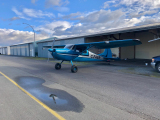
The idea is that ram air forces air into the air inlets (A in your picture). Since it is pressurized a bit (ram air), it is then directed (by baffling around your engine cylinders) to flow downward, THROUGH the cylinder cooling fins, and into the lower portion of the pressure cowling, which is at a lower pressure. The air then flows out the cowling exit (C in your picture).
There are two very different cooling tasks that go on here:
Cylinder cooling, and oil cooling. If you don't have an oil cooler (and some small engines didn't), then obviously you can't cover the oil cooler to increase oil temp. The little Continentals came with (or there was available) an insulating blanket for the OIL SUMP--the bulge that is at the bottom of your engine, where the oil lives when its not lubricating the engine. This "jacket" would raise oil temps some, but not a whole lot. NEvertheless, probably the best deal you can get.
You are correct that blocking off the air inlets can create havoc with your cylinder cooling. The biggest problem is that it's really difficult to predict what tape across the cowl inlets will do, even one strip.
I've seen a lot of folks put tape across the cowl inlets, but leave part open. I don't like doing this, cause you are disturbing the airflow through the cowl, which could be a bad thing. Problem is, you won't know for a long time.
The best plan is to do what manufacturers do to keep an engine warm, which is to restrict airflow OUT of the cowling, at point C on your picture. That way, inlet air is still flowing the way it should, but just at a lower velocity. This is precisely what cowl flaps do on many aircraft.
Unfortunately, this is easier said than done on most of these little airplanes. An adjustable cowl flap is a wonderful device, but really difficult to get approved these days.
MTV
The cowling on these aircraft is called a "pressure cowl", unless it's a J-3 Cub, of course.
The idea is that ram air forces air into the air inlets (A in your picture). Since it is pressurized a bit (ram air), it is then directed (by baffling around your engine cylinders) to flow downward, THROUGH the cylinder cooling fins, and into the lower portion of the pressure cowling, which is at a lower pressure. The air then flows out the cowling exit (C in your picture).
There are two very different cooling tasks that go on here:
Cylinder cooling, and oil cooling. If you don't have an oil cooler (and some small engines didn't), then obviously you can't cover the oil cooler to increase oil temp. The little Continentals came with (or there was available) an insulating blanket for the OIL SUMP--the bulge that is at the bottom of your engine, where the oil lives when its not lubricating the engine. This "jacket" would raise oil temps some, but not a whole lot. NEvertheless, probably the best deal you can get.
You are correct that blocking off the air inlets can create havoc with your cylinder cooling. The biggest problem is that it's really difficult to predict what tape across the cowl inlets will do, even one strip.
I've seen a lot of folks put tape across the cowl inlets, but leave part open. I don't like doing this, cause you are disturbing the airflow through the cowl, which could be a bad thing. Problem is, you won't know for a long time.
The best plan is to do what manufacturers do to keep an engine warm, which is to restrict airflow OUT of the cowling, at point C on your picture. That way, inlet air is still flowing the way it should, but just at a lower velocity. This is precisely what cowl flaps do on many aircraft.
Unfortunately, this is easier said than done on most of these little airplanes. An adjustable cowl flap is a wonderful device, but really difficult to get approved these days.
MTV
Fri Sep 21, 2007 11:53 am

Fri Sep 21, 2007 12:11 pm
Last edited by Zzz on Fri Sep 21, 2007 12:25 pm, edited 1 time in total.
- Zzz offline


- Posts: 2855
- Joined: Fri Oct 08, 2004 11:09 pm
- Location: northern
- Aircraft: Swiveling desk chair
Half a century spent proving “it is better to be thought a fool than to open your mouth and remove all doubt.”


Fri Sep 21, 2007 3:41 pm
Ok, so taping up the cowl inlets isn't recommended... So what should I do ? My Champ has a PA-12 nose on it, along with a 0-235 engine, and the oil cooler is mounted in front of the cylinder in the right side (facing the plane) cowl inlet.
The usual place for mounting an oil cooler on the PA-12 nose is blocked off with tin. I wonder why they just didn't mount the cooler there ???
The temps are starting to dip down into the 30's and 40's at night, should I switch over to 30wt oil now, or wait longer ? I'll be due for an oil change in about another 10 hours, so I was thinking Id just go ahead and do it sooner than later.
Thanks !
Bob K.
Anchorage, AK
The usual place for mounting an oil cooler on the PA-12 nose is blocked off with tin. I wonder why they just didn't mount the cooler there ???
The temps are starting to dip down into the 30's and 40's at night, should I switch over to 30wt oil now, or wait longer ? I'll be due for an oil change in about another 10 hours, so I was thinking Id just go ahead and do it sooner than later.
Thanks !
Bob K.
Anchorage, AK
Fri Sep 21, 2007 9:13 pm
Remember what temp water boils at, if your oil does not get that hot water(condensation) and other contaminates don't boil out plus with thick oil the engine is working harder.
Water boils at 100C at 29.92 inches mercury.
Are we sure the oil has to reach the boiling point of water at a given barometric pressure in order to maintain a healthy engine? My chemistry skills make my mechanical skills look superb, by which I mean I can mix vinegar and baking soda and NOT get a reaction five times out of ten...but I'm having a hard time seeing this.

My vehicle engine has a coolant temperature of 87C...far below the H2O boiling point. I don't know if the engine oil runs hotter than this, but I don't see why it would.
My airplane oil temperature gage rarely goes over 65C...again well below boiling point at sea level. In fact, I don't think I've ever seen it over 93C even when flying in triple digits.
Granted I don't know how accurate the gage is, but I've never seen condensation on the dipstick, either.
BTW, I don't have an oil cooler...I have a hard time seeing why my oil should be running cool while flying in triple digit weather at max gross weight. If it matters I run Shell 15w-50 and change the oil every 25 hours, oil and filter every 50 hours.


Fri Sep 21, 2007 11:12 pm
Ravi, you are right. It is not necessary to exceed the boiling temperature of water to "boil" off the water content in your oil.
Evaporation of water occurs faster the higher the temperature of the water. The higher the temp of the water (heated by the oil it is suspended in) the higher its vapor pressure. Combine that increased vapor pressure with the lower atmospheric pressures you encounter at altitude, and you have a more rapid vaporization of water, just not as rapid as the actual "boiling" we associate with seeing bubbles.
I had to review my chemistry textbook to remember that.
I found this link on the TCM website. It seems like a pretty good reference for the topic of dehydrating your engine oil.
Read the rest here.
Evaporation of water occurs faster the higher the temperature of the water. The higher the temp of the water (heated by the oil it is suspended in) the higher its vapor pressure. Combine that increased vapor pressure with the lower atmospheric pressures you encounter at altitude, and you have a more rapid vaporization of water, just not as rapid as the actual "boiling" we associate with seeing bubbles.
I had to review my chemistry textbook to remember that.
I found this link on the TCM website. It seems like a pretty good reference for the topic of dehydrating your engine oil.
Teledyne-Continental Motors wrote:When operating the engine, be sensitive to the need to develop an oil temperature above 170 degrees Fahrenheit for approximately an hour to boil off the water and acids in the oil as a means of minimizing corrosion risk.
Read the rest here.
- Zzz offline
- Posts: 2855
- Joined: Fri Oct 08, 2004 11:09 pm
- Location: northern
- Aircraft: Swiveling desk chair
Half a century spent proving “it is better to be thought a fool than to open your mouth and remove all doubt.”
Sat Sep 22, 2007 4:35 am
ravi,
While you don't have an "oil cooler" in an official sense, the engine oil sump in those engines was specifically designed to provide cooling to the lubricant. So you do have a cooler, just not a radiator type.
Again, there were "jackets" designed to cover those oil sumps for winter flying. Don't know where you'd find one now, but Continental still produces the O-200 (many of the new LSA airplanes use them) so maybe start with them.
MTV
While you don't have an "oil cooler" in an official sense, the engine oil sump in those engines was specifically designed to provide cooling to the lubricant. So you do have a cooler, just not a radiator type.
Again, there were "jackets" designed to cover those oil sumps for winter flying. Don't know where you'd find one now, but Continental still produces the O-200 (many of the new LSA airplanes use them) so maybe start with them.
MTV
Sat Sep 22, 2007 8:26 am
ravi wrote: ......I have a hard time seeing why my oil should be running cool while flying in triple digit weather at max gross weight. If it matters I run Shell 15w-50 and change the oil every 25 hours, oil and filter every 50 hours.
Ravi, these oil temp gauges are notoriously inaccurate. I had the stock one fail when I first bought my airplane, after about 8 years it's replacement (Scott) decided to never go above 180 or so. Normally in the summer my oil temp's run around 200 or a bit higher. Check your gauge by dipping the sensor bulb into boiling water (easier when it's off the airplane)....it should read somewhere around 212 degrees at sea level.
Oh, and what's with all the Celsius figures? I don't speak metric very well....
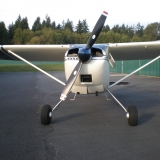
Whee, for (slightly) warmer oil you'd block off opening B with duct tape. An opening in this area directs air top blow on the ol sump, at least it does on the C-170. I made a little cover plate that installs for winter op's, I also block off the 2 blast tubes that direct cooling air onto the oil screen area. Not sure how much it helps, but it can't hurt (unless I forget to take them off come spring!).
Eric
(or you can call me....Antipasto)

Cessna Skywagon -- accept no substitute!
Sat Sep 22, 2007 11:39 am
Oh, and what's with all the Celsius figures? I don't speak metric very well....
"The metric system is a tool of the devil. My car gets forty rods to the hogshead and that's the way I like it" - Grandpa Simpson
The metric system is so damn easy...water boils at 100 and freezes at 0...verses the fahrenheit system of boiling at 212 and freezing at 32.
1760 yards to a mile?? 192 teaspoons to a quart? A 13/16th socket for crying out loud!
Our reluctance to convert to the metric system would be quaint if it wasn't so smucking much better than the English system. I remember a big push to teach the metric system when I was in grade school, then it all just stopped. My guess is the John Birch Society got wind of it.
Anyhow, I still can't think in metric. I think in fahrenheit, feet, miles and gallons. But if I want to see the relationship between things I end up converting them to metric, because it's a liner scale and infinitely easier for me to visualize.
For any of you with a palm pilot there is a free conversion program which covers every possible conversion you could imagine. It's worth having a palm pilot just for the program.
DISPLAY OPTIONS
Who is online
Users browsing this forum: No registered users and 0 guests
Latest Features
-
Live to Tell
A Minnesota pilot is surprised to learn that the sudden asymmetric drag of an out-of-rig ski can…Read More -
Creators
Working in some of the Yukon's most beautiful and remote environments, photographer Simon Blakesley captures aircraft in…Read More -
Aircraft Ownership and Maintenance
Upgrading to big tires can make a huge difference in backcountry performance, but with those gains come…Read More -
Tales from Yesteryear
In this tale from bush flying yesteryear, Don Cogger signs up to help Atlee Dodge Jr recovery…Read More


Latest Knowledge Base
-
Destinations
A regional guide with ideas for winter camping destinations in California, Nevada, New Mexico, and Arizona.Read More -
Aircraft
Finding an affordable aircraft that can handle the backcountry for $80K or less? A challenge for sure, but with the…Read More -
Aircraft
01.29.2018 - Zane - Updated tire diameter graphic to add 8.50x10 Guide to tires for use in the backcountry and off-airport landing…Read More -
Pilots
12.22.2013 - Initial article format Operating aircraft on skis and negotiating a snow-covered landscape is an entirely unique skillset and environment.…Read More


