Good morning everyone,
I'm a contractor working for a marine-based company that is looking to conduct open ocean personnel transfers to / from a ~150 OSV-style vessel using seaplanes. Our idea is to attach a floating dock aft of the vessel that has gangways on either side of the seaplane when it is moored. We are very familiar with ship to ship personnel transfers but have little to no experience with seaplanes.
In a nutshell, our idea for the transfers is to have the seaplane approach and moor using the floating dock while the vessel is dead in the water. We will be operating in very calm waters. By procedure, we will ensure that weather conditions and sea state support the transfer. The make and model of plane that we'll be using is a 2013 CESSNA GRAND CARAVAN EX AMPHIBIOUS, https://www.wipaire.com/wp-content/uploads/2018/06/C208B-5030-EX-N904LS-v1.pdf.
Does this plan seem achievable? If so, how much room do you typically have on either side of the wheel / float base for the dock? Would a nose-first approach work in this scenario? These are just some questions that I had off the top of my head, but any and all feedback would be greatly appreciated! Thanks.
Open Ocean Personnel Transfer
Wed Jul 06, 2022 6:59 am
Wed Jul 06, 2022 9:23 am
Re: Open Ocean Personnel Transfer
That sort of operation CAN succeed, but it can be challenging.
First, the notion of "Open ocean" with the term "very calm waters" is pretty much a fairy tale in my experience, at least with any reliability. I've landed a Beaver in open ocean three or four times, and, while winds were calm, there was a swell. The point being "calm" and "smooth" are not necessarily synonymous in ocean operations. Add into that docking to a vessel, and it gets even more complex.
I used to do a fuel haul once a year for several years, taking fuel drums from a 50 foot vessel in an ocean bay, and that was totally doable, because the vessel was low enough aft that my wing cleared the stern. I would bring the plane alongside the stern of the boat. Gave me the creeps, because my wingtip was VERY close to masts, etc, but I had good helpers on the vessel. I moved 70 drums of fuel and a number of 100 pound propane bottles each year, flying them about 20 miles to a camp on an inland lake.
I know of at least one Beaver operator who went to an offshore ship from Kodiak. Not a pretty operation, and spotty due to swell/weather, etc, but that's a fact of life in Kodiak. That plane wound up trashed, but not necessarily because of the offshore ops.
They used a sloping ramp, as opposed to a "dock", and that would probably be my preference as well. It's easier to "stick" the plane on a ramp than it is to come to a dock. But, coming alongside in calm conditions is pretty easy, particularly with a turbine equipped with blade locks. A U-shaped dock, with a ramp in the center is what I used a lot, but it requires pushing the plane out on a line to turn it around, or simply shoving off, depending on how brave the pilot is.
Then, of course, you have to figure out how to get people/stuff from the vessel to the "dock", then to the plane, and vice versa. That part could be a real challenge as well, particularly if the vessel's rail is substantially higher than the plane's wing.
Long story short, I'd say it can be done, IF (and that's a BIG if) you can indeed consistently find truly calm waters. Wind is easy to deal with....a significant swell could be complex with the plane to dock to vessel connections.
MTV
First, the notion of "Open ocean" with the term "very calm waters" is pretty much a fairy tale in my experience, at least with any reliability. I've landed a Beaver in open ocean three or four times, and, while winds were calm, there was a swell. The point being "calm" and "smooth" are not necessarily synonymous in ocean operations. Add into that docking to a vessel, and it gets even more complex.
I used to do a fuel haul once a year for several years, taking fuel drums from a 50 foot vessel in an ocean bay, and that was totally doable, because the vessel was low enough aft that my wing cleared the stern. I would bring the plane alongside the stern of the boat. Gave me the creeps, because my wingtip was VERY close to masts, etc, but I had good helpers on the vessel. I moved 70 drums of fuel and a number of 100 pound propane bottles each year, flying them about 20 miles to a camp on an inland lake.
I know of at least one Beaver operator who went to an offshore ship from Kodiak. Not a pretty operation, and spotty due to swell/weather, etc, but that's a fact of life in Kodiak. That plane wound up trashed, but not necessarily because of the offshore ops.
They used a sloping ramp, as opposed to a "dock", and that would probably be my preference as well. It's easier to "stick" the plane on a ramp than it is to come to a dock. But, coming alongside in calm conditions is pretty easy, particularly with a turbine equipped with blade locks. A U-shaped dock, with a ramp in the center is what I used a lot, but it requires pushing the plane out on a line to turn it around, or simply shoving off, depending on how brave the pilot is.
Then, of course, you have to figure out how to get people/stuff from the vessel to the "dock", then to the plane, and vice versa. That part could be a real challenge as well, particularly if the vessel's rail is substantially higher than the plane's wing.
Long story short, I'd say it can be done, IF (and that's a BIG if) you can indeed consistently find truly calm waters. Wind is easy to deal with....a significant swell could be complex with the plane to dock to vessel connections.
MTV


Wed Jul 06, 2022 10:02 am
Re: Open Ocean Personnel Transfer
MTV,
Thanks so much for your input, this is a great help. Our operating area is going to provide consistently calm waters (nothing like the northern latitudes), as we will be operating in a specific location near the equator where wave heights and periods support this type of personnel transfer. We will be monitoring sea state and weather conditions to ensure that a transfer is safe and achievable as well, as we understand that this is a dangerous evolution.
As far as personnel movement is concerned, how do people typically exit float planes? I was under the impression that they could exit the door of the plane, stand on the float, and step off onto the dock, but please correct me if I'm wrong. Additionally, the transfer to the vessel will be conducted via pilot ladder or stairs, based on what our design can accommodate.
In this scenario, what does "shoving off" or pushing the plane out on a line look like? You mentioned that it would depend on how brave the pilot is; is shoving off dangerous? I know these are probably a lot basic questions for a pilot like yourself, but as I mentioned I know next to nothing about seaplanes, other than what I learned in the USCG Rules of the Road. Thanks again for your help, and I would greatly appreciate any further information you can provide.
-Bryan
Thanks so much for your input, this is a great help. Our operating area is going to provide consistently calm waters (nothing like the northern latitudes), as we will be operating in a specific location near the equator where wave heights and periods support this type of personnel transfer. We will be monitoring sea state and weather conditions to ensure that a transfer is safe and achievable as well, as we understand that this is a dangerous evolution.
As far as personnel movement is concerned, how do people typically exit float planes? I was under the impression that they could exit the door of the plane, stand on the float, and step off onto the dock, but please correct me if I'm wrong. Additionally, the transfer to the vessel will be conducted via pilot ladder or stairs, based on what our design can accommodate.
In this scenario, what does "shoving off" or pushing the plane out on a line look like? You mentioned that it would depend on how brave the pilot is; is shoving off dangerous? I know these are probably a lot basic questions for a pilot like yourself, but as I mentioned I know next to nothing about seaplanes, other than what I learned in the USCG Rules of the Road. Thanks again for your help, and I would greatly appreciate any further information you can provide.
-Bryan
Wed Jul 06, 2022 12:43 pm
Re: Open Ocean Personnel Transfer
bcooley wrote:MTV,
Thanks so much for your input, this is a great help. Our operating area is going to provide consistently calm waters (nothing like the northern latitudes), as we will be operating in a specific location near the equator where wave heights and periods support this type of personnel transfer. We will be monitoring sea state and weather conditions to ensure that a transfer is safe and achievable as well, as we understand that this is a dangerous evolution.
As far as personnel movement is concerned, how do people typically exit float planes? I was under the impression that they could exit the door of the plane, stand on the float, and step off onto the dock, but please correct me if I'm wrong. Additionally, the transfer to the vessel will be conducted via pilot ladder or stairs, based on what our design can accommodate.
In this scenario, what does "shoving off" or pushing the plane out on a line look like? You mentioned that it would depend on how brave the pilot is; is shoving off dangerous? I know these are probably a lot basic questions for a pilot like yourself, but as I mentioned I know next to nothing about seaplanes, other than what I learned in the USCG Rules of the Road. Thanks again for your help, and I would greatly appreciate any further information you can provide.
-Bryan
Bryan,
If you have a mast with winch that can lift the “dock” out of water while vessel is underway, that would be ideal for the vessel operator. In truly calm waters, a simple dock may be best, the trick being keeping the wings clear of the vessel….which, for a Caravan, would imply a fairly large dock. In that case, the plane would come alongside the dock, and with a handler on the dock, tie off to the dock. In that case, getting underway is easy: Start engine, dock hand casts off, and off you go. BUT, that requires enough separation from the vessel for wing clearance, assuming the wing on a Caravan won’t clear the vessels railing. And in that case, passengers all embark/debark from the dock side of the plane…..simple.
Alternatively, a very short dock could be used, with the plane nosed in. That presents a bit more challenge, since seaplanes don’t have brakes, and, while the Caravan does have reverse, it’s nice to have a dock hand to help secure the plane, and that doesn’t work if you keep the fan running, unless you have a pretty large dock.
As I said before, a short ramp to “stick” the plane could work, but if nosed in you may want an extension alongside the plane to load/unload.
When you cast off with a seaplane, prior to start, you’re assuming the engine will start. Its very rare for an engine not to start on a well maintained engine, especially a turbine, but, if it doesn’t, you are now adrift. Drift toward the vessel, and very bad things could happen. I’ve paddles small seaplanes short distances, but a Caravan? No thanks. But that’s usually up to the pilot.
On ramps, I usually nose in, secure a line to an aft cleat, push the plane out and spin it around with the line. Pull it up on the ramp stern to, get in and fire up.
It might be possible to devise a small dock with a long gangway to the vessel, that keeps the wing clear of the vessel. Something like that might be easiest to haul aboard.
Interesting conundrum……. So, how high is the railing/deck of the vessel?
MTV
Wed Jul 06, 2022 1:23 pm
Re: Open Ocean Personnel Transfer
Unfortunately the company hasn't purchased the vessel yet, so I don't have specifics. I anticipate that we will have 3-5 ft of freeboard depending on our draft, plus probably another 3 feet of railing, although this is just an estimation.
That was what ultimately led us to the idea of attaching the dock to the aft part of the ship, since we didn't want to put the plane's wings in jeopardy by pulling alongside.
Just so I understand you correctly, if you were to be departing the scenario involving a "u" shaped dock / ramp, the deck hands would unlash the plane, push it off, turn it around using the lines, then back it up onto the ramp, and from there the pilot would start up and drive out? As opposed to just pushing off with the possibility that the engine won't start? Thanks again for your help, this is extremely useful!
As an aside, we will have two operational cranes onboard to bring the dock on deck when not in use.
-Bryan
That was what ultimately led us to the idea of attaching the dock to the aft part of the ship, since we didn't want to put the plane's wings in jeopardy by pulling alongside.
Just so I understand you correctly, if you were to be departing the scenario involving a "u" shaped dock / ramp, the deck hands would unlash the plane, push it off, turn it around using the lines, then back it up onto the ramp, and from there the pilot would start up and drive out? As opposed to just pushing off with the possibility that the engine won't start? Thanks again for your help, this is extremely useful!
As an aside, we will have two operational cranes onboard to bring the dock on deck when not in use.
-Bryan
Wed Jul 06, 2022 4:33 pm
Re: Open Ocean Personnel Transfer
Pretty much what MTV said.
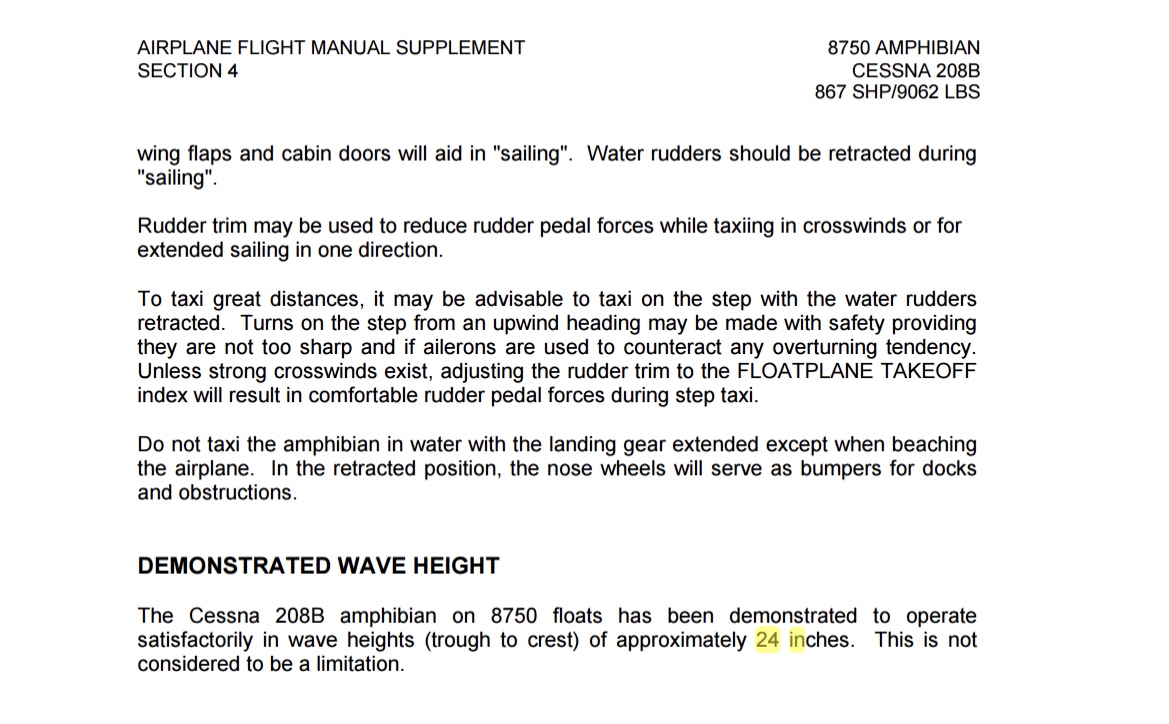
The 208B EX on wips is a great plane, but it is delicate when it comes to sea state
Crews are going to be a big factor, not a job for a low time pilot, some people look at these planes as small planes, lots more involved in judgement and skill than most of the airline stuff, expect to pay 130k+ with a good schedule.
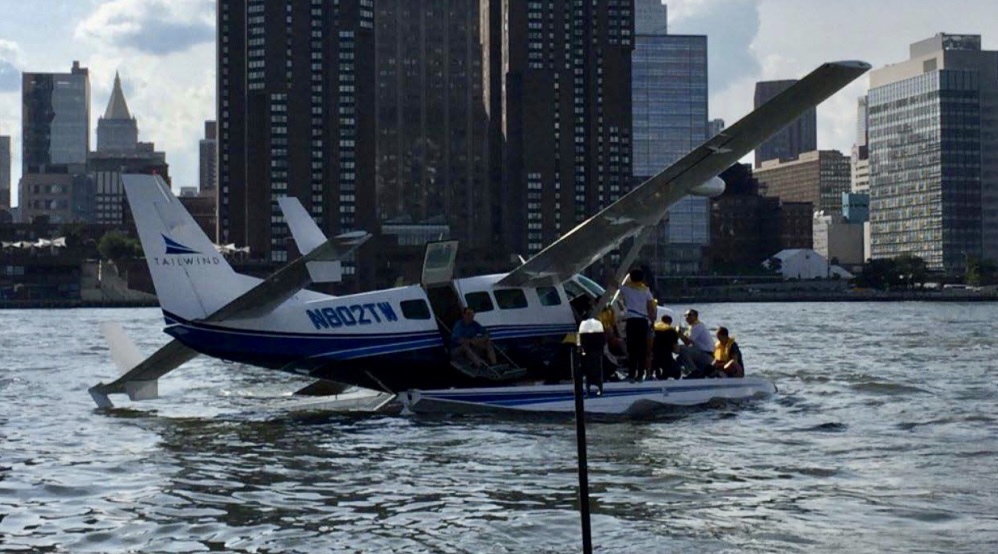
east river boat wake and a few swells vs 208
http://www.kathrynsreport.com/2018/02/c ... o.html?m=1
The 208B EX on wips is a great plane, but it is delicate when it comes to sea state
Crews are going to be a big factor, not a job for a low time pilot, some people look at these planes as small planes, lots more involved in judgement and skill than most of the airline stuff, expect to pay 130k+ with a good schedule.
east river boat wake and a few swells vs 208
http://www.kathrynsreport.com/2018/02/c ... o.html?m=1
- NineThreeKilo offline
- Retired
- Posts: 1678
- Joined: Thu Dec 31, 2009 8:16 pm
- Location: _
Wed Jul 06, 2022 5:22 pm
Re: Open Ocean Personnel Transfer
Caravan can load from either side, so a U-dock seems unnecessary and complicated. Why not keep it simple?
If you take this sentence seriously: "By procedure, we will ensure that weather conditions and sea state support the transfer.", then this is really no different than docking a floatplane on a land-based dock.
If you take this sentence seriously: "By procedure, we will ensure that weather conditions and sea state support the transfer.", then this is really no different than docking a floatplane on a land-based dock.
- Screenshot 2022-07-06 161303.png (47.19 KiB) Viewed 2574 times
- Screenshot 2022-07-06 161359.png (44.63 KiB) Viewed 2574 times

Thu Jul 07, 2022 4:11 am
Re: Open Ocean Personnel Transfer
Asa,
Thanks for the reply and information, it was very helpful. Our logic with the "u" shaped dock was plane security, as the pilot will likely be staying onboard overnight and departing the next day.
Now that I think about it, and given the information you and MTV provided, if the plane is securely moored a T-shaped dock might be the easiest and safest option.
Thanks again,
Bryan
Thanks for the reply and information, it was very helpful. Our logic with the "u" shaped dock was plane security, as the pilot will likely be staying onboard overnight and departing the next day.
Now that I think about it, and given the information you and MTV provided, if the plane is securely moored a T-shaped dock might be the easiest and safest option.
Thanks again,
Bryan
Thu Jul 07, 2022 5:39 am
Re: Open Ocean Personnel Transfer
Asa,
Thanks for the reply and information, it was very helpful. Our logic with the "u" shaped dock was plane security, as the pilot will likely be staying onboard overnight and departing the next day.
Now that I think about it, and given the information you and MTV provided, if the plane is securely moored a T-shaped dock might be the easiest and safest option.
Thanks again,
Bryan
Thanks for the reply and information, it was very helpful. Our logic with the "u" shaped dock was plane security, as the pilot will likely be staying onboard overnight and departing the next day.
Now that I think about it, and given the information you and MTV provided, if the plane is securely moored a T-shaped dock might be the easiest and safest option.
Thanks again,
Bryan
Thu Jul 07, 2022 6:04 am
Re: Open Ocean Personnel Transfer
If your clearance is as you note, and depending on obstacles astern on vessel, you may be able to bring the wing over top of the aft deck. That would be ideal, frankly, because most any larger floating “dock” is going to be VERY cumbersome to bring aboard and stow…..remember, this has to be a FLOATING contraption, so requires floatation, read LARGE.
So, if you can put a wing over the aft deck, with a, say six or eight foot wide dock off the stern, and bring the plane up perpendicular to the vessel, aft……might be simplest. That’s what I did with the Beaver loading drums, though we never used any “dock” there.
In that case, and most others, your pilot is going to have to be skilled. You DO NOT want to get your jet driver float rated and put him/her in that Caravan for this deal. Bringing a plane up to a vessel requires some skill and a lot of currency.
MTV
So, if you can put a wing over the aft deck, with a, say six or eight foot wide dock off the stern, and bring the plane up perpendicular to the vessel, aft……might be simplest. That’s what I did with the Beaver loading drums, though we never used any “dock” there.
In that case, and most others, your pilot is going to have to be skilled. You DO NOT want to get your jet driver float rated and put him/her in that Caravan for this deal. Bringing a plane up to a vessel requires some skill and a lot of currency.
MTV
Thu Jul 07, 2022 7:09 am
Re: Open Ocean Personnel Transfer
MTV,
Yeah, the wing clearance is really going to depend on the draft and freeboard of the vessel we end up purchasing. I don't think moving the dock will be an issue, as we will have adequate equipment onboard to maneuver it to / from the ship. Additionally, the ship is going to be DIW for extended periods of time, so we may end up just leaving it attached aft of the vessel for ease of use and safety.
Could you provide some insight into how secure the plane would be with only one side moored (i.e. with a "T" dock) as opposed to both sides moored ("U" shaped dock)? We want to ensure that the plane will be in a safe condition while it is alongside the vessel.
Once again, thanks for the help, you and asa have given me a lot!
-Bryan
Yeah, the wing clearance is really going to depend on the draft and freeboard of the vessel we end up purchasing. I don't think moving the dock will be an issue, as we will have adequate equipment onboard to maneuver it to / from the ship. Additionally, the ship is going to be DIW for extended periods of time, so we may end up just leaving it attached aft of the vessel for ease of use and safety.
Could you provide some insight into how secure the plane would be with only one side moored (i.e. with a "T" dock) as opposed to both sides moored ("U" shaped dock)? We want to ensure that the plane will be in a safe condition while it is alongside the vessel.
Once again, thanks for the help, you and asa have given me a lot!
-Bryan
Thu Jul 07, 2022 10:24 am
Re: Open Ocean Personnel Transfer
bcooley wrote:MTV,
Yeah, the wing clearance is really going to depend on the draft and freeboard of the vessel we end up purchasing. I don't think moving the dock will be an issue, as we will have adequate equipment onboard to maneuver it to / from the ship. Additionally, the ship is going to be DIW for extended periods of time, so we may end up just leaving it attached aft of the vessel for ease of use and safety.
Could you provide some insight into how secure the plane would be with only one side moored (i.e. with a "T" dock) as opposed to both sides moored ("U" shaped dock)? We want to ensure that the plane will be in a safe condition while it is alongside the vessel.
Once again, thanks for the help, you and asa have given me a lot!
-Bryan
Bryan,
The security of a seaplane to a mooring/dock is dependent on two things: Security of tiedowns and water tightness of floats.
In the scenario you describe, by definition there will be no wind. I'm a little skeptical that I'd bet the price of a Caravan on that, but.....
So, in that scenario, really all you're worried about is that the plane is secured to the "dock", which is secured to the vessel. One side or both really doesn't matter if there's no wind/wave action. If you're broadside to a dock, just affix a bow and stern line to that float.
As to water tightness, you need to start with good water tight floats, and then monitor them periodically when they are in the water to verify there are no leaks, and pump as needed.
Now, if a wind WERE to come up, in open water, I would rig a harness to the base of the propeller, and allow the plane to tend a little ways behind the vessel on a stout line. Allow the plane to tend into the wind, in other words. And, I would have the pilot IN the plane. Trust me, that's a LOT of fun! Been there. Generally, in anything short of really serious storms, a floatplane on tight floats will ride a storm well rigged like that.
In a wind, I would NOT want that plane broadside to the boat, or tied down on one side only. That's where nosing a plane up to the stern on a ramp, with tiedowns on both sides might be better. Nosed in, with the bows secured tightly via the forward spreader bar (as opposed to tied to the nose cleats, which have been known to pull out.) that plane should be fairly secure.
But, as you said, there will be no wind or waves.....

MTV
Thu Jul 07, 2022 10:53 am
Re: Open Ocean Personnel Transfer
I had the good fortune of sitting left seat with a very experienced pilot that was a salesman for a chemical company that sold chemicals for de watering crude oil. This was south of New Orleans and how they tied up down there. We headed into whatever we tied to and there were cut pieces of car tires on the front of the float for bumpers. We were tied to a barge in this picture.


Thu Jul 07, 2022 11:48 am
Re: Open Ocean Personnel Transfer
This has been interesting to follow.
Being quite a bit less experienced in any of this on the water than you all, man, I'd be concerned with having the 208 tied up to this dock overnight.. or for any length of time like that in open ocean. I think it was MTV that mentioned having it on a tend, and that seems like it could mitigate issues with weather, winds, and water roughness that could come up overnight, but would still freak me out!
Being quite a bit less experienced in any of this on the water than you all, man, I'd be concerned with having the 208 tied up to this dock overnight.. or for any length of time like that in open ocean. I think it was MTV that mentioned having it on a tend, and that seems like it could mitigate issues with weather, winds, and water roughness that could come up overnight, but would still freak me out!
Thu Jul 07, 2022 12:31 pm
Re: Open Ocean Personnel Transfer
Tadpole wrote:This has been interesting to follow.
Being quite a bit less experienced in any of this on the water than you all, man, I'd be concerned with having the 208 tied up to this dock overnight.. or for any length of time like that in open ocean. I think it was MTV that mentioned having it on a tend, and that seems like it could mitigate issues with weather, winds, and water roughness that could come up overnight, but would still freak me out!
Yes, the problem with having a plane out on a bridle and line is that if there is wind, especially a light wind, and it switches fairly quickly, the plane could drift into the vessel. That's why I said if twer me, I'd have the pilot IN the plane in that kind of deal. If it was blowing hard, I'd have the plane OUT of there preferably.
This is indeed a very challenging proposal, and I'm not sure there are good answers. I've never flown anywhere that has no winds/wave action. But.....could be, the doldrums, eh?
MTV
Fri Jul 08, 2022 2:12 am
Re: Open Ocean Personnel Transfer
MTV,
Thanks for the recommendations regarding different mooring configurations once the plane is near the vessel.
I don't want to be misleading, there certainly will be wind and wave action, it is, after all, the open ocean. However, we chose our operating area specifically because the wave heights, wave periods, and wind speed are very, very low. Most certainly this is going to have to be a procedural and structural solution - optimizing both how the plane is moored and picking the right days to conduct personnel transfers.
Tadpole - keeping the plane moored overnight is concerning to us as well. We are trying out voyage planning options that would allow the pilot to do an "out and back" in a single day, thus mitigating this risk.
Thanks again everyone for your input, it's been a great help for a non-pilot!
-Bryan
Thanks for the recommendations regarding different mooring configurations once the plane is near the vessel.
I don't want to be misleading, there certainly will be wind and wave action, it is, after all, the open ocean. However, we chose our operating area specifically because the wave heights, wave periods, and wind speed are very, very low. Most certainly this is going to have to be a procedural and structural solution - optimizing both how the plane is moored and picking the right days to conduct personnel transfers.
Tadpole - keeping the plane moored overnight is concerning to us as well. We are trying out voyage planning options that would allow the pilot to do an "out and back" in a single day, thus mitigating this risk.
Thanks again everyone for your input, it's been a great help for a non-pilot!
-Bryan
Fri Jul 08, 2022 5:17 am
Re: Open Ocean Personnel Transfer
I've been following this with some interest, an friend of mine regularly ties to the stern of a pleasure cruiser but in very calm, sheltered waters. I like the the idea of a horseshoe style but wonder about adding a "lift" to elevate the airplane out of the water for the longer, overnight stays. Possibly a ramp within the collar, hinged at the front edge with the aft edge submerged when arriving/departing but then raised to level with the mooring deck for longer stays.
Sat Jul 09, 2022 1:08 pm
Re: Open Ocean Personnel Transfer
bcooley wrote:Thanks again everyone for your input, it's been a great help for a non-pilot!
-Bryan
While this has been an interesting thread, non-pilots are not allowed to post, per the guidelines you read when signing up. Hopefully you've gotten all the info you need at this point.

Sun Jul 10, 2022 7:31 pm
Re: Open Ocean Personnel Transfer
If you have a crane on deck, skip the dock. Just build a nice bridle sling and STC a hatch in the top of the Caravan fuselage. Taxi under the hook and lift it out of the water onto the deck. Way safer in every regard.
Sun Jul 10, 2022 7:42 pm
Re: Open Ocean Personnel Transfer
Pinecone wrote:If you have a crane on deck, skip the dock. Just build a nice bridle sling and STC a hatch in the top of the Caravan fuselage. Taxi under the hook and lift it out of the water onto the deck. Way safer in every regard.
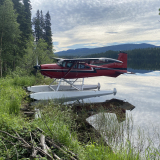
Or just nose in dock, off load, and leave, southern seaplanes makes a good point at how well that works.
- NineThreeKilo offline
- Retired
- Posts: 1678
- Joined: Thu Dec 31, 2009 8:16 pm
- Location: _
DISPLAY OPTIONS
Who is online
Users browsing this forum: No registered users and 2 guests
Latest Features
-
-
Featured Bush Planes
As one of the undisputed legends of bush flying, the Cessna 180 hauls a…Read More -
Aircraft Ownership and Maintenance
9 modification mistakes aircraft owners make when trying to "bush out" their birds—why some…Read More -
Live to Tell
A Minnesota pilot is surprised to learn that the sudden asymmetric drag of an…Read More


Latest Knowledge Base
-
Destinations
Canada offers some of the most spectacular backcountry flying on the continent. Here's what you need to know before you go.Read More -
Safety and Survival
Hope that you never have to use your survival vest but knowing you have it and knowing how to use…Read More -
Destinations
A regional guide with ideas for winter camping destinations in California, Nevada, New Mexico, and Arizona.Read More -
Aircraft
Finding an affordable aircraft that can handle the backcountry for $80K or less? A challenge for sure, but with the…Read More