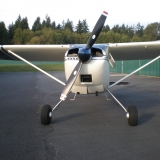
DENNY wrote:A Cessna 170 that can slow down to 40 mph and maintain altitude is going to be nose high!!! Even a super cub at 40 mph is nose high I don't care what the CG is
Trying to get this straight.
A more forward CG position requires more downward force at the elevator.
This means more elevator up deflection and consequently higher AoA of the wing (more nose up), which generates more lift to compensate for the downward force, and more drag, ie reduced speed.
Moving the CG backwards reduces this force and thus also lowers the AoA.
On a plane with a trim tab (like a C170) rather than a stabilizer trim a far forward CG also limits elevator deflection by the yoke as some of it is already used to trim.
One would have to have a really extreme case of forward CG (well outside certified limits, or perhaps caused by a less than perfectly rigged airplane, in angle of incidence of wing and/or horizontal tail) to run out of elevator deflection and having to increase airspeed to keep the tail down and the plane in level flight.
Consequently, a CG in the center allows for more elevator deflection and yields less control forces around the elevator’s centered position, which might qualify as “nicer to fly”.
A gain in performance at low speeds would be too small to be noticeable, I think.
It’s a somewhat different story at high speeds where the up-elevator necessary with forward CG causes increased trim drag.
In high performance gliders the drag penalty of a forward CG at typical cruise speeds (around 100 kts) is several percent, too much to be neglected by serious racers.
We typically put the CG at about 25-30% forward of the rearmost position.