My idea of getting a SES add-on germinated several years ago after my small boat trip into Canada in my 19’ Sea Ray. It’s been fed by visits to the Seaplane Base each year at OSH, and then 2 years ago I took a first lesson with Pat Bay Seaplanes near Victoria Airport in BC. So it was just a matter of time, figuring out how to work it into a vacation to wherever it might be offered. I had been in touch with an outfit in Wisconsin last year, but that never materialized. With some advance planning and the fantastic cooperation of Mah Woman, Marilyn, we were able to work it into our vacation this year.
My training was supposed to begin on Tuesday July 1 but my assigned instructor was sick and the other one would not be available until July 2. So that meant that I would have to split my training, with lessons on July 2 and 3, and then after we returned from our boat charter on July 12 and 13, with the checkride on July 14.
My substitute instructor, Kit, did a lot of early ground schooling and emphasized “on the water” control when we got in the airplane—we did not fly the first lesson, but I got pretty good at slow speed taxiing and docking. Docking with a normal seaplane is done by idling to within an estimated distance of the dock, the engine is killed with the mixture, and the airplane glides to the dock, with the pilot steering it with the water rudders, which are connected to the air rudder with cables and springs. With years of boating experience behind me, I found this pretty easy, but when another airplane was already at the dock, it was pretty intimidating—the opportunity to kill 2 birds with one screw-up was just a bit scary.
The training manual provided by Seattle Seaplanes is pretty thorough, and I studied and studied it. There are a lot of similarities between comparable seaplanes and landplanes, but a lot of differences, too.
Over the course of flying with Kit the next 2 days, I did a number of take-offs and landings in different locations, and more taxiing and docking. I did several glassy water style landings, but there was no real glassy water. I had trouble with pitch attitude control while on the water—there’s a very fine line between too low and too high, and neither helps the airplane get off the water well. But eventually that got better.
Then we left for Anacortes where we had a chartered 36’ Grand Banks waiting for us, which we took into the islands and over to Nanaimo, BC. We returned a week later, and the next day I resumed training, this time with my assigned instructor, Bob. From him, I learned to step taxi both straight and turning, and to beach, and to make glassy water landings, this time for real. My pitch control improved significantly.
A word about Lake Union. When I said “very busy”, that’s an understatement. The weekend recreational traffic is incredible! There is every kind of small watercraft imaginable, from 50’ yachts to ski boats, canoes, kayaks, paddle boards, and an enormous number of sailboats of varying sizes. Many boaters appear to have no idea how little control a seaplane pilot has on the water, so they’re constantly getting in front of that 78” meat grinder. Sailboats have the right of way, and they take it without any hesitancy. It makes it very hard to find the window to take off, and it requires pretty precise control and observation to land in the few open spaces that are left. During the week we were gone on the trawler, a seaplane lane was created with anchored buoys, but honestly that seemed to draw more traffic than anything.
With the takeoffs all at sea level, the seaplane is pretty spritely, once it gets off the water. But the water run is approximately 80% longer than an equivalent aircraft’s land run. Because the seaplane trainer was so similar to my own airplane, the flying part was nearly identical (although the seaplane could use a rerigging and my airplane was rerigged 3 or 4 years ago, and of course the drag from the floats lowers cruise speed by roughly 15 mph). But the water run under best conditions was actually longer at sea level and approximately 85 degrees (DA of approximately 1600’) than my airplane’s land run at 4700’ MSL and 85 degrees (DA of approximately 7400’), with a comparable load.
Monday July 14 came, and it was time for the checkride. The DE was a retired airline pilot who had also owned a seaplane FBO for some 14 years. He greeted me with “Ah, you’re my victim!” But although I was very nervous to start (I haven’t taken any checkrides in years), the friendly banter we shared soon set me somewhat at ease. The oral went very well, although it would have been better if I’d looked some things up instead of going by memory. I discovered that I have a major weakness of not knowing all of the Sectional information as well as I thought I did. I can read terrain well; I’m weak on a lot of the symbolism, something I need to work on.
We examined the airplane’s logbooks in detail, and we discussed density altitude—he likes to use Lake Tahoe as an example, and he wanted to know if I could use this particular airplane, fly to Lake Tahoe with both of us aboard, land, refuel and take off again. He did not require me to calculate the distance, although I’d done so the night before guessing his weight, and it would have been a water run of more than a mile!
We also had a discussion about weight and balance, why some seaplane conversions make lousy seaplanes and others make excellent conversions, all based on CG. Especially we discussed what the effects are of forward CG and aft CG, especially as those affect seaplane operations (forward CG, for instance, makes it harder to raise the nose sufficiently in a no power landing, so that in an emergency, it could be a disaster if the floats were to hit the water nose down). Most of this I knew pretty well, based on the knowledge I’ve acquired over the years in land airplane operations, and it wasn’t hard to guess what the effects would be with a seaplane.
He created a number of hypothetical scenarios and asked me how I would handle each one, mostly due to wind and fuel issues.
Then we went flying. First I pumped the floats as part of the preflight—a requirement for all seaplanes, but especially this one, which because it is used for training so much, has developed a few leaks more than it might if it were privately used. Then we departed, and taxied for a long time to the northern end of the lake, avoiding Monday water traffic—less than on the weekend, but still significant. After a normal take off, we flew to Lake Washington, where we did every kind of seaplane landing, step turns, a beaching where we both got out, a departure from the beach, a “Lake Tahoe take off” in which he operated the throttle at a reduced setting to simulate high DA—and on this one, because we’d landed and immediately turned around to do the Lake Tahoe simulation, I slipped up and forgot to pull the flaps on (20 degrees) until we’d high speed taxied for more than half a mile—but he forgave me by saying “you saw that something was wrong and you corrected it, and that was good”.
He did not like my approach speed of 70 mph during a simulated engine failure from 500’ while flying downwind—again reminding me how important it is to have enough airspeed control to be able to flare—although I had successfully flared and landed into the wind, he said he would have used 80 mph into the flare.
When we returned to Lake Union, it was again hard to find a place to set down, but I picked a good spot, he asked where I intended to land, and I told him exactly where in relationship to a couple of boats that were blocking the way, and that’s where I landed. The final docking went perfectly.
All in all, I have to say that my performance was adequate but rough. That’s what I told the DE when he said, “Well you passed, but how do you think you did?” The DE was fair, but picky. Since this was a commercial add-on rating, he held me to commercial standards, and that added to my assessment that I was rough—I could have and should have done better. But I knew the material pretty well, I flew safely if not perfectly, and now my temporary certificate says “Commercial Pilot; airplane single engine land; airplane single engine sea; instrument airplane; [limitations]; English proficient”. I have to say that getting the rating in only 6 hours of flight training (plus the 1 hour I had in BC 2 years ago) and about 2 hours of ground school plus many hours of self study was not easy—but on the other hand, it has to be the single most fun thing I’ve done in an airplane. Combining two of my great loves, boating and flying, is a wonderful treat. I hope I’ll find ways to use this newly minted skill, but although I know I’m a long way from being an accomplished seaplane pilot, I am a seaplane pilot! Yee haw!
Cary
Some pictures:
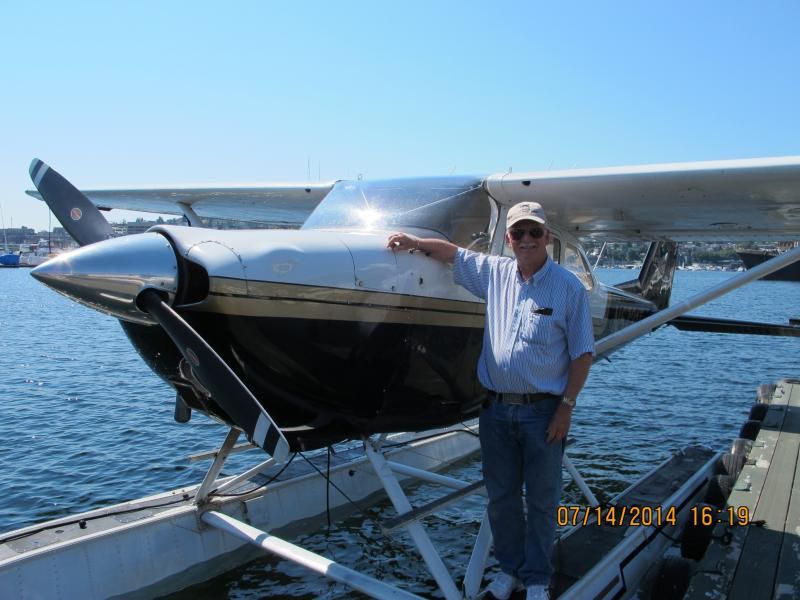
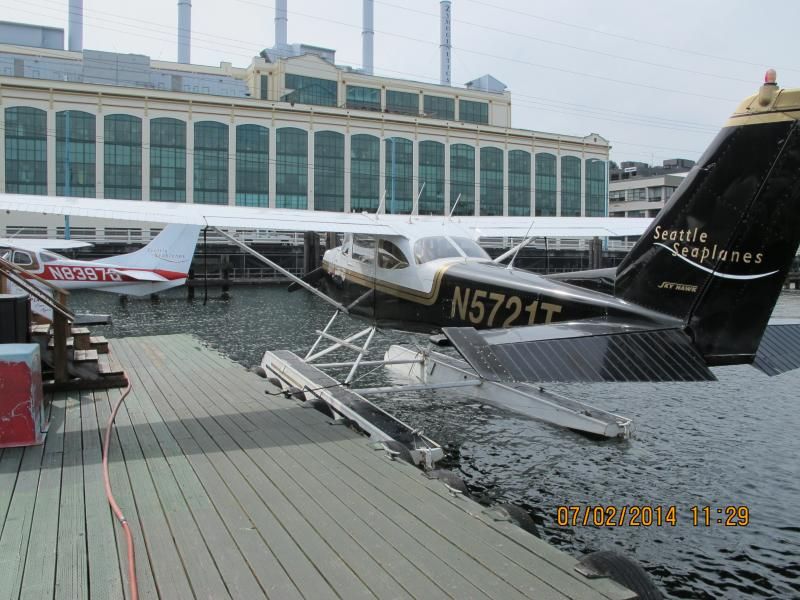
The trainer, a 1964 C172E on straight floats, with a 180hp Lycoming and CS prop conversion:
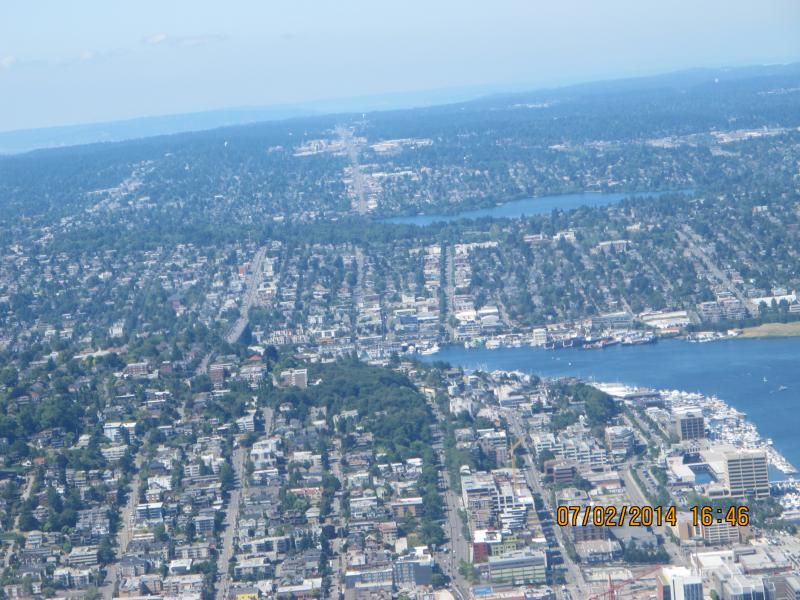
Seattle from the air, taken from 5721T:
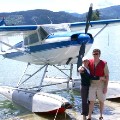
TOF, still grinning after passing the SES checkride just a few minutes earlier: