It appears that everyone pretty much has the same take on JC, it is safely used by almost all planes as long as the pilot and aircraft limitations are not exceeded. If a 65HP Ercoupe can get in and out, I know my C150 can get out, within limits of course. I just want the weather to clear enough to start flying some recon before the summer heat gets here.
Until then, I guess I can continue flying in circles where the blue sky allows. It sure gets boring going in a 100 mile circle, T&G's help break up the routine, but even they get old after a while.
N3110V
Questions on flying into Johnson Creek
Sat Mar 11, 2006 9:51 am
Sat Mar 11, 2006 10:58 am
Awesome stuff, great thread.
What was said about using charts is imperative. GPS Direct is really a function I use only for reference when flying around this sort of terrain... Sort of a reverse from "normal" flying nowadays, I suppose. When flying in the mountains, the chart is always in my lap with my finger stuck to my position. If all you do is go "GPS-Direct", then the only time you won't be lost is when you originate and then again when you touch down at your destination... Provided nothing happens to "change your plans" enroute!
M
What was said about using charts is imperative. GPS Direct is really a function I use only for reference when flying around this sort of terrain... Sort of a reverse from "normal" flying nowadays, I suppose. When flying in the mountains, the chart is always in my lap with my finger stuck to my position. If all you do is go "GPS-Direct", then the only time you won't be lost is when you originate and then again when you touch down at your destination... Provided nothing happens to "change your plans" enroute!
M
- punkin170b offline
- Posts: 210
- Joined: Fri Feb 04, 2005 4:48 pm
- Location: Northern UT
"Rule books are paper, they will not cushion a sudden meeting of stone and metal." E.K. Gann
Mon Mar 13, 2006 11:35 pm
Re: Rules of Thumb - mtn. flying into Johnson Creek
bonth123 wrote:I need to know just how early in the morning I need to be on the ground and just how late I have to stay before I can safely depart in my hot rod C-150.
Several rules of thumb on mtn. flying:
Study your P.O.H. and add your "comfort factor" to the book figures, including tailwinds, one-way situations, grass resistance, density altitude, weight & balance, etc.
Remember that it is suggested to have 75 h.p. per person - or the baggage weight equivalent of, in the mtns.(an FAA person is 160#'s)
Also follow the "tied down by 10am" rule to be safest. You can almost set your watch to the time that the bumps & downdrafts commence on an "average" summer day in the mtns. (10am).
Do not consider flying in the mtns if the winds over the ridges are >/= 30mph. This is when less is more!
Know where the winds are coming from, and try to determine where to anticipate the eddies and downdrafts, - but expect the unexpected.
Do a high pass, or two, or three, or more, to be sure you're familiar with the terrain features, and obstacles, before you go in for landing. Be prepared for a possible go-around. Expect unexpected opposite direction traffic. Accurately announce your position & intentions in the blind on 122.9. Study the current sectional charts, and guide books, & get local advice from other experienced pilots.
Look for lift on the sunny-side slopes. Slow down in an updraft, and speed through a downdraft.
Don't worry about landing "on the #'s" - you can land a little bit long, since the grass will slow you right down.
Be fuel light, but reserve safe, in the mtns.
Leave extra gear under a tarp at the tie-down in McCall, or other location, with lots of rwy. Weight saving is everything.
Invest in some competent, experienced, mtn. flying instruction - very well worth it!
Pack it in, pack it out.
Have a ton of fun.
Hope to see you in the mtns! Enjoy, Berk (stock 1959 C-172)
Ed note: Berk Snow perished in a crash June 14, 2007. He was a great contributor and will be missed. -Z
Tue Mar 14, 2006 8:29 am
OK, they say confession is good for the soul. I went to JC as a noobie in 2004 and I don't mind sharing a few of the things I would do differently next time. First, in the picture below, did you notice our altitude? We climbed to 11.5 near San Francisco to clear the Sierras. We flew over Lake Tahoe and never let down. After the better part of 5 hours (4.6 actually) we arrived overhead at JC. The OAT was 57F. Nice shirtsleeve environment, except our Dalt was 14K+ the whole way. From sea level to 14K+ for the better part of 5 hours. Remember, Dalt doesn't just affect your engine, it affects your brain too.
So, ADVICE #1: If you have come a long way, do as others have suggested and land at Cascade or McCall, have a cold Coke, think about your load, think about conditions in the mountains, get your poop together and if everything is cool, come on in.
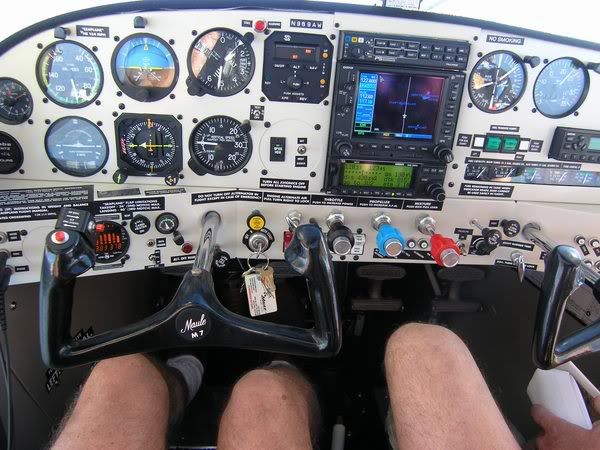
I didn't. So I ended up overhead JC with the intelligence of Pinky instead of The Brain. As many have pointed out, it is NOT a difficult strip to land at. We circled the field and watched a couple of others land from a normal pattern, so we decided to do the same. We descended and flew a downwind for 17.
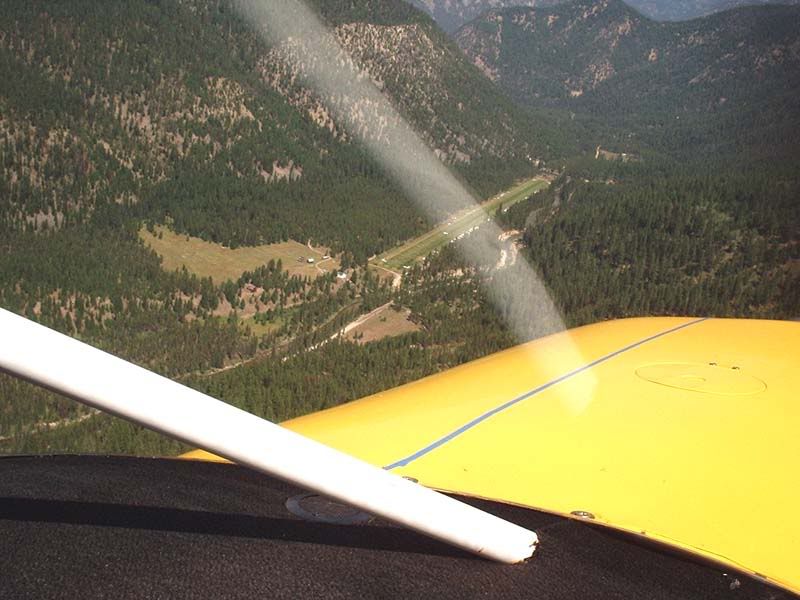
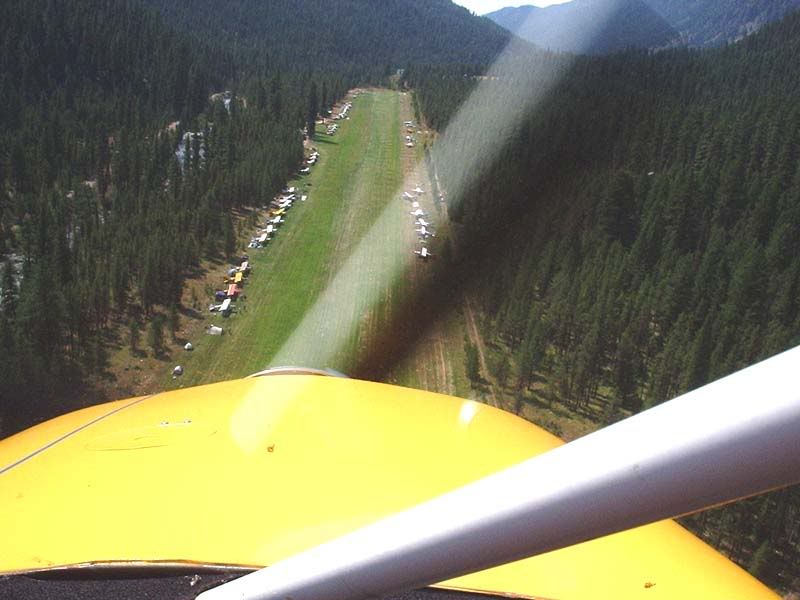
There is a big bowl north of the field where you can manuever and we headed for that to make our base leg. This is where events converged to form ADVICE #2: NEVER GET IN A HURRY. You have all the time you need, so slow down your plane, slow down your brain, lower your shoulder blades and make a NORMAL pattern. On my downwind, suddenly, there was a radio call from a plane inbound from Yellow Pine, along with an almost simultaneous call from a guy on the runway asking if he had time to back taxi before we came in and, maybe it was the gradually increasing atmospheric pressure of the descent, but we suddenly realized that after almost 5 hours, we both REALLY needed to pee. The end result was that I turned base early to avoid conflict with the invisible inbound traffic around the bend coming from Yellow Pine and so I could get to the privvy before our man could back taxi. This is what it looks like if you are too high on final for Johnson Creek:
This leads to ADVICE #3: IF IT LOOKS LIKE THIS, GO AROUND!!
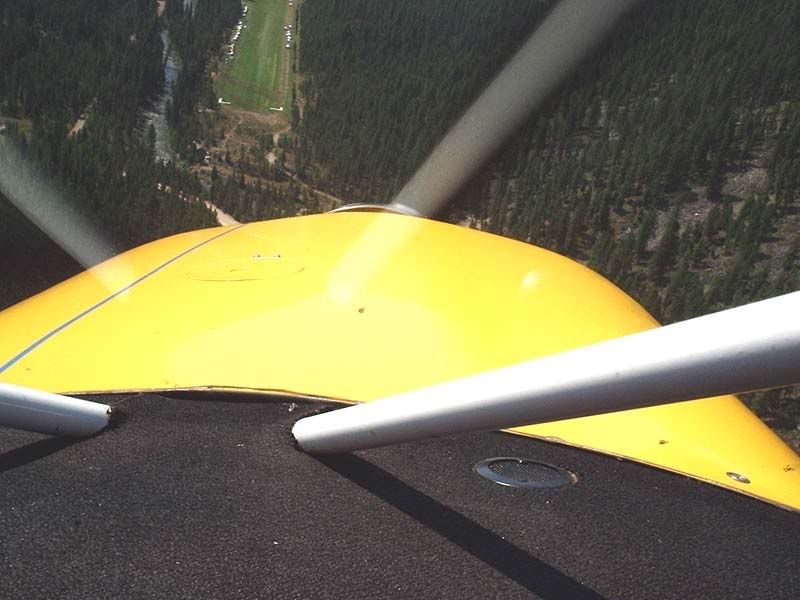
I didn't. But, fortunately, the Maule has a "plummet" mode. With full flaps, slow airspeed and a slip, she glides like a bank vault. We still landed long. We just told folks who were watching that we wanted to check out the camping at the far end of the field.
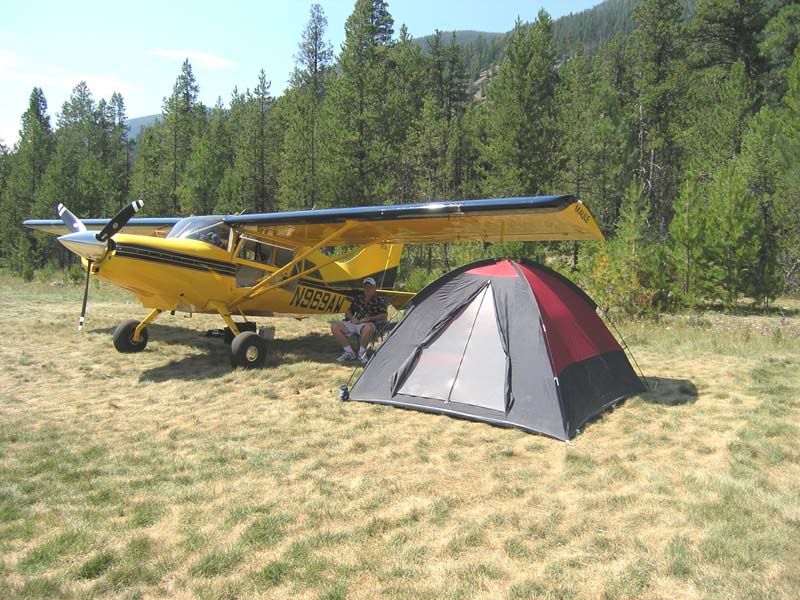
ADVICE #4: IF IT LOOKS LIKE THIS, WAVE TO EVERYONE AND SAY YOU ARE CAMPING AT THE SOUTH END OF THE FIELD.
We got down OK. We had a good pee. We set up camp and fell into the magic of this place. I'm looking forward to seeing all the BCP folks there in July. If you see the Yellowbelly flash by overhead, come visit us down at the south end of the field.
YB
So, ADVICE #1: If you have come a long way, do as others have suggested and land at Cascade or McCall, have a cold Coke, think about your load, think about conditions in the mountains, get your poop together and if everything is cool, come on in.
I didn't. So I ended up overhead JC with the intelligence of Pinky instead of The Brain. As many have pointed out, it is NOT a difficult strip to land at. We circled the field and watched a couple of others land from a normal pattern, so we decided to do the same. We descended and flew a downwind for 17.
There is a big bowl north of the field where you can manuever and we headed for that to make our base leg. This is where events converged to form ADVICE #2: NEVER GET IN A HURRY. You have all the time you need, so slow down your plane, slow down your brain, lower your shoulder blades and make a NORMAL pattern. On my downwind, suddenly, there was a radio call from a plane inbound from Yellow Pine, along with an almost simultaneous call from a guy on the runway asking if he had time to back taxi before we came in and, maybe it was the gradually increasing atmospheric pressure of the descent, but we suddenly realized that after almost 5 hours, we both REALLY needed to pee. The end result was that I turned base early to avoid conflict with the invisible inbound traffic around the bend coming from Yellow Pine and so I could get to the privvy before our man could back taxi. This is what it looks like if you are too high on final for Johnson Creek:
This leads to ADVICE #3: IF IT LOOKS LIKE THIS, GO AROUND!!
I didn't. But, fortunately, the Maule has a "plummet" mode. With full flaps, slow airspeed and a slip, she glides like a bank vault. We still landed long. We just told folks who were watching that we wanted to check out the camping at the far end of the field.
ADVICE #4: IF IT LOOKS LIKE THIS, WAVE TO EVERYONE AND SAY YOU ARE CAMPING AT THE SOUTH END OF THE FIELD.
We got down OK. We had a good pee. We set up camp and fell into the magic of this place. I'm looking forward to seeing all the BCP folks there in July. If you see the Yellowbelly flash by overhead, come visit us down at the south end of the field.
YB
- Yellowbelly offline

- Posts: 355
- Joined: Wed Apr 27, 2005 9:03 pm
- Location: Beautiful southern Utah
Maule M-7-235C
I'm lost
but I'm not afraid
I'm lost
but I'm not afraid
Tue Mar 14, 2006 10:07 am
Hey YB,
I was there in 2004 and remember your landing.
Oh Gawd! I hoped I had slipped into anonymity by now. Just you wait tho. This year I'll be in the creek short of the runway if anything. I was so much younger then. I am older than that now.
I hear ya on the headaches. O2 is on my shopping list this year. Funny thing was, we felt fine all the way over. The headache only became apparent once we were on the ground.
ADVICE #5: YOU'RE PROBABLY IN WORSE SHAPE THAN YOU THINK.
ADVICE #6: PEOPLE ARE WATCHING AND WILL NEVER FORGET.
Besides, what good is 3400 feet of runway if you only use 800?
- Yellowbelly offline
- Posts: 355
- Joined: Wed Apr 27, 2005 9:03 pm
- Location: Beautiful southern Utah
Maule M-7-235C
I'm lost
but I'm not afraid
I'm lost
but I'm not afraid
Tue Mar 14, 2006 11:12 am
I gotta get me a Maule, I see all these pictures, movies about the Maule fly-in that one of you posted on Griffinstudios website. Then Yellowbelly uploads pictures of a five hour trip at 11,500 to JC. Too bad I can't afford to pay for a Maule, are the PA-20/150 Pacers any good at back country strips? they are cheap to buy. But god I love that Maule dash, and the fact they are built like tanks, have more fuel than anyone I know could sit long enough to burn and are basically just one cool looking bird. OK, I know this is all opinion, maybe you 170 drivers need to post more pictures so I can start drooling over them as well 
Is a M4-145 worth owning? I have seen them reasonably priced? but I worry about age issues and the motor they are running. Isn't the 145 a Franklin motor?
N3110V
Is a M4-145 worth owning? I have seen them reasonably priced? but I worry about age issues and the motor they are running. Isn't the 145 a Franklin motor?
N3110V
Tue Mar 14, 2006 3:37 pm
The M-4-145 has an O-300 Continental. Probably a little underpowered at high density altitudes unless you're just carrying yourself or with a passenger not carrying much camping gear.
M-4-220's can be found in the $40-50K range and are worth considering.
M-4-220's can be found in the $40-50K range and are worth considering.
- Strata Rocketeer offline
- Posts: 504
- Joined: Sat Mar 26, 2005 11:19 am
"I've been ionized, but I'm okay now." - Buckaroo Bonzai
Tue Mar 14, 2006 8:36 pm
Berk,
It would be really nice to have an airplane with 75 HP per person or equivalent, but Johnson Creek would be lonely as hell if it was required.
I go in and out with a stock engined C-170 with two 200# guys and camping gear. Plenty of stock C-172s do the same. I've seen Taylorcrafts, and similar aircraft do the same. It really boils down to knowing your airplane and its capabilities.
With my C-170 I usually arrive at JC at gross wt. (2200 lbs.) less about eight or ten gallons of burn off from Nampa or Caldwell. Fly outs from there are less the camping gear, about 250 lbs., or 1900 lbs for the first flight take off. Departure for home usually runs 1950 to 2000 lbs. and is done in the cool of the morning. Actually almost all flying is done in the morning while it is cool and before the winds come up.
Afternoon flights can give you a really wild ride most of the time.
Next time you're up there, check the flight line for "The Silver Pig". I may be there too.
It would be really nice to have an airplane with 75 HP per person or equivalent, but Johnson Creek would be lonely as hell if it was required.
I go in and out with a stock engined C-170 with two 200# guys and camping gear. Plenty of stock C-172s do the same. I've seen Taylorcrafts, and similar aircraft do the same. It really boils down to knowing your airplane and its capabilities.
With my C-170 I usually arrive at JC at gross wt. (2200 lbs.) less about eight or ten gallons of burn off from Nampa or Caldwell. Fly outs from there are less the camping gear, about 250 lbs., or 1900 lbs for the first flight take off. Departure for home usually runs 1950 to 2000 lbs. and is done in the cool of the morning. Actually almost all flying is done in the morning while it is cool and before the winds come up.
Afternoon flights can give you a really wild ride most of the time.
Next time you're up there, check the flight line for "The Silver Pig". I may be there too.


Thu Mar 16, 2006 12:35 pm
Wished I'd had a camera with me the other day, we flew past JC, and it looked really pretty all covered in snow - very different from most pics you see of it... We didn't land, we were enroute to Cabin Creek, which only had a little snow, and a lot of mud. I was just a passenger, the boss was flying, and I bummed a ride because I've been pretty bored at the airport and not flying. Don't know about the rest of you, but this guy is ready for some summer weather - it's snowed every day this week, and all my windows are half covered. (At this point I'd even settle for just a little bit of sunshine.)
John
John
- LowAndSlow offline
- Posts: 161
- Joined: Wed Feb 15, 2006 9:27 am
- Location: Medford, OR
Thu Mar 16, 2006 2:54 pm

- retired user offline
- Posts: 710
- Joined: Sat Oct 01, 2005 7:07 am
Fri Mar 17, 2006 12:24 pm
- LowAndSlow offline
- Posts: 161
- Joined: Wed Feb 15, 2006 9:27 am
- Location: Medford, OR
Sat Jun 03, 2006 9:54 pm
FLY IN BEAGLE GROUP
HOWDY ALL,I going in june 16 after picking my pacer.The beagl crew will be there.I going to take my cam-cord so i can give info.If any one can give some info and some advice to get in i would very greatful.BEAGLE PS, ANY ONE AROUND THAT TIME COME IN MY END NO.20PR
Wed Mar 28, 2007 8:00 pm
Mtn. comfort level & options in reserve
blueldr wrote:Berk,
It would be really nice to have an airplane with 75 HP per person or equivalent, but Johnson Creek would be lonely as hell if it was required.
...almost all flying is done in the morning while it is cool and before the winds come up.
Afternoon flights can give you a really wild ride most of the time.
...
Yeah, but saving all usable options while in the mountains, enhances my comfort level. Having a little power in reserve sure makes me enjoy canyon flying a lot more. Going in light with my old C-172 is soooo much nicer if the winds should pick up a bit more than expected.
What ever floats your boat - oh, wait - that's a different site altogether.
I hope to see you all there in J.C. this June!
Enjoy, Berk
Ed note: Berk Snow perished in a crash June 14, 2007. He was a great contributor and will be missed. -Z
Wed Mar 28, 2007 11:02 pm
1. The canyon at Johnson is plenty big enough to fly a close in standard pattern from about 600 ft.AGL, even bigger from higher up.
2. A 90 HP Champ should not have any problem at all, especially one with a thin (climb) prop. I've seen 65 HP Ercoupes and T'craft fly in many times, not to mention numerous 85 HP Cessna 120s and 140s.
3.On departure, just plan on taking off to the north and follow the creek. The water runs downhill all the way to Astoria, Oregon, where it meets the ocean. That's sea level, you know. If you happen to gain enough altitude along the way to see over the top of the mountains, you can then turn in comfort.
2. A 90 HP Champ should not have any problem at all, especially one with a thin (climb) prop. I've seen 65 HP Ercoupes and T'craft fly in many times, not to mention numerous 85 HP Cessna 120s and 140s.
3.On departure, just plan on taking off to the north and follow the creek. The water runs downhill all the way to Astoria, Oregon, where it meets the ocean. That's sea level, you know. If you happen to gain enough altitude along the way to see over the top of the mountains, you can then turn in comfort.
Thu Mar 29, 2007 1:23 pm
Johnson Creek is one of the easiest of the Idaho backcountry airstrips, and yet it has one of the highest accident rates. A lot of pilots are uncomfortable with flying a pattern at Johnson Creek because of the close proximity of the rising terrain. They tend to stay too high, the result is a go around. If you decide to go around, do it early with altitude and speed, don't wait until you are low and slow. If you go around, there is nothing wrong with going straight ahead up river towards the Wapiti Ranch. Get altitude, get stable, then make your turn. The easiest approach is to fly overhead and note the contour of the river and the proximity to the airport . Start your approach over Yellow Pine follow the river up to runway threshold. Just be aware that you will not see the runway until you round the corner.
Enjoy Johnson Creek!
Idaho Supercub
Enjoy Johnson Creek!
Idaho Supercub
- Idaho SuperCub offline
- Posts: 141
- Joined: Sun Nov 19, 2006 3:46 pm
- Location: McCall, Idaho
Thu Mar 29, 2007 7:09 pm
The reason Johnson Creek Airport has had so many accidents is because of the amount of traffic. It is, hands down, the premier fly in camping airport in the US and draws people from every part of the country, not to mention visitors from a number of foreign countries that visit the US because flying here is so inexpensive compared to their homelands.
Show me any other airport of the type in the US that can draw over a hundred airplanes for a fly in at least once every year.
I've been up there as many as six times a season and there is always an interesting group to associate with camping on the airport, and plenty of airplanes in attendance.
Mile High airport has a sterling record of busted aircraft, but how many guys do you know who have landed there, or tried to?
Traffic volume really does make a big difference.
Show me any other airport of the type in the US that can draw over a hundred airplanes for a fly in at least once every year.
I've been up there as many as six times a season and there is always an interesting group to associate with camping on the airport, and plenty of airplanes in attendance.
Mile High airport has a sterling record of busted aircraft, but how many guys do you know who have landed there, or tried to?
Traffic volume really does make a big difference.
Fri Mar 30, 2007 6:06 am
I agree,
Any time there is any kind of flyin I steer clear. When the Cessna 180/185 flyin happens, there is always an incident. I prefer the more isolated and difficult airstrips myself.
Idaho Supercub
Any time there is any kind of flyin I steer clear. When the Cessna 180/185 flyin happens, there is always an incident. I prefer the more isolated and difficult airstrips myself.
Idaho Supercub
- Idaho SuperCub offline
- Posts: 141
- Joined: Sun Nov 19, 2006 3:46 pm
- Location: McCall, Idaho
Fri Mar 30, 2007 7:07 am
Idaho SuperCub wrote:I agree,
Any time there is any kind of flyin I steer clear. When the Cessna 180/185 flyin happens, there is always an incident.
I don't agree.
I believe you could say the same thing about Maule Fly-ins and even SuperCub Fly-ins and be equally incorrect. I have been attending the 180/185 Fly-ins for 13 years and have only seen or heard of a dozen or so "incidents". I have, however, been aware of many times that number of stupid moves that luckily did NOT result in an incident, so I agree heartily that the larger Fly-ins are something to avoid, but mostly because they are so noisy and it's difficult to establish real friendships at such large gatherings. I too much prefer a Fly-in of just ten or maybe fifteen planes. In fact the most pleasant times I've had in the backcountry have been with 2 or 3 other planes and folks I already know and get along with.
I do feel that the 180/185 group has a high percentage of very professional and experienced pilots (maybe 'cause most of them are airline pilots who can afford the 180/185's...at least they used to be able to
). I only had about 3000 hours when I joined the Club and I think I learned more about being a competent professional from some of these guys than anything I had learned in the previous twenty years of hangar flying, and I'm very grateful for their tutelage. However, I do refuse to go to Johnson Creek during their Fly-in anymore for the above reasons. I like to sleep in at these things!
Rocky

DISPLAY OPTIONS
Who is online
Users browsing this forum: No registered users and 6 guests
Latest Features
-
Live to Tell
A Minnesota pilot is surprised to learn that the sudden asymmetric drag of an out-of-rig ski can…Read More -
Creators
Working in some of the Yukon's most beautiful and remote environments, photographer Simon Blakesley captures aircraft in…Read More -
Aircraft Ownership and Maintenance
Upgrading to big tires can make a huge difference in backcountry performance, but with those gains come…Read More -
Tales from Yesteryear
In this tale from bush flying yesteryear, Don Cogger signs up to help Atlee Dodge Jr recovery…Read More


Latest Knowledge Base
-
Destinations
A regional guide with ideas for winter camping destinations in California, Nevada, New Mexico, and Arizona.Read More -
Aircraft
Finding an affordable aircraft that can handle the backcountry for $80K or less? A challenge for sure, but with the…Read More -
Aircraft
01.29.2018 - Zane - Updated tire diameter graphic to add 8.50x10 Guide to tires for use in the backcountry and off-airport landing…Read More -
Pilots
12.22.2013 - Initial article format Operating aircraft on skis and negotiating a snow-covered landscape is an entirely unique skillset and environment.…Read More


