Mike,
Have to point out that you are incorrect on a couple important points. You can do spins in your approved aircraft without a parachute, without a CFI, and without breaking regs as long as you are not carrying passengers (non-crew). CFIs can teach spin training without parachutes even if the trainee is not going for their instructor rating. The provision would also allows a CFI to do "flight maneuvers" such as recovery from unusual attitudes that may exceed the definition of aerobatic flight.
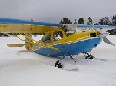
I will counter this by pointing out that the regs allow us to do lots of things - such as fly into the mountains in 1SM vis and clear of clouds - that may not be wise. I do own a pair a' chutes and prefer to have them on me when doing spins and other maneuvers. However, when winter rolls around and the citabria is on skis I haven't been keeping the chutes up to date on their repacks ($100 here - what are y'all paying??). At that point, if I am confronted with someone wanting to do spins in an approved plane I have to consider the risk of flying per the regs without chutes or not fly at all. In weighing the risks, I have decided my personal minimums are OK without the chutes as long as there is no intent to do more than 2 turn spins in a known aircraft.
I personally would wear my well cared for and properly stored chute for a year at a time if it were just me (no liability) but at the same time the regs say I can't even have it in the plane if out of date.
For everyone's reading pleasure, I have included below, the pertinent text of:
AC61-67 spin training
91.303 aerobatic flight
91.307 parachutes
I believe that the current training of pilots is quite deficient in stall/spin "awareness". I have enjoyed taking many pilots for a spin. Having witnessed their reactions, I can relate that not many would do well with recovery from an inadvertent spin if they have
never experienced a spin . I would like to think that their chances of survival are improved after learning the recovery process even once in their flight careers. As with anything in life or in aviation, risks must be considered as should risk reducing strategies.
Humbly submitted,
Matt
AC 61-67C states:
301. SPIN TRAINING AND PARACHUTES. Part 91, section 91.307(c), prohibits the pilot of a civil aircraft from executing any intentional maneuver that exceeds 60° of bank relative to the horizon, or exceeds 30° noseup or nosedown attitude relative to the horizon, unless an approved parachute is worn by each occupant (other than a crewmember). Section 91.307(d) states, in pertinent part, that section 91.307(c) does not apply to flight tests for a pilot certificate or rating; or spins and other flight maneuvers required by the regulations for any certificate or rating when given by a certified flight instructor (CFI) or an airline transport pilot (ATP) instructing in accordance with section 61.167.
a. Section 61.183(i) requires an applicant for a flight instructor certificate or rating to receive flight training in stall awareness, spin entry, spins, and spin recovery procedures. The applicant must also possess and demonstrate instructional proficiency in these areas to receive the certificate or rating.
b.
Because spin entry, spins, and spin recovery are required for a flight instructor certificate or rating, a person receiving instruction from a CFI (or an ATP instructing in accordance with section 61.167) need not wear an approved parachute while instruction is being provided in these maneuvers. This provision applies regardless of the certificate or rating for which the person is receiving training and also if the person is receiving instruction that is not being provided for the purpose of obtaining any additional certificate or rating. The instructor providing the training is also not required to wear an approved parachute while providing this flight training.
c. Additionally, it should be noted that any pilot or required crewmember may perform a maneuver that exceeds the limits prescribed in section 91.307(c) without wearing an approved parachute, provided there are no other occupants in the aircraft or the other occupants are wearing approved parachutes.
Here's the pertinent sections of part 91:
§
91.303 Aerobatic flight.
top
No person may operate an aircraft in aerobatic flight—
(a) Over any congested area of a city, town, or settlement;
(b) Over an open air assembly of persons;
(c) Within the lateral boundaries of the surface areas of Class B, Class C, Class D, or Class E airspace designated for an airport;
(d) Within 4 nautical miles of the center line of any Federal airway;
(e) Below an altitude of 1,500 feet above the surface; or
(f) When flight visibility is less than 3 statute miles.
For the purposes of this section, aerobatic flight means an intentional maneuver involving an abrupt change in an aircraft's attitude, an abnormal attitude, or abnormal acceleration, not necessary for normal flight.
§
91.307 Parachutes and parachuting.
top
(a) No pilot of a civil aircraft may allow a parachute that is available for emergency use to be carried in that aircraft unless it is an approved type and—
(1) If a chair type (canopy in back), it has been packed by a certificated and appropriately rated parachute rigger within the preceding 120 days; or
(2) If any other type, it has been packed by a certificated and appropriately rated parachute rigger—
(i) Within the preceding 120 days, if its canopy, shrouds, and harness are composed exclusively of nylon, rayon, or other similar synthetic fiber or materials that are substantially resistant to damage from mold, mildew, or other fungi and other rotting agents propagated in a moist environment; or
(ii) Within the preceding 60 days, if any part of the parachute is composed of silk, pongee, or other natural fiber, or materials not specified in paragraph (a)(2)(i) of this section.
(b) Except in an emergency, no pilot in command may allow, and no person may conduct, a parachute operation from an aircraft within the United States except in accordance with part 105 of this chapter.
(c) Unless each occupant of the aircraft is wearing an approved parachute, no pilot of a civil aircraft carrying any person (other than a crewmember) may execute any intentional maneuver that exceeds—
(1) A bank of 60 degrees relative to the horizon; or
(2) A nose-up or nose-down attitude of 30 degrees relative to the horizon.
(d) Paragraph (c) of this section does not apply to—
(1) Flight tests for pilot certification or rating; or
(2) Spins and other flight maneuvers required by the regulations for any certificate or rating when given by—
(i) A certificated flight instructor; or
(ii) An airline transport pilot instructing in accordance with §61.67 of this chapter.
Here's a link to the entire Advisory Circular on stall/spin training
http://rgl.faa.gov/Regulatory_and_Guida ... 61-67C.pdf
 I was extremely grateful for that demonstration because it made me even more careful about keepin it centered in low and slow turns. I just can't imagine not fully testing the plane because the treat of a spin.