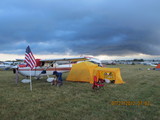
I think I mentioned meeting a fellow at the First Ever Colorado Seaplane Splash-in at Meredith Lake this past summer who was still actively flying a T210 at age 93. He was a P-38 pilot during WWII, coincidentally stationed in the same places (New Guinea and the Philippines) at the same times as my Daddy.
Obviously not every aging pilot can keep on flying for that long, and there are some who continue flying after they should have quit sooner.
I may have mentioned this also: when I was chairing the Laramie Airport Board years ago, I gave a dog & pony slide show to many of the service organizations (Lions, Sertoma, Rotary, etc.) about the airport, to tout its value to the community, to correct misinformation about it, etc. After one such presentation, a retired professor from UW that I already knew because his wife and I served on another board, Vic by name, called me and asked if I could teach him to fly. Since I was only a part-time instructor, my plate was full at the time, but I gave him some recommendations of CFIs to call, and I told him to feel free to call me with questions. We talked briefly about getting a 3rd class medical, and I referred him to my doc who was an AME.
A few weeks later, Vic called to tell me that he had soloed. Of course he was elated--no 20 year old who just soloed could be more excited than that 75 year old. Then a few months later, he called to say that he had just passed his checkride, and again the excitement was evident. To make a long story short, Vic continued to fly for another couple of years, then began to realize that his cognitive abilities were slipping. Soon his wife told me that he'd been diagnosed with early-onset Alzheimer's, and he had handed his pilot certificate to her and told her to keep it safe, because it meant so much to him. Vic died a few years later at age 82.
Age itself is no impediment to learning to fly, nor to continue flying, as long as health and cognitive abilities remain acceptable. For those of us in that aging pilot status (I'll be 73 in a later this month), it gives us hope that with some perseverance and perhaps a bit of luck, we can continue for awhile. That's encouraging.
Cary