Which gauge to add?
Wed May 27, 2015 6:48 pm
Which gauge to add?
Going to add an aux gauge to the ei fuel computer in my old Cessna. What do you guys suggest? Thinking digital oil pressure would be nice. Oil temp instead? Carb temp? What do you guys use n why. The old analog Cessna gauges have a lot to be desired but the guys that make the rules say I need to spend 5k+ or keep them so...
- SKYLANEDAVE offline
- Posts: 38
- Joined: Thu Jan 29, 2015 9:22 am
- Location: Yuba City
- Aircraft: Cessna 182A
Thu May 28, 2015 11:35 am
Re: Which gauge to add?
You didn't provide too much info to get this going.....but I will try to guess what you may find helpful.
Guys have flown their planes for years with the old Cessna analog gauges for oil pressure and temp. You are simply improving resolution on existing gauges by going digital.
If I were flying a 182 and presumably behind a carbureted O-470, I would add carb temp. I've seen planes go down due to improper use of carb heat and I believe a carb temp gauge would have helped them. Adding carb temp would give you new information rather than improved resolution on stuff you already have.
Good luck.
Guys have flown their planes for years with the old Cessna analog gauges for oil pressure and temp. You are simply improving resolution on existing gauges by going digital.
If I were flying a 182 and presumably behind a carbureted O-470, I would add carb temp. I've seen planes go down due to improper use of carb heat and I believe a carb temp gauge would have helped them. Adding carb temp would give you new information rather than improved resolution on stuff you already have.
Good luck.

Thu May 28, 2015 11:56 am
Re: Which gauge to add?
+1 on carb temp.


Thu May 28, 2015 5:03 pm
Re: Which gauge to add?
When I had my EI FP-5L installed, it replaced the mandatory fuel pressure gauge in my airplane, so that's what the aux position went for. If you don't need fuel pressure, though, by all means get the carb temp. I have that in another gauge (Insight G1), and I agree that it's a really good thing to have in any carb'd airplane. Serious carb ice is a killer.
Cary
Cary

"I have slipped the surly bonds of earth..., put out my hand and touched the face of God." J.G. Magee
Thu May 28, 2015 5:25 pm
Re: Which gauge to add?
Upgrading to a carburetor temp gauge would seem a logical choice for my 0360. Might do it during the next annual inspection in October, thread is good reminder.

CFII, MEI, CFISES, ATPME, IA/AP, RPPL, Ski&Amphib ops, RHC mechanic cert, RHC SC— 3000TT
Thu May 28, 2015 8:28 pm
Re: Which gauge to add?
Hard to say without knowing what you already have on screen and your mission.
I'd say if you have the GPS input, I'd go endurance, range, or fuel at destination.
If you don't have that, maybe OAT if you don't have anything for that already, especially if you fly any IFR.
I'd say if you have the GPS input, I'd go endurance, range, or fuel at destination.
If you don't have that, maybe OAT if you don't have anything for that already, especially if you fly any IFR.
- NineThreeKilo offline
- Retired
- Posts: 1678
- Joined: Thu Dec 31, 2009 8:16 pm
- Location: _
Thu Jun 04, 2015 3:01 am
Re: Which gauge to add?
Yeah, carb temp was high on the list, only reason I hesitate is that the only plane I've ever flown that had one, the gauge was always reading where it should be icing up, n here in northern Calif, vfr anyway, ice is rarely a problem. Reason I thought maybe a digital oil pressure may be good is you could see any trends. Probably end up w an ei oil press/temp gauge at some point or better yet the 30or50 so I guess the carb temp makes sense. Thanks for the input
- SKYLANEDAVE offline
- Posts: 38
- Joined: Thu Jan 29, 2015 9:22 am
- Location: Yuba City
- Aircraft: Cessna 182A
Thu Jun 04, 2015 8:28 am
Re: Which gauge to add?
How about a $ per mile meter? 
Or a digital fun meter
Pretty much opposites.
Or a digital fun meter
Pretty much opposites.
Cessna Skywagon -- accept no substitute!
Thu Jun 04, 2015 10:49 am
Re: Which gauge to add?
SKYLANEDAVE wrote:Yeah, carb temp was high on the list, only reason I hesitate is that the only plane I've ever flown that had one, the gauge was always reading where it should be icing up, n here in northern Calif, vfr anyway, ice is rarely a problem. Reason I thought maybe a digital oil pressure may be good is you could see any trends. Probably end up w an ei oil press/temp gauge at some point or better yet the 30or50 so I guess the carb temp makes sense. Thanks for the input
Carb ice can form at higher temps, even in the absence of visible moisture. The various carb icing charts indicate that pretty graphically. For instance, today is a nice VFR day here. Clouds are a bit lower than usual, broken at 2200'. The temp/dew point spread is 6 degrees F, well above what is necessary for fog to form. OAT is 70F. Where the clouds aren't, the skies are crystal clear blue. But if you look at any of these charts (which are only representative--there are a lot more of them out there), the probability of carb icing, especially at lower power settings, is pretty significant:
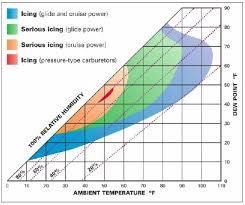
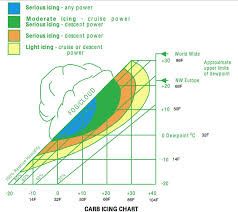
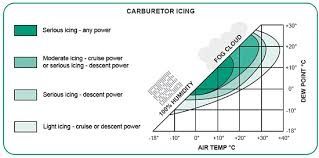
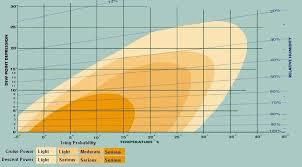
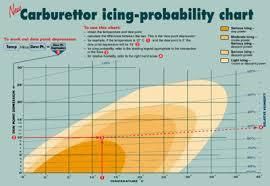
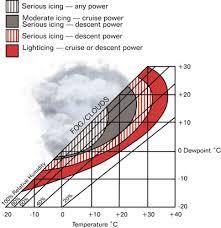
This is a day when if I was flying, I'd be keeping an eye out on my carb temp gauge, and I'd be using carb heat periodically to check whether ice had actually formed. I'm guessing that you have similar days from time to time in northern California.
Cary
"I have slipped the surly bonds of earth..., put out my hand and touched the face of God." J.G. Magee
Thu Jun 04, 2015 11:16 am
Re: Which gauge to add?
Cary;
Where are those carb icing charts found? They are way too small to read on your post. I live in the land of carb icing (2-4C w/ 90% humidity) and would love to have these on hand.
Thanx
TD
Where are those carb icing charts found? They are way too small to read on your post. I live in the land of carb icing (2-4C w/ 90% humidity) and would love to have these on hand.
Thanx
TD

Wed Jun 10, 2015 11:23 am
Re: Which gauge to add?
TomD wrote:Cary;
Where are those carb icing charts found? They are way too small to read on your post. I live in the land of carb icing (2-4C w/ 90% humidity) and would love to have these on hand.
Thanx
TD
If you Google "carburetor icing charts", you'll get a whole page worth of examples. Some are easier to read than others. Also, here's a pretty good article on the topic: https://www.aopa.org/-/media/Files/AOPA ... s/SB09.pdf As the article points out, the real key is to recognize that it can happen under pretty benign weather situations, to recognize it when it does happen, and to take immediate corrective action. The problem I've seen is called "denial"--it can't be happening! That's true of other situations, too, but really often with carb icing, because sort of like a stall can happen at any attitude and airspeed, carb icing can happen at a lot of different combinations of humidity and temperature.
Cary
"I have slipped the surly bonds of earth..., put out my hand and touched the face of God." J.G. Magee
Thu Jun 11, 2015 9:41 am
Re: Which gauge to add?
Looking at the owners manual for my 1953 C180, it looks like a carb temp gauge was standard equipment...even though vacuum gyro's weren't! But they weren't required equipment. Like mine, most of the 180's I see no longer have a carb temp. I have the habit of just pulling on the carb heat once in a while, just because.
If you can do it, I would think about adding a CHT feature to your electronic gauge, preferably one which cycles through all 6 cyl's and maybe lets out a squawk if any of them exceed a pre-programmed limit. Not only lets you monitor all the temps in hot weather, but can be a good diagnostic tool if you have cylinder-related engine troubles. My airplane doesn't even have an EGT gauge anymore (had one but it was inop so I removed it), but I think I would invest the money & panel space into a multi-cyl CHT before installing an EGT or anything else.
If you can do it, I would think about adding a CHT feature to your electronic gauge, preferably one which cycles through all 6 cyl's and maybe lets out a squawk if any of them exceed a pre-programmed limit. Not only lets you monitor all the temps in hot weather, but can be a good diagnostic tool if you have cylinder-related engine troubles. My airplane doesn't even have an EGT gauge anymore (had one but it was inop so I removed it), but I think I would invest the money & panel space into a multi-cyl CHT before installing an EGT or anything else.
Cessna Skywagon -- accept no substitute!
Fri Jun 12, 2015 8:45 pm
Re: Which gauge to add?
hotrod180 wrote:Looking at the owners manual for my 1953 C180, it looks like a carb temp gauge was standard equipment...even though vacuum gyro's weren't! But they weren't required equipment. Like mine, most of the 180's I see no longer have a carb temp. I have the habit of just pulling on the carb heat once in a while, just because.
If you can do it, I would think about adding a CHT feature to your electronic gauge, preferably one which cycles through all 6 cyl's and maybe lets out a squawk if any of them exceed a pre-programmed limit. Not only lets you monitor all the temps in hot weather, but can be a good diagnostic tool if you have cylinder-related engine troubles. My airplane doesn't even have an EGT gauge anymore (had one but it was inop so I removed it), but I think I would invest the money & panel space into a multi-cyl CHT before installing an EGT or anything else.
Most multi-channel CHTs include multi-channel EGTs, such as my Insight G1.
Cary
"I have slipped the surly bonds of earth..., put out my hand and touched the face of God." J.G. Magee
DISPLAY OPTIONS
Who is online
Users browsing this forum: No registered users and 3 guests
Latest Features
-
-
Featured Bush Planes
As one of the undisputed legends of bush flying, the Cessna 180 hauls a…Read More -
Aircraft Ownership and Maintenance
9 modification mistakes aircraft owners make when trying to "bush out" their birds—why some…Read More -
Live to Tell
A Minnesota pilot is surprised to learn that the sudden asymmetric drag of an…Read More




Latest Knowledge Base
-
Destinations
Canada offers some of the most spectacular backcountry flying on the continent. Here's what you need to know before you go.Read More -
Safety and Survival
Hope that you never have to use your survival vest but knowing you have it and knowing how to use…Read More -
Destinations
A regional guide with ideas for winter camping destinations in California, Nevada, New Mexico, and Arizona.Read More -
Aircraft
Finding an affordable aircraft that can handle the backcountry for $80K or less? A challenge for sure, but with the…Read More



