Backcountry Pilot • My lesson in Mountain Turbulence

My lesson in Mountain Turbulence

Share tips, techniques, or anything else related to flying.
29 postsPage 1 of 21, 2

My lesson in Mountain Turbulence

I've been thinking a lot about the recent discussion concerning flying in the Sierra's and how to evaluate the weather. Most of my flying is in the central Idaho mountains and I have my personal limits for weather conditions when flying there but I've never had a good grasp on enroute weather flight planning as it pertains to mountain winds. Saturday I was taught a valuable lesson.

I decided to fly from Idaho Falls to near Billings, MT. I pulled up skyvector.com, put in the two airports, looked at the route and thought, yep, that's doable. I checked the weather and all seemed pretty good. Billings was going to have some wind but nothing noteworthy. Pulled up a briefing via 1800wxbrief and didn't see anything of concern but honestly, it has been so long since I have read those briefings that I got bored and skimmed what was likely the important parts.

Image

Fairly early in the morning, I left KIDA and headed direct to my destination. Everything was typical of a winter morning flight, smooth dense air.

Image

As I was approaching the edge of Yellowstone NP I got to thinking about the next hour of flying and how there is absolutely nothing out there. It was somewhat discomforting since I'm still getting familiar with my airplane.

Image

As I approached the Absaroka Range I was impressed with their size, beauty and jaggedness. I had no clue how awesome this range was and was thoroughly enjoying the view.

Image

Image

Image

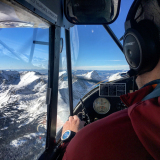
About halfway through I noticed snow blowing off the ridges and thought, "that is awesome!" It was so beautiful and I wanted a pic.

Image

As I leaned over and took some pics the first jolt of turbulence hit and that's when it clicked, "this ain't good." I looked at my ground speed and saw it was indicating 190mph+, a solid 50mph faster than normal. I knew the rest of the ride through the mountains was going to be miserable...and it was.

I thought I was through the worst of it so I began to settle down and figured I should take a pic of my impressive ground speed. I snapped this pic as I entered the downward portion of the wave coming off the ridge behind me, a couple of seconds later I was climbing at 2400+ fpm.

Image

The remainder of the flight was stressful. I had to cross some foothills I normally wouldn't have given a second thought about but found myself flying along the leeward side of them, which was unpleasant, and I had to figure out how to get back home.

Image

When it was time to head home I decided to fly south through Bighorn Canyon which was not a great idea. This put me on the leeward side of the hills which has some pretty significant ridges. A better route would have been to fly west then south over Bridger, MT which would have put me in a big open valley.

Image

My biggest concern was that I still needed to get back over the Absaroka Range and I wasn't sure I'd be able to do that. The plan was to fly to Cody, WY then turn west and fly up the Shoshone River. I hoped Sylvan pass would be open enough that I could fly through it without encountering any major turbulence. As I flew up the Shoshone things were going pretty well, the winds had seemed to calm a bit and I was feeling pretty alright. Then I turned a corner to this view (sorry about the dirty windshield):

Image

I wasn't sure what to do; stay below the ridgeline and try to squeak through, climb up to 12.5ish and maybe get above it. I thought, "let's just go poke my nose in there a bit and see how rough it is." Immediately I realized how dumb of an idea it would be to "poke your nose in" to feel out turbulence. I decided to climb to 12.5. It was rough but not terrible and I made it to the other side.

Now that I was through the mountains I was feeling better but not home free. All the extra rerouting and flying into a big headwind had cost me a lot of time so I was getting low on fuel. Normally it wouldn't be a concern but I had never flown this plane so low on fuel. I had flown each tank to empty but always had plenty of fuel in the other tank.

I had been monitoring fuel closely and knew my left tank was about empty. As I was crossing Yellowstone Lake the engine sputtered so I switched tanks knowing whatever was in the right tank was all that remained. We are still in the calibration phase of the fuel computer; it is pretty close so I was confident I had enough fuel to get all the way home but there was still some concern. At 10K I get about 20" MP at WOT and typically cruise at 2350rpm. This puts me at 8.5gph. I've flown LOP some but I need balanced injectors so the engine is a bit happier doing it. On this occasion I decided to go LOP for a while; my speed drops about 4mph and my fuel burn drops about 2gph. Doing so brought my estimated fuel remaining to about 2 hours and I was only an hour from home. I landed with 1.2hr of fuel remaining but I doubt the controller has seen such a tight of a pattern before.

I made lots of mistakes on this flight and have been feeling pretty lousy about my decision making but it was one of the most educational flights I have ever made. I'm glad it turned out alright and I hope to never have a similar flight in the future.

whee offline
User avatar
Posts: 3386
Joined: Fri Jan 20, 2006 1:59 pm
Location: SE Idaho

Re: My lesson in Mountain Turbulence

Sounds like you are getting a good feel for it. Both thermals and rapids like uneven terrain (ridge) turbulence produce updrafts and downdrafts in the range you mentioned. Wave, a sympathetic combination of updrafts and downdrafts, produces much greater, much longer lift and sink.

Were you able to compare the effectiveness of rudder to aileron in mitigating upsets? Unfortunately counterintuitive to the way most pilots are trained, more rudder and less aileron can produce happy results. The first time I ride rough air with a pilot I let him/her go a bit and then ask them to let me have the stick or yoke and to try just rudder movement, lots of rudder movement. It gets noticeably better. Moderate turbulence suddenly gets light.

Just like sympathetic energy application, as in a wave, adverse yaw creates sympathetic wing wagging in turbulence. Perfect coordination in turbulence? Try Dutch rolls in turbulence. Or use mostly rudder only and beat it.
contactflying offline
Posts: 4972
Joined: Wed Apr 03, 2013 7:36 pm
Location: Aurora, Missouri 2H2
Download my free "https://tinyurl.com/Safe-Maneuvering" e-book.

Re: My lesson in Mountain Turbulence

Some days are like that.

When able to climb above, I try to clear mountainous terrain by 2000 feet if the wind is blowing.

When down in it, I try to make sure I am familiar with the realistic maneuvering speed for my weight configuration and fly that whenever it gets rough.

I use the upslope winds to help wherever possible, cross passes with good clearance, and sometimes I will make solo flights in conditions that I would reject for passenger flights. If you fly in a lot of turbulence, you get used to it. Passengers rarely fly enough to get used to it. So I just try to talk them into another day if feasible. Luckily at my work that is encouraged and usually feasible.
Troy Hamon offline
User avatar
Posts: 913
Joined: Tue Apr 06, 2010 8:27 am
Location: King Salmon
FindMeSpot URL: http://share.findmespot.com/shared/face ... 04iX0FXjV2
Aircraft: Piper PA-22

Re: My lesson in Mountain Turbulence

whee wrote:I made lots of mistakes on this flight and have been feeling pretty lousy about my decision making but it was one of the most educational flights I have ever made.


Thanks for sharing this trip report. Lots of good inferences to be had within it. The fact that this flight has been on your mind will ensure you will remember it and implement what you learned. Thanks for sharing.
Nushi offline
Supporter
User avatar
Posts: 160
Joined: Sun Nov 25, 2018 7:04 pm
Location: Wilmington
Aircraft: 1960 Cessna 182C

Re: My lesson in Mountain Turbulence

Hell Whee, don't feel bad...this is how we learn. I'm guessing you'll pay extra attention to winds-aloft the next time you flight plan, and that information mean a whole lot more to you today than it did last week.

Not sure I'd have run a tank dry over inhospitable terrain. I've done it in the past, then I came to the realization that leaving ten minutes of fuel in the low tank doesn't cost me anything, while having the fuel selector come off in my hand when the engine sputters might cost me plenty. It's never actually happened, but...

One more thing...put a crowbar in your wallet and buy a can of Plexus. :wink:
Hammer offline
KB and Supporter
User avatar
Posts: 2094
Joined: Mon Jan 08, 2007 9:15 am
Location: 742 Evergreen Terrace

Re: My lesson in Mountain Turbulence

Turbulence can take the fun out of it for sure. Using more rudder definitely helps when it’s just rough and not crazy windy also. I learned a very hard and scary lesson about unsecured cargo, close to gross, and a dog that wasn’t tied down but just kinda hanging out behind me. Never again.
Greg
roamak offline
User avatar
Posts: 138
Joined: Thu Nov 15, 2012 8:52 pm
Location: Wasilla

Re: My lesson in Mountain Turbulence

Great report with good lessons learned. I will assume that the Windy app was used as a preflight planning tool, if not, you might consider it as a wind forecasting method, it’s phenomenal. Write it down, file it away, remember it...the forecasted/actual winds at appropriate altitudes and use those numbers (speed AND direction) as a reference for conditions that you don’t want to fly in on that route. Everyone’s comfort level will be different. My experience is that it is surprising how bad it can be on the leeward side of something with as little as 20 kts of wind, it’s all about the angle that it hits the obstruction, and the obstruction itself. A sheer cliff hits way different than a gradual upslope. Also, call me conservative, but I don’t fly direct over the mountains in the winter unless I’m getting paid for it, which I’m not. Out here in Oregon and Washington, I follow the passes and only if the winds are light. Bottom line, I drive a lot in the winter, vs. flying.

I have a Bearhawk Patrol which is just OK for riding the bumps. It’s way better than my Rans S7 was and not even close to as good as the C180 was. For me, this matters because I might not fly my Patrol on a day that I might have flown the 180 and the S7 was downright scary at times. I’m assuming your 4 place fits into the category of “just OK.” Once again, my opinion is that this matters and it’s reasonable to develop your own set of standards for wind conditions in the mountains. We’re not talking Kansas here......

Once again, thanks for putting together a great post. I think it’s something we should all discuss more often.
Mike
mpm offline
Supporter
Posts: 61
Joined: Sat Mar 14, 2015 3:49 pm
Location: Camas
Aircraft: C185, BH Patrol

Re: My lesson in Mountain Turbulence

Sounds like a rough ride, all right. You might also put a portable O2 system and a pulse oximeter on your Christmas list. Above 15,000' would have been smooth, I'll bet. Supplemental O2 allows you to take full advantage of what the airplane is perfectly capable of doing. My wife HATES turbulence, so going early and/or going high are part of my regular playbook. Headwinds are worse up high, of course, but you can go direct, run at peak EGT and--worst case-- stop for gas and a pee break if necessary.
CAVU offline
User avatar
Posts: 659
Joined: Wed May 10, 2006 4:54 pm

Re: My lesson in Mountain Turbulence

Troy Hamon wrote:When able to climb above, I try to clear mountainous terrain by 2000 feet if the wind is blowing.

When down in it, I try to make sure I am familiar with the realistic maneuvering speed for my weight configuration and fly that whenever it gets rough.


I spent a quite a bit of time as an air taxi pilot in the Bristol Bay/AK Peninsula and what Troy said about maneuvering speed is spot on. It had to be REALLY windy before we halted ops. Turbulence was just something to be dealt with on a daily basis. A longtime pilot/check airman from Naknek “GT” always said it’s one of the most important speeds and to know how it varies with weight. I had lots of tolerance for it back in the day but the guys who regularly did Chigniks/Perryville/Ivanoff were on a different level. I’m not as tolerant as I was before.....grey hairs.
TVATIVAK71 offline
User avatar
Posts: 114
Joined: Tue Aug 02, 2016 6:21 pm
Location: Anchorage

Re: My lesson in Mountain Turbulence

Yikes. Sounds like you went for quite the ride.

I live in a relatively windy place. Honestly, most days there's no escaping it and I've become somewhat fascinated with trying to better understand the different weather products and forecasts available to plan for wind. I eagerly await for updated winds aloft forecasts, and enjoy the new windy type websites.

We have a lot of channeled winds that we can plan for because we know the Seward Peninsula. For example, we know if an airport up north is blowing twenty knots, then certain valleys to the south will be rippin forty knots, and thats just because of the natural venturies that exist across the land scape. It's something to pay attention to.

I personally feel there's a lot to learn about the wind and how to use it. Everyone likes to land off airport, practice short take offs, etc., but I think pilots should spend more time learning about and flying in windy conditions. Twenty five knots doesn't have to shut you down, and updrafts can save you gas during those really long flying days. Even cubs at twenty five or twenty six hundred rpm use a lot of gas. Why not take the free ride up?

I do wish I knew how to plan for the bumpy fifteen knots versus the smooth twenty five. When we are flying long survey days, I'm always impressed how much fun a smooth twenty or twenty five knots can be, but how miserable a bumpy ten or fifteen knots can be. If there's a way to read the forecasts and plan for that I'd like to learn it.

I agree with others that crossing terrain by a few thousand feet is a good option. Especially if you're somewhere new and you don't know the country that well. I've also learned that besides your constant adaptive planning, reading terrain, feeling the plane, etc., keep an eye on that VSI. I've found it comes alive a little sooner then I do, and can tell me what's about to happen. Perhaps I'm a bum pilot, but I find I need my head on a swivel during the reallly windy days. Constantly reading terrain, planning for up or down drafts, and the occasionally planned bump. Take a moment to look up that valley and think about how you're going to work it, an how you're getting out if you have to.

I strongly agree with the comment about aircraft type. The one eighty or eighty five handles a lot more compared to the cub. They all seem to handle more than we can though. :)

Thanks for your post. Fun to think about the wind.
Arctic Flyer offline
Supporter
User avatar
Posts: 63
Joined: Fri Sep 02, 2016 11:07 pm
Location: Nome
Aircraft: 1974 C-180J

Re: My lesson in Mountain Turbulence

Agree! Wind is interesting, fun, and very useful energy.
contactflying offline
Posts: 4972
Joined: Wed Apr 03, 2013 7:36 pm
Location: Aurora, Missouri 2H2
Download my free "https://tinyurl.com/Safe-Maneuvering" e-book.

Re: My lesson in Mountain Turbulence

That's a gnarly route Whee took. I had a retired Air Force pilot who lived in West Yellow once tell me that the Absaroka Range looked to him to be about the most rugged area he'd ever flown over. The following is an excerpt from an early '80's account Jack McCornack (prez of the Pterodactyl ultralight company, and a real character) wrote of the time he and a buddy flew from the west coast to Oshkosh.

"Keith and I spent a few days camping in the Idaho mountains (while Brad and Joe drove off in search of lakes and monster trout) before we flew—this time by choice—over the Grand Teton ... accompanied by three guys in a Cessna 172. (To be completely accurate, the Cessna fellows tried to accompany us. However, the hot weather and thin air actually hindered the "real" airplane more than it did our Pterodactyls—we were able to fly about 1,000 feet higher than it could!) While passing over the peak, Keith soared in close to exchange a few air-to-ground words with a group of mountain climbers. I'm not sure just what was said, except that there was a mutual questioning of sanity.

Our next extended stop took place at the Diamond L Ranch about 30 miles from Jackson, Wyoming, a next-to-ideal rest spot with a big grassy meadow "runway" and no telephones. From there we headed over the mighty Rockies themselves, chugging along at nearly 15,000 feet! That particular jaunt made us awfully grateful that we'd brought along cold weather gear. It's right chilly three miles in the air. I sure wouldn't want to try flyin' that high during the winter!"

I remember talking with Jack about their route later, as I became his Idaho 'dac dealer a short time later. Think of it: at 15 K, 45 mph (at most), due to turbulence, the roughest they hit on the entire flight. No heat, no windshield, no cabin floor, no radio or ELT/PLB/SPOT, no Ipad or Foreflight, no GPS, and a single cylinder Sachs 2 stroke powerplant! They did it because they wanted to clearly illustrate the 'dac's were different from the other ultralights of the time,and because they were a bit crazy of course!

I was poking around the Pioneer's the same day Whee, and also noticed the winds aloft, (which put an end to any thought of some 9K ridge ski landings I had my eye on, no thanks) and at one point had the thought I didn't really need to go to Stanley that day after all.....didn't want to climb to 14 K or so, which would have been the sane altitude at the angle I would have crossed at. So, before more then a few minor bumps, I bailed out and decided to eat lunch at Fairfield instead of Stanley. The rest of the day was great, down low, perfect in fact, all the more reason not to beat myself up at nosebleed flight levels. I did get a vicarious thrill out of your account though!
courierguy offline
User avatar
Posts: 4197
Joined: Thu Mar 31, 2005 6:52 pm
Location: Idaho
"Its easier to apologize then ask permission"
Tex McClatchy

Re: My lesson in Mountain Turbulence

As has been said, maneuvering speed is a useful tool in turbulence. Flying in NM on hot desert afternoons is not fun because of the thermal activity. The ground below you is at 6000' MSL which makes the cloud bases out of reach of your aircrafts ceiling, so over the top is not an option. Riding it out in the bumps below requires slowing down. In the Maule, I have found that slowing down to 90 or 100 mph air speed turns a lot of the jolts into mushy waves. Since your Bearhawk wing is a little longer, I suspect a little slower still would make a more comfortable experience.

Glad you shared your experience and got the conversation started as these are the things we really need to share amongst ourselves. They don't teach this stuff any where else.
DeltaRomeo offline
KB and Supporter
User avatar
Posts: 391
Joined: Sun Oct 19, 2014 11:26 am
Location: TX and NM
Aircraft: M5 180C

Re: My lesson in Mountain Turbulence

Funny the mention of the commercial operation and maneuvering speed. I’ve flown with the air taxis here for the better part of 25 years (as a passenger) and they never lay off the throttle. Must be in the op specs. It’s 24 square come Hell or high water. The abuse those things take without coming apart is truly amazing. Never buy a former air taxi ship from SE AK.

The only airplane I was ever “comfortable” in Rocky Mountain turbulence was a 250 Comanche. Drop the rollers when it got real rough. Wing loading must have been perfect.
gbflyer offline
User avatar
Posts: 2317
Joined: Sun Oct 14, 2007 5:35 pm
Location: SE Alaska

Re: My lesson in Mountain Turbulence

gbflyer wrote:Funny the mention of the commercial operation and maneuvering speed. I’ve flown with the air taxis here for the better part of 25 years (as a passenger) and they never lay off the throttle. Must be in the op specs. It’s 24 square come Hell or high water. The abuse those things take without coming apart is truly amazing. Never buy a former air taxi ship from SE AK.


In 207’s, maneuvering speed is 15kts faster than 24 squared would get us in cruse. Similar with the planes on floats and bushwheels. Maybe the operators there have a similar situation.
asa offline
Supporter
User avatar
Posts: 1532
Joined: Mon May 16, 2016 1:56 pm
Location: ak

Re: My lesson in Mountain Turbulence

asa wrote:
gbflyer wrote:Funny the mention of the commercial operation and maneuvering speed. I’ve flown with the air taxis here for the better part of 25 years (as a passenger) and they never lay off the throttle. Must be in the op specs. It’s 24 square come Hell or high water. The abuse those things take without coming apart is truly amazing. Never buy a former air taxi ship from SE AK.


In 207’s, maneuvering speed is 15kts faster than 24 squared would get us in cruse. Similar with the planes on floats and bushwheels. Maybe the operators there have a similar situation.


Thanks. That’s a good point. I still slow down though my own self.
gbflyer offline
User avatar
Posts: 2317
Joined: Sun Oct 14, 2007 5:35 pm
Location: SE Alaska

Re: My lesson in Mountain Turbulence

In my first Tripacer, an older model, maneuvering speed was slower than cruise. In my current, later model, maneuvering speed is basically at what we cruise at when at GW. But at lighter weights, maneuvering speed is slower. The heavier you fly, the faster maneuvering speed is, so operations at GW are substantially different than running light. And different airplanes have speeds in very different ranges in relation to their cruise operations, so you have to know what the specifics are.
Troy Hamon offline
User avatar
Posts: 913
Joined: Tue Apr 06, 2010 8:27 am
Location: King Salmon
FindMeSpot URL: http://share.findmespot.com/shared/face ... 04iX0FXjV2
Aircraft: Piper PA-22

Re: My lesson in Mountain Turbulence

And a very light at GW, but very slick, airplane like the Luscombe 8A can beat up a bad back.
contactflying offline
Posts: 4972
Joined: Wed Apr 03, 2013 7:36 pm
Location: Aurora, Missouri 2H2
Download my free "https://tinyurl.com/Safe-Maneuvering" e-book.

Re: My lesson in Mountain Turbulence

Bearhawk has a high lift wing with no washout, so bad turbulence is not their favourite place to be. It's the price you pay for high performance at both ends of the speed range. I like to slow down to less than 100 kts.

I've done a couple bad runs of turbulence lately, to get to and from the national STOL contest. Not fun at the best of times, downright scary at the worst of times. Once winds go over 60kts you start to get some interesting wind phenomena. Areas which should be turbulent can become smooth, and vice versa.
Battson offline
Knowledge Base Author
User avatar
Posts: 1810
Joined: Wed May 09, 2012 11:19 pm
Location: New Zealand
Aircraft: Bearhawk 4-place
IO-540 260hp

Re: My lesson in Mountain Turbulence

Troy Hamon wrote:In my first Tripacer, an older model, maneuvering speed was slower than cruise. In my current, later model, maneuvering speed is basically at what we cruise at when at GW. But at lighter weights, maneuvering speed is slower. The heavier you fly, the faster maneuvering speed is, so operations at GW are substantially different than running light. And different airplanes have speeds in very different ranges in relation to their cruise operations, so you have to know what the specifics are.

The scout I just got (being from the current millennium) benefits from extreme documentation, including all V type speeds at various weights from empty to gross. Not sure if this is an FAA thing or simply a benefit of modern technology. It’s great.
asa offline
Supporter
User avatar
Posts: 1532
Joined: Mon May 16, 2016 1:56 pm
Location: ak

DISPLAY OPTIONS

Next
29 postsPage 1 of 21, 2

Who is online

Users browsing this forum: No registered users and 0 guests

Latest Features

Latest Knowledge Base