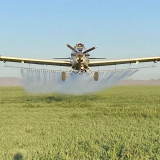
In practical terms, if a power failure with prop still windmillng occurs when fairly low, it's probably not wise to pull up slow enough to stop the prop, which in some aircraft won't stop until almost at stall. But if high and you need to maximize your glide ratio, then slowing enough to stop the prop and then going to best glide speed is something to consider.
In reference to turning down wind, ATK said, " . . . Not to mention the wind being up your ass pushing you down." Absent wind gradient, turning down wind has no negative aerodynamic effect on the aircraft. Remember your instructor probably said something like, "Consider the airplane is flying in a box of moving air, except for ground track and ground speed, aerodynamically speaking, there is no difference between turning in still or turning in moving air."
But, ATK is most correct in that wind gradient with altitude will make a big difference if the plane is ascending or descending! If climbing into an increasing headwind, the dynamic affect is just like climbing into lift or rising air, in that while maintaining airspeed, climb rate at first increases while ground speed decreases. Unfortunately, the opposite occurs when turning off the wind, with the apparent wind decreasing as the aircraft descends into an increasing tailwind component - - the bottom can feel like it's dropping out from under you - - and it is. This is why when towing gliders with a crosswind, it is wise veer off downwind on the climbout, so in the event of a rope break, the glider will be turning into the wind and will thus have an easier time lining up with the runway for a downwind landing - - with those long wings you don't want to be making steep alignment turns close to the ground.

If the aircraft has retractable gear, leave the gear up and configure for best glide speed. Don't put the gear down until short final or until you have the runway made. I know of a very experienced Mooney pilot who retracted the gear early on take off (as is common with Mooney drivers as the gear cycles quickly). Then he had a power failure, and while still on runway heading dropped the gear . . . then started a turn back. He stalled during the turn and augered into an orchard. Survived, but with serious head and leg injuries. The lesson, keep the airplane clean, you don't need the extra drag.
Bet I get some disagreement on this post . . . the whole drag thng with prop windmilling vs. stopped almost usually sparks disagreement. So I'll end with, a windmilling prop has almost the same effective flat plate area as its entire swept arc, whie a stopped prop presents only its actual surface flat plate area. Consider a helicopter during auto rotation, not a good glider for sure, but a whole lot better than if the rotor blades were stopped.
bumper





 However, for motoadve, if you think your exercise is going to give you a big edge in this situation you might find this interesting, specially the last sentence: