Options are all about having both slow speed and power at touchdown. Slow speed allows us to truely choose the touchdown spot and power allows us to truely control the descent rate. Only full flaps truely enhance the slow rate of closure and the sink rate that requires power to control it.
My apparent brisk walk rate of closure approach is much like the normal descent angle MAF approach. It also works with the much steeper but slow power pitch approach that hotrod180 uses.
The guy who uses both power and pitch will get down shorter, other things being equal. Power off spot landings are good practice for forced landings. Power off and/or less than full flap is not good short field technique. Too much energy management is given up.
Short Field Practice
Sun Feb 25, 2018 7:58 am
- contactflying offline
- Posts: 4972
- Joined: Wed Apr 03, 2013 7:36 pm
- Location: Aurora, Missouri 2H2
Download my free "https://tinyurl.com/Safe-Maneuvering" e-book.
Sun Feb 25, 2018 11:00 am
Re: Short Field Practice
Sometimes I think that all of the possible approaches really lead to the same thing. I want to be at my chosen point on the runway, aligned with the centre line, with either a) the airplane going so slow it wont fly anymore 1" off the ground in a three point position, or b) the airplane going just fast enough that the tail will still fly on its wheels with the tailwheel at some height off the ground.
My best landings always happen when I am slowest. But we need to have some margin above stall speed on the approach. I love headwinds. I need to get to one of the above conditions safely.
When conditions are challenging I always try to fly the plane actively to that point, and for me it will always be a three point landing (or tail wheel low wheeler) for the simple reason that my ground speed is the slowest it can be. I understand that this is personal choice.
It sure is fun trying different ways to get there consistently. YMMV.
My best landings always happen when I am slowest. But we need to have some margin above stall speed on the approach. I love headwinds. I need to get to one of the above conditions safely.
When conditions are challenging I always try to fly the plane actively to that point, and for me it will always be a three point landing (or tail wheel low wheeler) for the simple reason that my ground speed is the slowest it can be. I understand that this is personal choice.
It sure is fun trying different ways to get there consistently. YMMV.
- daedaluscan offline


- Posts: 1269
- Joined: Sat Jan 12, 2013 1:06 pm
- Location: Texada BC
Sun Feb 25, 2018 11:22 am
Re: Short Field Practice
The wind is our friend when we can manage heading into it when slow groundspeed or decreased radius turns are desirable. In short field and low level work, there are many ways wind can be managed to our advantage.
Increased airspeed negates the advantages of headwind component. "Use the force Luke Skywalker."
Increased airspeed negates the advantages of headwind component. "Use the force Luke Skywalker."
- contactflying offline
- Posts: 4972
- Joined: Wed Apr 03, 2013 7:36 pm
- Location: Aurora, Missouri 2H2
Download my free "https://tinyurl.com/Safe-Maneuvering" e-book.
Wed Mar 07, 2018 6:23 am
Short Field Practice
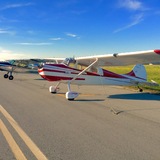
Nice job. Here’s my 170B with full tanks on a no wind day at sea level.
https://youtu.be/TZW4dgG-c5I
https://youtu.be/TZW4dgG-c5I
Wed Mar 07, 2018 9:47 pm
Re: Short Field Practice
Today, on the bump a couple hundred yards out my front door. Coming home from a 3.5 hour breakfast flight to Afton and back, with a few dozen off airport ski landings so I was as warmed up as I can get, on my best game. A measured 13 degrees upslope,, field elevation 5640', zero wind, about 35 degrees air temp, total rollout (slide out) was about 2 fuselage lengths, before slowing almost to a total stop. NO braking  Did it twice, witnessed by a 182 back country pilot with 2500 hours, he agreed, touchdown speed was 20 mph max. We are both bike riders so we know what that speed looks like. I attribute this to UHGE, UpHillGroundEffect.
When I approach this bump at min speed, I am over more less level ground, as I get to the slope, the nose comes up, the lift increases, and the speed drops to a freaking unbelievable low. Like the most extreme slatted aircraft approaches I've seen videos of, 18 to 22 mph is my best guess. I land the same spot in the summer on tires (duh) with similar results. Forget the slope shortening the rollout, I get that. But the main reason for the short landing is the ultra low speed on very short final, caused by the ground effect "bubble" hitting that up slope and allowing me to reach and maintain a much higher AOA. That's my theory anyway, I sure as heck can't fly that slow over level ground. Up a steep slope, it's natural feeling and with full control. I do have a fair bit of throttle in, but not that much, the hill is doing all the work.

Did it twice, witnessed by a 182 back country pilot with 2500 hours, he agreed, touchdown speed was 20 mph max. We are both bike riders so we know what that speed looks like. I attribute this to UHGE, UpHillGroundEffect. When I approach this bump at min speed, I am over more less level ground, as I get to the slope, the nose comes up, the lift increases, and the speed drops to a freaking unbelievable low. Like the most extreme slatted aircraft approaches I've seen videos of, 18 to 22 mph is my best guess. I land the same spot in the summer on tires (duh) with similar results. Forget the slope shortening the rollout, I get that. But the main reason for the short landing is the ultra low speed on very short final, caused by the ground effect "bubble" hitting that up slope and allowing me to reach and maintain a much higher AOA. That's my theory anyway, I sure as heck can't fly that slow over level ground. Up a steep slope, it's natural feeling and with full control. I do have a fair bit of throttle in, but not that much, the hill is doing all the work.
- courierguy offline

- Posts: 4197
- Joined: Thu Mar 31, 2005 6:52 pm
- Location: Idaho
"Its easier to apologize then ask permission"
Tex McClatchy
Tex McClatchy
Wed Mar 07, 2018 10:07 pm
Re: Short Field Practice
The anti-gravity of uphill is as useful, on landing, as is the gravity of downhill, on takeoff. Ground effect is ground effect. It allows the wing to fly sooner on takeoff and slower (hover taxi) on landing. Getting down to hover taxi speed, on short final final is very helpful. Any wind over that natural snow covered wing, the hump, would also be helpful. The wind speed will increase over the wing, the hump.
- contactflying offline
- Posts: 4972
- Joined: Wed Apr 03, 2013 7:36 pm
- Location: Aurora, Missouri 2H2
Download my free "https://tinyurl.com/Safe-Maneuvering" e-book.
Thu Mar 08, 2018 12:59 pm
Re: Short Field Practice
Now I know the secret to STOL ops...use anti-gravity! Awesome!
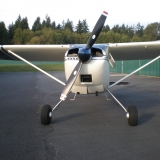
Cessna Skywagon -- accept no substitute!
Thu Mar 08, 2018 3:01 pm
Re: Short Field Practice
Would not a hill, by any other name, be just as inclined?
- contactflying offline
- Posts: 4972
- Joined: Wed Apr 03, 2013 7:36 pm
- Location: Aurora, Missouri 2H2
Download my free "https://tinyurl.com/Safe-Maneuvering" e-book.
DISPLAY OPTIONS
Who is online
Users browsing this forum: No registered users and 1 guest
Latest Features
-
Live to Tell
A Minnesota pilot is surprised to learn that the sudden asymmetric drag of an out-of-rig ski can…Read More -
Creators
Working in some of the Yukon's most beautiful and remote environments, photographer Simon Blakesley captures aircraft in…Read More -
Aircraft Ownership and Maintenance
Upgrading to big tires can make a huge difference in backcountry performance, but with those gains come…Read More -
Tales from Yesteryear
In this tale from bush flying yesteryear, Don Cogger signs up to help Atlee Dodge Jr recovery…Read More


Latest Knowledge Base
-
Destinations
A regional guide with ideas for winter camping destinations in California, Nevada, New Mexico, and Arizona.Read More -
Aircraft
Finding an affordable aircraft that can handle the backcountry for $80K or less? A challenge for sure, but with the…Read More -
Aircraft
01.29.2018 - Zane - Updated tire diameter graphic to add 8.50x10 Guide to tires for use in the backcountry and off-airport landing…Read More -
Pilots
12.22.2013 - Initial article format Operating aircraft on skis and negotiating a snow-covered landscape is an entirely unique skillset and environment.…Read More


