Rob's response is an excellent one. It is, however instructive to understand where the idea of "20 on downwind, 30 on base, etc" comes from:
In flying airplanes, there are a myriad of variables that we have to learn to control. Flap deflection is one variable that is easy to "Fix" for an aspiring student pilot. So, we tell them to apply the first notch (whatever deflection that may be) abeam the numbers, then the next deflection on base, and full flaps on final. By doing that, the instructor has fixed one variable.
But, as a pilot gains experience, Rob's advice is right on: USE the flaps aerodynamically, to accomplish what you need to accomplish in a given situation.
As others have said, back country flying almost always demands somewhat non standard (and sometimes REALLY non standard) traffic patterns. As a long time float pilot, I really like to fly patterns lower than "Standard", so I can get a good look at what I'm about to land on. In a deep canyon, though, that's not always a good plan.
So, we fit our approaches to the task at hand, as Rob so eloquently explained.
Fixing variables allows the budding aviator to get a better handle on one variable at a time. But, as we gain experience, introducing, and learning to use other variables in our flying makes us better, more adaptable aviators.
MTV
Skywagon landing techniques: flaps?
Mon Sep 27, 2021 10:57 am


Mon Sep 27, 2021 11:25 am
Re: Skywagon landing techniques: flaps?
I don't have a lot to add to what MTV and a few others have said.
But I will for the sake of contributing to the discussion, say that my operation is similar to MTV's. I use full flaps for most, in fact almost all, landings on the 185s I fly, most of which are RSTOL equipped, and many of which have a number of other wing mods in addition to the Robertson kit. I do that for both wheels and floats, calm, windy, crosswinds, etc. If it is gusty, I may go for 20 degrees flaps instead.
There was a commenter above stating that they used reduced flaps in crosswinds due to RSTOL equippage. I will not use 30 degrees flaps for landing or takeoff in a crosswind with an RSTOL aircraft because of the low effectiveness of the ailerons, but at 40 degrees you get some aileron function back and we land in some real winds out here.
As MTV said, get good instruction. And spend some time exploring the flight envelope in all the flap settings so you have a good basis for making decisions.
But I will for the sake of contributing to the discussion, say that my operation is similar to MTV's. I use full flaps for most, in fact almost all, landings on the 185s I fly, most of which are RSTOL equipped, and many of which have a number of other wing mods in addition to the Robertson kit. I do that for both wheels and floats, calm, windy, crosswinds, etc. If it is gusty, I may go for 20 degrees flaps instead.
There was a commenter above stating that they used reduced flaps in crosswinds due to RSTOL equippage. I will not use 30 degrees flaps for landing or takeoff in a crosswind with an RSTOL aircraft because of the low effectiveness of the ailerons, but at 40 degrees you get some aileron function back and we land in some real winds out here.
As MTV said, get good instruction. And spend some time exploring the flight envelope in all the flap settings so you have a good basis for making decisions.
- Troy Hamon offline
- Posts: 913
- Joined: Tue Apr 06, 2010 8:27 am
- Location: King Salmon
- FindMeSpot URL: http://share.findmespot.com/shared/face ... 04iX0FXjV2
- Aircraft: Piper PA-22
Mon Sep 27, 2021 1:05 pm
Re: Skywagon landing techniques: flaps?
Hover taxi in low ground effect will demonstrate the more comfortable pitch attitude of full flaps with the considerable power necessary.
- contactflying offline
- Posts: 4972
- Joined: Wed Apr 03, 2013 7:36 pm
- Location: Aurora, Missouri 2H2
Download my free "https://tinyurl.com/Safe-Maneuvering" e-book.
Mon Sep 27, 2021 2:52 pm
Re: Skywagon landing techniques: flaps?
I learned Flaps 10 on downwind, 20 base, and 30 on final with targeted airspeeds and still teach this technique. It is beneficial to learn standard operating procedures. I think it is a good technique when one is learning. Prior to buying my C180 I was a pavement pounder and for me a good landing was a smooth one. Fast forward 14 years later - it's very different. I judge my landing distance and hitting my spot rather than the smoothness of the landing. When I am practicing for STOL/Backcountry landings it is common for me to be 40 degrees of flaps on downwind just prior to turning base. Main reason is to keep the airplane in a configuration needed for final approach and landing. I do not want to mess with pitch, power, elevator, and trim changes on final when I am making a short landing. I like having that variable fixed as early as possible. As mentioned many backcountry strips have non-standard patterns/approaches and getting the wing configured earlier reduces the workload when the workload is highest. Downside - engine quits on final but making a short landing or flying a non standard approach in the backcountry carries some risk.
Josh
Josh
- Dog is my Copilot offline
- Posts: 433
- Joined: Thu Apr 12, 2018 11:38 am
- Location: Portland
- Aircraft: 1958 Cessna 180A
Mon Sep 27, 2021 3:03 pm
Re: Skywagon landing techniques: flaps?
Understand and agree with MTV 100%.
Agree with Troy on the RSTOL systems, my 180 is RSTOL as well . If you have anything that droops ailerons it is important to understand the mechanics behind the droop. They're not all created the same, and in arbitrarily selecting less flaps thinking you'll get back some roll you may in fact (as Troy pointed out) be accomplishing the opposite.
In the RSTOL 180 I run full flap even in gustys, I just get rid of them sooner than I might otherwise. In ALL the work airplanes I fly regardless of whether they droop ailerons or not, I clean them up the instant they hit dirt (sometimes a few feet yet to go) as I am usually busy on the rollout, and the firmer they're planted the better.
And x2 on what Contact said. While as Mike pointed out your speed may not be tremendously different with full vs partial flaps, it is some. But as a much appreciated benefit to us that are not born to play basketball, the deck angle affords a much better view with everything hanging out. So much so, that in a Thrush for example, if you are coming over the fence full flapped and level attitude (or even pitched down) and clean it up a few feet off the ground it will 'rotate' into a 3 pt position and land... gusts like that? easy peasy...
Take care, Rob
Agree with Troy on the RSTOL systems, my 180 is RSTOL as well
. If you have anything that droops ailerons it is important to understand the mechanics behind the droop. They're not all created the same, and in arbitrarily selecting less flaps thinking you'll get back some roll you may in fact (as Troy pointed out) be accomplishing the opposite.In the RSTOL 180 I run full flap even in gustys, I just get rid of them sooner than I might otherwise. In ALL the work airplanes I fly regardless of whether they droop ailerons or not, I clean them up the instant they hit dirt (sometimes a few feet yet to go) as I am usually busy on the rollout, and the firmer they're planted the better.
And x2 on what Contact said. While as Mike pointed out your speed may not be tremendously different with full vs partial flaps, it is some. But as a much appreciated benefit to us that are not born to play basketball, the deck angle affords a much better view with everything hanging out. So much so, that in a Thrush for example, if you are coming over the fence full flapped and level attitude (or even pitched down) and clean it up a few feet off the ground it will 'rotate' into a 3 pt position and land... gusts like that? easy peasy...
Take care, Rob


Mon Sep 27, 2021 4:16 pm
Re: Skywagon landing techniques: flaps?
contactflying wrote:Sorry. IGE is In Ground Effect. OGE is Out of Ground Effect. Vso is an Out of Ground Effect airspeed for when the wing stalls with full flaps. There is no airspeed in the Pilot Operating Handbook for when the airplane stalls in very low ground effect, which of course is where it should be full stalled or near full stalled (wheel landing) to land slowly.
The use of Velocity stall everything out, Vso, in association with landing is confusing. The wing will still be flying in ground effect at that airspeed. Since ground effect cannot be escaped during landing, it should be covered more extensively. IGE should be as common as OGE and discussions of the sounds and feel of much slower but still flying below Vso in ground effect should be conducted.
Vso in connection with stabilized approach is logical. Vso in connection with landing airspeed is misinformation. Stabilized approach to short final is logical. Beyond there it is a guarantee of round out, hold off, and a faster and longer than necessary landing.
The plane I have been flying stalls at 42 OGE (thanks for the clarification on the acronym) and I like to land SLOW… As a newbie pilot I was not prepared for the plane to still be wanting to fly so much at 46-47mph. It took me a while to comfortably get down to touching down at 43-45mph. The plane still has plenty in it IGE at that speed. I would not go slower though… That being said I am no longer flying that plane. Matter of fact I am not flying anything

Mon Sep 27, 2021 4:19 pm
Re: Skywagon landing techniques: flaps?
AS to MTV’s post about the backcountry being non-standard most of the time, when I went to train with Dick Williams this summer he had me at full flaps on the downwind so there is no messing around coming in on final, just flying a stabilized approach. it made things really easy too.
Mon Sep 27, 2021 10:57 pm
Re: Skywagon landing techniques: flaps?
Thanks for everyone's replies, letting me jump in on the conversation and taking the time to help me become a better pilot.
I hate to say it, but I say "time to hit the brakes" when I put in 40 degrees of flaps. It's a fun to do, slows me down and it stabilizes me right out. I'll try to do as Rob & you guys say in the future. I also fly with a couple great CFI's and I'll run your comments by them.
A long time ago I was born in Idaho and I hope to get back there in my own plane.
All the best'
Dale
I hate to say it, but I say "time to hit the brakes" when I put in 40 degrees of flaps. It's a fun to do, slows me down and it stabilizes me right out. I'll try to do as Rob & you guys say in the future. I also fly with a couple great CFI's and I'll run your comments by them.
A long time ago I was born in Idaho
and I hope to get back there in my own plane.All the best'
Dale
Tue Sep 28, 2021 6:51 am
Re: Skywagon landing techniques: flaps?
As Rob and we short guys know, everything out provides a lower deck angle so we can see what's going on. Also, I have always used cushions under butt and behind back in everything except J-3 and short guy sized homebuild. In Cessnas my helmet is rattling against the headliner plastic. Seeing out is the most important thing. Flying low all the time, missing things just up there a bit, is really important. Look where they put the pilot in Ag planes. I feel for Rob and the jet Ag guys with the big hoppers up front. The Pawnee couldn't haul so much so the hopper and whole upper fuselage in front of the pilot could be slopped down...a lot. Also using cushions to get up off the floor in the back of Cubs helps the old man's back a lot.
Lumbar decompression surgery went well and I feel much better. Safe in TW. No, you are still going to have to drive on the ground.
Lumbar decompression surgery went well and I feel much better. Safe in TW. No, you are still going to have to drive on the ground.
- contactflying offline
- Posts: 4972
- Joined: Wed Apr 03, 2013 7:36 pm
- Location: Aurora, Missouri 2H2
Download my free "https://tinyurl.com/Safe-Maneuvering" e-book.
Tue Sep 28, 2021 4:35 pm
Re: Skywagon landing techniques: flaps?
Rob wrote: So much so, that in a Thrush for example, if you are coming over the fence full flapped and level attitude (or even pitched down) and clean it up a few feet off the ground it will 'rotate' into a 3 pt position and land... gusts like that? easy peasy...
Take care, Rob
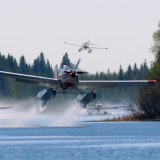
The 802 is same as the thrush. In the Fireboss, I retract the flaps as I get close to the water or runway, the nose comes up on its own "flaring" for me, and once on the water/ground, its done flying. But the controls are positioned just right to make this happen easily. Can't do this in the 180, too much monkey motion and head down.
Sun Oct 03, 2021 4:48 pm
Re: Skywagon landing techniques: flaps?
Tangogawd wrote:The 802 is same as the thrush. In the Fireboss, I retract the flaps as I get close to the water or runway, the nose comes up on its own "flaring" for me, and once on the water/ground, its done flying.
Like!
Wed Oct 06, 2021 3:14 pm
Re: Skywagon landing techniques: flaps?
Tangogawd wrote:Rob wrote: So much so, that in a Thrush for example, if you are coming over the fence full flapped and level attitude (or even pitched down) and clean it up a few feet off the ground it will 'rotate' into a 3 pt position and land... gusts like that? easy peasy...
Take care, Rob
The 802 is same as the thrush. In the Fireboss, I retract the flaps as I get close to the water or runway, the nose comes up on its own "flaring" for me, and once on the water/ground, its done flying. But the controls are positioned just right to make this happen easily. Can't do this in the 180, too much monkey motion and head down.
Never flown those big boy planes but I love doing this in bonanzas. The electric flap retract timing/speed is just perfect for it.
DISPLAY OPTIONS
Who is online
Users browsing this forum: No registered users and 1 guest
Latest Features
-
Live to Tell
A Minnesota pilot is surprised to learn that the sudden asymmetric drag of an out-of-rig ski can…Read More -
Creators
Working in some of the Yukon's most beautiful and remote environments, photographer Simon Blakesley captures aircraft in…Read More -
Aircraft Ownership and Maintenance
Upgrading to big tires can make a huge difference in backcountry performance, but with those gains come…Read More -
Tales from Yesteryear
In this tale from bush flying yesteryear, Don Cogger signs up to help Atlee Dodge Jr recovery…Read More


Latest Knowledge Base
-
Destinations
A regional guide with ideas for winter camping destinations in California, Nevada, New Mexico, and Arizona.Read More -
Aircraft
Finding an affordable aircraft that can handle the backcountry for $80K or less? A challenge for sure, but with the…Read More -
Aircraft
01.29.2018 - Zane - Updated tire diameter graphic to add 8.50x10 Guide to tires for use in the backcountry and off-airport landing…Read More -
Pilots
12.22.2013 - Initial article format Operating aircraft on skis and negotiating a snow-covered landscape is an entirely unique skillset and environment.…Read More


