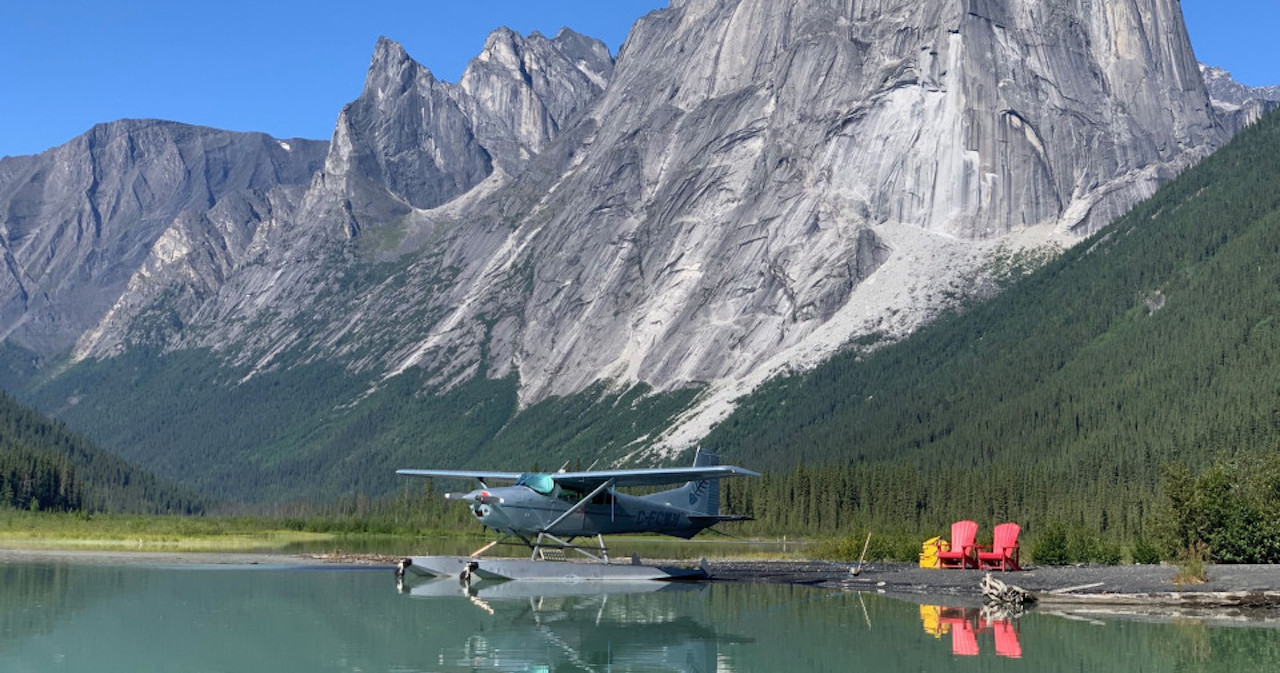
I recently started experimenting with this method. I'm certain it's much easier in a Husky or a Cub with bushwheels than in a C180 with 8.50s, but it's doable even in calm winds when light. Bigger tires would make it easier and more forgiving. Look forward to experimenting after installing my bushwheels this summer.
It requires brakes for the first 20-30 feet of the ground roll and a light load, but somehow doesn't seem to affect the length of the takeoff roll too significantly. Is it possible that trading the initial drag from braking with the reduced wing and horizontal drag results in a wash as it affects the ground roll? I haven't taken any measurements, but it seems like I'm flying in the same distance as the three pointer.
The benefits are obviously to save the tailwheel from a beating and it puts the tail higher, reducing the chances of nailing your tail with a rock. The obvious disadvantages are that it putts more stress on the mains and lots of stress in the gear box and if you have a little speed and your brakes on, it's likely that you might prop strike if you hit an obstacle with one of your mains.
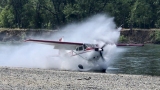
You can see in this video that it gets a little rowdy on the rougher ground at the beginning of the roll. I had plenty of energy to launch when I did, so it wasn't a short takeoff technique. It was a pretty blustery afternoon in the canyon and I got a little sideways.
Any horror stories? Words of caution? Is is a super stupid idea? Thoughts?
Tail Up Takeoff
Mon Mar 17, 2014 12:22 pm
- Scolopax offline

- Posts: 1718
- Joined: Tue Sep 27, 2005 5:02 pm
- Location: Nottingham
- FindMeSpot URL: http://share.findmespot.com/shared/face ... 4aYqSexnZC
Mon Mar 17, 2014 12:45 pm
Re: Tail Up Takeoff
I'm a pretty low tailwheel time pilot(about 50hrs) but I'll offer some thought from my A&P/IA point of view:
1)Brake calipers do stick, I think this is a bad time to be on the brakes. It would realy suck to have one hang up on your take off roll.(groundloop under full power is a realy bad thing )
)
2)If you know you are going to cause wear and tear on either the tailwheel of the mains, I would rather it be the tail. The tailwheel parts easier to inspect for damage, cheaper to replace, and less likely to cause major damage to the airframe in the event of a failure.
This being said, my standard practice in a tailwheel airplane has been to start the roll fill full down elevator to get the pressure off the tail. I would be willing to bet that this induced drag is less than applying brake pressure durring the roll. Just my thoughts, interested in seeing what others have to say.
1)Brake calipers do stick, I think this is a bad time to be on the brakes. It would realy suck to have one hang up on your take off roll.(groundloop under full power is a realy bad thing
)2)If you know you are going to cause wear and tear on either the tailwheel of the mains, I would rather it be the tail. The tailwheel parts easier to inspect for damage, cheaper to replace, and less likely to cause major damage to the airframe in the event of a failure.
This being said, my standard practice in a tailwheel airplane has been to start the roll fill full down elevator to get the pressure off the tail. I would be willing to bet that this induced drag is less than applying brake pressure durring the roll. Just my thoughts, interested in seeing what others have to say.
- Jeredp offline

- Posts: 625
- Joined: Fri Apr 20, 2012 10:31 am
- Location: WA
- FindMeSpot URL: http://share.findmespot.com/shared/face ... 7NYN40QT2I
- Aircraft: Cessna 172
Mon Mar 17, 2014 12:52 pm
Re: Tail Up Takeoff
It's interesting to see how the supersonic shockwave off the prop tips effects the video as it passes over the camera. cool.
This has been hashed over before, and according to some of the most experienced on here. it doesn't seem to make a lot of difference in t/o roll, there are trade offs in the varying procedures. Where they say the benefits are is actually depicted in the above video. Getting good visibility sooner, important, especially on a narrow strip like that one and the mentioned less impact on the tail wheel.
This has been hashed over before, and according to some of the most experienced on here. it doesn't seem to make a lot of difference in t/o roll, there are trade offs in the varying procedures. Where they say the benefits are is actually depicted in the above video. Getting good visibility sooner, important, especially on a narrow strip like that one and the mentioned less impact on the tail wheel.
- Sidewinder offline
- Posts: 340
- Joined: Mon Sep 30, 2013 5:07 pm
- Location: SouthWest Kanada eh?
Mon Mar 17, 2014 1:22 pm
Re: Tail Up Takeoff
Using the brakes to lift the tail on takeoff on a Wagon doesn't seem like the best idea to me. There was a Wagon that ground looped on takeoff around two weeks ago, took out landing gear and wing, among other things I'm sure. Get a sudden crosswind, both feet on the brakes, stab the rudder hard to hold the plane, at the same time inadvertently increasing brake pressure and over on your back you go.
If you want to get the tail up quickly and easily, roll the elevator trim all the way forward before take off (try half forward first, baby steps you know). Just don't forget that to climb you'll be roll roll roll roll roll roll roll roll roll roll getting the trim back so you can pull on the yoke, so make sure you have enough room after you are off the ground to do this before encountering rising terrain.
Just my thoughts.
If you want to get the tail up quickly and easily, roll the elevator trim all the way forward before take off (try half forward first, baby steps you know). Just don't forget that to climb you'll be roll roll roll roll roll roll roll roll roll roll getting the trim back so you can pull on the yoke, so make sure you have enough room after you are off the ground to do this before encountering rising terrain.
Just my thoughts.
- Barnstormer offline
- Posts: 2700
- Joined: Sun Oct 14, 2012 7:42 am
- Location: Alaska
- Aircraft: C185
Mon Mar 17, 2014 1:34 pm
Re: Tail Up Takeoff
I know you have a ton more experience than me Scolopax but I'll share my thought anyways. After watching the video I'd wager that you could get off shorter by applying full down elevator till the tail lifts off then hold it up high enough that the tailwheel just skips off the largest rocks and keep it there till she flys off. Yeah it's not as cool as a tail up takeoff but it works.
My Luscombe doesn't have the hp to keep the tail off the ground once I start the takeoff roll so I use the technique I listed and my tail wheel is up in about 20ft and the roll is shorter than a standard three point takeoff.
My Luscombe doesn't have the hp to keep the tail off the ground once I start the takeoff roll so I use the technique I listed and my tail wheel is up in about 20ft and the roll is shorter than a standard three point takeoff.

Mon Mar 17, 2014 1:40 pm
Re: Tail Up Takeoff
As you say, the tail will stay up (without brakes) in some aircraft from the word go. I don't need to use brakes to keep the tail up with a light load on. Once I have a decent load on, I'm committed to a fair bit of ground roll before I can lift the tail. I just keep the tailwheel tube pressure high, and (so far) avoid really rough stuff with any load on. Those few times I have experimented with brakes, it felt counter-productive to accelerating.
Last edited by Battson on Mon Mar 17, 2014 1:46 pm, edited 1 time in total.

Mon Mar 17, 2014 1:44 pm
Re: Tail Up Takeoff
I think you have to consider the surface roughness, and whether you're really looking at being very hard on the tailwheel at the low low airspeeds where it's hard to lift the tail without brakes. Also, the quality of the roughness. Is it badger holes? Just bumpy ground? Baby head sized rocks on a river bar?
Max performance takeoff is probably going to result from just floating the tailwheel a little so it's not in contact with the ground, while seeking that max AOA to get in the air. That's my rough field takeoff technique anyway.
The really tail high, bouncy takeoffs make me pucker a little, waiting for that prop strike when the gear splay out a little too much.
Prediction: This thread goes ten pages.
Max performance takeoff is probably going to result from just floating the tailwheel a little so it's not in contact with the ground, while seeking that max AOA to get in the air. That's my rough field takeoff technique anyway.
The really tail high, bouncy takeoffs make me pucker a little, waiting for that prop strike when the gear splay out a little too much.
Prediction: This thread goes ten pages.

Mon Mar 17, 2014 1:48 pm
Re: Tail Up Takeoff
Zzz wrote:Baby head sized rocks on a river bar?
This is a great unit of measure.
I'd have said coconut

Mon Mar 17, 2014 1:53 pm
Re: Tail Up Takeoff
I like getting the tail up on takeoff as soon as possible for better visibility and to protect the tailwheel on rough ground, I don't think using brakes is the best idea though. Just start your roll with down elevator like others have said.
Mon Mar 17, 2014 1:55 pm
Re: Tail Up Takeoff
Battson wrote:Zzz wrote:Baby head sized rocks on a river bar?
This is a great unit of measure.
I'd have said coconut
Yeah baby head is too general, some are grapefruit sized and some are watermelon sized.
Mon Mar 17, 2014 1:59 pm
Re: Tail Up Takeoff
Battson wrote:Zzz wrote:Baby head sized rocks on a river bar?
This is a great unit of measure.
I'd have said coconut
I used to go bouldering at this spot with a route called "Baby's head." It literally was a knob the size of a baby's head, and that simile has stuck ever since for all things baby-headish.
Mon Mar 17, 2014 5:28 pm
Re: Tail Up Takeoff
I also like to get the tail up early, some say it's showing off, I say it's for visibility. 
But I can force it up to soon and need some right brake to counter p-factor, when that happens I always thought I lost anything that I might have gained vs a 3 point take off?
Just doin' my part to make 10 pages.
But I can force it up to soon and need some right brake to counter p-factor, when that happens I always thought I lost anything that I might have gained vs a 3 point take off?
Just doin' my part to make 10 pages.
- Terry offline
- Posts: 1365
- Joined: Sat Nov 10, 2007 9:11 pm
- Location: Willamette Valley
- FindMeSpot URL: http://share.findmespot.com/shared/face ... 4GzPHI6t1d
Mon Mar 17, 2014 5:34 pm
Re: Tail Up Takeoff
Scolopax wrote:I recently started experimenting with this method. I'm certain it's much easier in a Husky or a Cub with bushwheels than in a C180 with 8.50s, but it's doable even in calm winds when light. Bigger tires would make it easier and more forgiving. Look forward to experimenting after installing my bushwheels this summer.
It requires brakes for the first 20-30 feet of the ground roll and a light load, but somehow doesn't seem to affect the length of the takeoff roll too significantly. Is it possible that trading the initial drag from braking with the reduced wing and horizontal drag results in a wash as it affects the ground roll? I haven't taken any measurements, but it seems like I'm flying in the same distance as the three pointer.
The benefits are obviously to save the tailwheel from a beating and it puts the tail higher, reducing the chances of nailing your tail with a rock. The obvious disadvantages are that it putts more stress on the mains and lots of stress in the gear box and if you have a little speed and your brakes on, it's likely that you might prop strike if you hit an obstacle with one of your mains.
You can see in this video that it gets a little rowdy on the rougher ground at the beginning of the roll. I had plenty of energy to launch when I did, so it wasn't a short takeoff technique. It was a pretty blustery afternoon in the canyon and I got a little sideways.
Any horror stories? Words of caution? Is is a super stupid idea? Thoughts?
Your propeller manufacturer will LOVE you for holding the brakes while applying power!!! Great way to destroy a prop blade.
Lifting the tail on takeoff works well, but you don't need those brakes to accomplish that. Apply power, push forward on yoke, and as the man said, start off weth some nose down trim.
MTV

Mon Mar 17, 2014 5:35 pm
Re: Tail Up Takeoff
Full flaps, full power, forward elevator to raise the tail. You have to push real hard. Release the brakes and go. Drop flaps to 20, be ready to pull some more to rotate early.
I don't think it hurts the gearboxes any, way less stress than a hard landing (the kind I do). Brakes are cheap. It does shake the hell out of the tail though. If you looked back at it, say as a passenger while someone else was driving you might not think so much of doing it again. Also, the prop is going to suck up anything that isn't firmly nailed down, so be ready with a file if you're doing much of it.
There's a place for needing to do this, probably not anywhere that you're going to be with 8.50's though. I say go for it though. Practice it and get good at it as long as its fun.
I don't think it hurts the gearboxes any, way less stress than a hard landing (the kind I do). Brakes are cheap. It does shake the hell out of the tail though. If you looked back at it, say as a passenger while someone else was driving you might not think so much of doing it again. Also, the prop is going to suck up anything that isn't firmly nailed down, so be ready with a file if you're doing much of it.
There's a place for needing to do this, probably not anywhere that you're going to be with 8.50's though. I say go for it though. Practice it and get good at it as long as its fun.
Mon Mar 17, 2014 5:44 pm
Re: Tail Up Takeoff
I never liked the idea of pushing the elavator very far forward to get the tail up. I think ya put the elavator in harms way from flying rocks and debris. In the 180 I would use down trim on the horizontal and that worked great. On the 170 just a little down trim and let the tail come up. It's a lot lighter and comes up pretty quick anyways.
That's my .02
Gary
That's my .02
Gary
- shortfielder offline
- Posts: 2345
- Joined: Sun Mar 05, 2006 7:14 pm
- Location: Durango, Colorado
- FindMeSpot URL: http://share.findmespot.com/shared/face ... D263l9HKFb
If you want to go up, pull back on the controls. If you want to go down, pull back farther.
My SPOT page
My SPOT page
Mon Mar 17, 2014 6:20 pm
Re: Tail Up Takeoff
It's been discussed a lot here already, but here's me in the 185 demonstrating. I get the tail up ASAP in the takeoff roll, but not so much as to be "pinning" the mains down with a negative angle of attack. No brakes, just a bit of nose down trim and full forward elevator until it's up. With the tail wheel clear, a soft-field takeoff gets that gearbox out of the rough and avoids a longer takeoff roll at high speed which can kick something up into the horizontal stab. The main difference between empty and loaded is the amount of nose-down trim and the takeoff distance.
- born2flyak offline

- Posts: 190
- Joined: Sat Dec 06, 2008 9:41 pm
- Location: Anchorage
- FindMeSpot URL: http://share.findmespot.com/shared/face ... GrbFWMETdm
Mon Mar 17, 2014 6:40 pm
Re: Tail Up Takeoff
My Scout flys off well. No need to hand jam it.
But, in some condition I keep stuck down until about Vx. Then go for it.
But, in some condition I keep stuck down until about Vx. Then go for it.

CFII, MEI, CFISES, ATPME, IA/AP, RPPL, Ski&Amphib ops, RHC mechanic cert, RHC SC— 3000TT
Tue Mar 18, 2014 12:23 am
Re: Tail Up Takeoff
I used to "push the tail up" with elevator/brake as soon as I was rolling with full power. Depending on load and what I am flying, sometimes you spend several seconds full down elevator which adds a slight amount of drag, but worse, puts the elevator at risk to flying debris. I found I was putting holes in the bottom of the elevator.
I now try and predict when the tail is ready to come up and use a quick push to raise the tail when it is ready to fly. This works better in my Maule than the Pacer because the tail comes up faster. There is no doubt, that sometimes visibility is more important than a few extra feet T.O. roll, so using brakes/elevator makes sense. I always try and get rolling before adding full power/elevator/brakes etc., but sometimes this just isn't prudent when you realize it is going to take it all to get out.
The other factor is using the "J turn" when launching. This obviously requires brakes and the tail most certainly needs to be off the ground if there is anything sizable to hit/roll over when swinging the tail.
I now try and predict when the tail is ready to come up and use a quick push to raise the tail when it is ready to fly. This works better in my Maule than the Pacer because the tail comes up faster. There is no doubt, that sometimes visibility is more important than a few extra feet T.O. roll, so using brakes/elevator makes sense. I always try and get rolling before adding full power/elevator/brakes etc., but sometimes this just isn't prudent when you realize it is going to take it all to get out.
The other factor is using the "J turn" when launching. This obviously requires brakes and the tail most certainly needs to be off the ground if there is anything sizable to hit/roll over when swinging the tail.
- highroad offline

- Posts: 785
- Joined: Wed Feb 20, 2008 10:28 am
- Location: Southern Oregon Coast
- FindMeSpot URL: http://share.findmespot.com/shared/face ... SBWeUVDhQd
- Aircraft: A Maule we call X-ray
Tue Mar 18, 2014 9:19 am
Re: Tail Up Takeoff
highroad wrote:
The other factor is using the "J turn" when launching. This obviously requires brakes and the tail most certainly needs to be off the ground if there is anything sizable to hit/roll over when swinging the tail.
 Now you've done it!!
- M6RV6 offline
- Posts: 2313
- Joined: Mon Feb 25, 2008 5:52 pm
- Location: Rice Wa. 82WN Magee Creek AERODROME
- FindMeSpot URL: http://share.findmespot.com/shared/face ... sWKXuhKlg2
Have as much Fun as is Safe, and Keep SMILIN! GT,
Tue Mar 18, 2014 11:05 am
Re: Tail Up Takeoff
The Airknocker I got my TW training in seemed to like the three point take off best. In the Pitts, you get that tail up RIGHT NOW or you feel like you're flying from the bottom of a barrel. The nice thing is that it comes up in what seems like about half a second. When i did my Luscombe training I tried it both ways and I was more comfortable getting the tail up high in cleaner air. The rudder had much more authority so that with a little jab or two you could stay centered. The problem was that it took a fair roll before you could get it up there to do some good. That's all my experience which doesn't amount to much does it? For me they are all different.
DISPLAY OPTIONS
Who is online
Users browsing this forum: No registered users and 2 guests
Latest Features
-
-
Featured Bush Planes
As one of the undisputed legends of bush flying, the Cessna 180 hauls a…Read More -
Aircraft Ownership and Maintenance
9 modification mistakes aircraft owners make when trying to "bush out" their birds—why some…Read More -
Live to Tell
A Minnesota pilot is surprised to learn that the sudden asymmetric drag of an…Read More


Latest Knowledge Base
-
Destinations
Canada offers some of the most spectacular backcountry flying on the continent. Here's what you need to know before you go.Read More -
Safety and Survival
Hope that you never have to use your survival vest but knowing you have it and knowing how to use…Read More -
Destinations
A regional guide with ideas for winter camping destinations in California, Nevada, New Mexico, and Arizona.Read More -
Aircraft
Finding an affordable aircraft that can handle the backcountry for $80K or less? A challenge for sure, but with the…Read More