Curiosity in Kantishna
I was lucky enough to spend the summers of 2018 and 2019 living in Denali National park, working for Kantishna Air Taxi (KAT Air) as a Part 135 air taxi pilot. The little airline operation was based inside the park at the old gold rush mining center of Kantishna, on the north side of the Alaska range, about 25 miles from Denali itself.
Formerly known as Mt McKinley, Denali at 20,310' MSL is not only the highest peak in North America, but by some measure has the highest base to peak rise of any mountain on earth, since it rises some 18,000 feet from its lower reaches to the summit. It totally dominates the landscape and is, simply put, massive in all its dimensions.
 The distinction and grandeur of Denali shot from the north end of Wonder Lake.
Photo: Denali National Park @ Flickr.com
The distinction and grandeur of Denali shot from the north end of Wonder Lake.
Photo: Denali National Park @ Flickr.com
The best part, for me, of my job flying tours as a naturalist guide/pilot in and around Denali was really getting to know the mountain in all sorts of weather and conditions, becoming intimate with the glaciers cascading off on all sides, the passes and flying routes we use to circumnavigate, the climbing routes and camping sites, the spectacular canyons and gorges carved by the massive glaciers, and a bit of the geology and history.
I enjoy sharing as much of the natural history of the mountain as one can in a short aerial tour, from the plate tectonics and resulting visible fault lines, the composition of the rocks, the effects of the glaciers and yes, even the look of the melting glaciers as they react to warmer temperatures at the lower elevations.
 The summer job as an air taxi pilot requires basing in the small village of Kantishna, flying tourists from the left seat of a C-206.
 A Kantishna Air Taxi flight departing the gravel strip.
Because the Cessna 206 aircraft we use as the backbone of the KAT Air fleet are both unpressurized and without supplemental oxygen, our commercial operations are limited to 12,000 feet and below. This obviously leaves a great deal of the mountain unexplored, and I found myself with a strong curiosity about the upper reaches. Accordingly, I resolved to do something about that, which took the form of a flight over the summit in my own little plane.
The Bird Dog
I have been lucky enough to have somehow collected a very special little Cessna L19 Bird Dog.
My Bird Dog is a later, civilian "Ector" model of the two seat military observation and liason aircraft. It is one of 18 which have been modified with a P.Ponk engine and a constant-speed propeller, a combo which puts out somewhere between 275 and 295 horsepower (called by some an "O-520"). This is in contrast to the military de-rated O-470 engine of 213 HP with a fixed pitch prop the Bird Dog originally sported.
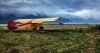
 The L-19 Bird Dog at Alaska's Kobuk Dunes
My plan was to lighten the airplane and see if it would carry me up and over the summit. I looked around for ceiling information on the Bird Dog, but the combination of old military records, and the engine modifications on the Ector Bird Dog made it hard to pin down a ceiling I could reasonably expect to reach. I surmised it would require a light updraft on the windward side of the mountain to make the climb easier, and just wanted to avoid the tremendous turbulence in the lee if the winds were too high. I needed the right conditions.
I borrowed an oxygen tank, and started to watch the weather closely. Meanwhile, I contracted a bad head cold (downside of being in close quarters with lots of passengers from all over the world), and was forced to wait for the symptoms to pass as I wanted clear nasal passages for the altitude changes.
 The L-19 Bird Dog relaxing on a river bar in the western Brooks range.
The airstrip at Kantishna sits at a 1,550' MSL elevation. I didn't know how long it would take me to climb 19,250' for a safe cushion over the top. My Bird Dog came with Ector long range tanks, so I figured I would try with half fuel, about 3.5 hours worth.
Stars aligned...time to go
The Solstice, June 21st arrived and it looked like all the stars were aligned – blue skies, unusually light easterly winds aloft, and I had the day off.
I unloaded all of the usual gear one flies around Alaska with, all the camping supplies, emergency rations, tool kit, spare parts, firearm and ammunition, rain tarps, and so on. Upon reflection, I loaded back in my good sleeping bag, pad, and expedition tent. If I was to end up perched on a glacier up there, I might as well be comfortable while waiting for the emergency responders. I also took the usual flight bag I always carried, with water, snack bars, and Inreach satellite tracker/communicator.
 Departing the airstrip at Kantishna
I made up a flight log on a yellow legal pad, planning on keeping track of the engine parameters, my O2 levels, and so on while I was making the attempt. I set it up with 1,000' intervals. In addition to keeping track of my own and the airplanes performance, I wanted a photographic record, so I was juggling my cell phone and a camera as well. All in all, it was a bit of a hectic Bird Dog cockpit.
Departing Kantishna, I set the airplane up for a good rate of climb, setting RPM at 2,500. I started keeping notes, striving for the 1,000' intervals, but I blew past them so rapidly that I thought I would just try for 2,000'. Those came and went too rapidly as well, so then I thought, "I'll go for 4,000".
 A view of Denali from the north side of the Alaska range
Climbing through 12,000 feet
At 12,000' MSL, above my favorite east side landmark, Gunsight Pass on the Upper Muldrow glacier, I turned on the oxygen and continued the climb.
Forecast was for a light east wind, and thus perhaps updrafts, so I made large figure eight gentle climbing turns, staying on the east face, and making radio callouts on the local mountain frequency (where I was given "top cover" by a fellow KAT air pilot, who stayed below 12,000').
 The 14,000' climbers' camp
I was trying not to bump off my finger mounted oximeter while taking notes, trying to snap a few pictures, hold a steady climb, not lose the oxygen mask, keep the engine happily leaned – all the while still trying to take in the awesome grandeur of the mountain around me.
I took close-up photos of the peaks I had been pointing out to passengers from a distance, as well as photos of my instruments to help me later interpret just how the airplane was performing. My photos show the airplane was climbing strong at 14,500', where I was climbing at 74 knots indicated. It was -4°C and we were making 430 FPM in the climb.
 A seldom-seen instrument panel condition indicating summit altitude, 12.6" manifold pressure, and still climbing.
I kept my primary altimeter set at the local field setting, but at 18,000 feet set the secondary Aspen Avionics glass panel altimeter to 29.92.
By 19,500' I had increased the stick back pressure and trimmed my airspeed to 67 knots indicated. It was -15°C out and still making 260 FPM. I felt like the airplane was a bit more sensitive on the ailerons; kept my turns very gentle, and could not detect much in the way of any outside help, lift or winds.
I was busily snapping photos, managing the oximeter, and trying to recognize the landmarks, like Denali Pass (between the North Peak and the South peak), the Kahiltna Horn, the "football field" on the South Peak, and admiring the dark marine layer of sedimentary rock which caps the North Peak, sitting atop the light grey granite of the McKinley massif itself.
 The 17,000' climbers' camp
I reached the peak ridgeline, and slowly orbited just above it. My altimeters were reading 20,220', and 20,020' respectively. I was not too concerned about the discrepancy, as it was such a gorgeous VFR day and I was safely above the summit. I was envious of the ski tracks successful climbers had left as the worked their way along the summit.
I was still showing a 210 FPM climb at 62 knots indicated, with an OAT of -16°C. I made a couple of orbits, noticing the sensitivity of the airplane as I was simulatneously handling the stick, the oximeter, and the cameras. I had, of course, managed to drop my pen at least once and, with the summit below me, keeping records to help my next attempt go smoothly suddenly didn't seem to mean as much. Looking back at my photos, I can see the cost of the juggling in my varied airspeeds and some panel photos showing 2 or 3 hundred foot per minute descent rates.
Time to descend
It was time to start down, and I set up a normal cruise power setting of 2200 RPM, left the throttle where it was, added a bit to the mixture and started down the West Buttress side of the mountain.
 Looking down at the summit of Denali from a naturally aspirated Bird Dog.
The West Buttress is the most climbed route. Normally we are told as commercial tour operators to steer clear of the climbers' camps, not wanting to bother them with aircraft noise. On this occasion, I mentally shrugged and made my gliding descent down past the 17,000' high camp, the 14,000' and the 11,000' camps. I took a snapshot of each camp as I passed by, still juggling cameras. Around 18,000' my oximeter was down to reading 85%, when I could actually keep it attached to my finger, and my "top cover" pilot buddy was beginning to coaxingly/jokingly urge me to come back down to where the oxygen was as my radio callouts might've been a bit... abbreviated.
I glided my way over Kahiltna Pass and down along the North Face, descending at a nice pace, clearing my ears all the way back to the gravel strip at Kantishna, thrilled with the sights, thrilled with the performance of the Bird Dog, and thankful for the help and support of the friends who encouraged me and helped make it happen.
I was back on the ground after a short 1.2 hours logged on the Hobbs meter, with never a bump or a burble, except those that were pilot induced...