"Water Dog" is a serendipitous intersection of two forces in general aviation: Aviat Aircraft, a sponsor and advertiser here at Backcountry Pilot, and the Seaplane Pilots Association. The article is written by SPA editor Mark Twombly and originally appeared in the July/August 2021 issue of Water Flying magazine. Photos by Brad Fuller and Mark Twombly.
The Piper Super Cub has been the standard-bearer for tandem-seat floatplanes for many, many decades and like the J-3 Cub from which it originated, it still commands an iconic status. But the PA-18 has been out of production for a long time, so new designs have come along in that Super Cub genre to satisfy pilots who want to fly the latest and the greatest two-seat floatplane. One such Adam’s-rib PA-18 that itself has been around awhile but still is very much in production is the Aviat Husky. And there’s a brand-new Husky flying that has a prominent new/old feature of its own—the 500th set of Wipline 2100 amphibious floats built by Wipaire, Inc.
When Wipline was developing the 2100s in 1996 the first set was installed on a 1951 Super Cub owned by Bob Wiplinger. It had been his father Ben’s airplane, and Bob still owns and flies it—on the same set of 2100s. The first airplane model the 2100s were certified on was the Husky, in March 1997, and since then more than 120 sets of Wipline 2100 floats have been installed on Huskies. The vast majority have been the amphibious 2100As.
 Photo: Brad Fuller
Aviat’s distinctive Anniversary paint scheme and Husky logo make for an attractive airplane
Photo: Brad Fuller
Aviat’s distinctive Anniversary paint scheme and Husky logo make for an attractive airplane
As for the Husky, it has gone through several iterations since it was introduced in 1987 by Christen Industries, the forerunner to Aviat Aircraft, which builds the Husky in Afton, Wyoming. The current model is the A-1C, available with a variety of sport and utility options including a carbureted 180- or fuel-injected 200-hp Lycoming 360 cubic-inch engine; various propellers—the Wipaire-float-equipped A-1C comes with either an 80-inch Hartzell Trailblazer composite prop or MT composite reversible prop; and your choice of landing apparatus: conventional wheeled landing gear, Wipline or PK floats, snow skis, or bush wheels. A glider tow kit also is available.
As with most new-production airplanes these days the panel can be populated with a mixture of old-school dials, instruments and gauges along with some glass for VFR flying or, more likely, an all-glass IFR-capable Garmin TXi array that electronically depicts what’s happening with the engine, systems, navigation and communications. Aviat also is offering an intermediate VFR panel with a Garmin G3X Touch.
Demo on floats
I had an extended introduction to the Wipline-shod A-1C thanks to Kevin Oaks, Aviat’s Southeast Regional Sales Director and Seaplane Specialist. A Florida resident and seaplane pilot, Kevin pitched the company on getting a new Husky demonstrator on floats to tempt the seaplane-rich Florida pilot population. Aviat was intrigued, and when Wipaire agreed to partner on the project Aviat built a new Husky and delivered it to Wipaire’s complex on Fleming Field in South St. Paul, Minnesota, for installation of the 2100A float kit.
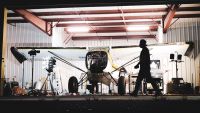
I rendezvoused with Kevin at Wipaire’s complex at KSGS one brisk, windy morning in early April to retrieve N73WY and fly it south to warmer air and waters in Central Florida. Wipaire was taking some glamor photos of the airplane inside one of its hangars and finishing up a few last-minute details, so we planned our departure for the next morning in calmer conditions.
 Photo: Brad Fuller
Wipaire installed the 500th set of 2100s it has produced on the new Husky A-1C.
Photo: Brad Fuller
Wipaire installed the 500th set of 2100s it has produced on the new Husky A-1C.
That gave me time to bone up on the airplane and the floats, and to observe the photo shoot. The professional lighting the photographers had set up cemented my first impression that this airplane is a beautiful piece of work. It stands tall and proud on the wheeled floats, and the Pitch Black, Bright White and Sparkling Silver paint, done in what Aviat calls its Anniversary design, is gorgeous. Wipaire did a good job of matching the airframe colors and design on the floats.
Rounding out the very appealing aesthetics is the distinctive metallic silver Husky logo on the vertical stabilizer. Piper’s iconic Cub emblem is endearing—a loveable, huggable teddy bear; Aviat’s Husky is commanding—muscular, capable and confident.
That gorgeous paint is applied to Ceconite skin covering a 4130 Chrome Molybdenum steel-tube fuselage frame. The cabin structure geometry is engineered for crashworthiness, and the seat structures are built to withstand 16g impacts. The major change to the Husky airframe dictated by the floats is installation of a finlet on each horizontal stabilizer. Earlier float-equipped Huskies have a ventral fin on the aft end of the fuselage, but according to Wipline’s Amy Gesch, an Alaskan operator suggested finlets over the ventral fin to improve yaw stability in gusty conditions and on crosswind landings. The fins add no additional flat-plate surface in a crosswind as does a ventral fin. They also provide better aft-fuselage dock clearance compared to a ventral fin.
 Photo: Mark Twombly
Finlets make for better crosswind landings and dock clearance.
Photo: Mark Twombly
Finlets make for better crosswind landings and dock clearance.
The cockpit is modified with the addition of a water rudder mechanism, and gear selector and four-light gear-position indicator with audible alerts. N73WY is equipped with the Wipaire Laser Gear Advisory System, which is standard on all new Wipline float kits and optional for existing floats. The laser is mounted on the underside of the wing and is active when the airplane is within about 400 feet of any surface. At about 50 feet above the surface it will issue an audible alert only if the gear is in the incorrect position based on the landing surface. No alert, no problem. Hear an alert, go around.
The hydraulic reservoirs for the landing gear and brake systems are mounted in a compartment behind the aft baggage hold. The gear hydraulic reservoir has a sight gauge to check fluid level. The only available float option not on N73WY was a walk wire between the float bows; it was added later.
All the good stuff
The 2100s haven’t changed much since they were introduced except that the amphibious version now features rebuildable landing gear cylinders. The 2100s were among the first Wipline floats to benefit from laser cutting of the aluminum skins and laser drilling of rivet holes for precision assemblage. What the 2100s have always had are all of the Wipline float features—wide, flat, non-skid tops; a large storage locker in each float that will hold 50 pounds of gear; heavy-duty keel with wear strip; sister keelsons to improve takeoff performance by reducing wetted area on the forebody of the floats; and mechanical “straws” to visually confirm gear position.
The 2100As displace 2185 pounds of fresh water, while the straight 2100s displace 2325 pounds. Maximum displacement per FAR 23.751 (80 pct reserve buoyancy) is 2428 pounds for the amphibs and 2581 pounds for the straight 2100s.
 Photo: Brad Fuller
An airplane for any surface.
Photo: Brad Fuller
An airplane for any surface.
The floats and all associated hardware for the amphibs weigh 432 pounds, 285 pounds for the straight-float version, for a net exchange weight of 349 pounds for the amphibs and 202 pounds for the straight floats. The floats come with an STC that adds 50 pounds to the maximum gross weight of the Husky, to 2,250 pounds, easing the gain in heft a bit. Useful load—fuel, people and cargo—of the Husky on 2100 amphibs is around 625 pounds, depending on airplane options. The airplane holds a maximum of 50 gallons in two wing tanks, so there is flexibility in managing fuel and payload.
Before departing we received some good advice from Wipaire: keep the nosewheel tires inflated to 50 pounds each for taxiing and to avoid the potential for rolling a tire off the wheel rim in a tight turn. Also, do not reposition the aircraft using a tow bar attached to just one nosewheel. Better to use a rope bridle tied to both floats. And a comment that applies to all floatplanes: to avoid damaging the prop when on the water, throttle up slowly until spray from the bows of the floats moves aft of the prop arc.
We took off from Fleming Field, Kevin flying, and headed east a few miles to pick up the Mississippi River, our nav source south for a day and a half, almost to Memphis. The first landmark was the Wipline Seaplane Base and grass strip on the west shore of the river. It’s where Wipaire owners, employees and friends gather each Tuesday evening for some good grub and gab.
 Photo: Mark Twombly
IFR on the Mississippi River airway
Photo: Mark Twombly
IFR on the Mississippi River airway
Headed south, the Mississippi alternates between a broad and casual river that lives up to its “mighty” descriptor to a much narrower waterway moving at a frenetic pace. The surface is pockmarked with islands, some with cabins and cultivation and more than a few protected by riprap and groins, and its east and west banks do little to shield adjacent, same-level fields from flooding except where fortified banks have been constructed.
Grain barges were a constant presence on the river. Harvest was months in the future so most were empty and tied up or nosed into the shoreline and held there by idling tugs.
 Photo: Mark Twombly
Grain barges awaiting the harvest
Photo: Mark Twombly
Grain barges awaiting the harvest
Stilt houses—weekend fishing getaways—were numerous as were fishing and pleasure boats, although it was early spring and still cool and thus most were still on trailers or dry-docked, covered in blue tarps. Small towns with a European look—long and narrow and hemmed in by the river on one side and bluffs on the other, neatly kept, with the railroad running through town along the shoreline—dotted the eastern shores.
 Photo: Brad Fuller
Lycoming power — 180 or 200 hp — makes for brisk takeoff performance.
Photo: Brad Fuller
Lycoming power — 180 or 200 hp — makes for brisk takeoff performance.
More than just us
Flying across long stretches of the country at a low altitude and modest pace is one of the most humbling and inspiring things a person can do. It offers up a unique appreciation for all that you see below—the land and its infinitely varied personality, the clever industry and inventiveness of the civilizations that have grown up on the land, and the impressive communities and homesteads people have created for themselves. If more than just general aviation pilots and our passengers could enjoy the privilege of taking in that view, we might have more understanding of and respect for one another and the land.
 Photo: Brad Fuller
Laser Gear Advisory system alerts the pilot only when gear position does not match landing surface.
Photo: Brad Fuller
Laser Gear Advisory system alerts the pilot only when gear position does not match landing surface.
Enough big-picture pontification. Three days spent traversing a good chunk of the country at 500 to 1000 feet and 90-95 knots indicated airspeed also afforded plenty of time to observe my immediate surroundings—the Husky cabin. It’s a nice place to spend some time. The seats have comfortable Oregon Aero cushions and five-point harnesses. The front seatback tilts forward to make it easier for the rear passenger to enter and exit, the entire seat adjusts fore and aft and the back cushion inclines as well. The rear seat and stick can be removed quickly for much more cargo space.
The rear-seater has throttle, propeller and mixture controls, a stick, and rudder pedals/toe brakes, but you fly the Husky from the front seat. The prop and mixture controls have been moved from the panel to the throttle position on left sidewall because all of that glass on the panel consumes all of the available real estate. It requires some attention and finesse to adjust the engine controls as they are tightly packed.
Storage in the Husky isn’t an issue. There’s a large baggage hold behind the rear seat accessible from the rear seat and also through a separate hatch on the right-side fuselage. A left-side hatch is available as an option. Also, a few light items can be stowed in the compartment where the gear and brake cylinders are mounted. A pouch on the back of the front seat held all of my daily stuff—coffee mug, water bottle, small camera, notepad and mobile phone—when I was back there, and I moved it all to a pouch on the sidewall when I was up front.


(Above) Hartzell composite Trailblazer prop and Wipline’s signature wide float tops with nonskid coating.
 Photo: Mark Twombly
Husky is available with full IFR-capable Garmin TXi panel.
Photo: Mark Twombly
Husky is available with full IFR-capable Garmin TXi panel.
The left-side Plexiglas is in two pieces and slides fore and aft for an open window. The right-side door is a two-piece hatch, and the top portion can be latched up while in flight although it gets very breezy for the back-seater. The roof of the cabin also is a Plexiglass panel so all-around visibility is great, but a cap and sunglasses are a must.
Fuel gauges are clear sight tubes on each wing root, and the controls for the dual Bose headsets handily fit in plastic brackets.
The first fuel stop involved a crosswind landing in Galesburg, Illinois. Kevin had the right rudder pinned to the stop to keep the nose pointed straight in the right-to-left crosswind, but he wanted a bit more. It was later determined that a cable that is part of the aircraft rudder/water rudders system was a bit slack, which prevented full rudder deflection. The cable was tightened in Florida following our trip, and Kevin says that he now has full rudder authority.
Ogling
I got my first turn in the front on day two when we departed St. Charles, Missouri, north of St. Louis for Blairsville, Georgia, with a fuel stop in Covington, Tennessee. The Covington stop was typical of every airport we landed at to refuel. People walked over to ogle the Husky and comment that it is a beautiful bird.
 Photo: Mark Twombly
Floats come with an STC that increases gross weight 50 pounds. The 50-gallon fuel capacity affords flexibility in endurance vs payload.
Photo: Mark Twombly
Floats come with an STC that increases gross weight 50 pounds. The 50-gallon fuel capacity affords flexibility in endurance vs payload.
The Husky is easy to taxi on hard surfaces using a dab of brake to turn the castoring nosewheels. The 180-hp Lycoming makes for brisk acceleration and a short takeoff run. I didn’t get a chance to time the takeoff or judge the distance so I’ll quote Wipaire’s POH Supplement specifications, which say that hard-surface takeoff distance at gross weight in sea-level standard conditions (59 degrees F) is 720 feet; to clear a 50-foot obstacle it’s 1525 feet. (This is with a 76-inch propeller; no figures were published for the 80-inch Trailblazer prop.) In cruise flight the airplane is stable longitudinally, with little of the wallowing typical of many floatplanes.


(Clockwise from above) Cable and strut geometry for air and water rudders and horizontal stabilizer. Wipline 2100s feature sister keelsons and factory-installed spray rails. An oar for paddling to shore. Cabin door, baggage, and aft compartment opened up. See-and-avoid markings on flap hinges.


 Photo: Mark Twombly
My first water landing came on day three on the St. Johns River in northwestern Florida. It was a no-surprises event—good visibility and control all the way to flare and touchdown. Step-taxiing was the same—easy to find the sweet spot on plane and keep it there with throttle and pitch, and good directional and lateral control using rudder and ailerons.
Water takeoffs featured short runs thanks to the power. Wipiare says water takeoff distance on the amphibs is 913 feet; takeoff distance to clear a 50-foot obstacle is 1612 feet; at a warmer 79 degrees F the distance would be 1847 feet. Again, this is with a 76-inch prop.
 Photo: Mark Twombly
Plenty of plexiglass for excellent all-around visibility
Photo: Mark Twombly
Plenty of plexiglass for excellent all-around visibility
 Photo: Mark Twombly
Funmeter on Kevin Oaks’ shoulder is pegged.
Photo: Mark Twombly
Funmeter on Kevin Oaks’ shoulder is pegged.
The Husky on Wipaire 2100s competes in a tight, popular PA-18-progeny market populated by various certified and Experimental models that are PA-18 progenies. No surprise these are expensive airplanes compared to the Super Cubs of old—N73WY lists for $468,928—but a Super Cub would be playing in that league if it were in production today.
With a remarkable 1500 built over the years, the Husky is a proven package. It’s available with lots of options to configure it for the precise sport or utility role desired. It’s a performer, it’s stable and it’s predictable in all regimes—in the air, on the water and on the ground. And it’s comfortable for pilot and passengers. It’s all that the logo on the tail suggests: muscular, capable and confident.
Aircraft Specifications
| Aircraft specs | |
|---|---|
| Engine | Lycoming O-360-A1P |
| Propeller | Hartzell 76" Composite |
| Length | 22' 7" |
| Height | 7' 5" |
| Wing Span | 35' 6" |
| Wing Area | 183 sq ft |
| Wing Loading | 12 lbs/sq ft |
| Power Loading | 12.2 lbs/hp |
| Seats | 2 tandem |
| Cabin Height | 48 inches |
| Cabin Width | 27" |
| Empty Weight | 1,275 lbs |
| Maximum Gross Weight | 2,250 lbs |
| Maximum Gross Weight Floats | 2,250 lbs |
| Useful Load | 975 lbs |
| Payload w/Full Fuel | 675 lbs |
| Fuel Capacity | 50 U.S. gallons usable |
 Photo: Dan Nickens
Wipaire has installed more than 120 sets of 2100s on Huskies.
Photo: Dan Nickens
Wipaire has installed more than 120 sets of 2100s on Huskies.
Full gallery


https://backcountrypilot.org/features/category/featured-bush-planes/water-dog-aviat-husky-wipline-amphibs/97-water-dog-aviat-husky-wipline-amphibs#sigProGalleria42df172101