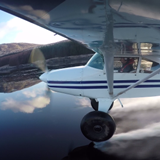
33 mile tire cleaning session
Wed Feb 17, 2016 9:08 pm
Re: 33 mile tire cleaning session
I like your response, Kevin
- CamTom12 offline

- Posts: 3705
- Joined: Sun Jul 08, 2012 1:08 pm
- Location: Huntsville
- FindMeSpot URL: https://share.delorme.com/camtom12
- Aircraft: Ruppe Racer
Experimental Pacer
home hand jam "wizard"
Thu Feb 18, 2016 10:51 am
Re: 33 mile tire cleaning session
Damn, I was going to point out nose wheels weren't properly represented in the photos and start a movement, "Nosewheels Matter"


Thu Feb 18, 2016 10:58 am
Re: 33 mile tire cleaning session
Timberwolf wrote:hotrod180 wrote:....might get a "flight below 2000' AGL prohibited" zone placed on Lake Tahoe. Don't think it can't be done either- Lake Crescent on the north edge of Olympic National Park in Washington has such a restriction.
For my own education, I looked up lake crescent area and couldn't find where this restriction existed. I do see that such a restriction lies over the western seaboard and it violaties NOAA regulations through 15 CFR 922. However, is lake crescent not located in the area that you are requested not to fly below 2000' AGL, but is not regulatory?......
I doubt the NPS really cares about someone flying over lake Crescent at 1500' or even 1000', but it would probably get them pretty worked up if you flew the length of the lake at 20' off the water.
"Requested" vs "regulatory"....NavMag Indian Island is a US Navy munitions handling base located about 3 miles east of my airport, right off the departure end of 27. There was a TFR placed over it after 9/11, nowadays it is tagged on the sectional with "for reasons of national security, pilots are requested to avoid flight at and below 2900' MSL in this area". I violate this requested 2900' fairly often, but I don't push my luck by doing it at 500'. I likewise don't push it by doing a low pass by their munitions loading dock when a warship's tied up to it. There are two other Navy bases in the Puget Sound area likewise tagged, I don't push my luck at them either.
Cessna Skywagon -- accept no substitute!
Thu Feb 18, 2016 6:46 pm
Re: 33 mile tire cleaning session
Awesome Video Thanks for sharing. 
Fri Feb 19, 2016 9:24 pm
Re: 33 mile tire cleaning session


Now that's funny right there, I don't care who you are!!
- bart offline

- Posts: 545
- Joined: Fri Aug 21, 2009 7:54 pm
- Location: Fresno, CA
- FindMeSpot URL: http://share.findmespot.com/shared/face ... 1ZTy9zAEWv
- Aircraft: Cessna 180
Sun Feb 21, 2016 5:51 pm
Re: 33 mile tire cleaning session
Hahaha, best response ever . Just what this thread needed. Drop the mike and walk off the stage!
. Just what this thread needed. Drop the mike and walk off the stage!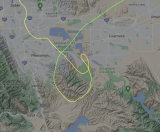
Mon Feb 22, 2016 5:24 pm
Re: 33 mile tire cleaning session
Zenithguy wrote:Damn, I was going to point out nose wheels weren't properly represented in the photos and start a movement, "Nosewheels Matter"
I only know for sure of one pilot who has successfully water-skied a nose-wheel aircraft. Theoretically quite difficult, because with the centre of mass in front of the main wheels the aircraft is in unstable equilibrium at best. Water-skiing a taildragger is much easier, by which I don't mean to belittle the stamina required to do it for half an hour...
People often ask about use of brakes, etc. and the answers to such questions are in the 1963 NASA Technical Note TN D-2056, "Phenomena of pneumatic tire hydroplaning". Unfortunately it's long out of print, so I put a PDF copy on our airfield website: http://jacksonrifles.com/zz-gs/information_links. In spite of the provenance, it's not rocket science - quite an easy read. The only significant change since 1963 is that radial tires with their different footprint shape have reduced the constant in the well-known equation for hydroplaning speed from 9 to about 6.
This, and other finer points of applying these phenomena for the use and convenience of backcountry aviators are covered in my how and why article: "Hydroplaning and water-assisted landings", a copy of which resides with the NASA TN at the adbove URL.
Apart from being a convenient way to approach for narrow beach and river bank landings, this mode of flight sharpens awareness of elevator control. The drag on the tires is roughly proportional to the vertical load, so the slightest pitch change is immediately felt as acceleration or deceleration, to be countered by a power change. Who knows, if the "pilots" of AF447 had spent a bit of time water-skiing at school, they might have twigged what not to do with the side-sticks of an A330...
Oh, I almost forgot, nice work and nice photos AKT, thanks for posting.
Mon Feb 22, 2016 10:34 pm
Re: 33 mile tire cleaning session
This high pressure parked over So Cal you could clean your tires to Catalina and back. Avoid LAX airspace and no one would give a shit.

Tue Feb 23, 2016 8:57 am
Re: 33 mile tire cleaning session
N-Jacko wrote:This, and other finer points of applying these phenomena for the use and convenience of backcountry aviators are covered in my how and why article: "Hydroplaning and water-assisted landings", a copy of which resides with the NASA TN at the adbove URL.
Both articles are indeed pretty accessible. Thanks for sharing them, and for writing one of them. I was getting ready to start a similar effort with a student using CFDs, but will probably abandon that since it would now be an exercise in creating pretty charts and graphs rather than contributing significant new information.
I have three questions:
1) Using Dreher and Horne's formula the speed at which hydroplaning occurs rises with tire pressure. Is this because the higher pressure allows the tire to penetrate more easily, rather than spreading the load across a wider footprint due to compression of the bottom of the tire?
2) You quote the NAL as suggesting that the constant can be lowered from 9 to 6 to account for modern tires. This means that hydroplaning occurs at a *lower* speed, seemingly not what one would expect after 50+ years of advancement in tire technology. Can you provide any detail as to why this particular aspect of tire design seems to have gotten worse and what the trade-offs are that made that reduction in capability a reasonable compromise? Is it that modern tires are softer or lower pressure than tires in the 1960's, providing better braking action on normal days, but an increased tendency to hydroplane?
3) The pilots forums often make comments about only wanting to do this with big tires. Do you have any data about radius and width and their effect on hydroplaning speed? Intuitively it seems like a larger diameter would reduce the bow wave and allow the tire to get on top more quickly, but maybe that difference is so minor as to be a non-factor until you get to exceptionally small tires. Width seems like it would have a linear relationship to speed. What do you know about these issues?
- rw2 offline

- Posts: 1799
- Joined: Sat Dec 22, 2012 1:10 pm
- Location: San Miguel de Allende
- FindMeSpot URL: https://share.delorme.com/LaNaranjaDanzante
- Aircraft: Experimental Maule
Follow my Flying, Cooking and Camping adventures at RichWellner.com
Tue Feb 23, 2016 11:19 am
Re: 33 mile tire cleaning session
gbflyer wrote:How do I hydroplaning the wheels?
Your question is outdated, sir.
Now it's proper to ask "how do I "Phenomena of pneumatic tire hydroplaning" the wheels?"
Cessna Skywagon -- accept no substitute!
Tue Feb 23, 2016 4:23 pm
Re: 33 mile tire cleaning session
rw2,
Please don't drop the idea of writing on this subject. What's been done so far is mostly from the point of view of avoiding hydroplaning, so a new look with some finite element analysis on how to use it would surely not go amiss. For instance, I don't think anyone has modelled the effect (if any) of tire diameter, or wave/ripple heights, or water depth of more than an inch or two.
1): yes, that's as good a way of looking at it as any. Pneumatic tires exert ground pressure roughly equal to their inflation pressure, although if the sidewalls are very stiff the tire begins to behave more like a solid wheel. This relationship between tire pressure and hydroplaning speed explains why trucks are generally less susceptible to hydroplaning than automobiles.
2) yes, the NAL came up with a constant of 6.4 for radial tires, and I've water-skied bushwheels (which are radials) down to about V=6*sqrt(Pt). I say "about", because the transition is not a steady state easily measured on a lake or river. For automobiles, lower hydroplaning speed is a quid pro quo for all the advantages brought by the supple sidewalls of radial tires. However, I think this has been mitigated by modern automobile tires having lower profiles (less sidewall) and better tread design, along with improvements in highway pavement technology and drainage.
3) There's plenty of evidence that small tires can be water-skied, but those tires do tend to have higher inflation pressures, hence higher hydroplaning speed. Apart from the famous "cool dudes in their Harvards" video, there's Brian Lansburgh in his C140, and Dave Phillips in a Tiger Moth on Lake Karapiro, NZ:
If the hydroplaning speed is higher than stall speed in ground effect there's not much point in water-skiing for gravel bar landings. However, I'm about to change my 31" ABWs for 8.50x6 for a trip to Germany, so I might try the 8.50s next month just to see how they feel on the water.
Please don't drop the idea of writing on this subject. What's been done so far is mostly from the point of view of avoiding hydroplaning, so a new look with some finite element analysis on how to use it would surely not go amiss. For instance, I don't think anyone has modelled the effect (if any) of tire diameter, or wave/ripple heights, or water depth of more than an inch or two.
1): yes, that's as good a way of looking at it as any. Pneumatic tires exert ground pressure roughly equal to their inflation pressure, although if the sidewalls are very stiff the tire begins to behave more like a solid wheel. This relationship between tire pressure and hydroplaning speed explains why trucks are generally less susceptible to hydroplaning than automobiles.
2) yes, the NAL came up with a constant of 6.4 for radial tires, and I've water-skied bushwheels (which are radials) down to about V=6*sqrt(Pt). I say "about", because the transition is not a steady state easily measured on a lake or river. For automobiles, lower hydroplaning speed is a quid pro quo for all the advantages brought by the supple sidewalls of radial tires. However, I think this has been mitigated by modern automobile tires having lower profiles (less sidewall) and better tread design, along with improvements in highway pavement technology and drainage.
3) There's plenty of evidence that small tires can be water-skied, but those tires do tend to have higher inflation pressures, hence higher hydroplaning speed. Apart from the famous "cool dudes in their Harvards" video, there's Brian Lansburgh in his C140, and Dave Phillips in a Tiger Moth on Lake Karapiro, NZ:
If the hydroplaning speed is higher than stall speed in ground effect there's not much point in water-skiing for gravel bar landings. However, I'm about to change my 31" ABWs for 8.50x6 for a trip to Germany, so I might try the 8.50s next month just to see how they feel on the water.
Sat Mar 05, 2016 5:06 pm
Re: 33 mile tire cleaning session
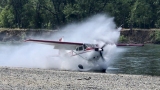
Added a GoPro to the left tie down ring so we can see wheel rotation.
The wheel and tire spin quite freely when carrying little vertical load at 50-60 knots, but when we reduce speed to 40 kts and the tire is carrying more of the airplane's weight, the rotation slows markedly - as predicted by NASA:
The wheel and tire spin quite freely when carrying little vertical load at 50-60 knots, but when we reduce speed to 40 kts and the tire is carrying more of the airplane's weight, the rotation slows markedly - as predicted by NASA:
Sat Mar 05, 2016 6:56 pm
Re: 33 mile tire cleaning session
rw2 wrote:I was getting ready to start a similar effort with a student using CFDs, but will probably abandon that since it would now be an exercise in creating pretty charts and graphs rather than contributing significant new information.
CFD would likely be fruitless without some remarkable modeling efforts, since the actual results change so much with other variables (tire construction, for example, due to differences in footprint geometry changes).
Wider profile tires per the literature listed above and elsewhere, hydroplane at lower speeds.
Sun Mar 06, 2016 11:13 am
Re: 33 mile tire cleaning session
Didn't want to tack onto this thread with all its grief and acrimony, however it seems to be the forum du jour for this topic.
Hope y'all take the time out for an interesting read of the Hydroplaning and Water Assisted Landings pdf, by Peter Jackson. Including some cheap shots at EASA mentality and methodology - easy fodder.
Odd that the speed is independent of tire radius, though there is the oblique connection of larger-diameter -> lower tire pressure. If the different diameters were at the same pressure would the results be the same? We will soon benefit from the experimentation of the 8:50x6 tires vs the 31 ABW. Hopefully with some video.
Likewise the concept of a decrease in speed resulting (all on its own, through the water pushing up on the tires) in an increase in angle of attack to rebalance the airplane is counter-intuitive, especially at speeds that are getting seriously below stall speed. More heartening is the feedback loop (porpoising) from decreased speed that warns the pilot he is approaching his waterskiing limit.
Running 10psi I should be good to waterski at 25mph. Using GPS ground speed of course, if the lift is coming from the water-pressure on the tires, a headwind will show a higher IAS than the tires need, besides, the IAS isn't that good below about 40 mph. So maybe the angle of attack isn't holding the plane up at all at this point (?).
I was waterskiing up to a beach yesterday and though the same - if I'm going faster than stall speed, what's the point? Reading this paper gives some background for the next step to slowing as you hit the beach.
Hope y'all take the time out for an interesting read of the Hydroplaning and Water Assisted Landings pdf, by Peter Jackson. Including some cheap shots at EASA mentality and methodology - easy fodder.
Odd that the speed is independent of tire radius, though there is the oblique connection of larger-diameter -> lower tire pressure. If the different diameters were at the same pressure would the results be the same? We will soon benefit from the experimentation of the 8:50x6 tires vs the 31 ABW. Hopefully with some video.
Likewise the concept of a decrease in speed resulting (all on its own, through the water pushing up on the tires) in an increase in angle of attack to rebalance the airplane is counter-intuitive, especially at speeds that are getting seriously below stall speed. More heartening is the feedback loop (porpoising) from decreased speed that warns the pilot he is approaching his waterskiing limit.
Running 10psi I should be good to waterski at 25mph. Using GPS ground speed of course, if the lift is coming from the water-pressure on the tires, a headwind will show a higher IAS than the tires need, besides, the IAS isn't that good below about 40 mph. So maybe the angle of attack isn't holding the plane up at all at this point (?).
I was waterskiing up to a beach yesterday and though the same - if I'm going faster than stall speed, what's the point? Reading this paper gives some background for the next step to slowing as you hit the beach.
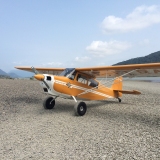
'74 7GCBC, 26" ABW, Aera 660 feeding G5 and FC-10 FF.
Sun Mar 06, 2016 1:09 pm
Re: 33 mile tire cleaning session
Karmutzen wrote:1. Odd that the speed is independent of tire radius
2. If the different diameters were at the same pressure would the results be the same?
3. Likewise the concept of a decrease in speed resulting (all on its own, through the water pushing up on the tires) in an increase in angle of attack to rebalance the airplane is counter-intuitive, especially at speeds that are getting seriously below stall speed.
4. Running 10psi I should be good to waterski at 25mph....So maybe the angle of attack isn't holding the plane up at all at this point (?).
Karmutzen,
I'll try to answer those points.
1. Yes, it is too odd to be true, because if we imagine an infinitely large or vanishingly small diameter there must be some relationship between diameter and hydroplaning speed. However, within reason, pneumatic tire contact area is a function of inflation pressure and load, so if a small tire and a large one are inflated to the same pressure, the small one will deform more to support the same weight.
2. In theory yes, unless the disparity in diameter is very great. We know that small diameter low pressure automobile tires hydroplane more readily than larger diameter high pressure truck tires. It's going to be difficult to check, because I don't know of any small diameter airplane tires which run at 10 psi, and because no one is going to be keen to sacrifice an airplane (even a Maule
 ) to prove a not terribly important point - most backcountry airplanes have big tires.
3. It is excessive angle of attack which causes a wing to stall, not airspeed. With much/most of the airplane's weight supported by the tires and the tailwheel well out of the water, the angle of attack is below that which would stall the wing.
4. Yes, at 25 mph the wing contributes only a quarter as much lift as it would at 50 mph with the same AoA. (Those pesky NASA scientists again - https://www.grc.nasa.gov/www/k-12/airplane/lifteq.html)
ATB, Peter.
Mon Mar 07, 2016 2:20 am
Re: 33 mile tire cleaning session
Karmutzen,
Just one other point; it's none of my business how you fly your aeroplane, but if your 29" Airstreak tyres are cross-ply rather than radials, then your theoretical minimum hydroplaning speed at 10 psi may be closer to 28 knots than 25 mph. Your math may vary, and the theory may be wrong, but I would approach 30 knots with caution on those tyres.
Just one other point; it's none of my business how you fly your aeroplane, but if your 29" Airstreak tyres are cross-ply rather than radials, then your theoretical minimum hydroplaning speed at 10 psi may be closer to 28 knots than 25 mph. Your math may vary, and the theory may be wrong, but I would approach 30 knots with caution on those tyres.
Mon Mar 07, 2016 10:36 am
Re: 33 mile tire cleaning session
N-Jacko wrote:.... We know that small diameter low pressure automobile tires hydroplane more readily than larger diameter high pressure truck tires. ....
Maybe I'm taking this out of context, but you don't suppose that the car hydroplanes more readily than the truck because it weighs much much less, and thus has less weight per sq inch on the tires?
Think of a pickup truck spinning it's rear wheels when empty, but getting traction with a heavy load in back. Same tires, same inflation, different weight.
Cessna Skywagon -- accept no substitute!
Mon Mar 07, 2016 10:39 am
Re: 33 mile tire cleaning session
N-Jacko wrote:....The wheel and tire spin quite freely when carrying little vertical load at 50-60 knots, but when we reduce speed to 40 kts and the tire is carrying more of the airplane's weight, the rotation slows markedly - as predicted by NASA...
Someone once told me that he thought you had to have the brakes locked to waterski.
I've never waterskied, and (just call me chicken) don't plan to, but it seems to me that locking the brakes might drag the wheel under. ??
Cessna Skywagon -- accept no substitute!
Mon Mar 07, 2016 10:41 am
Re: 33 mile tire cleaning session
hotrod180 wrote:Someone once told me that he thought you had to have the brakes locked to waterski.
I've never waterskied, and (just call me chicken) don't plan to, but it seems to me that locking the brakes might drag the wheel under. ??
It won't.
Mon Mar 07, 2016 11:19 am
Re: 33 mile tire cleaning session
So wheels locked or freewheeling doesn't make a difference.
Cessna Skywagon -- accept no substitute!
DISPLAY OPTIONS
Who is online
Users browsing this forum: No registered users and 23 guests
Latest Features
-
Live to Tell
A Minnesota pilot is surprised to learn that the sudden asymmetric drag of an out-of-rig ski can…Read More -
Creators
Working in some of the Yukon's most beautiful and remote environments, photographer Simon Blakesley captures aircraft in…Read More -
Aircraft Ownership and Maintenance
Upgrading to big tires can make a huge difference in backcountry performance, but with those gains come…Read More -
Tales from Yesteryear
In this tale from bush flying yesteryear, Don Cogger signs up to help Atlee Dodge Jr recovery…Read More


Latest Knowledge Base
-
Destinations
A regional guide with ideas for winter camping destinations in California, Nevada, New Mexico, and Arizona.Read More -
Aircraft
Finding an affordable aircraft that can handle the backcountry for $80K or less? A challenge for sure, but with the…Read More -
Aircraft
01.29.2018 - Zane - Updated tire diameter graphic to add 8.50x10 Guide to tires for use in the backcountry and off-airport landing…Read More -
Pilots
12.22.2013 - Initial article format Operating aircraft on skis and negotiating a snow-covered landscape is an entirely unique skillset and environment.…Read More


