Any back country experience in a Cherokee?
Fri Jun 24, 2016 9:03 pm
Re: Any back country experience in a Cherokee?
The USA-35b was used for the ragwings, the Apache, the Aztec, and the Pawnee. The rest, including the Cherokee, used a small handful of other profiles that offered mild low speed characteristics and slightly better cruise performance.
Fri Jun 24, 2016 11:03 pm
Re: Any back country experience in a Cherokee?
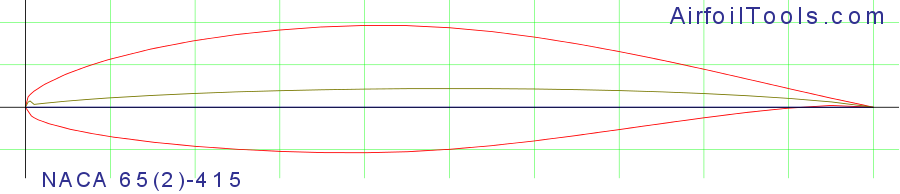
The Cherokee uses the NACA 65-415. Here is the shape:
http://airfoiltools.com/images/airfoil/ ... 5-il_l.png
This is about as far from a flat bottom low speed "bush" airfoil as you're gonna get. Sharp leading edge, aft loaded, max thickness way back.
The Cherokee was designed by Fred Weick (and John Thorp) to be a faster competitor to the all-metal Cessnas, because the old fabric Tri-Pacer was seen by airplane buyers as "old", crude, and less elegant. So Piper put a "faster" and more modern swoopy looking airfoil on the Cherokee that looked closer tot he P-51 airfoil than the Cessna airfoil.
Now we did have swoopy looking "Fast" airfoils on our racing gliders trying to achieve laminar flow and low drag, and the truth is that you could slow those wings down pretty good. But in order to do that you had to use camber (flaps and ailerons that drooped full span). But the sharp pointed airfoils simply do not have the slow speed "manners" and "tolerance" of the flat bottom bush plane wings.
This is relevant to the OP's Cherokee question because you can possibly make the Cherokee fly slower and have much better STOL performance, by re-rigging it to have this droop at the trailing edge. But it is 100% not legal, it will probably void the crap out of your insurance policy, and get you in trouble down at the FSDO. The airplane might have good raw STOL performance but it will likely not have the friendly and solid low speed safety that the Cub pilots love so much in demanding environments.
http://airfoiltools.com/images/airfoil/ ... 5-il_l.png
This is about as far from a flat bottom low speed "bush" airfoil as you're gonna get. Sharp leading edge, aft loaded, max thickness way back.
The Cherokee was designed by Fred Weick (and John Thorp) to be a faster competitor to the all-metal Cessnas, because the old fabric Tri-Pacer was seen by airplane buyers as "old", crude, and less elegant. So Piper put a "faster" and more modern swoopy looking airfoil on the Cherokee that looked closer tot he P-51 airfoil than the Cessna airfoil.
Now we did have swoopy looking "Fast" airfoils on our racing gliders trying to achieve laminar flow and low drag, and the truth is that you could slow those wings down pretty good. But in order to do that you had to use camber (flaps and ailerons that drooped full span). But the sharp pointed airfoils simply do not have the slow speed "manners" and "tolerance" of the flat bottom bush plane wings.
This is relevant to the OP's Cherokee question because you can possibly make the Cherokee fly slower and have much better STOL performance, by re-rigging it to have this droop at the trailing edge. But it is 100% not legal, it will probably void the crap out of your insurance policy, and get you in trouble down at the FSDO. The airplane might have good raw STOL performance but it will likely not have the friendly and solid low speed safety that the Cub pilots love so much in demanding environments.
.
Sat Jun 25, 2016 1:42 am
Re: Any back country experience in a Cherokee?
KSPAJC
Google - handling notes on the piper pa28
Good - Loonng - but good read on Cherokee.
https://www.google.com/webhp?sourceid=c ... %20pa%2028
Hope I got it all.
Chris C
Google - handling notes on the piper pa28
Good - Loonng - but good read on Cherokee.
https://www.google.com/webhp?sourceid=c ... %20pa%2028
Hope I got it all.
Chris C
53 C-170-B+
It is better to be late in this world, than early in the next.
It is better to be late in this world, than early in the next.
Sat Jun 25, 2016 6:30 am


- Crzyivan13 offline
- Posts: 1811
- Joined: Sat Nov 24, 2012 9:50 pm
- Location: Ohio- OI27 Checkpoint Charlie
- FindMeSpot URL: https://share.delorme.com/EvanDavis
- Aircraft: 1957 Cessna 182A
Sat Jun 25, 2016 8:40 am
Re: Any back country experience in a Cherokee?
Probably one thing that is fairly obvious is that pilot technique varies all up and down the scale, no matter what airplane is being flown. Most average pilots don't begin to take advantage of what their airplanes are capable of doing.
That takes me back to something I've said to several other relative newbies, and that is practice, practice, practice. If you can't reliably and consistently place the mains of your Cherokee on the spot that you intend them to be, practice until you can. If you need help from a qualified instructor to adjust your technique until you can do that, then get the help. But stay out of the back country until you can. It's one thing to screw up landing on a 5000' strip by floating 1000' past the touchdown markers where you intended to land; it's another thing altogether to screw up landing on a 1500' strip by floating 1000' past the intended point of touchdown.
The Cherokee's airfoil may not be the ideal one for slow speed, but how slow do you need to go? Fact: approach at 1.3 Vso, and place the mains exactly where you want them to be, and the Cherokee will get into and out of just about any reasonable strip that any similarly powered Cessna tricycle will get into and out of. The 3-4 knot slower Vso of the Cessna is pretty inconsequential.
Cary
That takes me back to something I've said to several other relative newbies, and that is practice, practice, practice. If you can't reliably and consistently place the mains of your Cherokee on the spot that you intend them to be, practice until you can. If you need help from a qualified instructor to adjust your technique until you can do that, then get the help. But stay out of the back country until you can. It's one thing to screw up landing on a 5000' strip by floating 1000' past the touchdown markers where you intended to land; it's another thing altogether to screw up landing on a 1500' strip by floating 1000' past the intended point of touchdown.
The Cherokee's airfoil may not be the ideal one for slow speed, but how slow do you need to go? Fact: approach at 1.3 Vso, and place the mains exactly where you want them to be, and the Cherokee will get into and out of just about any reasonable strip that any similarly powered Cessna tricycle will get into and out of. The 3-4 knot slower Vso of the Cessna is pretty inconsequential.
Cary
"I have slipped the surly bonds of earth..., put out my hand and touched the face of God." J.G. Magee
Sat Jun 25, 2016 9:13 am
Re: Any back country experience in a Cherokee?
Common practice in Alaska for years and it works 
tcj wrote:Take a length of radiator hose, cut it lengthwise and clamp it around the nose wheel strut with hose clamps so the strut doesn't collapse when the nitrogen leaks out. Use a piece long enough that the plane looks like a tail dragger with a nose high attitude on the ground. It'll keep the prop up out of the grass.

Keep the shiney side up and the dirty side down...
Sat Jun 25, 2016 9:46 am
Any back country experience in a Cherokee?
Thanks guys! I completely agree with you Cary. I've practiced and practiced and practiced some more on spot landings and am, in my opinion at least, pretty good at them. Proficient definitely. I practice the short/soft field techniques frequently as well. Only thing is that i'm practicing all of this on a paved runway with a clear approach path. So I know it will be different from a grass or dirt strip that is surrounded by trees. I'm going to practice some grass strip stuff here pretty soon. There are a few around here that wiuld be good to practice on. I'm also practicing with just me in the airplane and no bags or cargo like would be taken for camping or whatnot....so, still a lot to try/practice, but I am definitely going to be working on it. As a side question: anyone on the forum in the southeast that could recommend some good destinations around here??? Otherwise I guess I'll be making a pilgrimage to the left side of the country for some fun and experience. Again, thanks for all of the input!!!
Sent from my iPhone using Tapatalk
Sent from my iPhone using Tapatalk
Mon Jun 27, 2016 3:11 am
Re: Any back country experience in a Cherokee?
Backcountry Cherokee!?!? Now you're speaking my language!
I have a 1966 Cherokee 180 and I spend a fair bit of time in the summer exploring old abandoned and remote airstrips.
Every airplane is compromise, with strengths and weaknesses. The Cherokee is no different. The Cherokee's nose gear is very robust, attaching to the engine mount rather than the firewall (a la Cessna), but like most tricycle gear airplanes there isn't a whole lot of prop clearance so you have to be careful of any major dips or potholes. The low wing is both an advantage and a disadvantage in backcountry flying. The low wing gives you much better visibility in turns, which can be a big deal when flying into tight areas. Low wings are also safer in a crash, there's no way around the fact that backcountry flying is a somewhat higher risk form of aviation. More structure underneath you is a good thing. What you lose with the low wing is utility/ease of loading, downward visibility for sightseeing, brush clearance, and the rain/sun protection provided by the high wing.
The Cherokee's wing is interesting and I believe fairly unique. I'm sure one exists, but I can't think of another airplane that uses a laminar flow aerofoil for a high lift application. The reason for this design is that a conventional aerofoil would put the main spar right where the back seat passenger's feet are supposed to go, rather than under the seat. Now the wing isn't bad, but it is different than the Cessnas that you (and I) learned to fly on. The laminar flow aerofoil on the Cherokee develops prodigious amounts of drag on the back side of the power curve. This has implications for both takeoff and landing.
The best takeoff in a stock Cherokee is done jet style: stabilator neutral, accelerate to Vr (50-60 mph depending on weight) then rotate to lift off. This is in contrast to keeping the nosewheel light and allowing it to fly off as one would do in a Cessna. If you hold the yoke too far back in a Cherokee and try to take off you will assume a nose high attitude into ground effect, and carry that attitude right into the trees at the far end of the runway due to the excessive drag at low speed. Don't do this. It gets expensive.
If you get a Cherokee slow on landing you will be rewarded with approximately the same glide ratio as a New York city manhole cover thrown from the top of the Empire State building. This scares many people coming from other machines so they wind up flying ludicrously fast approaches leading them to float down the runway in ground effect. An old Cherokee, with those short, fat wings shouldn't float at all on landing. Stabilator authority (as in lack thereof) can be an issue in the old birds when landing at low speeds, a touch of power can aid greatly with this. I usually don't fully retard the throttle until after the wheels touch. The video on landings from the knowledge base is worth a watch, but be aware that using those techniques with the Cherokee can require quite a blast of power to arrest the descent rate to flare and should be approached with caution. A Cherokee approach flown on the backside of the power curve can be remarkably steep, which is handy for dropping in over an obstacle, but it does require a lot of familiarity with the airplane and its behaviour near stall. Also keep in mind that there isn't a Cherokee on Earth that takes off shorter than it lands so in practical terms a real, edge of the envelope short field landing is mostly an academic exercise anyway. I landed my Cherokee in 400' the other day, which is cool and all, but I sure as hell can't take off in 400' so I didn't really gain anything.
If you want to take your Cherokee into the backcountry you must become intimately familiar with it. Go flying, slow it down and learn how it handles at slow speed. Enter slow flight and keep that stall warning going for an hour. Do steep turns, climbs, and descents all with the stall warning going. Learn where the corners of the envelope are. Even if you never go off pavement I promise that your landings will improve if you do this.
Start paying close attention to how your airplane handles and performs at different weights and in different conditions (a journal can help with this). If a Super Cub is an eagle with its long wings providing plenty of lift and a muscular engine giving lots of power to a light and slender airframe then a Cherokee is a chicken. Have you ever seen a chicken fly? Lots of effort for not much result. Cherokees are built like chickens, short, fat wings, and chubby bodies with not much in the way of power to weight ratio. You MUST respect your airplane's limitations. A heavy Cherokee on a hot day likes the ground like a drunk likes the liquor store. Add a bit of altitude and less than ideal runway and you have a recipe for disaster. Throw the book numbers out the window. Your airplane is ancient and you aren't a test pilot. Fly it with varying loads at different density altitudes and check out how it climbs and how much runway it takes. No locked brake flight school style "short field" takeoffs, you definitely won't be doing them off of some gravel strip, unless you enjoy replacing props and paint. Any surface that isn't pavement adds significantly to your takeoff roll, be aware of that. KEEP THE AIRPLANE LIGHT. A heavy Cherokee is a different animal all together than a light one. Reducing weight is every bit as good (in some ways better) than increasing horsepower. Keeping it light is an easy and free way to stack the deck in your favour.
A Cherokee is far from the most capable backcountry machine, but it will go anywhere a 172 or similar machine will go. With some skill development and common sense you can use your Cherokee to explore 95% of the places the guys with Maules and Super Cubs actually go. I would highly recommend flying out west and hooking up with an instructor who specialises in backcountry flying to take you out and show you the ropes.
Jim's book is great. If I ever find myself in that part of the world I'd leap at the opportunity to go flying with him. You should too.
Art Mattson died a few years ago, but his STCs are available at http://planedynamix.com/ I put a set of his vortex generators on in May and the difference in low speed handling is incredible. They effectively remove a lot of the disadvantage of the laminar flow aerofoil. They're cheap too, as mods go. It took me all of an hour to install them (and I'm mostly inept). I think that every Hershey bar owner should have them installed yesterday (and taper wing owners, they work good on the Six too, but they aren't STC'd for it).
http://www.homedepot.ca/en/home/p.flexible-coupling-112.1000119990.html
Even comes with the hose clamps. I don't think it's necessary to make it look like a tail dragger (I would be concerned about the effect of the top of the hose being in constant contact with the bottom seal of the nose oleo), but a bit of extra insurance off the bottom stop doesn't hurt. I started looking for a bit of extra protection after making one particularly hard landing. I saw from the grease mark on the nose oleo just how much it had compressed, and compared that distance to the distance of my prop to the ground. I recall it was somewhere in the neighbourhood of an inch. Too close for comfort. Prop strikes will ruin your day.
I have a 1966 Cherokee 180 and I spend a fair bit of time in the summer exploring old abandoned and remote airstrips.
Every airplane is compromise, with strengths and weaknesses. The Cherokee is no different. The Cherokee's nose gear is very robust, attaching to the engine mount rather than the firewall (a la Cessna), but like most tricycle gear airplanes there isn't a whole lot of prop clearance so you have to be careful of any major dips or potholes. The low wing is both an advantage and a disadvantage in backcountry flying. The low wing gives you much better visibility in turns, which can be a big deal when flying into tight areas. Low wings are also safer in a crash, there's no way around the fact that backcountry flying is a somewhat higher risk form of aviation. More structure underneath you is a good thing. What you lose with the low wing is utility/ease of loading, downward visibility for sightseeing, brush clearance, and the rain/sun protection provided by the high wing.
The Cherokee's wing is interesting and I believe fairly unique. I'm sure one exists, but I can't think of another airplane that uses a laminar flow aerofoil for a high lift application. The reason for this design is that a conventional aerofoil would put the main spar right where the back seat passenger's feet are supposed to go, rather than under the seat. Now the wing isn't bad, but it is different than the Cessnas that you (and I) learned to fly on. The laminar flow aerofoil on the Cherokee develops prodigious amounts of drag on the back side of the power curve. This has implications for both takeoff and landing.
The best takeoff in a stock Cherokee is done jet style: stabilator neutral, accelerate to Vr (50-60 mph depending on weight) then rotate to lift off. This is in contrast to keeping the nosewheel light and allowing it to fly off as one would do in a Cessna. If you hold the yoke too far back in a Cherokee and try to take off you will assume a nose high attitude into ground effect, and carry that attitude right into the trees at the far end of the runway due to the excessive drag at low speed. Don't do this. It gets expensive.
If you get a Cherokee slow on landing you will be rewarded with approximately the same glide ratio as a New York city manhole cover thrown from the top of the Empire State building. This scares many people coming from other machines so they wind up flying ludicrously fast approaches leading them to float down the runway in ground effect. An old Cherokee, with those short, fat wings shouldn't float at all on landing. Stabilator authority (as in lack thereof) can be an issue in the old birds when landing at low speeds, a touch of power can aid greatly with this. I usually don't fully retard the throttle until after the wheels touch. The video on landings from the knowledge base is worth a watch, but be aware that using those techniques with the Cherokee can require quite a blast of power to arrest the descent rate to flare and should be approached with caution. A Cherokee approach flown on the backside of the power curve can be remarkably steep, which is handy for dropping in over an obstacle, but it does require a lot of familiarity with the airplane and its behaviour near stall. Also keep in mind that there isn't a Cherokee on Earth that takes off shorter than it lands so in practical terms a real, edge of the envelope short field landing is mostly an academic exercise anyway. I landed my Cherokee in 400' the other day, which is cool and all, but I sure as hell can't take off in 400' so I didn't really gain anything.
If you want to take your Cherokee into the backcountry you must become intimately familiar with it. Go flying, slow it down and learn how it handles at slow speed. Enter slow flight and keep that stall warning going for an hour. Do steep turns, climbs, and descents all with the stall warning going. Learn where the corners of the envelope are. Even if you never go off pavement I promise that your landings will improve if you do this.
Start paying close attention to how your airplane handles and performs at different weights and in different conditions (a journal can help with this). If a Super Cub is an eagle with its long wings providing plenty of lift and a muscular engine giving lots of power to a light and slender airframe then a Cherokee is a chicken. Have you ever seen a chicken fly? Lots of effort for not much result. Cherokees are built like chickens, short, fat wings, and chubby bodies with not much in the way of power to weight ratio. You MUST respect your airplane's limitations. A heavy Cherokee on a hot day likes the ground like a drunk likes the liquor store. Add a bit of altitude and less than ideal runway and you have a recipe for disaster. Throw the book numbers out the window. Your airplane is ancient and you aren't a test pilot. Fly it with varying loads at different density altitudes and check out how it climbs and how much runway it takes. No locked brake flight school style "short field" takeoffs, you definitely won't be doing them off of some gravel strip, unless you enjoy replacing props and paint. Any surface that isn't pavement adds significantly to your takeoff roll, be aware of that. KEEP THE AIRPLANE LIGHT. A heavy Cherokee is a different animal all together than a light one. Reducing weight is every bit as good (in some ways better) than increasing horsepower. Keeping it light is an easy and free way to stack the deck in your favour.
A Cherokee is far from the most capable backcountry machine, but it will go anywhere a 172 or similar machine will go. With some skill development and common sense you can use your Cherokee to explore 95% of the places the guys with Maules and Super Cubs actually go. I would highly recommend flying out west and hooking up with an instructor who specialises in backcountry flying to take you out and show you the ropes.
contactflying wrote:No link, no cost, but you have to be a legal PIC. I am legal as a passenger only. But I talk a lot, which is how I taught as a legal CFII anyway.
Jim
[email protected]
417-830-06380
Jim's book is great. If I ever find myself in that part of the world I'd leap at the opportunity to go flying with him. You should too.
EZFlap wrote:
There's a guy named Art Mattson, AMRD Development
(recently bought out by another company http://www.aviationpros.com/press_relea ... f-faa-stcs ). Some of his modifications notably improved the STOL capabilities of the Cherokee.
Art Mattson died a few years ago, but his STCs are available at http://planedynamix.com/ I put a set of his vortex generators on in May and the difference in low speed handling is incredible. They effectively remove a lot of the disadvantage of the laminar flow aerofoil. They're cheap too, as mods go. It took me all of an hour to install them (and I'm mostly inept). I think that every Hershey bar owner should have them installed yesterday (and taper wing owners, they work good on the Six too, but they aren't STC'd for it).
tcj wrote:Take a length of radiator hose, cut it lengthwise and clamp it around the nose wheel strut with hose clamps so the strut doesn't collapse when the nitrogen leaks out. Use a piece long enough that the plane looks like a tail dragger with a nose high attitude on the ground. It'll keep the prop up out of the grass.
http://www.homedepot.ca/en/home/p.flexible-coupling-112.1000119990.html
Even comes with the hose clamps. I don't think it's necessary to make it look like a tail dragger (I would be concerned about the effect of the top of the hose being in constant contact with the bottom seal of the nose oleo), but a bit of extra insurance off the bottom stop doesn't hurt. I started looking for a bit of extra protection after making one particularly hard landing. I saw from the grease mark on the nose oleo just how much it had compressed, and compared that distance to the distance of my prop to the ground. I recall it was somewhere in the neighbourhood of an inch. Too close for comfort. Prop strikes will ruin your day.
- BCPilotguy offline

- Posts: 73
- Joined: Sat Oct 25, 2014 10:22 am
- Location: Prince George
- FindMeSpot URL: tinyurl.com/kvw9hof
- Aircraft: PA-28-180
Mon Jun 27, 2016 8:33 am
Re: Any back country experience in a Cherokee?
BCPilotguy,,
Great videos of how the apparent rate is faster than a Cub but the briskier apparent rate stays the same all the way down.
I use the basic low ground effect takeoff with Cherokee too, but it is just habit. It requires a stronger pull in a Cherokee, Comanche, or C-180/182 to haul it into ground effect and a harder push to stay at six inches. I just feel more comfortable off and into low ground effect. You are certainly right, in any airplane but especially the Cherokee, about not trying to accelerate with the nose up. Staying behind the power curve is not the way to accelerate. Also how helpful it is to get behind the power curve with lots of power just before touchdown. I have many more hours in lighter airplanes than heavier ones, with the exception of spray planes.
Great videos and article with,
Jim
Great videos of how the apparent rate is faster than a Cub but the briskier apparent rate stays the same all the way down.
I use the basic low ground effect takeoff with Cherokee too, but it is just habit. It requires a stronger pull in a Cherokee, Comanche, or C-180/182 to haul it into ground effect and a harder push to stay at six inches. I just feel more comfortable off and into low ground effect. You are certainly right, in any airplane but especially the Cherokee, about not trying to accelerate with the nose up. Staying behind the power curve is not the way to accelerate. Also how helpful it is to get behind the power curve with lots of power just before touchdown. I have many more hours in lighter airplanes than heavier ones, with the exception of spray planes.
Great videos and article with,
Jim
- contactflying offline
- Posts: 4972
- Joined: Wed Apr 03, 2013 7:36 pm
- Location: Aurora, Missouri 2H2
Download my free "https://tinyurl.com/Safe-Maneuvering" e-book.
Mon Jun 27, 2016 9:36 am
Re: Any back country experience in a Cherokee?
Some more thoughts: while you're doing all that practicing, do some with a full load. The difference will be dramatic, between the performance you experience by yourself and the performance flying at full gross.
Landing: Adjust your approach speeds, depending on the weight. The book figure for Vso is based on full gross. When you're flying light, Vso is slower. So your landing distances will be shorter when running light, if you make that adjustment.
Taking off: With a full load, it takes more power and more time just to get up to rotation speed. Right after lift off, lower the nose to stay in ground effect to allow the speed to build to something between Vx and Vy, before pitching up to climb at that speed. (Hint: I find it much easier to pull rather than push, so I use a little nose down trim so that the airplane won't climb out of ground effect prematurely--as speed builds, the airplane wants to climb, and until it passes Vx, you don't want it to do that).
Once you're in the air and climbing at something between Vx and Vy, the climb rate with a full load is significantly less than with a light load. There's nothing you can do about it (other than next time, don't carry so much stuff ), so just accept the lower climb rate and be patient.
The important thing here is to learn what your airplane does, using different weights and different techniques.
Cary
Landing: Adjust your approach speeds, depending on the weight. The book figure for Vso is based on full gross. When you're flying light, Vso is slower. So your landing distances will be shorter when running light, if you make that adjustment.
Taking off: With a full load, it takes more power and more time just to get up to rotation speed. Right after lift off, lower the nose to stay in ground effect to allow the speed to build to something between Vx and Vy, before pitching up to climb at that speed. (Hint: I find it much easier to pull rather than push, so I use a little nose down trim so that the airplane won't climb out of ground effect prematurely--as speed builds, the airplane wants to climb, and until it passes Vx, you don't want it to do that).
Once you're in the air and climbing at something between Vx and Vy, the climb rate with a full load is significantly less than with a light load. There's nothing you can do about it (other than next time, don't carry so much stuff
), so just accept the lower climb rate and be patient. The important thing here is to learn what your airplane does, using different weights and different techniques.
Cary
"I have slipped the surly bonds of earth..., put out my hand and touched the face of God." J.G. Magee
Mon Jun 27, 2016 10:47 am
Re: Any back country experience in a Cherokee?
I don't have a ton of Cherokee time, but it was all on soft grass fields with trees at the ends, etc.
I would second everything BCPilotGuy says about how that wing behaves on the left side of the LD curve.
I would second everything BCPilotGuy says about how that wing behaves on the left side of the LD curve.

Mon Jun 27, 2016 2:08 pm
Re: Any back country experience in a Cherokee?
Great post BCPilotGuy ! I'm sorry to hear of Art Mattson's passing. All I know is that his modifications were known to work well on the Cherokee.
The only other airplane I can think of that uses a basically laminar-ish airfoil in high lift is the Pilatus Porter.
The only other airplane I can think of that uses a basically laminar-ish airfoil in high lift is the Pilatus Porter.
.
Mon Jun 27, 2016 6:03 pm
Re: Any back country experience in a Cherokee?
saw a real pretty cherokee that tried to take off on soft ground with little tires, it clipped a hump and busted up the landing gear then they really tore it up with the helicopter lift, total loss. However I have seen cherokee sixes land on gravel many times and haul good loads out, it just needs to be a hard surface and of course you may end up with the leading edges of the wings green!
Mon Jun 27, 2016 7:05 pm
Re: Any back country experience in a Cherokee?
shorton wrote:it just needs to be a hard surface and of course you may end up with the leading edges of the wings green!
I've never had green wings, but I have had a green prop:

- BCPilotguy offline
- Posts: 73
- Joined: Sat Oct 25, 2014 10:22 am
- Location: Prince George
- FindMeSpot URL: tinyurl.com/kvw9hof
- Aircraft: PA-28-180
Tue Jun 28, 2016 8:55 pm
Re: Any back country experience in a Cherokee?
Compared to my modest total time, I am lucky to have enjoyed a lot of time on backcountry airstrips. I have flown a small selection of types off-airport including a C172, Maule, Bearhawk, 90hp Cub, various LSAs, Cherokee 140 and 150...
Out of all those aircraft, I have only had 'scares' due to poor performance in one aircraft type - the Cherokee. Flying with the owner, we've only taken it on a few bush strips, but I am always concerned by how long the Cherokee takes to pull itself out of the long grass. Even the 150 model.
I am not really comparing it to a "fair" selection of aircraft. But in my limited experience, they are relatively poor performers. I would say don't push your limits. Yes - they will do the job if you are careful - if that is the plane you have to work with, and you are careful about your limits. Stay away from the limits!!
Out of all those aircraft, I have only had 'scares' due to poor performance in one aircraft type - the Cherokee. Flying with the owner, we've only taken it on a few bush strips, but I am always concerned by how long the Cherokee takes to pull itself out of the long grass. Even the 150 model.
I am not really comparing it to a "fair" selection of aircraft. But in my limited experience, they are relatively poor performers. I would say don't push your limits. Yes - they will do the job if you are careful - if that is the plane you have to work with, and you are careful about your limits. Stay away from the limits!!
Last edited by Battson on Tue Jun 18, 2019 2:20 pm, edited 1 time in total.

Tue Jun 28, 2016 10:37 pm
Re: Any back country experience in a Cherokee?
Yep, figure out your limits at the home field with imaginary restrictions imposed, or with an instructor you trust. Nobody is paying me to fly, so I choose my flights so that I have no pressure to push those limits. I abide by the 80% rule when I am away from my familiar haunts (and help), and prefer 50% when I am responsible for others.
Always have a way out. Do as many low passes as it takes to get comfortable (or not) with the situation.. learn how to read the landing surface (can you do a touch and go here?) Always have a plan "B" and use it without hesitation. We all have airplanes and skills with different limits, but you have to figure out what yours are carefully. Not really an answer you can get off the internet. A lot of the stuff you see pilots do on this site has taken them years and years to get to that level.
Always have a way out. Do as many low passes as it takes to get comfortable (or not) with the situation.. learn how to read the landing surface (can you do a touch and go here?) Always have a plan "B" and use it without hesitation. We all have airplanes and skills with different limits, but you have to figure out what yours are carefully. Not really an answer you can get off the internet. A lot of the stuff you see pilots do on this site has taken them years and years to get to that level.
Wed Jun 29, 2016 12:30 pm
Re: Any back country experience in a Cherokee?
When you camp under the wing, your tent space will be significantly restricted and you'll be much more likely to bonk your head when you get up.
On the other hand, you're less likely to bonk your head on the trailing edge than if you had a high wing bird.
Like everyone else has said, get to know your limits and be careful of wing and prop clearance. If you find it's too limiting, you always have the option of selling and getting something else. Have fun and hope to see you out there.
On the other hand, you're less likely to bonk your head on the trailing edge than if you had a high wing bird.
Like everyone else has said, get to know your limits and be careful of wing and prop clearance. If you find it's too limiting, you always have the option of selling and getting something else. Have fun and hope to see you out there.
- GroundLooper offline

- Posts: 1168
- Joined: Wed Jun 13, 2007 6:52 pm
- Location: Vancouver, WA
BCP Poser.
Life is good. Life is better with wings.
Life is good. Life is better with wings.
Wed Jun 29, 2016 4:48 pm
Re: Any back country experience in a Cherokee?
Here is a valuable pdf for backcountry flying. http://www.mountaincanyonflying.com/DA%20Workbook.pdf
Let's assume your Cherokee 140 has 150HP. and work from there.
It does not take much in the way of temperature increase at altitude to make any plane a dog. At 5,000 ft the standard temperature is 41F.
Here is a pretty useful tool to play with: http://www.sportys.com/pilotshop/takeof ... puter.html
Best idea is to calibrate your own plane and technique at your local airport and then mark the aircraft slider for the appropriate aircraft (probably be between types).
A interesting test is to do the calculations for a certain altitude from the canyon flying workbook and figure what your horsepower would be. Then set a throttle setting at your local airport that would duplicate the horsepower available at the higher altitude. It will not be perfect since the prop and wings will perform better but it is an eye opener for how little horsepower you will have.
Fly safely!
TD
Let's assume your Cherokee 140 has 150HP. and work from there.
It does not take much in the way of temperature increase at altitude to make any plane a dog. At 5,000 ft the standard temperature is 41F.
Here is a pretty useful tool to play with: http://www.sportys.com/pilotshop/takeof ... puter.html
Best idea is to calibrate your own plane and technique at your local airport and then mark the aircraft slider for the appropriate aircraft (probably be between types).
A interesting test is to do the calculations for a certain altitude from the canyon flying workbook and figure what your horsepower would be. Then set a throttle setting at your local airport that would duplicate the horsepower available at the higher altitude. It will not be perfect since the prop and wings will perform better but it is an eye opener for how little horsepower you will have.
Fly safely!
TD
Fri Jul 01, 2016 7:49 pm
Re: Any back country experience in a Cherokee?
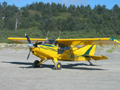
Previous replies pretty much nail cherokee performance. There are the obvious, get comfortable with slow flight, being able to hit your desired spot on landing,and being able to arrest that sink rate if you are trying to land behind power curve. I have a 67 cherokee with 160 hp, gap seals and a bush stol kit as well as a 150 hp PA-18. The cherokee is no super cub, but with those mods and keeping it light it will surprise you how well it performs Climbs very well even on a hot texas day.
Sat Jul 02, 2016 3:12 pm
Re: Any back country experience in a Cherokee?
On calculating available power, first calculate density altitude using an E6b. Then multiply that by 3, because you lose about 3% of sea level power for each thousand feet of density altitude. So for example, you calculate the density altitude to be 4000' at your <1000' elevation homedrome, because it's a hot day in Spartanburg and the pressure is low, then you've lost 12% of your power, leaving you with 132 hp, but probably less because you don't have a new engine or prop.
Now recalculate the density altitude for that higher elevation airstrip that you want to use. Let's fly on up to Jackson County at Sylva, NC, and it's still a hot day. Now you're starting out at 2865', and the density altitude is 6400'. Now you've lost more than 19%, reducing your power to 122 hp or less. The question is, how much of that 2850' nicely paved airstrip will you use? Can you safely climb out?
If you do the test back at Spartanburg by limiting your take off power to mimic what you'd have at Jackson County, you'll get a rough idea. Of course, DA also affects lift, not just power. And if you decide to tackle even higher elevation airstrips, or airstrips which aren't paved, that will affect how your airplane will do.
Like I said earlier, I've seen Cherokees at Marble, CO, which is at 7800' MSL and has a density altitude on a warm summer day approaching 10,000', so it's doable with care--light airplane, good piloting technique, patience. But that's the operative word, care.
Cary
Now recalculate the density altitude for that higher elevation airstrip that you want to use. Let's fly on up to Jackson County at Sylva, NC, and it's still a hot day. Now you're starting out at 2865', and the density altitude is 6400'. Now you've lost more than 19%, reducing your power to 122 hp or less. The question is, how much of that 2850' nicely paved airstrip will you use? Can you safely climb out?
If you do the test back at Spartanburg by limiting your take off power to mimic what you'd have at Jackson County, you'll get a rough idea. Of course, DA also affects lift, not just power. And if you decide to tackle even higher elevation airstrips, or airstrips which aren't paved, that will affect how your airplane will do.
Like I said earlier, I've seen Cherokees at Marble, CO, which is at 7800' MSL and has a density altitude on a warm summer day approaching 10,000', so it's doable with care--light airplane, good piloting technique, patience. But that's the operative word, care.
Cary
"I have slipped the surly bonds of earth..., put out my hand and touched the face of God." J.G. Magee
DISPLAY OPTIONS
Who is online
Users browsing this forum: No registered users and 0 guests
Latest Features
-
Live to Tell
A Minnesota pilot is surprised to learn that the sudden asymmetric drag of an out-of-rig ski can…Read More -
Creators
Working in some of the Yukon's most beautiful and remote environments, photographer Simon Blakesley captures aircraft in…Read More -
Aircraft Ownership and Maintenance
Upgrading to big tires can make a huge difference in backcountry performance, but with those gains come…Read More -
Tales from Yesteryear
In this tale from bush flying yesteryear, Don Cogger signs up to help Atlee Dodge Jr recovery…Read More


Latest Knowledge Base
-
Destinations
A regional guide with ideas for winter camping destinations in California, Nevada, New Mexico, and Arizona.Read More -
Aircraft
Finding an affordable aircraft that can handle the backcountry for $80K or less? A challenge for sure, but with the…Read More -
Aircraft
01.29.2018 - Zane - Updated tire diameter graphic to add 8.50x10 Guide to tires for use in the backcountry and off-airport landing…Read More -
Pilots
12.22.2013 - Initial article format Operating aircraft on skis and negotiating a snow-covered landscape is an entirely unique skillset and environment.…Read More