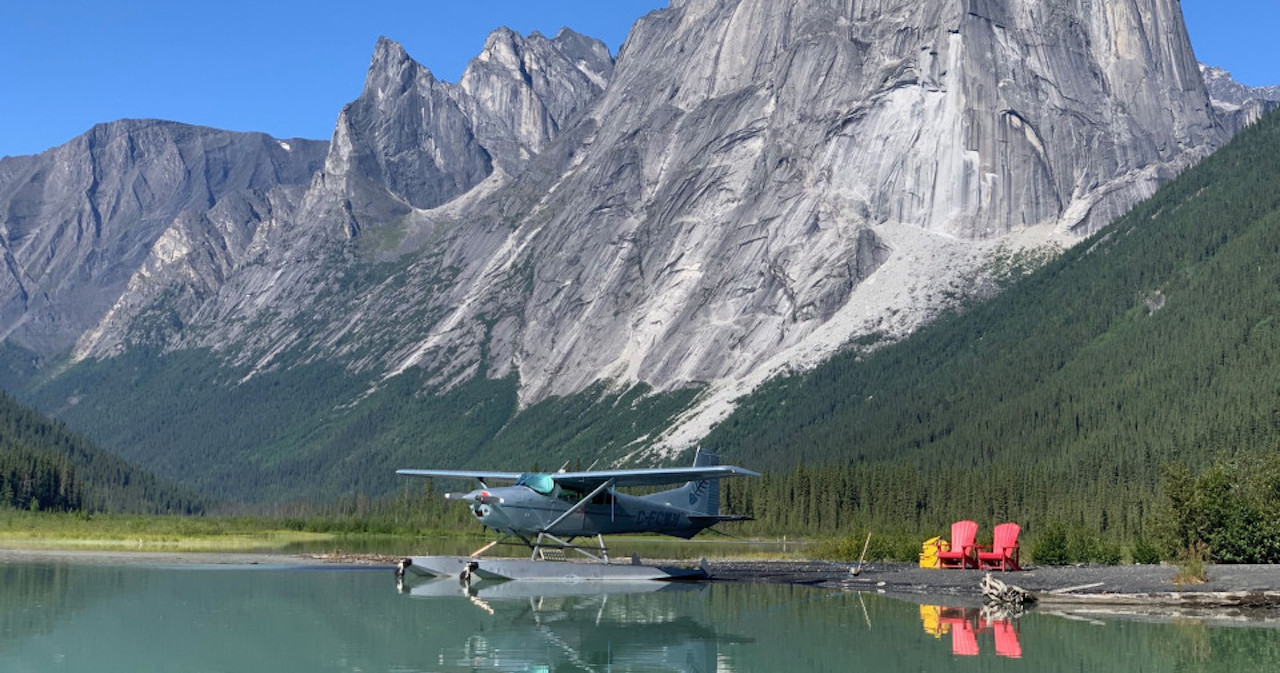
We bought a rural lakefront cabin a year ago and after a good push trying to make it livable I'm now ready to make some real improvements.
First up is a dock and a place to tie up the plane. I have a fair idea of how I'm going to build the dock but I've really been struggling with how best to accommodate the plane. After some reading and research, I think the best solution is a ramp but I can't find any information about how to build one.
The lake is about 1200 yards wide and about 10 miles long running west to east. We are on the south side, about halfway down. The prevailing winds will be sideshore when they blow but the lake is usually pretty calm in the summer. We face a mountain so I don't worry too much about wind/wave action straight onto the beach other than the occasional boat wake.
Approach to the lake from the house is a moderately steep footpath then there is about 8 foot of flat land before the lake starts. In spring, the lake is shallow with a gentle slope outward for about 15-20 feet then it drops off quickly. During the summer the water recedes a bit and it is probably only shallow for 10-15 feet before it drops off.
As I see them from photos, ramps are just sloping wood surfaces that allow the plane to skid up to the point it is no longer floating. So, a few questions--
-- how do you get a wood surface to stay underwater at the entry point? Without being cinched down to something underwater it would just be a raft, not a ramp.
-- does it have to fixed to the lakebed at the point furthest from shore or can it be floating just underwater?
-- how long, how wide? If I recall correctly, my floats are about 5' apart.
-- is wood the best for slipperyness or should I try and source a TREX or similar composite decking? Treated or non-treated lumber?
-- the plane is an amphib. (EDO 2790) should I plan to put the gear down in the water to make ascending the ramp easier? I could make it sloped out of the water then flat where the plane will stop which would reduce the risk of the plane rolling backwards when the engine stops.
The site is fairly remote so anything that has to go in will go in the back of my F350. Still in the design phase, so nothing is set in stone. Any thoughts or insights appreciated.
Allan
Building a ramp-- help!
Sun Apr 07, 2019 4:25 pm
Mon Apr 08, 2019 9:14 am
Re: Building a ramp-- help!
This is the one I used to run on a lake. It was made out of a few dock sections and worked great ramping and pushing the Cub back down when needed. (I used plastic decking as it didn't get as slippery walking on it.)


http://www.supercub.org/forum/showthrea ... &styleid=8
http://www.supercub.org/forum/showthrea ... &styleid=8
Mon Apr 08, 2019 9:33 am
Re: Building a ramp-- help!
What Brad posted is a good example. Having a dock next to it simplifies boarding and egress.
Wood in water gets slicker than snot, so at the very least, put some sort of grippy material where you'll have to walk. Again, the dock allows you to get in and out more easily, from the dock itself.
We used a two part dock, kind of U-shaped, in Kodiak. In your situation, a dock may be more problematic, with changing water levels. If you tie the ramp to the dock, the water recedes or rises, and your ramp may not be positioned right. So, you may want to design a stand alone ramp, that you can move in and out, as water recedes.
I've used a number of ramps, including ones that were well out from shore, in shallow water. The ramp has to fit the area, but generally, I like them at least as long as the floats, or a bit longer. You can make a full width ramp, or essentially two ramps, aligned with your floats width...basically two parallel ramps, tied together. That saves lumber and doesn't float as much.
Outboard end needs to be weighted so that it sinks.....and that takes a lot more weight than you might think. I've used whatever scrap metal I could come up with, like a long steel axle type rod, secured UNDER the outboard end of the ramp. But, you just need enough weight to sink the outboard end.
I TRY to keep the inboard end on the bottom, so it doesn't move, and it won't permit the outboard end of the ramp to skew to one side or the other. Put some sleeves along the inboard end of the ramp, at the very corner, and drive some steel stakes through the sleeves, to secure the ramp from movement.
I would NOT put the wheels down UNLESS you actually build a solid ramp on the bottom, and even then, make damn sure you cannot possibly hook a front wheel on the outboard edge of the thing even at lowest water.
You could build a concrete ramp on the bottom, or try to secure a wood ramp to the bottom, but frankly, I think you're better off to let the ramp float a bit, hinge it at the inboard end, and go on it wheels up.
A U shaped ramp would be sort of like Brad's picture, but with a narrow dock section on each side, ramp in the middle. We used that sort of setup in Kodiak at Lilly Lake, but that lake level never varied. If your lake level varies much, that may not work for you. If its only a few inches, build two narrow docks, wide enough for the plane to fit between fairly comfortably, then install a ramp between them, hinged at the front and weighted at the outboard end. ,
That allows you to slide up on the ramp, stick the plane lightly, unload nose in, then slide the plane off the ramp, turn it around, and heel it up onto the ramp, then tie it down to permanent tiedowns you put in at the docks. Now, when you're ready to go, load the plane, untie the tie downs, fire up and power off the ramp.
Works great. Again, if you just do a ramp, no docks, put some non skid material just outboard of where the floats rest. Those boards will get SLICK.
As far as I'm concerned, ramps are absolutely the best way to beach airplanes.....
MTV
Wood in water gets slicker than snot, so at the very least, put some sort of grippy material where you'll have to walk. Again, the dock allows you to get in and out more easily, from the dock itself.
We used a two part dock, kind of U-shaped, in Kodiak. In your situation, a dock may be more problematic, with changing water levels. If you tie the ramp to the dock, the water recedes or rises, and your ramp may not be positioned right. So, you may want to design a stand alone ramp, that you can move in and out, as water recedes.
I've used a number of ramps, including ones that were well out from shore, in shallow water. The ramp has to fit the area, but generally, I like them at least as long as the floats, or a bit longer. You can make a full width ramp, or essentially two ramps, aligned with your floats width...basically two parallel ramps, tied together. That saves lumber and doesn't float as much.
Outboard end needs to be weighted so that it sinks.....and that takes a lot more weight than you might think. I've used whatever scrap metal I could come up with, like a long steel axle type rod, secured UNDER the outboard end of the ramp. But, you just need enough weight to sink the outboard end.
I TRY to keep the inboard end on the bottom, so it doesn't move, and it won't permit the outboard end of the ramp to skew to one side or the other. Put some sleeves along the inboard end of the ramp, at the very corner, and drive some steel stakes through the sleeves, to secure the ramp from movement.
I would NOT put the wheels down UNLESS you actually build a solid ramp on the bottom, and even then, make damn sure you cannot possibly hook a front wheel on the outboard edge of the thing even at lowest water.
You could build a concrete ramp on the bottom, or try to secure a wood ramp to the bottom, but frankly, I think you're better off to let the ramp float a bit, hinge it at the inboard end, and go on it wheels up.
A U shaped ramp would be sort of like Brad's picture, but with a narrow dock section on each side, ramp in the middle. We used that sort of setup in Kodiak at Lilly Lake, but that lake level never varied. If your lake level varies much, that may not work for you. If its only a few inches, build two narrow docks, wide enough for the plane to fit between fairly comfortably, then install a ramp between them, hinged at the front and weighted at the outboard end. ,
That allows you to slide up on the ramp, stick the plane lightly, unload nose in, then slide the plane off the ramp, turn it around, and heel it up onto the ramp, then tie it down to permanent tiedowns you put in at the docks. Now, when you're ready to go, load the plane, untie the tie downs, fire up and power off the ramp.
Works great. Again, if you just do a ramp, no docks, put some non skid material just outboard of where the floats rest. Those boards will get SLICK.
As far as I'm concerned, ramps are absolutely the best way to beach airplanes.....
MTV


Mon Apr 08, 2019 12:35 pm
Re: Building a ramp-- help!
I'm working on the same project for the 185. Some info in the attached AC in chapter 4. Was leaning towards a U-shape, but am thinking more of a ramp with a dock besides it and running out and away in an L-shape so there's spot to tie the boat up and hang out on the dock without being under the wing all the time.
https://www.faa.gov/documentLibrary/media/Advisory_Circular/150_5395_1a.pdf
https://www.faa.gov/documentLibrary/media/Advisory_Circular/150_5395_1a.pdf

Mon Apr 08, 2019 1:37 pm
Re: Building a ramp-- help!
I have a wood ramp that i park my 185 on and i love it. Wish I had put it in earlier. I can drive the plane on it in windy conditions, shut down and very casually exit the plane without worrying about the plane blowing away. I usually shut down and coast in, but if i need to due to wind, traffic, I can idle my way onto the ramp without worry and shut down once I am parked.
I built mine with 2x12’s and spaced 3ea 4x4s underneath in areas where the fasteners(ss screws) would not ever rub on my keels. My keel spacing is about 7.5ft. I used 12’ 2x10’s with a 4x4 on each end and one in the middle. All pressure treated. I have a dock on the side that I exit from the plane..(also my cargo door side).
To get it to sink, I bought 2ea concrete parking blocks and attached them to the bottom of the ramp at the deep end. I used straps to fasten the parking blocks to the ramp. I found that you only need the weight to hold the ramp down for about one season. After that, the ramp lumber is so water logged that it stays on the bottom.
To excavate a trench for the parking blocks and 4x4’s to neatly fit into i used my pressure washer to wash out the soil. Not exactly the most environmentally friendly method, but it was super simple.
To keep the ramp from shifting, I used duck-bill anchors driven into the lake bottom on all 4 corners.
Let me know if you would like a sketch of how I did it all. It works great and highly recommend having one.
Page 36ish has some good info on building a ramp that i loosely used in my simple design.
https://washingtonseaplanepilots.org/re ... lities.pdf
I built mine with 2x12’s and spaced 3ea 4x4s underneath in areas where the fasteners(ss screws) would not ever rub on my keels. My keel spacing is about 7.5ft. I used 12’ 2x10’s with a 4x4 on each end and one in the middle. All pressure treated. I have a dock on the side that I exit from the plane..(also my cargo door side).
To get it to sink, I bought 2ea concrete parking blocks and attached them to the bottom of the ramp at the deep end. I used straps to fasten the parking blocks to the ramp. I found that you only need the weight to hold the ramp down for about one season. After that, the ramp lumber is so water logged that it stays on the bottom.
To excavate a trench for the parking blocks and 4x4’s to neatly fit into i used my pressure washer to wash out the soil. Not exactly the most environmentally friendly method, but it was super simple.
To keep the ramp from shifting, I used duck-bill anchors driven into the lake bottom on all 4 corners.
Let me know if you would like a sketch of how I did it all. It works great and highly recommend having one.
Page 36ish has some good info on building a ramp that i loosely used in my simple design.
https://washingtonseaplanepilots.org/re ... lities.pdf
- As Requested
Last edited by Hsivany on Tue Apr 09, 2019 5:39 am, edited 1 time in total.

Mon Apr 08, 2019 4:32 pm
Re: Building a ramp-- help!
very helpful comments, thanks!
I'm headed up there tomorrow morning and will sanity check these ideas but I think I have enough to work with.
I'm headed up there tomorrow morning and will sanity check these ideas but I think I have enough to work with.
Thu Apr 11, 2019 6:44 pm
Re: Building a ramp-- help!
Thanks very much for the diagram. I was going to WAY overbuild it, with 8"x8" beams, until I saw your 4x4 comment. Thinking about it some more, I'm probably going to use logs instead of beams because I can easily get 18' logs from the surrounding terrain but 18' beams are a pain to transport.
Why did you use 2x12 instead of 2x6? How much space between boards? I'm thinking a bit less than an inch, just to let the water drain.
I'm inclined to build it at least a couple feet wider than necessary because I'm not confident enough that I'll hit the exact right spot every time.
I was thinking of a few scrap driveshafts as ballast to sink the outboard end but the concrete idea is pretty slick.
For those people that use a winch to pull the plane up onto the ramp, do you just attach to the forward cleats on the floats? I'm thinking I'll leave a pulley on the outboard end so I can go out to the pulley and back to the forward cleats to pull the plane backwards to launch (if necessary).
Ok, last question-- should I be concerned that my floats are amphib, not straight? Is there enough keel to support the weight of the plane?
Why did you use 2x12 instead of 2x6? How much space between boards? I'm thinking a bit less than an inch, just to let the water drain.
I'm inclined to build it at least a couple feet wider than necessary because I'm not confident enough that I'll hit the exact right spot every time.
I was thinking of a few scrap driveshafts as ballast to sink the outboard end but the concrete idea is pretty slick.
For those people that use a winch to pull the plane up onto the ramp, do you just attach to the forward cleats on the floats? I'm thinking I'll leave a pulley on the outboard end so I can go out to the pulley and back to the forward cleats to pull the plane backwards to launch (if necessary).
Ok, last question-- should I be concerned that my floats are amphib, not straight? Is there enough keel to support the weight of the plane?
Thu Apr 11, 2019 7:54 pm
Re: Building a ramp-- help!
Last question first: Amphibious floats are essentially modified straight floats....keels are plenty strong. Just make sure the keels contact the ramp before the front wheels do, which will happen if you get the outboard end sunk a bit....doesn't have to be all the way on the bottom, by the way.
Get a good idea of how deep and steep your bank is. If it's a gradual slope out toward deeper water, and you put concrete blocks under the end of the ramp, you may wind up with the ramp too shallow, with the concrete blocks on the bottom. Maybe. Old axles are fine, may take a few.
Yes, make the ramp wider than your floats. You'll want to be able to step on the edges of the ramp....and consider putting some sort of no slip stuff out there.
Small logs will work just fine for the long sections. Just keep them reasonable sized.
The cross boards needn't be any particular width. And, in fact, one ramp I built, I ran the boards the floats rested on lengthwise, in other words, one end of te decking on shore, the other out at the lake end. Of course, that required cross beams under to mount the decking to.....
With cross decking, make certain that you don't have any boards sticking up higher than others. Hook a step keel on one of those, and it may be tough to get the plane back off the ramp.
Which brings up the point: You don't need a winch, either to ramp the plane securely or to get it off the ramp. If you want it really, really stuck on the ramp, power it up on the ramp. Throwing some water on the ramp first helps, but you can stick a plane pretty good just with a bit of power.
Getting off the ramp will take a little grunt labor, but you should be able to shove one side, then the other, back and forth, and get it to move, unless, of course, you've used a rough log for the beam, and it's not even.....Those steps can hang up on irregularites.
I ramped a Beaver and could always get it off the ramp by myself, BEFORE LOADING it of course.
In fact, I usually parked the plane heeled up on the ramp. That allows access to the tail surfaces in the event of a wind storm, and then it's easy to power off, even loaded. It also keeps the wing at a fairly level or even slightly negative angle of attack. As opposed to leaving the plane nosed up on the ramp.....where your wing has a very high AOA when parked.
So, I'd drive it onto the ramp, not real hard. Unload, service, put in control locks, then push it off the ramp, with long lines on the heel cleat. Push the plane out, then spin it, and pull the heels up onto the ramp. Reef it up as high as practical, then tie it down.
As to winching, I wouldn't, but, absolutely DO NOT winch floats using the cleats. Those things aren't structural, and it's possible to do some damage if you reef on them too hard.
IF you're going to winch the plane (and again, I wouldn't, you really don't need to) secure your lines to the outboard ends of the spreader bars, or the vertical struts at the bases.
MTV
Get a good idea of how deep and steep your bank is. If it's a gradual slope out toward deeper water, and you put concrete blocks under the end of the ramp, you may wind up with the ramp too shallow, with the concrete blocks on the bottom. Maybe. Old axles are fine, may take a few.
Yes, make the ramp wider than your floats. You'll want to be able to step on the edges of the ramp....and consider putting some sort of no slip stuff out there.
Small logs will work just fine for the long sections. Just keep them reasonable sized.
The cross boards needn't be any particular width. And, in fact, one ramp I built, I ran the boards the floats rested on lengthwise, in other words, one end of te decking on shore, the other out at the lake end. Of course, that required cross beams under to mount the decking to.....
With cross decking, make certain that you don't have any boards sticking up higher than others. Hook a step keel on one of those, and it may be tough to get the plane back off the ramp.
Which brings up the point: You don't need a winch, either to ramp the plane securely or to get it off the ramp. If you want it really, really stuck on the ramp, power it up on the ramp. Throwing some water on the ramp first helps, but you can stick a plane pretty good just with a bit of power.
Getting off the ramp will take a little grunt labor, but you should be able to shove one side, then the other, back and forth, and get it to move, unless, of course, you've used a rough log for the beam, and it's not even.....Those steps can hang up on irregularites.
I ramped a Beaver and could always get it off the ramp by myself, BEFORE LOADING it of course.
In fact, I usually parked the plane heeled up on the ramp. That allows access to the tail surfaces in the event of a wind storm, and then it's easy to power off, even loaded. It also keeps the wing at a fairly level or even slightly negative angle of attack. As opposed to leaving the plane nosed up on the ramp.....where your wing has a very high AOA when parked.
So, I'd drive it onto the ramp, not real hard. Unload, service, put in control locks, then push it off the ramp, with long lines on the heel cleat. Push the plane out, then spin it, and pull the heels up onto the ramp. Reef it up as high as practical, then tie it down.
As to winching, I wouldn't, but, absolutely DO NOT winch floats using the cleats. Those things aren't structural, and it's possible to do some damage if you reef on them too hard.
IF you're going to winch the plane (and again, I wouldn't, you really don't need to) secure your lines to the outboard ends of the spreader bars, or the vertical struts at the bases.
MTV
Fri Apr 12, 2019 8:55 am
Re: Building a ramp-- help!
Mike, as usual-- thanks for sharing your knowledge.
I think I have had the wrong idea of what a ramped airplane looks like. I've been imagining it high and dry, out of reach of boat wakes or wind-driven chop. That would mean advancing at least six, maybe eight feet from the point the keels kit the ramp. I think what you are describing is a plane that is nudged up just past the water line, secured partly by contact with the ramp but also by tie down lines. Should the rear of the floats still be in contact with the water, assuming the slope of the ramp is pretty shallow?
Not gonna lie, I'm terrified of lining up on my newly built ramp and giving it a squeeze of power that shoots me up over my ramp into the very unforgiving terrain just past. I watched a buddy do that while loading his sled onto the back of his pickup and it was pretty messy.
I love being the only floatplane at my airport, and on my lake, and one of very few in this area, but when it comes time to find an instructor to teach me stuff like this it kind of sucks. Trial and error can get pretty expensive in this business.
Again, thanks.
I think I have had the wrong idea of what a ramped airplane looks like. I've been imagining it high and dry, out of reach of boat wakes or wind-driven chop. That would mean advancing at least six, maybe eight feet from the point the keels kit the ramp. I think what you are describing is a plane that is nudged up just past the water line, secured partly by contact with the ramp but also by tie down lines. Should the rear of the floats still be in contact with the water, assuming the slope of the ramp is pretty shallow?
Not gonna lie, I'm terrified of lining up on my newly built ramp and giving it a squeeze of power that shoots me up over my ramp into the very unforgiving terrain just past. I watched a buddy do that while loading his sled onto the back of his pickup and it was pretty messy.
I love being the only floatplane at my airport, and on my lake, and one of very few in this area, but when it comes time to find an instructor to teach me stuff like this it kind of sucks. Trial and error can get pretty expensive in this business.
Again, thanks.
Fri Apr 12, 2019 10:04 am
Re: Building a ramp-- help!
Yes, unless you're building a REAL ramp setup like Kenmore uses, all the ramp is there for is to protect the bottoms of the floats from whatever is on the bank. So, no, you don't HAVE to yard the plane clear out of the water.....in fact that's going to make a lot more work, and opportunities to break things.
As I said, I prefer to have the heels of the floats on the ramp when parked and tied down. I used big Duckbill earth anchors under where the wing tiedowns would be when parked. Then, secure a short handling line to your tiedown rings, with a loop on the end. Make it just long enough that in flight, it reaches almost back to the trailing edge of the wing. When you're securing the plane, use this line to tie your tiedown lines to.
Again, the reason I like the plane heeled up, as opposed to nosed in, is wind. If a wind comes up, and you're nosed in, you'll never be able to get to the tail surfaces to secure them. With the plane heeled up, the tail feathers are within easy reach.
And, again, if a wind comes up, the plane will be sitting level when heeled up, as opposed to way nose high when nosed in. It'll ride a lot of wind that way.
If there's wave action, and not of sufficient height to surf on, the plane will work on the ramp. That's fine, let it rock a bit....the wood will protect the floats.
On the other hand, if you get huge wave action where you're building this thing, you may indeed want to get the plane out of the water. But, in that case, I'd try to figure out some sort of dolly arrangement. Trying to slide a seaplane on a dry ramp is going to take some serious force.
But a simple ramp will work in most any conditions except wide open water with a lot of fetch and big winds.
MTV
As I said, I prefer to have the heels of the floats on the ramp when parked and tied down. I used big Duckbill earth anchors under where the wing tiedowns would be when parked. Then, secure a short handling line to your tiedown rings, with a loop on the end. Make it just long enough that in flight, it reaches almost back to the trailing edge of the wing. When you're securing the plane, use this line to tie your tiedown lines to.
Again, the reason I like the plane heeled up, as opposed to nosed in, is wind. If a wind comes up, and you're nosed in, you'll never be able to get to the tail surfaces to secure them. With the plane heeled up, the tail feathers are within easy reach.
And, again, if a wind comes up, the plane will be sitting level when heeled up, as opposed to way nose high when nosed in. It'll ride a lot of wind that way.
If there's wave action, and not of sufficient height to surf on, the plane will work on the ramp. That's fine, let it rock a bit....the wood will protect the floats.
On the other hand, if you get huge wave action where you're building this thing, you may indeed want to get the plane out of the water. But, in that case, I'd try to figure out some sort of dolly arrangement. Trying to slide a seaplane on a dry ramp is going to take some serious force.
But a simple ramp will work in most any conditions except wide open water with a lot of fetch and big winds.
MTV
Fri Apr 12, 2019 10:40 am
Re: Building a ramp-- help!
I’ve got something like a boat lift on Lake Washington, where there are huge yachts that go by and send three-foot wakes behind them. This lifts the floats clear of the water with a hydraulic lift. Probably too remote for you to put something like this where you are, but the link shows some of the dimensions. Jim Chrysler, of Seattle Seaplanes on Lake Union in Seattle, build ramps for his floatplanes using an inflatable bladder that would lift the floats out of the water for the night. Again, there are boat ramps that use that concept too. Just some thoughts if you find that the wave action is more than a ramp can handle.
https://bastaboatlifts.com/product/p66-seaplane-lift/
Sent from my iPad using Tapatalk Pro
https://bastaboatlifts.com/product/p66-seaplane-lift/
Sent from my iPad using Tapatalk Pro

Seattle float pilot
Fri Apr 19, 2019 10:40 am
Re: Building a ramp-- help!
Hsivany wrote:I have a wood ramp that i park my 185 on and i love it. Wish I had put it in earlier. I can drive the plane on it in windy conditions, shut down and very casually exit the plane without worrying about the plane blowing away. I usually shut down and coast in, but if i need to due to wind, traffic, I can idle my way onto the ramp without worry and shut down once I am parked.
I built mine with 2x12’s and spaced 3ea 4x4s underneath in areas where the fasteners(ss screws) would not ever rub on my keels. My keel spacing is about 7.5ft. I used 12’ 2x10’s with a 4x4 on each end and one in the middle. All pressure treated. I have a dock on the side that I exit from the plane..(also my cargo door side).
To get it to sink, I bought 2ea concrete parking blocks and attached them to the bottom of the ramp at the deep end. I used straps to fasten the parking blocks to the ramp. I found that you only need the weight to hold the ramp down for about one season. After that, the ramp lumber is so water logged that it stays on the bottom.
To excavate a trench for the parking blocks and 4x4’s to neatly fit into i used my pressure washer to wash out the soil. Not exactly the most environmentally friendly method, but it was super simple.
To keep the ramp from shifting, I used duck-bill anchors driven into the lake bottom on all 4 corners.
Let me know if you would like a sketch of how I did it all. It works great and highly recommend having one.
Page 36ish has some good info on building a ramp that i loosely used in my simple design.
https://washingtonseaplanepilots.org/re ... lities.pdf
Ice is almost out and I'm about ready to gather materials and build my ramp. What is the easiest way to assemble the ramp and get it positioned before it gets too heavy to move or drag in from the shore? My design will be similar to yours, but probably longer 4X4's due to slope issues. Would like to avoid giving myself a hernia trying to move all that lumber at once. Thanks.
Fri Apr 19, 2019 10:58 am
Re: Building a ramp-- help!
Henny,
Build the frame on land. Then if water isn’t too deep, slide whatever you think you can still move with two or three helpers into the water, and finish decking it in the water, screw gun and stainless long screws.
Or, find someone with a boom truck/skid steer, or ??? And get them to hook onto the shoe end of the fully built ramp, and slide it into the water. That’s assuming you’ve got room to maneuver and shore is solid.
Or, find five big goons and promise them a plane ride and mucho beer if they shove that thing into the lake.
MTV
Build the frame on land. Then if water isn’t too deep, slide whatever you think you can still move with two or three helpers into the water, and finish decking it in the water, screw gun and stainless long screws.
Or, find someone with a boom truck/skid steer, or ??? And get them to hook onto the shoe end of the fully built ramp, and slide it into the water. That’s assuming you’ve got room to maneuver and shore is solid.
Or, find five big goons and promise them a plane ride and mucho beer if they shove that thing into the lake.
MTV
Sun Apr 21, 2019 5:33 am
Re: Building a ramp-- help!
I've always like the idea of a "marine" railway; it seems like a simple concept or at least simple enough for me to wrap my brain around.
Old rails are not hard to find and if assembled in sections can be manhandled into place or removed in the Fall solo. I would craft up a "rolling platform" and once the airplane is resting on it thereafter winch it to higher ground or let gravity "assist" in the launch, under control of course !! In the off season the platform with airplane loaded it would be drawn up well above the high water mark and then remove the portions of rail that remain in the water or the ice will do it for you in the Spring breakup. Somewhere I recall seeing just this sort of setup for float/wheel change overs as well. The subject airplane was floated onto the platform; roll underneath an overhead hoist, work completed as required and then sent on its merry way.
I like MTV's suggestion of putting the floats heals first onto the platform thereby placing the wing in a negative angle of attack too better ride out the windy days.
Old rails are not hard to find and if assembled in sections can be manhandled into place or removed in the Fall solo. I would craft up a "rolling platform" and once the airplane is resting on it thereafter winch it to higher ground or let gravity "assist" in the launch, under control of course !! In the off season the platform with airplane loaded it would be drawn up well above the high water mark and then remove the portions of rail that remain in the water or the ice will do it for you in the Spring breakup. Somewhere I recall seeing just this sort of setup for float/wheel change overs as well. The subject airplane was floated onto the platform; roll underneath an overhead hoist, work completed as required and then sent on its merry way.
I like MTV's suggestion of putting the floats heals first onto the platform thereby placing the wing in a negative angle of attack too better ride out the windy days.

Sun Apr 21, 2019 9:59 am
Re: Building a ramp-- help!
I just put my chest waders on and built it in the water. The wood will float, I put the shore end of the ramp, just on land, maybe a foot or two, and put the 4x4’s in the water, then an end 2x12, the middle 2x12 and the second to last 2x12, made sure it was square, then filled between... the 4x4s were marked with the spacing so that you didn’t have to do measuring in the water.
After the ramp was complete with the exception of the last 2x12, I enlisted a buddy to help me do the weights and that last board. The weights was the trickiest part. You will need a helper for that step. I attached the weights to the 2x12 on land and then muscled that last board with the weights attached to it into place and attached it to the 4x4s. I remember that being a real pain.. to keep it from sinking before you can fasten it to the 4x4’s I think I propped the ramp up. The end next to the dock, I used a rope to the dock and the far end, I used a board cut to the proper length.. this was the most memorable part..
Then the last step was to duck bill anchor it down in place. Attach the duck bills before you sink the ramp and you might want to attach something that floats to them so can find them once you sink the ramp. I used a 6’ long steel bar to drive the duckbill anchors in and it was also handy for adjusting the ramps position when it was sunk on the bottom.
When it was all done, I remember that the end without the weights on it floated off the bottom unless my plane was parked on the ramp for the first few weeks. After a while, the wood soaked up enough water and it stays on the bottom very nicely.
Remember the pressure washer trick for excavating a little trench for the weights & 4x4’s to fit in.. I used it before the build, but I actually had the best luck by using it around the perimeter after the ramp was sunk, then using the pry bar to wiggle the ramp into final position.
Good luck! I think you will be happy you have it. I sure am happy with mine.
Scott
After the ramp was complete with the exception of the last 2x12, I enlisted a buddy to help me do the weights and that last board. The weights was the trickiest part. You will need a helper for that step. I attached the weights to the 2x12 on land and then muscled that last board with the weights attached to it into place and attached it to the 4x4s. I remember that being a real pain.. to keep it from sinking before you can fasten it to the 4x4’s I think I propped the ramp up. The end next to the dock, I used a rope to the dock and the far end, I used a board cut to the proper length.. this was the most memorable part..
Then the last step was to duck bill anchor it down in place. Attach the duck bills before you sink the ramp and you might want to attach something that floats to them so can find them once you sink the ramp. I used a 6’ long steel bar to drive the duckbill anchors in and it was also handy for adjusting the ramps position when it was sunk on the bottom.
When it was all done, I remember that the end without the weights on it floated off the bottom unless my plane was parked on the ramp for the first few weeks. After a while, the wood soaked up enough water and it stays on the bottom very nicely.
Remember the pressure washer trick for excavating a little trench for the weights & 4x4’s to fit in.. I used it before the build, but I actually had the best luck by using it around the perimeter after the ramp was sunk, then using the pry bar to wiggle the ramp into final position.
Good luck! I think you will be happy you have it. I sure am happy with mine.
Scott
Mon Apr 22, 2019 8:01 am
Re: Building a ramp-- help!
BRD shows his plane up the ramp, clear of the water but Scott's drawing shows the plane snugged up to the ramp but still floating.
Scott, how do you handle a wake from a passing boat or some storm-driven waves? Does your plane get pushed up the ramp further? If so, do you have to regularly re-tie it? My concern is the plane getting pushed up the ramp by some waves, making the lines loose, then the wind rotating the plane around the loose lines.
Also, an old hand told me never to tie a floating plane down to a non floating object because it doesn't allow the plane to ride up and down with the swell and the tie down points are heavily stressed. He said to moor it or tie it down to a floating dock, ramps were never discussed.
Scott, how do you handle a wake from a passing boat or some storm-driven waves? Does your plane get pushed up the ramp further? If so, do you have to regularly re-tie it? My concern is the plane getting pushed up the ramp by some waves, making the lines loose, then the wind rotating the plane around the loose lines.
Also, an old hand told me never to tie a floating plane down to a non floating object because it doesn't allow the plane to ride up and down with the swell and the tie down points are heavily stressed. He said to moor it or tie it down to a floating dock, ramps were never discussed.
Mon Apr 22, 2019 8:45 am
Re: Building a ramp-- help!
When approaching the ramp, add a bit of power just before contact with it. That creates a bow wake that will help push the floats up the ramp high and dry. When ready to go it's easy to push them back into the water.
Mon Apr 22, 2019 4:05 pm
Re: Building a ramp-- help!
Mapleflt wrote:I've always like the idea of a "marine" railway; it seems like a simple concept or at least simple enough for me to wrap my brain around.
Old rails are not hard to find and if assembled in sections can be manhandled into place or removed in the Fall solo. I would craft up a "rolling platform" and once the airplane is resting on it thereafter winch it to higher ground or let gravity "assist" in the launch, under control of course !! In the off season the platform with airplane loaded it would be drawn up well above the high water mark and then remove the portions of rail that remain in the water or the ice will do it for you in the Spring breakup. Somewhere I recall seeing just this sort of setup for float/wheel change overs as well. The subject airplane was floated onto the platform; roll underneath an overhead hoist, work completed as required and then sent on its merry way
I agree! After putting in a used rail system several years ago, life became much easier. The rail eliminates several of the downsides to ramps, gets the plane out of the water, no more high speed approaches in order to get the plane up the ramp, no more trouble in pushing the plane down the ramp. I opted to run the rail between two docks, you only need to coast in to put the plane on the platform and it is easy to get in and out of the plane from both sides, the whole system works super easy.
I have never taken the rail out in the winter, ice breakup has never been an issue yet, not to say it could not happen.
I have seen used rail systems for sale occasionally on the aviation sites and Craigs List. Many people have made their own out of pipe and have used car wheels for the rolling platform. There are several variations.
A rail system may not fit your needs, but may be something to consider.

Mon Apr 22, 2019 6:38 pm
Re: Building a ramp-- help!
steve wrote:Mapleflt wrote:I've always like the idea of a "marine" railway; it seems like a simple concept or at least simple enough for me to wrap my brain around.
Old rails are not hard to find and if assembled in sections can be manhandled into place or removed in the Fall solo. I would craft up a "rolling platform" and once the airplane is resting on it thereafter winch it to higher ground or let gravity "assist" in the launch, under control of course !! In the off season the platform with airplane loaded it would be drawn up well above the high water mark and then remove the portions of rail that remain in the water or the ice will do it for you in the Spring breakup. Somewhere I recall seeing just this sort of setup for float/wheel change overs as well. The subject airplane was floated onto the platform; roll underneath an overhead hoist, work completed as required and then sent on its merry way
I agree! After putting in a used rail system several years ago, life became much easier. The rail eliminates several of the downsides to ramps, gets the plane out of the water, no more high speed approaches in order to get the plane up the ramp, no more trouble in pushing the plane down the ramp. I opted to run the rail between two docks, you only need to coast in to put the plane on the platform and it is easy to get in and out of the plane from both sides, the whole system works super easy.
I like the "between the docks" idea, perfect
I have never taken the rail out in the winter, ice breakup has never been an issue yet, not to say it could not happen.
I have seen used rail systems for sale occasionally on the aviation sites and Craigs List. Many people have made their own out of pipe and have used car wheels for the rolling platform. There are several variations.
A rail system may not fit your needs, but may be something to consider.
I like the "between the docks" concept, good thinking
I did a Kijiji search for "marine railway" and about 6 popped up at a reasonable price so now I have a new cottage project to tackle
Mon Apr 22, 2019 6:54 pm
Re: Building a ramp-- help!
Everything you wanna know (and then some) in this link:
http://www.hegerdrydock.com/libraryPdf/ ... ilways.PDF
Sent from my iPad using Tapatalk Pro
http://www.hegerdrydock.com/libraryPdf/ ... ilways.PDF
Sent from my iPad using Tapatalk Pro
Seattle float pilot
DISPLAY OPTIONS
Who is online
Users browsing this forum: No registered users and 0 guests
Latest Features
-
-
Featured Bush Planes
As one of the undisputed legends of bush flying, the Cessna 180 hauls a…Read More -
Aircraft Ownership and Maintenance
9 modification mistakes aircraft owners make when trying to "bush out" their birds—why some…Read More -
Live to Tell
A Minnesota pilot is surprised to learn that the sudden asymmetric drag of an…Read More



Latest Knowledge Base
-
Destinations
Canada offers some of the most spectacular backcountry flying on the continent. Here's what you need to know before you go.Read More -
Safety and Survival
Hope that you never have to use your survival vest but knowing you have it and knowing how to use…Read More -
Destinations
A regional guide with ideas for winter camping destinations in California, Nevada, New Mexico, and Arizona.Read More -
Aircraft
Finding an affordable aircraft that can handle the backcountry for $80K or less? A challenge for sure, but with the…Read More